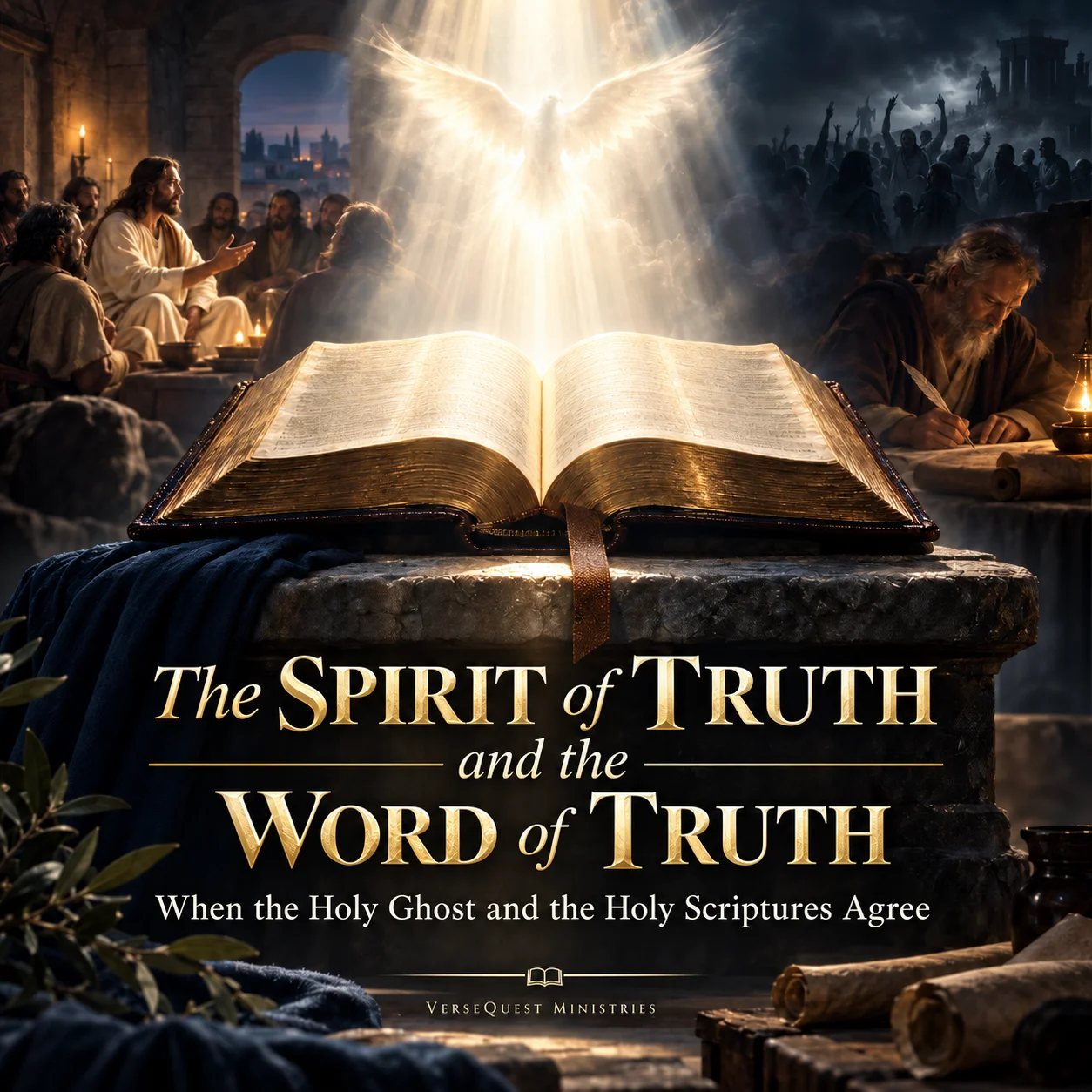
The Spirit of Truth and the Word of Truth
When the Holy Ghost and the Holy Scriptures Agree
Sermon Title:
The Spirit of Truth and the Word of Truth: When the Holy Ghost and the Holy Scriptures Agree
Key Passage:
John 16:13 — “Howbeit when he, the Spirit of truth, is come, he will guide you into all truth: for he shall not speak of himself; but whatsoever he shall hear, that shall he speak: and he will shew you things to come.”
Series:
Foundations of the Gospel of Grace
Topic:
The Ministry of the Holy Spirit, the Authority of the Written Word, and Why the Spirit of Truth Never Contradicts the Word of Truth
Book:
John, Ephesians, 1 Corinthians, 2 Timothy, 1 John, 2 Peter, Romans, Colossians
Speaker:
Paul Tackett
Suggested Sermon Text:
John 14:16–17, 26; John 15:26–27; John 16:7–15; John 17:17; Ephesians 1:13–14; Ephesians 3:1–10; Ephesians 4:30; Ephesians 6:17; 1 Corinthians 2:9–16; 1 Corinthians 12:3–11; 1 Corinthians 14:29–33; 2 Timothy 2:15; 2 Timothy 3:15–17; 1 John 4:1–6; 2 Peter 1:19–21; Romans 10:17; Colossians 3:16
Short Sermon Description:
This detailed VerseQuest Ministries sermon outline examines John 16:13 and the inseparable relationship between the Spirit of truth and the word of truth. Jesus promised the apostles that the Holy Ghost would guide them into truth, bring His words to their remembrance, testify of Christ, reveal things to come, and glorify the Son rather than Himself. This sermon carefully respects the Upper Room setting and the unique apostolic function of that promise while showing how the completed Scriptures provide the Church with the authoritative written standard by which every doctrine, impression, teacher, spirit, and spiritual claim must be tested. It explains why the Holy Spirit never contradicts the Bible He inspired, why genuine spiritual ministry exalts Jesus Christ rather than human experience, how Pauline revelation fits within the Spirit’s revelatory work, and why believers today must be filled with the word rather than chasing private revelations. Pastors, teachers, and Bible students will gain a strong KJV framework for distinguishing biblical illumination from counterfeit revelation, spiritual discernment from emotional impulse, and the genuine ministry of the Holy Ghost from religious experiences that refuse the authority of Scripture.
The Spirit of Truth and the Word of Truth
When the Holy Ghost and the Holy Scriptures Agree
Introduction
John 16:13 calls the Holy Ghost “the Spirit of truth.” John 17:17 says plainly, “thy word is truth.” There is no warfare between those statements. The Spirit of truth and the word of truth do not pull in opposite directions. The Holy Ghost did not inspire a Book on Monday and begin contradicting it through somebody’s private revelation on Tuesday. God is not divided against Himself. The Spirit who moved holy men of God to speak is the Spirit who exalts Jesus Christ, brings divine truth to remembrance, reveals what God gives Him to reveal, and operates in perfect harmony with the written Scriptures. When a claimed spiritual experience requires you to ignore a clear verse, you do not have deeper spirituality. You have stepped away from the only objective standard God gave you for judging spiritual claims.
But John 16 must be handled in its proper setting. Jesus is speaking in the Upper Room discourse to the apostles before Calvary, before His resurrection, before Pentecost, and before the full revelation of the mystery committed through Paul. These men would become foundational witnesses of Christ’s resurrection and authoritative messengers of His truth. Jesus promises that the Comforter would teach them, bring Christ’s words to remembrance, testify concerning Him, guide them into truth, and show them things to come. We should not carelessly take a promise connected to apostolic revelation and pretend every believer today has the same authority to announce new doctrine because he had a dream after eating too much pizza. Right division protects both the passage and the believer.
The modern religious world often talks loudly about the Spirit while treating the written word as though it were an inconvenient supervisor. Somebody says, “The Spirit told me,” and suddenly the Bible is expected to sit quietly in the corner. Another says, “God gave me a word,” although the supposed word contradicts what God already wrote. Somebody else makes emotion the test of truth: if the music swells, the crowd trembles, and the preacher shouts loudly enough, it must be the Holy Ghost. But Scripture commands believers to try the spirits. The Spirit of truth does not fear examination by the word of truth. He authored the Book. The real Holy Ghost never needs protection from the Bible.
I. Jesus Identified the Holy Ghost as the Spirit of Truth
Key Text: John 16:13
Supporting Texts: John 14:16–17; John 15:26; 1 John 4:6
Jesus does not merely call the Holy Ghost powerful, comforting, or supernatural. He calls Him “the Spirit of truth.” John 14:17 uses the same title: “Even the Spirit of truth; whom the world cannot receive.” John 15:26 says, “when the Comforter is come…even the Spirit of truth…he shall testify of me.” Truth is therefore not a side ministry of the Holy Ghost. Truth belongs to His very description.
That immediately gives us a standard for spiritual discernment. Whatever genuinely proceeds from the Holy Spirit will be true. He cannot lie because God cannot lie. He cannot lead a believer into doctrinal falsehood and then blame the confusion on mysterious spirituality. He cannot inspire Scripture to teach one thing and then privately tell a modern preacher the opposite. The Spirit of truth does not operate by contradiction.
First John 4:6 speaks of “the spirit of truth, and the spirit of error.” There are spiritual influences in this world that are not of God. Supernatural does not automatically mean divine. Religious does not automatically mean true. Spiritual vocabulary does not automatically mean Holy Ghost. The identifying issue is truth—and God has not left the Church without an objective standard for truth.
Main Truth:
The Holy Ghost is the Spirit of truth, and anything genuinely proceeding from Him will agree with the truth God has revealed.
II. Jesus Said the Father’s Word Is Truth
Key Text: John 17:17
Supporting Texts: Psalm 119:160; 2 Timothy 3:16; Romans 3:4
John 17:17 records Jesus praying, “Sanctify them through thy truth: thy word is truth.” Notice that He does not merely say God’s word contains truth somewhere among errors that scholars must rescue. He says, “thy word is truth.” That is an absolute statement. The believer therefore possesses something firmer than intuition, culture, denominational tradition, religious experience, or theological fashion.
Second Timothy 3:16 says, “All scripture is given by inspiration of God.” Inspiration belongs to Scripture because God breathed out His words through chosen men. Psalm 119:160 says, “Thy word is true from the beginning.” Romans 3:4 says, “let God be true, but every man a liar.” When man and God disagree, the matter is not awaiting arbitration. God wins before the hearing begins.
That is why the word must judge our spiritual experiences rather than our spiritual experiences judging the word. A man may sincerely feel something. He may sincerely believe he heard something. He may sincerely experience something dramatic. Sincerity proves sincerity; it does not prove divine origin. The word of truth determines whether the claim deserves to be believed.
Main Truth:
God’s written word is truth and therefore serves as the objective standard by which spiritual claims must be judged.
III. The Promise of John 16:13 Had a Special Apostolic Setting
Key Text: John 16:12–13
Supporting Texts: John 14:25–26; John 15:26–27; Acts 1:8
Jesus tells the apostles, “I have yet many things to say unto you, but ye cannot bear them now.” Then comes the promise: “Howbeit when he, the Spirit of truth, is come, he will guide you into all truth.” The immediate “you” consists of the apostles sitting with Christ in the Upper Room context. These men had walked with Jesus and would become witnesses of His resurrection.
John 14:26 says the Comforter would “bring all things to your remembrance, whatsoever I have said unto you.” That promise makes particular sense for men who personally heard Jesus speak. John 15 says the Spirit would testify of Christ and that the apostles would bear witness “because ye have been with me from the beginning.” Acts 1 likewise identifies the apostles as witnesses empowered by the Holy Ghost.
This protects the Church from the arrogant idea that John 16:13 makes every Christian his own apostle receiving fresh doctrine. The Spirit certainly teaches and illuminates believers through Scripture, but the original promise carried a unique revelatory and testimonial significance for Christ’s chosen witnesses. We receive their inspired witness in the Book rather than recreating their foundational office in every generation.
Main Truth:
John 16:13 was spoken directly to Christ’s apostles and included a unique promise of revelatory guidance connected with their foundational witness.
IV. The Spirit Guided God’s Chosen Men in Giving Scripture
Key Text: 2 Peter 1:20–21
Supporting Texts: 2 Timothy 3:16; 1 Corinthians 2:12–13; Ephesians 3:3–5
Second Peter 1 says prophecy came not “by the will of man: but holy men of God spake as they were moved by the Holy Ghost.” The Bible therefore did not originate in religious creativity. Men wrote, but the Holy Ghost moved them. Their vocabulary, personalities, historical situations, and human authorship were real, yet the product is rightly called Scripture given by inspiration of God.
Paul describes something similar in 1 Corinthians 2. God revealed things “unto us by his Spirit,” and Paul says those things were spoken “not in the words which man’s wisdom teacheth, but which the Holy Ghost teacheth.” Revelation concerns the truth God disclosed. Inspiration concerns the words by which that truth was communicated. The Holy Ghost did not merely give vague spiritual impressions and let the apostles guess at the wording.
Ephesians 3 is especially important for right division. Paul says the mystery was made known to him by revelation and that it was “now revealed unto his holy apostles and prophets by the Spirit.” This includes truth concerning the Body of Christ that was not made known in other ages as it is now revealed. The Spirit’s ministry therefore helps explain the progressive unfolding of New Testament revelation without collapsing Israel, the kingdom, and the Church into one undivided mass.
Main Truth:
The Holy Ghost moved God’s chosen messengers and gave divine revelation in inspired words, including the later revelation concerning the Church.
V. The Spirit of Truth Glorifies Jesus Christ, Not Himself
Key Text: John 16:14
Supporting Texts: John 15:26; 1 Corinthians 12:3; Colossians 1:18
Jesus says of the Holy Ghost, “He shall glorify me.” That is one of the great tests of genuine spiritual ministry. The Spirit does not arrive to build an entertainment empire around Himself. He points to Jesus Christ. He testifies concerning Christ. He takes the things of Christ and shows them to Christ’s witnesses. Genuine Holy Ghost ministry makes the Son magnificent.
John 15:26 says, “he shall testify of me.” First Corinthians 12 says no man speaking by the Spirit of God calls Jesus accursed, and no man can truly say Jesus is Lord but by the Holy Ghost. Colossians says Christ is to have “the preeminence.” The Spirit’s work is Christ-centered because the entire plan of redemption is Christ-centered.
That provides a needed warning. A meeting may contain noise, emotion, unusual behavior, dramatic testimonies, supposed miracles, ecstatic speech, falling bodies, trembling crowds, and claims of supernatural power while Jesus Christ and the gospel become almost incidental. Spectacle is not proof of the Spirit. The Spirit of truth glorifies Christ. The more an experience makes the experience itself the center, the more carefully it should be tested.
Main Truth:
The genuine ministry of the Holy Spirit glorifies Jesus Christ and directs attention toward His person, words, and finished work.
VI. The Spirit of Truth Never Contradicts the Word He Inspired
Key Text: Ephesians 6:17
Supporting Texts: 2 Timothy 3:16–17; 1 John 4:1; Isaiah 8:20
Ephesians 6:17 calls Scripture “the sword of the Spirit, which is the word of God.” Think about that expression. The Bible is identified with the Spirit’s own sword. It would be doctrinal insanity to imagine the Holy Ghost swinging His sword in one direction while supposedly revealing the opposite privately to somebody else.
First John 4:1 says, “Beloved, believe not every spirit, but try the spirits whether they are of God.” That command destroys gullibility as a Christian virtue. The believer is supposed to test spiritual claims. Scripture provides the doctrinal standard. If a preacher says the Spirit told him something contrary to the word, you do not need to determine how sincere his facial expression was. The claim has already failed the test.
Isaiah 8:20 gives the principle: “To the law and to the testimony.” If men speak not according to God’s revealed word, “it is because there is no light in them.” Though the dispensational setting differs, the principle of testing claims by revelation is sound. God does not contradict Himself. The Spirit of truth will never become the Spirit of theological confusion.
Main Truth:
Because the Holy Spirit inspired Scripture, no genuine work or leading of the Spirit will contradict the written word of God.
VII. The Spirit Illuminates the Word Without Giving New Scripture
Key Text: 1 Corinthians 2:12–14
Supporting Texts: Ephesians 1:17–18; Colossians 1:9; 2 Timothy 2:15
First Corinthians 2 teaches that spiritual things are spiritually discerned. The natural man receives not the things of the Spirit of God because they are spiritually discerned. The saved man possesses the Spirit and therefore has a capacity for spiritual understanding that the natural man does not possess. But illumination is not inspiration. Understanding Scripture is not the same thing as writing Scripture.
Ephesians 1 speaks of believers receiving spiritual wisdom and having the eyes of their understanding enlightened. Colossians 1 speaks of being filled with the knowledge of God’s will in spiritual wisdom and understanding. The Spirit helps believers understand, apply, and walk in revealed truth. Yet believers are still commanded in 2 Timothy 2:15 to study. The Holy Ghost does not reward laziness by downloading a Bible commentary into the brain while the Book stays closed.
This is where modern claims often drift. A believer says, “The Spirit showed me,” when what he really means is that he drew a conclusion. That conclusion may be right or wrong. It still must be tested by Scripture. No private impression becomes inspired merely because the person attaches the Holy Spirit’s name to it. Illumination submits to revelation; it does not compete with revelation.
Main Truth:
The Holy Spirit enlightens believers to understand and apply Scripture, but illumination must never be confused with receiving new inspired revelation.
VIII. The Word of Truth Must Be Rightly Divided
Key Text: 2 Timothy 2:15
Supporting Texts: Ephesians 1:13; Ephesians 3:1–9; Romans 11:13
Second Timothy 2:15 commands, “Study to shew thyself approved unto God…rightly dividing the word of truth.” Notice the phrase: word of truth. The Bible is true from Genesis to Revelation, but truth must still be rightly divided. An instruction can be perfectly inspired and still be directed to a different people under a different dispensation.
Ephesians 1:13 calls Paul’s message “the word of truth, the gospel of your salvation.” Ephesians 3 explains the dispensation of the grace of God and the mystery made known through revelation. Romans 11:13 records Paul saying, “I am the apostle of the Gentiles.” Those distinctions matter. The Spirit who inspired Scripture is not the author of the confusion produced when men refuse to distinguish Israel from the Church, law from grace, prophecy from mystery, or kingdom promises from the heavenly calling of the Body of Christ.
Right division therefore belongs to spiritual discernment. A man can quote a Bible verse and still misuse it by stealing another group’s instruction and making it the Church’s doctrine. Satan quoted Scripture to Jesus Christ. Quoting a verse is not the finish line. It must be believed, interpreted in context, and divided where God divided it.
Main Truth:
The Spirit of truth gave a word of truth that must be rightly divided so that God’s different peoples, dispensations, and doctrinal instructions are not confused.
IX. A Spirit-Filled Believer Should Become a Word-Filled Believer
Key Text: Ephesians 5:18
Supporting Texts: Colossians 3:16; Galatians 5:16; Psalm 119:11
Ephesians 5:18 commands believers to “be filled with the Spirit.” Colossians 3:16 says, “Let the word of Christ dwell in you richly in all wisdom.” Compare the practical results in those contexts and the relationship becomes obvious. Spirit-filled living and word-filled living are not rival Christian experiences. The Spirit works through truth.
A believer who wants more of the Spirit’s practical control should not begin by hunting mystical experiences. He should fill his heart and mind with the Book the Spirit inspired. Read it. Study it. Memorize it. Believe it. Rightly divide it. Obey it. Let it correct thoughts, speech, attitudes, priorities, doctrine, relationships, and service. Psalm 119 says, “Thy word have I hid in mine heart, that I might not sin against thee.”
Galatians 5 says, “Walk in the Spirit, and ye shall not fulfil the lust of the flesh.” The Spirit-filled life produces spiritual fruit, not merely spiritual excitement. Love, joy, peace, longsuffering, gentleness, goodness, faith, meekness, and temperance look far less spectacular than religious theatrics, but they are considerably harder for flesh to counterfeit over a lifetime.
Main Truth:
A believer under the practical control of the Holy Spirit will increasingly become a believer whose mind, doctrine, and walk are governed by the word of God.
Conclusion
John 16:13 introduces the Comforter as “the Spirit of truth.” John 17:17 identifies the Father’s word as truth. Those truths belong together. The Holy Ghost and Holy Scripture are not competitors for authority. The Spirit moved holy men to give Scripture, revealed truth to the apostles and prophets, glorifies Jesus Christ, and operates consistently with the word He inspired. The Bible therefore provides the Church with a trustworthy standard for judging every spiritual claim.
Right division keeps us from abusing the promise. John 16 was spoken directly to Christ’s apostles in the Upper Room and carried a foundational revelatory significance connected with their witness. The later revelation through Paul concerning the Body of Christ likewise came by the Spirit. Today, the Church does not need a fresh apostolic revelation every morning. It needs to study, believe, rightly divide, preach, and obey the revelation God has preserved.
The Christian should therefore refuse both dead intellectualism and uncontrolled mysticism. We need the word and the Spirit—but not as though those were two different authorities. We need the Spirit of God working through the word of God to magnify the Son of God. When somebody tells you the Spirit is leading away from Scripture, reject the claim. When somebody claims new truth that contradicts old truth, believe the Book. The Spirit of truth has never been embarrassed by the word of truth.
Final Call
Sinner, the Holy Spirit does not lead you toward salvation by telling you to trust your feelings, your goodness, your religion, or your spiritual experiences. He points you toward Jesus Christ and the truth of the gospel.
Jesus Christ died for your sins according to the Scriptures. He was buried. He rose again the third day according to the Scriptures. Believe on the Lord Jesus Christ, and thou shalt be saved. Ephesians 1:13 says that after hearing “the word of truth, the gospel of your salvation,” and believing, the believer is sealed with that holy Spirit of promise.
Believer, stop chasing voices while neglecting verses. Stop asking God for new revelation while ignoring what He already wrote. Study the Book. Rightly divide it. Test the spirits. Walk in the Spirit. Let the word of Christ dwell in you richly. And remember that the genuine Holy Ghost will always lead you toward truth, holiness, sound doctrine, and the glory of Jesus Christ.
Closing Verse:
John 17:17 — “Sanctify them through thy truth: thy word is truth.”
Closing Statement:
The Spirit of truth will never lead you away from the word of truth, because the Holy Ghost does not contradict the Book He inspired.