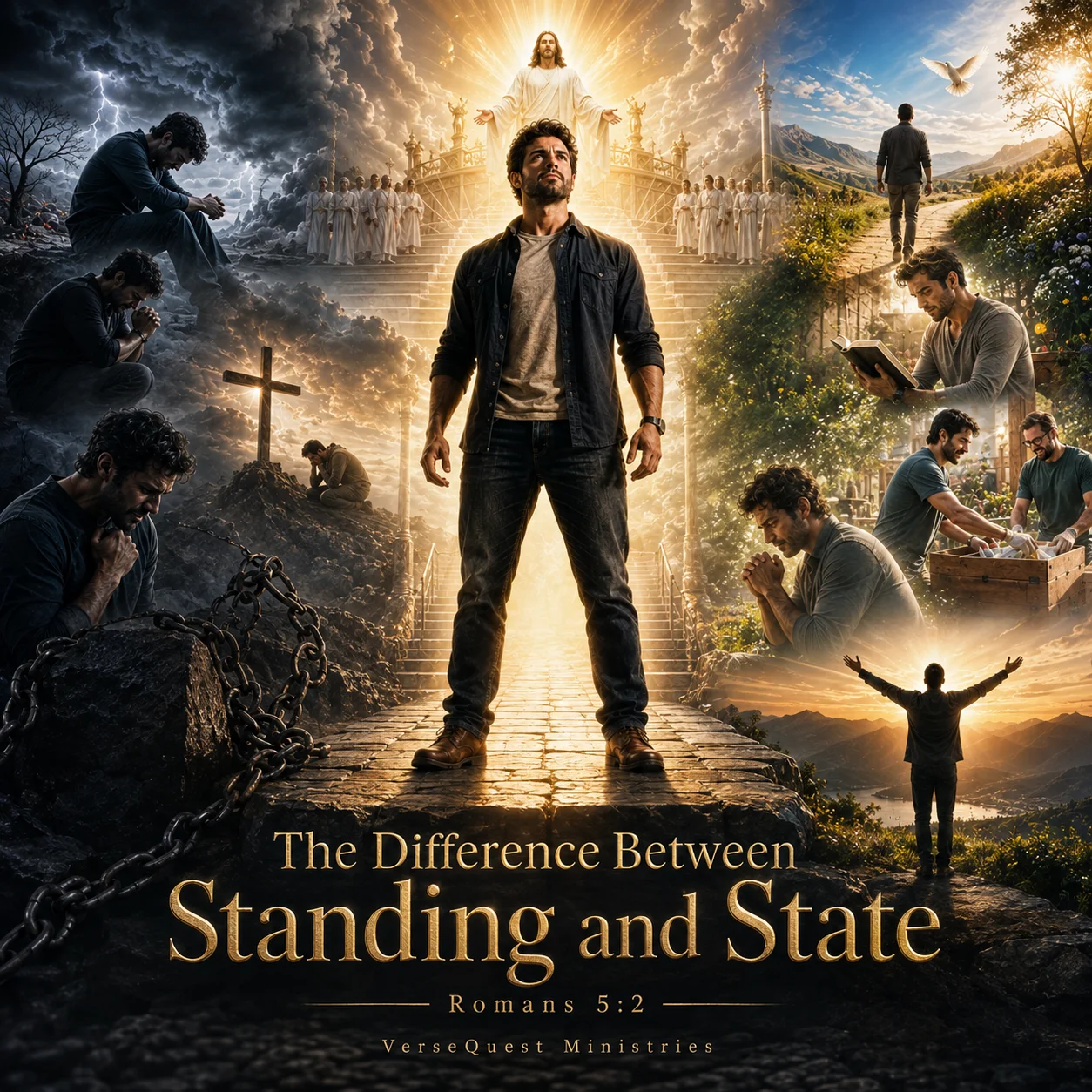
Sermon Title:
Standing in Grace, Walking in Practice: The Difference Between Standing and State
Key Passage:
Romans 5:2 — “By whom also we have access by faith into this grace wherein we stand, and rejoice in hope of the glory of God.”
Series:
Foundations of the Gospel of Grace
Topic:
The Difference Between the Believer’s Unchanging Standing in Christ and His Changing Practical State
Book:
Romans, Ephesians, Colossians, Galatians, 1 Corinthians, 2 Corinthians, Philippians, 1 John
Speaker:
Paul Tackett
Suggested Sermon Text:
Romans 5:1–11; Romans 6:1–14; Romans 7:14–25; Romans 8:1–17; Ephesians 1:3–14; Ephesians 2:4–10; Ephesians 4:1–32; Colossians 2:9–14; Colossians 3:1–17; Galatians 5:13–25; 1 Corinthians 3:11–15; 1 Corinthians 11:31–32; 2 Corinthians 5:17–21; Philippians 3:8–16; 1 John 1:7–9
Short Sermon Description:
This detailed VerseQuest Ministries sermon outline explains Romans 5:2 and the vital Bible distinction between the believer’s standing and his state. The believer’s standing is his settled position before God in Jesus Christ: justified by faith, standing in grace, accepted in the Beloved, complete in Christ, redeemed through His blood, sealed by the Holy Spirit, and free from condemnation. His state is his practical daily condition—his walk, fellowship, obedience, spiritual growth, service, fruitfulness, and response to sin. This sermon shows why a believer’s state can fluctuate while his standing remains anchored in Christ, why secure standing is never permission for careless living, how fellowship may be damaged without sonship being destroyed, and how chastening and the judgment seat of Christ relate to practical conduct rather than eternal condemnation. Designed for pastors, preachers, teachers, Bible students, and believers, this outline gives a strong KJV framework for assurance, sanctification, Christian growth, and rightly dividing salvation from service.
Standing in Grace, Walking in Practice
The Difference Between Standing and State
Introduction
Romans 5:2 says that through the Lord Jesus Christ “we have access by faith into this grace wherein we stand.” That word stand is one of the strongest words in Paul’s doctrine of the believer’s position before God. The saved man is not crawling toward grace, hoping to qualify for grace, renting grace until his next failure, or standing on the thin ice of his own performance. He has access by faith into grace, and in that grace he stands. His position is not built on how well the flesh behaved yesterday. It is built upon justification by faith, peace with God, the blood of Christ, and the righteousness of the risen Saviour.
Yet the same believer who stands perfectly accepted in Christ can have a miserable practical walk. He can grieve the Holy Spirit, lose joy, become carnal, neglect prayer, misuse his liberty, damage his testimony, lose reward, and require the Father’s chastening. That is where the distinction between standing and state becomes so important. Standing refers to what the believer is before God because he is in Christ. State refers to how the believer is walking practically from day to day. Standing is settled by Christ’s work. State changes according to the believer’s obedience. Standing is positional. State is practical. Standing determines acceptance. State affects fellowship, usefulness, testimony, fruit, and reward.
Confuse those two truths, and Christianity becomes either bondage or foolishness. Legalism looks at a believer’s poor state and concludes that his standing must have collapsed. Careless grace teaching looks at the believer’s secure standing and concludes that his state does not matter. Both errors are unscriptural. Paul teaches believers to stand in grace and walk worthy. He tells them they are complete in Christ and commands them to put off the old man. He tells them there is no condemnation and commands them to mortify the deeds of the body. The Bible believer must learn to rest where God says he stands and walk the way God says he ought.
I. Standing Begins With Justification by Faith
Key Text: Romans 5:1–2
Supporting Texts: Romans 3:24–28; Romans 4:5; Galatians 2:16
Romans 5 begins, “Therefore being justified by faith, we have peace with God through our Lord Jesus Christ.” Before Paul says we stand in grace, he says we are justified by faith. Standing therefore begins with a judicial act of God, not with practical improvement by man. Justification means God declares the believing sinner righteous on the basis of Jesus Christ. The sinner does not slowly become justified by accumulating enough obedient days. He is justified by faith because Christ has provided the righteousness he could never produce.
Romans 3 says believers are “justified freely by his grace through the redemption that is in Christ Jesus.” Romans 4:5 says God justifies “the ungodly” who believes. That word should flatten religious pride. God does not justify the man because he finally made himself worthy. He justifies the ungodly through faith in Christ. Galatians 2:16 repeats that a man is not justified by the works of the law. Standing therefore rests upon grace, redemption, blood, righteousness, and faith—not human performance.
That distinction must be settled early. If standing depends upon state, assurance disappears. Every bad day would place justification in doubt. Every temptation would reopen the courtroom. Every failure would require salvation to begin again. But Paul starts with justification as a completed verdict and then moves into Christian living. The believer’s state matters greatly, but it is not the foundation of his justification. Christ is.
Main Truth:
The believer’s standing begins with justification by faith, a settled verdict based on Christ’s righteousness rather than human performance.
II. Standing Means We Stand in Grace
Key Text: Romans 5:2
Supporting Texts: Romans 11:6; Ephesians 2:8–9; Titus 3:5–7
Romans 5:2 says believers have “access by faith into this grace wherein we stand.” Grace is not merely how the sinner gets saved and then disappears while law takes over the Christian life. The believer stands in grace. His whole relationship to God rests upon divine favour given through Christ rather than merit earned through flesh.
Romans 11:6 draws the line sharply: “if by grace, then is it no more of works.” Grace and works cannot both be the ground of acceptance. Ephesians 2 says salvation is “not of works, lest any man should boast.” Titus 3 says God saved us “not by works of righteousness which we have done.” The believer therefore does not begin in grace and later graduate into self-maintained acceptance. The Christian life is lived from grace, through grace, and under grace.
This does not mean grace produces laziness. Paul’s doctrine of grace is the opposite. Because the believer stands in grace, he can serve without trying to purchase acceptance. He can confess failure without imagining salvation has disappeared. He can pursue holiness because he belongs to God, not because he is terrified that one wrong step will throw him out of Christ. Standing in grace gives the believer secure ground from which real obedience can grow.
Main Truth:
The believer stands permanently in grace, not on the shifting ground of works, merit, or religious performance.
III. Standing Is Everything God Has Made the Believer in Christ
Key Text: 2 Corinthians 5:17
Supporting Texts: Ephesians 1:3–7; Colossians 2:10; 1 Corinthians 1:30
Second Corinthians 5:17 says, “if any man be in Christ, he is a new creature.” The phrase in Christ describes the believer’s spiritual location. Standing concerns what God has made the believer because of that position. Ephesians 1 says believers are blessed with all spiritual blessings in heavenly places in Christ, accepted in the Beloved, redeemed through His blood, and forgiven according to the riches of His grace.
Colossians 2:10 says, “And ye are complete in him.” First Corinthians 1:30 says Christ is made unto us wisdom, righteousness, sanctification, and redemption. Those statements do not describe how perfectly the believer behaved this morning. They describe what God has made him in Christ. A believer may feel weak while being complete in Christ. He may be struggling practically while still possessing Christ as his righteousness. His feelings do not redefine his standing.
Religion tells the believer to look inward for evidence that God ought to accept him. Paul points outward and upward to Christ. The standing of the believer is not “accepted because I prayed enough,” “accepted because I resisted enough temptation,” or “accepted because I feel spiritual.” It is “accepted in the beloved.” Standing is Christ-centered because salvation is Christ-centered.
Main Truth:
The believer’s standing consists of everything God has made him in Christ: accepted, redeemed, righteous, complete, and spiritually blessed.
IV. State Describes the Believer’s Practical Daily Walk
Key Text: Ephesians 4:1
Supporting Texts: Colossians 3:1–10; Galatians 5:16; Romans 6:11–13
After three chapters describing the believer’s riches and position in Christ, Paul begins Ephesians 4 by saying, “I therefore…beseech you that ye walk worthy of the vocation wherewith ye are called.” That word therefore connects standing to state. Because God has called you, accepted you, redeemed you, sealed you, and seated you in heavenly places, now walk worthy of that standing.
Colossians follows the same pattern. Chapters 1 and 2 emphasize the believer’s position and completeness in Christ. Then Colossians 3 says, “If ye then be risen with Christ, seek those things which are above.” The believer is told to put off anger, wrath, malice, blasphemy, filthy communication, and lying. Why? Not so he can become accepted, but because he already belongs to Christ. Practical state is supposed to line up increasingly with positional standing.
Galatians 5 says, “Walk in the Spirit, and ye shall not fulfil the lust of the flesh.” Romans 6 tells believers to reckon themselves dead indeed unto sin and alive unto God. That is practical responsibility. Standing is what God has done. State is how the believer responds. The saved man cannot improve his standing, but he absolutely can improve or damage his state through obedience or disobedience.
Main Truth:
The believer’s state is his practical walk, and God calls that daily walk to become increasingly consistent with his settled standing in Christ.
V. A Believer’s State Can Be Poor While His Standing Remains Secure
Key Text: 1 Corinthians 3:1
Supporting Texts: 1 Corinthians 5:1–5; 1 Corinthians 11:30–32; Ephesians 4:30
Paul told the Corinthians, “I…could not speak unto you as unto spiritual, but as unto carnal, even as unto babes in Christ.” Notice the phrase in Christ. Their standing was real. Their state was carnal. Paul did not congratulate them for carnality, but neither did he say their position in Christ vanished because their practical walk was poor. That one passage alone demonstrates the distinction.
First Corinthians 5 describes shocking immorality among people connected with the assembly. First Corinthians 11 says some believers were weak, sickly, and even died under the chastening hand of God because of sinful conduct surrounding the Lord’s supper. Yet Paul says when believers are judged, “we are chastened of the Lord, that we should not be condemned with the world.” Their state brought severe consequences, but chastening was distinguished from eternal condemnation.
Ephesians 4:30 says believers can grieve the Holy Spirit, yet the same verse says they are “sealed unto the day of redemption.” That is standing and state in one verse. Their state can grieve Him. Their standing includes being sealed by Him. A believer who understands this should neither excuse sin nor despair because of sin. He should confess, repent practically, submit to correction, and walk again in the light.
Main Truth:
A believer’s practical state can become carnal and grievous, yet his standing in Christ remains the ground from which God corrects and restores him.
VI. Broken Fellowship Is Not Broken Sonship
Key Text: 1 John 1:9
Supporting Texts: Ephesians 4:30–32; Hebrews 12:5–11; Galatians 4:4–7
First John 1:9 says, “If we confess our sins, he is faithful and just to forgive us our sins, and to cleanse us from all unrighteousness.” Confession deals with practical fellowship. The believer does not confess sin to persuade God to make him a son again. Sonship has already been established in Christ. He confesses because sin interferes with communion, joy, usefulness, and spiritual health.
Galatians 4 says believers have received the adoption of sons and cry, “Abba, Father.” Hebrews 12 shows that the Father chastens those whom He loves. Chastening itself proves relationship. God does not deal with His children as condemned strangers. He deals with them as sons. That is why correction can be severe without being damnation.
This distinction is liberating and sobering at the same time. Liberating, because a believer does not have to wonder whether every failure makes him spiritually unborn. Sobering, because being a son means the Father has every right to correct him. Fellowship can be damaged. Joy can disappear. Chastening can come. Reward can be lost. But sonship is the foundation upon which restoration takes place.
Main Truth:
Sin can break fellowship and bring chastening without destroying the believer’s sonship and settled relationship to God in Christ.
VII. Standing Is Perfect, but State Must Grow
Key Text: Philippians 3:12
Supporting Texts: Colossians 2:10; Philippians 3:14–16; 2 Peter 3:18
Colossians 2:10 says believers are “complete in him,” yet Philippians 3:12 records Paul saying, “Not as though I had already attained, either were already perfect.” There is no contradiction. Colossians speaks of positional completeness. Philippians speaks of practical attainment. Standing is complete. State is growing. Position is settled. Practice is developing.
Paul therefore says, “I press toward the mark for the prize of the high calling of God in Christ Jesus.” A believer who understands his perfect standing does not sit down spiritually and say there is nothing left to pursue. Quite the opposite. Knowing who he is in Christ gives him a reason to press forward. He wants his life to match his position.
The Christian life therefore involves growth in doctrine, holiness, wisdom, prayer, service, patience, charity, discernment, and spiritual maturity. A man may be completely accepted in Christ while still having much practical maturing to do. God is not asking him to become more justified. He is asking him to grow into the practical likeness of the One in whom he already stands.
Main Truth:
The believer is positionally complete in Christ while still needing continual practical growth and spiritual maturity.
VIII. The Judgment Seat Concerns State and Service, Not Standing and Salvation
Key Text: 2 Corinthians 5:10
Supporting Texts: 1 Corinthians 3:11–15; Romans 14:10–12; Ephesians 2:8–10
Second Corinthians 5:10 says believers must appear before the judgment seat of Christ to receive according to the things done in the body. That judgment does not determine whether the believer’s standing in Christ was real enough to keep him out of hell. Salvation has already been settled. The judgment seat concerns service, stewardship, motive, faithfulness, and reward.
First Corinthians 3 says every man’s work shall be tried by fire. Some work abides and receives reward. Other work burns and brings loss. Then Paul says of the man whose work burns, “he himself shall be saved; yet so as by fire.” There again is standing and state. His standing remains—he himself is saved. His practical service is judged—his work may burn.
Ephesians 2 makes the order plain: saved by grace through faith, not of works, then created in Christ Jesus unto good works. Works follow salvation. The judgment seat therefore should make believers serious about state without making them uncertain about standing. Grace settles the destination; accountability evaluates the journey.
Main Truth:
The judgment seat evaluates the believer’s practical service and reward, not whether Christ’s finished work was sufficient to secure his salvation.
IX. A Secure Standing Should Produce a Holy State
Key Text: Romans 6:1–2
Supporting Texts: Titus 2:11–14; Romans 12:1–2; 2 Corinthians 5:14–15
Whenever standing in grace is preached clearly, someone eventually asks, “If salvation is secure, why not sin?” Paul anticipated the question two thousand years ago: “Shall we continue in sin, that grace may abound? God forbid.” Secure standing is never permission for an unholy state. Grace does not encourage sin. Grace gives the believer the only healthy foundation from which to fight it.
Titus 2 says the grace of God teaches believers to deny ungodliness and worldly lusts and to live soberly, righteously, and godly. Romans 12 tells believers to present their bodies as living sacrifices “by the mercies of God.” Mercy comes first. Consecration follows. Second Corinthians 5 says the love of Christ constrains believers to live no longer unto themselves but unto Him who died and rose again.
Legalism tries to produce holiness with fear of losing standing. Grace produces holiness through gratitude for standing. The believer does not say, “I must obey so God will keep me accepted.” He says, “God has accepted me in Christ; therefore I want my life to honor the One who saved me.” That motive does not weaken holiness. It deepens it.
Main Truth:
The believer’s secure standing in grace should produce gratitude, holiness, obedience, and a practical state worthy of Jesus Christ.
Conclusion
Romans 5:2 says believers have access by faith “into this grace wherein we stand.” That is the believer’s settled ground. Justified by faith. At peace with God. Accepted in the Beloved. Complete in Christ. Redeemed through His blood. Sealed by the Holy Spirit. Free from condemnation. Those truths describe standing. They are not earned every morning and lost every night. They belong to the believer because he belongs to Christ.
State is different. State concerns the daily walk. A believer can be joyful or miserable, spiritual or carnal, obedient or stubborn, fruitful or barren, useful or sidelined. His state affects fellowship, testimony, usefulness, chastening, and reward. That is why sin matters even though salvation is secure. A saved man cannot improve the righteousness of Christ credited to him, but he can certainly dishonor Christ by the way he lives.
The Bible gives neither legalistic terror nor careless grace. It gives secure standing and serious walking. The believer rests in Christ for acceptance and presses forward in obedience for practical holiness. He does not confuse chastening with condemnation, fellowship with sonship, growth with justification, or reward with salvation. He stands in grace and then walks worthy of the grace wherein he stands.
Final Call
Sinner, you have no standing in grace simply because you are religious, sincere, moral, baptized, churched, charitable, or interested in the Bible. Outside Jesus Christ you stand guilty before God. Your practical state cannot earn a righteous standing because no amount of moral improvement can erase sin.
Jesus Christ died for your sins according to the Scriptures. He was buried. He rose again the third day according to the Scriptures. Believe on the Lord Jesus Christ, and thou shalt be saved. God will justify you by faith and give you access into the grace wherein believers stand.
Believer, stop trying to earn the standing Christ already purchased, and stop using secure standing as an excuse for a careless state. Rest in grace. Walk in the Spirit. Confess sin. Submit to chastening. Grow in grace. Serve faithfully. Let your practical life increasingly resemble the perfect position God has already given you in His Son.
Closing Verse:
Romans 5:2 — “By whom also we have access by faith into this grace wherein we stand, and rejoice in hope of the glory of God.”
Closing Statement:
Standing tells you where grace has placed you in Christ; state tells you how faithfully you are walking from the position Christ already secured.