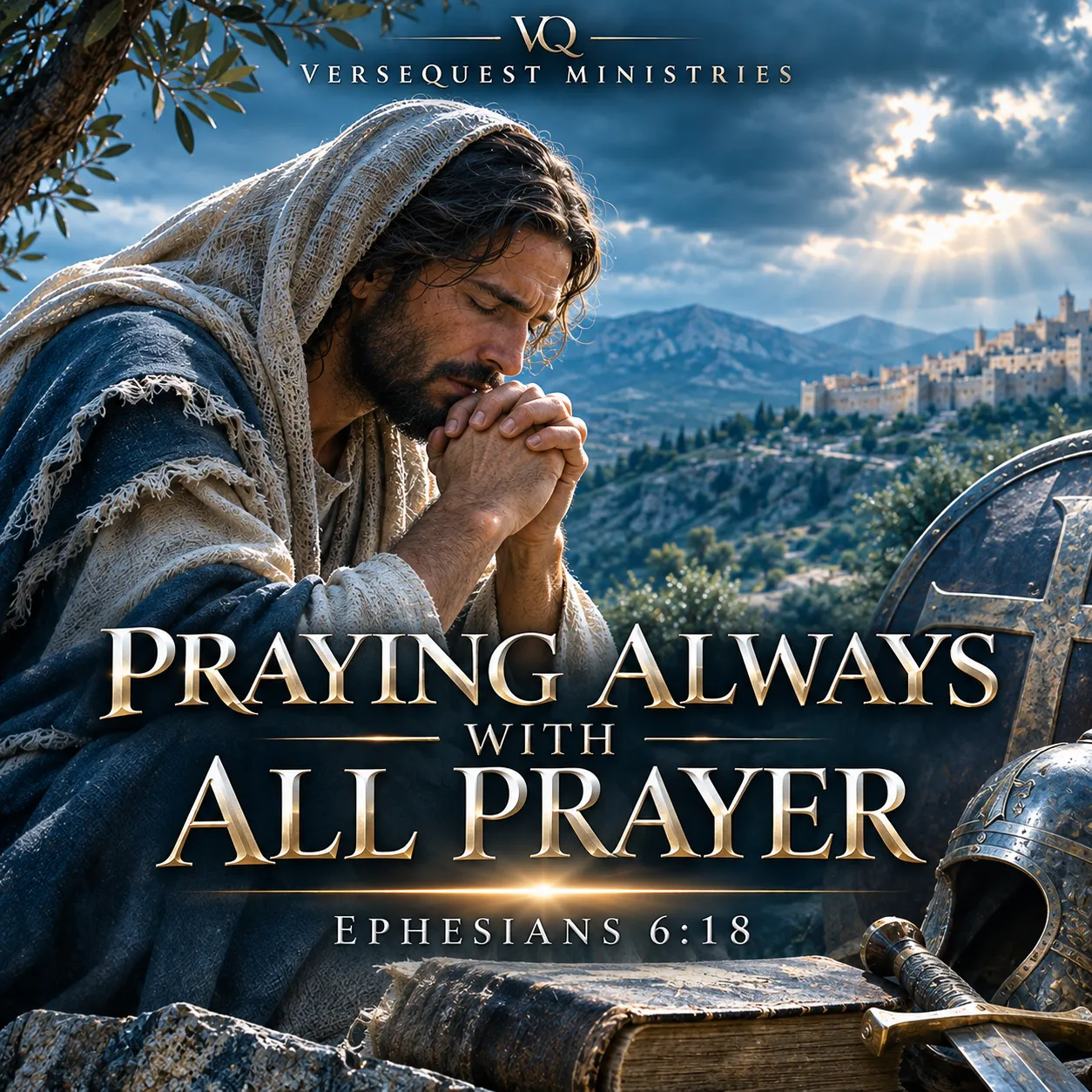
Sermon Title:
Praying Always With All Prayer
Key Passage:
Ephesians 6:18
“Praying always with all prayer and supplication in the Spirit, and watching thereunto with all perseverance and supplication for all saints;” (Ephesians 6:18)
Series:
The Book God Gave
Topic:
The Believer’s Responsibility to Pray Continually in the Spirit, Remain Spiritually Watchful, Persevere in Supplication, Intercede for All Saints, and Stand Faithfully in the Whole Armour of God
Book:
Ephesians
Speaker:
Paul Tackett
Suggested Sermon Text:
Ephesians 1:3–14, 15–23; Ephesians 2:1–10, 13–22; Ephesians 3:12–21; Ephesians 4:1–32; Ephesians 5:1–21; Ephesians 6:10–24; Romans 5:1–11; Romans 6:1–14; Romans 8:1–39; Romans 10:1–17; Romans 12:9–21; Romans 15:30–33; 1 Corinthians 2:9–16; 1 Corinthians 12:12–27; 1 Corinthians 14:13–19; 1 Corinthians 15:1–4, 57–58; 2 Corinthians 1:8–11; 2 Corinthians 4:1–18; 2 Corinthians 5:7–21; 2 Corinthians 12:7–10; Galatians 4:4–7; Galatians 5:16–26; Galatians 6:1–10; Philippians 1:3–11, 19–21; Philippians 4:4–9; Colossians 1:3–14; Colossians 2:6–15; Colossians 3:1–17; Colossians 4:2–6; 1 Thessalonians 3:9–13; 1 Thessalonians 5:6–11, 16–25; 2 Thessalonians 3:1–5; 1 Timothy 2:1–8; 2 Timothy 1:3–7; 2 Timothy 2:15; 2 Timothy 3:16–17; 2 Timothy 4:1–8; Hebrews 4:14–16; Hebrews 7:25; Luke 11:1–13; Luke 18:1–8; Matthew 26:36–46; 1 Peter 5:8–9; 1 John 5:14–15.
Short Sermon Description:
Ephesians 6:18 contains one of the Apostle Paul’s most comprehensive instructions concerning Christian prayer: “Praying always with all prayer and supplication in the Spirit, and watching thereunto with all perseverance and supplication for all saints.” This sermon examines that command within the immediate context of the whole armour of God, showing why prayer is inseparable from the believer’s responsibility to stand against the wiles of the devil. It explains how prayer relates to truth, righteousness, the gospel of peace, faith, salvation, and the sword of the Spirit, while warning against the assumption that spiritual warfare can be conducted through human determination, religious excitement, or impressive biblical knowledge without dependence upon God. Special attention is given to the meaning of praying always, the distinction between prayer and supplication, the necessity of praying in the Spirit, the responsibility to remain watchful, and the importance of persevering when answers do not arrive according to human expectations. The message examines the believer’s responsibility to intercede for all saints rather than limiting prayer to personal concerns, and considers Paul’s request in Ephesians 6:19–20 for boldness to make known the mystery of the gospel while serving as an ambassador in bonds. Drawing upon Romans 8, Philippians 4, Colossians 4, 1 Timothy 2, and other Pauline passages, the sermon distinguishes the present believer’s access to the Father through Jesus Christ from the kingdom setting of Christ’s earthly instruction to Israel. It also explains why praying in the Spirit does not require speaking in unknown ecstatic utterances, why persistence does not give Christians authority to manipulate God, and why prayer must be joined with sound doctrine, practical obedience, thanksgiving, and faithful gospel witness. Preachers, teachers, and Bible students will gain a comprehensive, KJV-based, rightly divided, sermon-ready framework for teaching biblical prayer, spiritual warfare, Christian perseverance, intercession, spiritual watchfulness, gospel boldness, and continual dependence upon the Lord Jesus Christ.
PRAYING ALWAYS WITH ALL PRAYER
Introduction
There is something rather remarkable about a Christian who can describe every piece of the armour of God but seldom spends any serious time in prayer. He can explain the loins girt about with truth, describe the breastplate of righteousness, identify the shield of faith, discuss the helmet of salvation, and deliver an impressive explanation of the sword of the Spirit. He knows the armour’s names, its location in Ephesians, and perhaps even the Greek terminology favored by the latest commentary on the subject. Yet when he reaches Ephesians 6:18, his enthusiasm begins to disappear. Apparently, it is considerably easier to admire the equipment than to depend upon the God who provided it. But Paul does not conclude his instruction concerning spiritual warfare by telling believers to become confident in their own ability to operate the armour. He continues, “Praying always with all prayer and supplication in the Spirit, and watching thereunto with all perseverance and supplication for all saints.” The man who wants to stand against the wiles of the devil while neglecting prayer has misunderstood the nature of his dependence. A soldier who admires his equipment but refuses to follow the commands of his superior is not demonstrating military excellence. He is demonstrating that he has confused possession of equipment with readiness for battle. Likewise, the Christian who possesses sound doctrine but continually neglects communion with God is in danger of allowing knowledge to become a substitute for dependence. The whole armour of God was never intended to turn the saved man into a self-sufficient spiritual warrior who no longer needs the Lord.
The setting of Ephesians 6 makes the command even more important. Paul has already spent considerable time explaining the magnificent spiritual position of believers in Jesus Christ. Ephesians 1 describes spiritual blessings in heavenly places, redemption through Christ’s blood, and the sealing of believers with the Holy Spirit of promise. Ephesians 2 explains salvation by grace through faith, the believer’s new position in Christ, and the reconciliation accomplished through the Saviour. Ephesians 3 reveals the mystery entrusted to Paul concerning the body of Christ and includes his prayer that believers might be strengthened with might by the Spirit in the inner man. Then the epistle turns toward the Christian’s practical walk. Believers are instructed to walk worthy of their calling, refuse the former conversation of the old man, speak truth, practice forgiveness, walk in love, walk as children of light, redeem the time, and fulfill responsibilities within the home and other relationships. By the time Paul reaches Ephesians 6:10, he has established that the saved man possesses an extraordinary spiritual position while continuing to live in a world where the devil opposes the truth and the flesh remains a source of temptation. The command to put on the whole armour of God therefore belongs to the responsibilities of someone already saved. And the instruction to pray always belongs to that same practical warfare. Prayer is not introduced as an additional payment toward salvation. It is an ongoing responsibility of those who already possess salvation through Jesus Christ.
There is also an enormous amount of doctrinal confusion surrounding the subject of prayer. One crowd treats prayer as a religious performance through which enough emotion, repetition, and impressive vocabulary will eventually persuade God to obey the petitioner. Another crowd reduces prayer to a mystical experience in which unusual sounds, private revelations, and supposed spiritual sensations become more important than the written word of God. Still another crowd approaches prayer like a commercial transaction, promising that sufficiently confident requests will produce financial prosperity, uninterrupted physical health, freedom from every difficulty, and whatever earthly advantage the flesh happens to desire. Yet Paul says nothing in Ephesians 6:18 about controlling God, manufacturing supernatural experiences, or obtaining a guarantee that earthly life will become comfortable. He commands prayer in the Spirit, spiritual watchfulness, perseverance, and supplication for all saints. Then he asks those believers to pray that he might speak boldly concerning the gospel—even while he remains an ambassador in bonds. That final detail should embarrass much modern teaching about prayer. The Apostle Paul was not primarily requesting a more comfortable prison experience. He wanted boldness to proclaim the message Christ had entrusted to him. The Christian’s prayer life is not supposed to become a private ordering service through which heaven supplies the flesh with whatever it wants. It is supposed to express continual dependence upon God while the believer stands faithfully in the truth. That is the doctrine Ephesians 6:18 places before us, and it reaches directly into the believer’s daily walk.
I. PRAYER BELONGS TO THE BELIEVER’S SPIRITUAL WARFARE, NOT TO RELIGIOUS SELF-CONFIDENCE
Key Text: Ephesians 6:10–18
Supporting Texts: 2 Corinthians 10:3–5; Romans 8:26–27; Ephesians 3:14–21; Philippians 4:6–7; Colossians 4:2; 1 Thessalonians 5:17
Paul begins the final major instruction of Ephesians with a command that ought to settle the question of where spiritual strength originates: “Finally, my brethren, be strong in the Lord, and in the power of his might” (Ephesians 6:10). Notice what he does not say. He does not tell believers to become strong in their natural personalities, intellectual abilities, religious reputations, or determination to prove themselves superior to other Christians. The strength is in the Lord. The power is His might. The following verse commands them to put on the whole armour of God so that they may stand against the wiles of the devil. Then verse 12 identifies the real nature of the conflict: “For we wrestle not against flesh and blood, but against principalities, against powers, against the rulers of the darkness of this world, against spiritual wickedness in high places.” The believer is not involved merely in a contest of human opinions. There is genuine spiritual opposition to the truth of God. Yet the Christian must not convert that opposition into an excuse to treat every disagreeable person as though he were the devil himself. Paul specifically says that the warfare is not against flesh and blood. People need the gospel, false doctrine needs correction, and the Christian needs the power of God to remain faithful in the midst of spiritual opposition.
The equipment Paul describes is thoroughly grounded in divine truth. The believer is to stand with his loins girt about with truth, having on the breastplate of righteousness, his feet shod with the preparation of the gospel of peace, taking the shield of faith, the helmet of salvation, and the sword of the Spirit, which is the word of God. These are not magical objects that become spiritually effective through an elaborate daily ceremony. They illustrate the divine provisions and responsibilities associated with standing faithfully in Christ. Truth must govern the Christian’s thinking. Righteousness must be reflected in his conduct. The gospel must remain central to his witness. Faith must rest upon what God has revealed. Salvation provides his position in Christ. The word of God supplies the weapon by which falsehood is exposed and divine truth is proclaimed. Then Paul continues with prayer. Ephesians 6:18 is not a disconnected devotional statement placed after a completed discussion. It is grammatically and practically connected with standing in the armour. The believer who attempts to separate biblical truth from dependence upon God has misunderstood both. The sword of the Spirit is the word of God, but the man carrying that sword is still commanded to pray.
There is also a warning here against confusing spiritual warfare with religious theatrics. Some people speak as though victory depends upon shouting commands into the atmosphere, identifying an invisible spirit behind every inconvenience, or performing elaborate verbal rituals against Satan. But Paul does not instruct believers to spend their days inventing the names of devils or conducting imaginary conversations with principalities and powers. He commands them to stand in the provisions God has supplied and to pray in the Spirit. Second Corinthians 10:4 declares, “For the weapons of our warfare are not carnal, but mighty through God to the pulling down of strong holds.” The surrounding passage concerns bringing thoughts into obedience to Christ, not the believer’s permission to invent spiritual techniques unsupported by Scripture. The Christian should therefore resist false doctrine, refuse fleshly temptation, maintain righteousness, proclaim the gospel, and depend upon the Lord through prayer. The believer’s confidence is not that he has become an expert at frightening devils with religious language. His confidence is that Jesus Christ has already accomplished redemption and supplied everything necessary for faithful obedience.
Main Truth: Prayer is inseparably connected with the whole armour of God because spiritual victory requires continual dependence upon the Lord, sound doctrine, practical righteousness, and faith in His revealed truth rather than human strength or religious theatrics.
II. “PRAYING ALWAYS” REQUIRES CONTINUAL DEPENDENCE UPON GOD
Key Text: Ephesians 6:18
Supporting Texts: 1 Thessalonians 5:16–18; Colossians 4:2; Romans 12:12; Philippians 4:6–7; Luke 18:1–8; 2 Timothy 1:3
Paul begins the instruction with two words that reach into the entire Christian life: “Praying always.” That is a remarkable command because it refuses to confine prayer to occasional religious ceremonies or emergency circumstances. Some Christians appear to possess a highly developed ability to remember God when everything goes wrong and forget Him when everything goes right. When illness arrives, prayer suddenly becomes important. When money becomes scarce, the believer remembers the throne of grace. When a family problem develops, he begins searching for biblical promises. But when circumstances improve, the same man may spend weeks treating communion with God as something that belongs to yesterday’s emergency. Paul does not command believers to pray only when human resources have been exhausted. He says, “Praying always.” The Christian ought to maintain a continuing disposition of dependence upon the Lord rather than approaching Him exclusively when personal circumstances become uncomfortable. A man who speaks to God only when he wants something is not necessarily displaying mature fellowship. He may simply have developed a religious method of placing orders.
First Thessalonians 5:17 gives the same principle in three words: “Pray without ceasing.” That command must be understood sensibly and according to the whole counsel of Scripture. Paul is not instructing Christians to spend every second of their lives verbally speaking prayers while neglecting sleep, employment, family responsibilities, Scripture, and other duties God has commanded. The same apostle instructs believers to work honestly, provide for their households, teach sound doctrine, and fulfill responsibilities in their ordinary relationships. Praying without ceasing describes the continuing practice and disposition of dependence upon God, not the abandonment of every other Christian obligation. The believer should possess regular habits of focused prayer while remaining ready to bring concerns before the Lord as circumstances arise. He may pray before beginning important work, while facing difficult decisions, when remembering someone in need, when tempted to sin, and whenever gratitude is appropriate. Prayer should become a natural part of Christian living rather than an activity assigned to a tiny religious compartment in an otherwise self-directed schedule.
Colossians 4:2 commands, “Continue in prayer, and watch in the same with thanksgiving.” That statement links persistence with watchfulness and gratitude. The Christian should not confuse constant prayer with constant anxiety. He is not commanded to spend his life repeating fearful requests because he imagines God will forget His people unless continually reminded. Philippians 4:6 directs believers to bring requests before God with thanksgiving, while verse 7 speaks of the peace of God keeping their hearts and minds through Christ Jesus. The believer can pray earnestly and then continue carrying out his responsibilities without surrendering to panic. Nor should the command become a legalistic contest concerning how many minutes a person must accumulate before God considers him sufficiently spiritual. Salvation is by grace through faith, and access to the Father rests upon Jesus Christ. Prayer is not a timekeeping competition. The Christian who prays always is not the man who never does anything except pray. He is the man who has learned that nothing he does should be conducted as though he no longer needs God.
Main Truth: Praying always means maintaining a continuing pattern of communion and dependence upon God throughout daily life without confusing persistent prayer with endless verbal repetition or the neglect of ordinary responsibilities.
III. “WITH ALL PRAYER AND SUPPLICATION” REVEALS THE BREADTH OF THE BELIEVER’S PRAYER LIFE
Key Text: Ephesians 6:18
Supporting Texts: Philippians 4:6; 1 Timothy 2:1–4; Colossians 4:2–4; Romans 15:30–33; Ephesians 3:14–21; 2 Corinthians 1:8–11
Paul does not merely command believers to pray. He says, “with all prayer and supplication.” The language emphasizes the breadth of the believer’s approach to God. Prayer should not be reduced to one narrow category of requests. The Christian may come before the Father in thanksgiving, praise, confession of personal wrongdoing, requests for wisdom, pleas concerning genuine needs, and intercession on behalf of others. Supplication directs particular attention toward earnest requests for help or provision. The believer may ask God for spiritual strength under temptation, wisdom in a difficult decision, endurance during suffering, assistance concerning legitimate responsibilities, and opportunities to proclaim the gospel. But his prayer life should not consist exclusively of requests for his own material comfort. First Timothy 2:1 identifies “supplications, prayers, intercessions, and giving of thanks” and commands that they be made for all men. That instruction demonstrates that a biblically balanced prayer life extends beyond the circumstances of the person praying. The Christian should remember the needs of others as well as his own.
Philippians 4:6 declares, “Be careful for nothing; but in every thing by prayer and supplication with thanksgiving let your requests be made known unto God.” Notice the breadth of the instruction and the presence of thanksgiving. Paul does not suggest that only extraordinary crises deserve prayer, nor does he encourage believers to approach God as though He has provided nothing worthy of gratitude. Thanksgiving ought to accompany the requests because the believer already possesses blessings that earthly circumstances cannot erase. He has redemption through Christ’s blood, forgiveness of sins, eternal life, the indwelling Holy Spirit, access to the Father, and the promise of future glory. A Christian may experience genuine sorrow while remaining thankful for those blessings. He may face serious financial hardship while remembering that his eternal inheritance does not depend upon the size of his bank account. Prayer and thanksgiving belong together because the Lord’s goodness is not measured exclusively by whether today’s circumstances agree with tomorrow’s preferences. A man who remembers every request God has not answered according to his wishes while forgetting the redemption God has already provided has developed a remarkably selective memory.
There is also a difference between broad prayer and careless, thoughtless repetition. The words “all prayer” do not authorize the believer to invent mystical formulas, perform elaborate ceremonies, or assume that certain arrangements of words possess supernatural power independently of faith in God. Jesus Christ warned against vain repetitions during His earthly ministry, and the Pauline epistles direct the Church toward prayer governed by truth, thanksgiving, and the will of God. Nor does the ability to use impressive religious vocabulary make one Christian’s prayers more acceptable than another’s. A believer who can barely express his burdens in ordinary language still possesses access to the Father through Jesus Christ. An elderly saint praying quietly for a missionary may exercise genuine intercession without ever delivering a public prayer before a congregation. The Lord does not require His children to become professional orators before they may approach Him. The Father is not impressed by how many religious words a man can arrange into a sentence while neglecting the genuine dependence, gratitude, and concern for others that prayer ought to express.
Main Truth: All prayer and supplication includes the believer’s varied expressions of thanksgiving, worship, personal requests, spiritual dependence, and intercession for others, all governed by Scripture rather than religious performance or mechanical formulas.
IV. “IN THE SPIRIT” IDENTIFIES THE DIVINE HELP AND DIRECTION NECESSARY FOR BIBLICAL PRAYER
Key Text: Ephesians 6:18
Supporting Texts: Romans 8:9, 15, 26–27; Ephesians 1:13–14; Ephesians 2:18; Galatians 4:6; Galatians 5:16–25; 1 Corinthians 14:14–19; Philippians 3:3
Paul continues with the expression “in the Spirit.” Those words are essential because the believer’s prayer life is not intended to operate independently of the Holy Spirit who dwells within him. Romans 8:9 identifies the Spirit of God as dwelling in those who belong to Jesus Christ, and Ephesians 1:13 declares that believers, after hearing and believing the gospel, “were sealed with that holy Spirit of promise.” The saved man does not have to manufacture the presence of the Holy Spirit through extraordinary emotion or repeated religious ceremonies. God has already supplied the indwelling Spirit as part of His saving work. Ephesians 2:18 declares, “For through him we both have access by one Spirit unto the Father.” That statement provides the proper relationship between the Father, the Son, and the Holy Spirit in Christian prayer. The believer approaches the Father through Jesus Christ by the Spirit. He does not independently possess sufficient righteousness to enter the presence of God through personal merit. His access rests upon the Saviour, and the Holy Spirit assists him in the exercise of that privilege.
Romans 8:26 explains why the Spirit’s ministry is necessary: “Likewise the Spirit also helpeth our infirmities: for we know not what we should pray for as we ought.” Those words should permanently remove the idea that mature Christians always possess perfect knowledge concerning what ought to be requested. Even the Apostle Paul acknowledges human weakness in prayer. We may know that a fellow believer is suffering without knowing which circumstances God intends to change. We may face a difficult decision without possessing complete information concerning the future. We may desire relief from a trial while failing to recognize the spiritual lessons God may accomplish through endurance. The Holy Spirit helps our infirmities and intercedes according to the will of God. This does not mean the believer should stop learning Scripture or abandon thoughtful prayer because the Spirit performs all necessary work without his participation. It means he should approach God humbly, recognizing that his knowledge is limited while divine wisdom is perfect. The Christian’s confidence in prayer should never depend upon the astonishing assumption that he always knows more about his circumstances than God does.
Praying in the Spirit must also be distinguished from the modern claim that every Christian needs a private language of ecstatic syllables before he can pray effectively. Ephesians 6:18 does not define praying in the Spirit as speaking in unknown sounds. First Corinthians 14 addresses the subject of tongues within its own historical and congregational setting, and Paul places great importance upon understanding and intelligible instruction. In verse 15 he declares, “I will pray with the spirit, and I will pray with the understanding also.” The biblical gift of tongues must not be confused with the supposed necessity of unintelligible private speech for all believers. Praying in the Spirit concerns prayer consistent with the ministry and direction of the Holy Spirit, not an emotional performance designed to prove extraordinary spirituality. The Spirit does not lead the Christian into prayer that contradicts Scripture, promotes sin, or magnifies the flesh. He directs attention toward the Lord Jesus Christ and the truth God has revealed. The Holy Spirit did not come to make the believer’s prayer life a contest in unusual religious sounds. He came to dwell within the redeemed and help them live and pray according to the will of God.
Main Truth: Praying in the Spirit means approaching the Father through Jesus Christ with the help of the indwelling Holy Spirit, according to divine truth and God’s will rather than fleshly confidence or invented mystical experiences.
V. “WATCHING THEREUNTO” COMMANDS SPIRITUAL ALERTNESS RATHER THAN CARELESS PRAYER
Key Text: Ephesians 6:18
Supporting Texts: Ephesians 5:15–17; Colossians 4:2; 1 Thessalonians 5:6–8; Matthew 26:40–41; 1 Peter 5:8–9; Romans 13:11–14; 2 Timothy 2:15
Paul joins prayer with the command concerning “watching thereunto.” That expression returns our attention to the seriousness of spiritual warfare. The Christian is not supposed to move through the present world as though no spiritual opposition exists, no fleshly temptation remains active, and no danger of doctrinal deception requires attention. A soldier assigned to guard a particular position cannot safely close his eyes simply because the previous hour passed without an attack. Neither should the believer become careless because earlier seasons of Christian service were comparatively peaceful. Paul has already warned that believers wrestle against spiritual wickedness, and his instruction concerning prayer includes remaining spiritually alert. The Christian should be attentive to the spiritual condition of his own life, the influences affecting his thinking, the needs of fellow believers, and the opportunities available for faithful service. Prayer and watchfulness belong together because the man who recognizes genuine spiritual needs should be concerned enough to bring them before God.
Colossians 4:2 gives the corresponding command: “Continue in prayer, and watch in the same with thanksgiving.” First Thessalonians 5:6 likewise instructs, “Therefore let us not sleep, as do others; but let us watch and be sober.” These passages establish the need for spiritual sobriety rather than religious carelessness. The believer must recognize when his attention has gradually become dominated by worldly influences. He should notice when resentment begins governing his speech, when covetousness begins replacing contentment, when false doctrine is being presented as biblical truth, or when ordinary distractions are consuming responsibilities that ought to receive serious attention. He should also recognize genuine needs among fellow Christians. A member of the Church may be struggling with discouragement, another may require instruction concerning sound doctrine, and another may face persecution because of faithful gospel witness. Watchfulness should make the Christian more attentive to such needs rather than more absorbed with himself. A watchman who spends his entire shift admiring how well equipped he is while refusing to look beyond the wall has misunderstood the purpose of his equipment.
Yet spiritual watchfulness must not be confused with paranoia, conspiracy speculation, or the assumption that every inconvenience proves the activity of a particular devil. Some Christians become so occupied with imagining invisible enemies behind every ordinary difficulty that they neglect the clearly revealed instructions of Scripture. They spend more time trying to identify unseen spiritual activity than examining whether their own conduct agrees with the Bible. But Paul’s command concerns sober, faithful readiness, not mystical excitement. Ephesians 5:15–17 has already commanded believers to walk circumspectly, redeem the time, and understand the will of the Lord. The Christian should therefore study Scripture, remain alert to temptation, recognize false teaching, and continue praying without surrendering his judgment to sensational claims. When the Lord instructed His disciples in Matthew 26:41 to “Watch and pray,” the immediate setting involved the approaching trial in Gethsemane. That historical setting must be preserved, but the principle of alertness joined with prayer remains instructive. The Christian is not called to spend his life frightened by every shadow. He is commanded to remain watchful because the God who has given him the truth has also warned him not to become careless with it.
Main Truth: Watching in prayer requires spiritual sobriety, doctrinal discernment, attention to genuine needs, and alertness against temptation without surrendering to fear, speculation, or unbiblical spiritual practices.
VI. “WITH ALL PERSEVERANCE” TEACHES CONTINUING FAITHFULNESS WHEN ANSWERS ARE NOT IMMEDIATE
Key Text: Ephesians 6:18
Supporting Texts: Romans 12:12; Colossians 4:2; 1 Thessalonians 5:17; Philippians 4:6–7; 2 Corinthians 12:7–10; Luke 11:5–13; Luke 18:1–8
Paul adds another important expression: “with all perseverance.” There is a difference between a man who prays because he genuinely depends upon God and a man who prays only while the answers arrive according to his preferred schedule. The flesh enjoys quick results. It wants immediate relief, immediate provision, immediate correction of other people, and immediate confirmation that its requests have been received. When circumstances remain difficult, the natural man begins questioning whether prayer is worthwhile. But Paul commands perseverance. The believer should not abandon dependence upon God merely because the situation has not developed according to his expectations. A Christian may pray for a lost relative for many years without seeing an immediate response to the gospel. He may pray for a struggling believer whose circumstances remain complicated. He may ask for wisdom concerning responsibilities that continue developing over time. Perseverance means remaining faithful in prayer rather than treating the Lord as useful only when His answers arrive quickly.
Second Corinthians 12 provides a remarkable example from Paul’s own life. The apostle explains that he sought the Lord three times concerning a thorn in the flesh. The Lord did not answer by removing the difficulty according to Paul’s request. Instead, Christ declared, “My grace is sufficient for thee: for my strength is made perfect in weakness” (2 Corinthians 12:9). That ought to correct the popular notion that a sufficiently spiritual Christian can always obtain the removal of suffering through greater persistence or stronger emotional confidence. Paul was not a novice in biblical doctrine. He was not unfamiliar with the power of God. He was an apostle entrusted with extraordinary revelation, yet his request did not receive the answer he initially desired. The Lord provided grace sufficient for the circumstances rather than changing the circumstances in the manner Paul requested. That did not make prayer a failure. It demonstrated that divine wisdom is greater than human preference. The man who assumes every unanswered request proves defective faith has apparently decided that even the Apostle Paul should have been more successful at persuading God.
The teaching of Jesus Christ concerning perseverance in Luke 11 and Luke 18 also illustrates the importance of continuing in prayer. Those passages belong to their respective settings during His earthly ministry and should not be made identical to every doctrinal instruction directed to the Church under grace. Nevertheless, their lessons concerning earnest asking and perseverance are valuable when understood properly. Persistence does not mean God is reluctant to listen and must be worn down through repeated demands. Neither does it mean a Christian can force the Lord to grant something contrary to His wisdom simply by praying long enough. Colossians 4:2 commands continued prayer accompanied by thanksgiving, not endless suspicion that God has become unwilling to hear. First John 5:14 places confidence in asking according to God’s will. The believer should therefore pray earnestly, persevere patiently, obey the truth already revealed, and trust the Lord with outcomes beyond his control. The purpose of persevering in prayer is not to continue arguing until God accepts our will. It is to continue depending upon Him while learning that His wisdom remains trustworthy even when His answer differs from our request.
Main Truth: Perseverance in prayer means continuing faithfully in dependence upon God through delay, hardship, and uncertainty without treating persistence as a means of compelling the Lord to satisfy human desires.
VII. “SUPPLICATION FOR ALL SAINTS” REMINDS THE BELIEVER THAT PRAYER IS NOT ABOUT HIMSELF ALONE
Key Text: Ephesians 6:18
Supporting Texts: 1 Timothy 2:1–4; Romans 12:9–16; Romans 15:30–33; 1 Corinthians 12:12–27; Philippians 1:3–11; Colossians 1:3–14; Galatians 6:1–10
Paul concludes the verse with a responsibility that reaches beyond the private concerns of the individual Christian: “supplication for all saints.” This expression exposes the selfishness that can quietly develop in a believer’s prayer life. A man may spend considerable time asking God to improve his circumstances, strengthen his health, provide financial assistance, remove personal difficulties, and arrange his future according to his preferences. None of those requests is necessarily improper. Scripture invites believers to bring their needs before the Lord. But Paul does not conclude his instruction concerning spiritual warfare by telling Christians to become exclusively occupied with themselves. He directs their attention toward all saints. The body of Christ contains many members, and those members face differing responsibilities, temptations, hardships, and opportunities. Some believers are enduring persecution. Others are struggling with discouragement or physical weakness. Some are teaching Scripture, others are laboring in difficult mission fields, and still others are faithfully serving Christ in circumstances known to very few people. These believers need prayer, and the Christian should learn to remember them before the throne of grace.
First Corinthians 12 teaches that the members of Christ’s body belong together and should exercise proper concern for one another. Verse 26 declares, “And whether one member suffer, all the members suffer with it; or one member be honoured, all the members rejoice with it.” That principle should influence the believer’s intercession. A Christian should not become so absorbed with his own ministry that he considers the spiritual needs of other believers irrelevant. He should not imagine that the only Christians worthy of prayer are those who agree with every personal preference or belong to his immediate circle. Sound doctrine certainly matters, and Scripture commands believers to recognize and separate from dangerous error. But necessary doctrinal distinctions do not authorize selfishness toward the body of Christ. A believer may disagree with another Christian concerning a secondary matter while still praying for his spiritual growth, protection, wisdom, and faithfulness. Neither does prayer for all saints require that every believer personally know the name of every saved person living on earth. Paul is establishing the broad responsibility of intercession rather than an impossible requirement to recite an exhaustive list of every member of the Church.
The broader Pauline instruction extends prayer even beyond the saints. First Timothy 2:1 commands supplications, prayers, intercessions, and thanksgiving for all men, including those in authority. Romans 10:1 records Paul’s desire and prayer concerning Israel’s salvation. Ephesians 6:18 specifically emphasizes the saints because spiritual warfare includes the needs of fellow believers, but Christians should also pray for the lost, their families, governing authorities, and those who oppose the truth. Yet intercession must never become a substitute for practical obedience. A man who prays for a struggling family while possessing the ability and responsibility to provide legitimate assistance should not use prayer as an excuse to ignore their needs. Likewise, the Christian should not turn prayer into a means of controlling others or presenting himself as indispensable to their relationship with God. The believer who has been granted access to the throne of grace should not approach that throne as though the only person in the world who ever needs help is the person doing the praying.
Main Truth: Christian prayer must include earnest intercession for all saints and appropriate concern for others, reflecting the unity of Christ’s body rather than limiting communion with God to personal desires and private needs.
VIII. PAUL’S REQUEST FOR BOLDNESS SHOWS THAT PRAYER SHOULD ADVANCE THE GOSPEL
Key Text: Ephesians 6:19–20
Supporting Texts: Romans 1:16; Romans 10:13–17; Romans 15:30–33; 1 Corinthians 15:1–4; 2 Corinthians 5:18–21; Colossians 4:2–6; 2 Thessalonians 3:1–2; 2 Timothy 4:1–5
Immediately after commanding prayer for all saints, Paul makes a personal request: “And for me, that utterance may be given unto me, that I may open my mouth boldly, to make known the mystery of the gospel.” Those words reveal something remarkable about the Apostle Paul. Here is a man entrusted with the revelation of the mystery, a preacher who had proclaimed the gospel throughout the Roman world, established churches, confronted false teachers, endured persecution, and written inspired Scripture. Yet he asks ordinary believers to pray for him. He does not consider himself beyond needing their intercession. He does not announce that his apostolic authority makes dependence upon God unnecessary. He recognizes that he needs utterance and boldness to continue fulfilling the ministry entrusted to him. That should encourage believers who possess little public recognition but who faithfully pray for pastors, teachers, missionaries, and gospel workers. Their intercession is not insignificant merely because they do not occupy the same public position. The great Apostle Paul asked the saints to pray for him, and his request concerned one of the most important responsibilities in the present dispensation: making known the gospel.
Paul then explains his circumstances: “For which I am an ambassador in bonds: that therein I may speak boldly, as I ought to speak.” There is a tremendous contrast in that statement. Paul describes himself as an ambassador, yet he is in bonds. He possesses a heavenly commission while experiencing earthly imprisonment. The man whose message concerns spiritual liberty in Jesus Christ is personally restrained by human authority. Yet his request is not primarily that the chains disappear, the prison becomes more comfortable, or the Roman government begins treating him with greater admiration. He asks for boldness to speak. That does not mean praying for deliverance from persecution is improper. Paul elsewhere requests prayer concerning dangerous and difficult circumstances. But here the emphasis is unmistakable. He wants to remain faithful to his commission even while suffering because of it. A man whose greatest concern in prison is that he might still proclaim the gospel boldly has understood something about Christian priorities that the prosperity preacher selling comfortable Christianity has apparently overlooked.
This also establishes the proper relationship between prayer and evangelism. The gospel for the present dispensation declares that “Christ died for our sins according to the scriptures; And that he was buried, and that he rose again the third day according to the scriptures” (1 Corinthians 15:3–4). The sinner is saved through faith in Jesus Christ, not through the prayers of another person as a substitute for personal belief. But believers should pray that the gospel will be proclaimed clearly and boldly, that doors of utterance will be opened, and that those hearing the message will understand the truth concerning salvation. Colossians 4:3 records a similar request that God would open a door of utterance for the word. Second Thessalonians 3:1 asks prayer that the word of the Lord may have free course and be glorified. The Christian who prays for gospel opportunities should also be willing to communicate the gospel when appropriate opportunities appear. Prayer does not replace preaching, and preaching should not be conducted in proud independence from prayer. The Church does not need to pray merely that its preachers will become popular. It needs to pray that they will remain faithful to the gospel whether popularity comes or goes.
Main Truth: Paul’s request for utterance and boldness teaches believers to pray for faithful gospel proclamation and courageous Christian service, even when obedience brings opposition rather than earthly comfort.
IX. THE BELIEVER’S CONFIDENCE IN PRAYER RESTS UPON CHRIST’S FINISHED WORK AND ACCESS THROUGH THE SPIRIT
Key Text: Ephesians 2:18
Supporting Texts: Ephesians 1:7, 13–14; Ephesians 3:12–21; Romans 5:1–2; Romans 8:15, 26–39; Galatians 4:4–7; 1 Timothy 2:5–6; Hebrews 4:14–16; Hebrews 7:25
The command to pray always must finally be understood in the light of the believer’s spiritual position in Jesus Christ. Ephesians 2:18 declares, “For through him we both have access by one Spirit unto the Father.” That verse provides the doctrinal foundation for the Church’s prayer life. The saved believer possesses access to the Father through the Lord Jesus Christ. He does not need to perform religious ceremonies to purchase that access, acquire a human priest capable of supplying additional righteousness, or become sufficiently impressive through personal discipline before God will receive him. The Saviour has already accomplished redemption. Ephesians 1:7 declares, “In whom we have redemption through his blood, the forgiveness of sins, according to the riches of his grace.” The believer’s standing rests upon Christ’s blood. His access is not secured by his ability to maintain an uninterrupted record of perfect prayers. He approaches the Father because Jesus Christ has opened the way. First Timothy 2:5 identifies “one mediator between God and men, the man Christ Jesus.” That should settle every attempt to place another redemptive mediator between the sinner and God.
Romans 5:1–2 connects justification by faith with peace with God and access into grace through Jesus Christ. Romans 8 explains the believer’s relationship with the indwelling Spirit, who helps his infirmities in prayer, and identifies the risen Christ as making intercession for those who belong to Him. Hebrews 4:16 declares, “Let us therefore come boldly unto the throne of grace, that we may obtain mercy, and find grace to help in time of need.” The Christian’s boldness in prayer is therefore not arrogance toward God. It is confidence in what Jesus Christ has accomplished. A saved man does not have to wonder whether his salvation remains sufficient each time he approaches the Father. He does not need another sacrifice for sin or an additional religious payment. The Lord Jesus Christ died, was buried, rose again, and now lives as the exalted Saviour. The believer is secure in Him. But that security must not become an excuse for careless prayer, fleshly conduct, or neglect of Scripture. The same grace that provides access also instructs believers concerning holiness, thanksgiving, obedience, and faithful service.
This distinction also protects the Church from turning prayer into another system of works-based righteousness. Some people imagine that salvation becomes more secure when they pray enough or that God will abandon them if their prayer schedule falls below a certain religious requirement. Others take eternal security and use it as a reason to neglect prayer altogether. Both misunderstand the doctrine. The sinner is not saved because he has prayed faithfully for many years. He is saved through faith in Jesus Christ. The saved believer is commanded to pray because he already belongs to Christ and possesses access to the Father through Him. Prayer should therefore be motivated by gratitude, dependence, love, spiritual concern, and obedience rather than fear that Christ’s finished work must continually be supplemented. Nor should the believer imagine that access guarantees every earthly request will be granted according to personal preference. The Father remains perfectly wise, and His will remains greater than ours. The Christian does not pray to persuade God to adopt him into the family. He prays because Jesus Christ has already brought him into that family, and the child of God has every reason to depend upon his Father.
Main Truth: The believer’s privilege of prayer rests upon redemption through Jesus Christ and access to the Father by the Holy Spirit, making continual prayer an expression of grace and dependence rather than a means of earning salvation.
Conclusion
Ephesians 6:18 stands as one of the Apostle Paul’s most comprehensive instructions concerning the prayer life of a saved believer: “Praying always with all prayer and supplication in the Spirit, and watching thereunto with all perseverance and supplication for all saints.” The verse belongs to the larger command concerning the whole armour of God, where believers are instructed to stand in the Lord’s strength against the wiles of the devil. Paul does not present the Christian life as an independent struggle in which fallen man eventually becomes strong enough to defeat spiritual opposition through natural determination. He directs believers toward the truth, righteousness, gospel of peace, faith, salvation, and word of God, and then commands prayer. The relationship is essential. Sound doctrine without dependence can become an occasion for pride. Religious activity without spiritual watchfulness can become an exercise in fleshly ambition. The possession of biblical knowledge without the practice of biblical obedience can leave a man exceptionally skilled at explaining truths he has become careless about applying. But the Christian who understands his position in Jesus Christ recognizes that his strength originates in the Lord. He must study the Book, rightly divide the word of truth, walk in the Spirit, maintain righteousness, stand against false doctrine, and continue approaching God in prayer. The armour of God does not make prayer unnecessary. It reminds the believer that the warfare belongs to a Lord whose strength he must continually depend upon.
The passage also exposes the weakness of a prayer life governed entirely by self-interest. Paul commands all prayer and supplication, watching, perseverance, and intercession for all saints. He does not tell believers to approach God only when their personal circumstances become uncomfortable. Nor does he encourage them to treat prayer as a method of forcing the Lord to grant whatever earthly advantage they desire. The Christian is commanded to pray in the Spirit, not in the confidence of the flesh. He must remain watchful, not spiritually careless. He must persevere, not abandon prayer whenever circumstances remain difficult. He must remember fellow believers, not reduce the entire world to the narrow boundaries of his own concerns. And when Paul requests prayer for himself, his concern is that he might speak boldly concerning the mystery of the gospel while serving as an ambassador in bonds. That request should teach the Church what faithful priorities look like. The apostle wanted the message of salvation proclaimed clearly and courageously, even when his circumstances were personally difficult. The Christian should likewise pray for the lost, intercede for fellow believers, uphold gospel workers, seek wisdom, give thanks, and continue faithfully in whatever responsibilities the Lord has entrusted to him. Prayer is not supposed to make the believer increasingly occupied with getting his own way. It should make him increasingly dependent upon God while he seeks to do God’s will.
So take the King James Bible and examine your own prayer life in the light of Ephesians 6:18. Are you praying always, or do you remember the Father only when your earthly resources have been exhausted? Are your prayers governed by the truth of Scripture, or have you begun depending upon emotional experiences and religious traditions? Are you watchful concerning the dangers of the present world, or have worldly distractions gradually consumed the time once devoted to spiritual responsibilities? Are you persevering when answers seem delayed, or have you concluded that God is interested only when circumstances change immediately? Are you remembering the saints, your family, those in authority, the lost, and those who labor in the gospel? Are you praying that ministers will remain faithful to sound doctrine, or have you become more interested in their popularity than their obedience? And when you bring requests before God, are you submitting them to His wisdom or demanding that heaven approve the preferences of your flesh? If the answers reveal neglected responsibilities, the solution is not to invent another religious ceremony or begin measuring spirituality with a stopwatch. Return to what God has written. Remember your position in Jesus Christ. Study the word of truth. Put on the whole armour of God. Walk in the Spirit. Pray with thanksgiving. Intercede for others. Persevere through difficulty. Seek boldness for gospel witness. And keep your confidence in the Saviour who redeemed you and provides access to the Father. The Christian who has learned to stand in the whole armour of God must never forget that the same passage which tells him to stand also commands him to pray.
Final Call
If you are lost, you cannot save yourself by learning to pray more frequently, repeating religious formulas, attending prayer meetings, joining a church, being baptized, performing good works, or demonstrating an extraordinary degree of spiritual dedication. The Bible does not teach that God justifies sinners because they have accumulated enough hours in prayer. Salvation comes through the finished work of Jesus Christ. First Corinthians 15:3–4 declares “that Christ died for our sins according to the scriptures; And that he was buried, and that he rose again the third day according to the scriptures.” The Lord Jesus Christ paid the price for sin through His blood and rose again victorious over death. Romans 4:5 declares that God justifies the ungodly who believe on Him. Ephesians 2:8–9 says, “For by grace are ye saved through faith; and that not of yourselves: it is the gift of God: Not of works, lest any man should boast.” Acts 16:31 declares, “Believe on the Lord Jesus Christ, and thou shalt be saved.” Do not confuse repeating a prayer with personally believing the gospel. Religious words cannot substitute for faith in the Saviour. You need redemption, not another program of self-improvement. Believe that Jesus Christ died for your sins, was buried, and rose again according to the Scriptures. Trust His finished work. Receive eternal life through faith in the risen Saviour. Then you will possess the access to the Father that belongs to those who are saved through Him.
If you are saved, remember that the Lord has already redeemed you through His blood, justified you by faith, sealed you with the Holy Spirit, and given you access to the Father through Jesus Christ. Those blessings should produce confidence, gratitude, holiness, and faithful dependence rather than spiritual carelessness. Stop treating prayer as an occasional emergency measure to be remembered only when everything else has failed. Stop assuming that knowledge of the armour of God automatically means you are walking faithfully in it. Stop allowing the flesh to turn prayer into a list of demands intended to make earthly life more comfortable. Read the Book. Study it. Rightly divide the word of truth. Put on the whole armour of God. Stand in the Lord’s strength. Pray always with all prayer and supplication in the Spirit. Remain spiritually watchful. Persevere when circumstances are difficult. Pray for all saints. Pray for the salvation of the lost. Pray for those who preach and teach Scripture. Pray for boldness to communicate the gospel. Give thanks for the blessings already received. And remember that the Lord who commands you to pray has already provided the access through which your prayers may be brought before the Father. You do not need to become strong enough to live independently of God. You need to recognize that every spiritual responsibility before you is another reason to remain dependent upon Him.
Closing Verse:
“Continue in prayer, and watch in the same with thanksgiving;” (Colossians 4:2)
Closing Statement:
The Christian who puts on the whole armour of God but neglects prayer has remembered his equipment and forgotten his dependence—stand in the truth, walk in the Spirit, watch with perseverance, and never become so confident in what God has given you that you forget to call upon the God who gave it.