
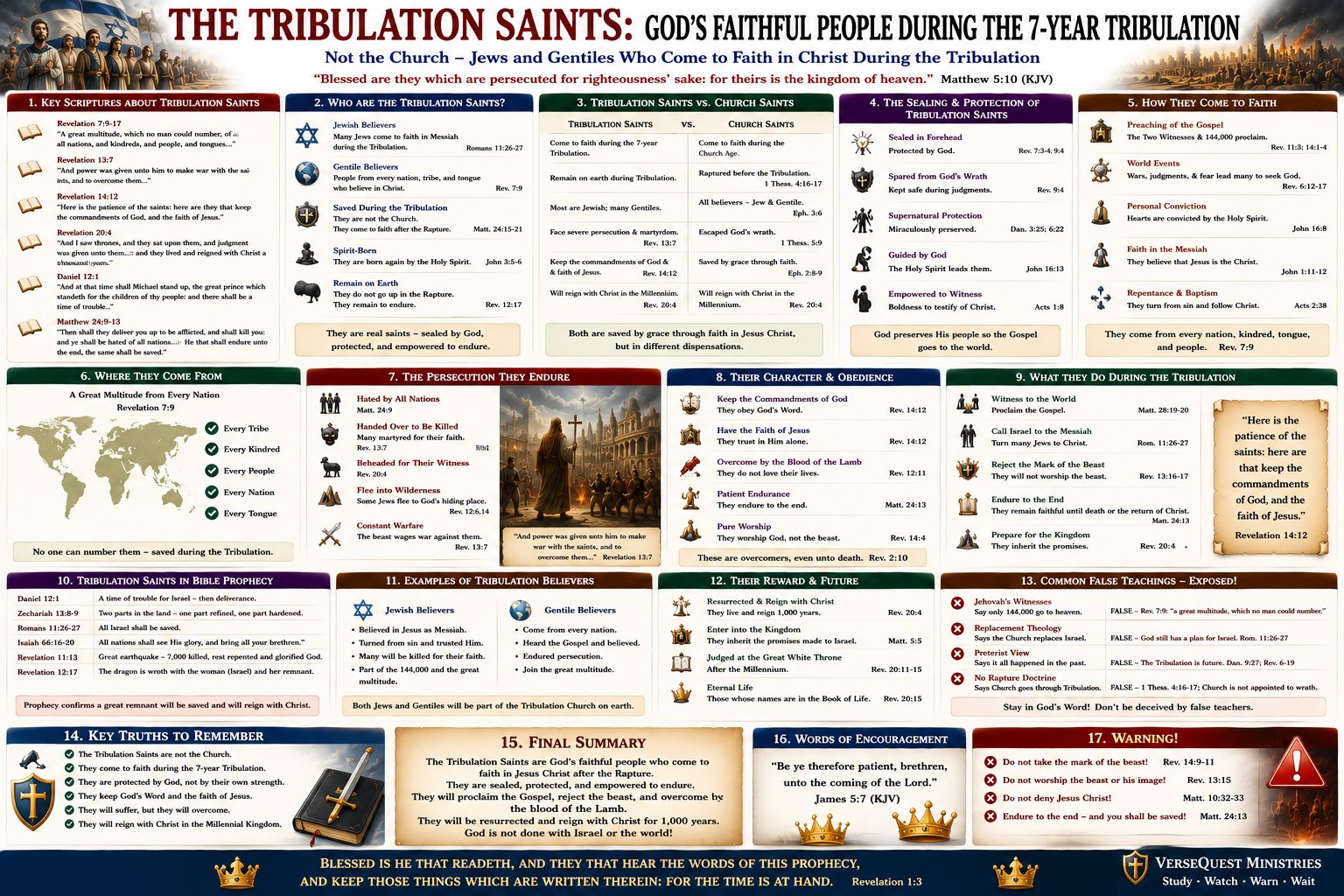
The Tribulation Saints – Jews and Gentiles Who Believe During Daniel’s Seventieth Week, Endure Persecution, Refuse the Beast, and Reign with Christ (KJV Bible Study Chart)
Understand the Tribulation saints with this detailed KJV chart covering believing Jews and Gentiles, the great multitude, their distinction from the Church, persecution by Antichrist, rejection of the beast and his mark, patient endurance, martyrdom, resurrection, and future reign with Jesus Christ.
$4.99
Description
The Tribulation Saints: God’s Faithful People During the Seven-Year Tribulation is a comprehensive, rightly divided KJV Bible study chart examining the men and women who believe God during Daniel’s future seventieth week, remain upon the earth during the Tribulation, endure severe persecution beneath Antichrist’s kingdom, refuse the worship and mark of the beast, and ultimately share in the victory of Jesus Christ. Drawing from Revelation 7:9–17, Revelation 12:11–17, Revelation 13:7, Revelation 14:12–13, Revelation 20:4–6, Daniel 12:1, and Matthew 24:9–13, the chart distinguishes these future saints from the present Church, the Body of Christ, while showing that God will continue to save, preserve, and use faithful people even during the darkest prophetic period in human history.
The phrase Tribulation saints is a theological description rather than a single biblical title appearing in one verse. It refers to believing people living within the future Tribulation setting revealed especially in Daniel, Matthew 24, and Revelation 6–19. Some are Israelites connected with the remnant and Israel’s restoration, while Revelation 7 reveals a great multitude from every nation, kindred, people, and tongue. The common element is that they belong to God during the period when the beast exercises authority, persecution intensifies, divine judgments fall, and the world is pressed toward worship of Antichrist.
These saints should not be confused with the present Church, the Body of Christ. During the present dispensation, believing Jews and Gentiles are made one Body in Jesus Christ through the Holy Spirit. Ephesians 3 identifies this one-Body truth as a mystery previously hidden, while First Corinthians 12:13 declares that believers are baptized by one Spirit into one Body. From the pre-Tribulation perspective represented by the chart, the Church is caught away before Daniel’s seventieth week begins, while the Tribulation saints come to faith within the subsequent prophetic period.
This distinction does not imply two saviours, two competing Christs, or salvation apart from the blood of the Lamb. Every redeemed person owes salvation to Jesus Christ. Revelation 7 describes the great multitude as having “washed their robes, and made them white in the blood of the Lamb.” Revelation 12:11 says the faithful overcome the accuser “by the blood of the Lamb, and by the word of their testimony.” The cross remains the only sufficient basis upon which sinful human beings can be reconciled to a holy God.
At the same time, right division recognizes that believers in different biblical settings may receive different commands, face different prophetic conditions, possess different earthly responsibilities, and stand within different dispensational programmes. The Church’s calling, identity, and blessed hope should not be transferred automatically to every saint appearing after Revelation’s Tribulation judgments begin.
Revelation 7 supplies one of the clearest pictures of redeemed people in the Tribulation. After the sealing of the 144,000 Israelites, John sees “a great multitude, which no man could number, of all nations, and kindreds, and people, and tongues.” They stand before the throne and before the Lamb, clothed with white robes and carrying palms.
This company is distinctly international. No denomination, ethnic group, earthly government, or human organization can claim exclusive ownership of it. The multitude demonstrates that the Tribulation does not eliminate God’s saving testimony among the nations.
One of the elders asks John who these people are and where they came from. The answer is direct: “These are they which came out of great tribulation.” Their white robes are connected with the blood of the Lamb, and they stand before God because redemption rests upon Christ rather than personal merit.
Their existence also proves that the Rapture does not mean no one can be saved afterward. The removal of the present Body of Christ does not remove God from the universe, silence every divine witness, eliminate the Holy Spirit’s activity, or prevent people from responding to truth during the subsequent prophetic period.
God will possess witnesses during the Tribulation. Revelation explicitly presents the two witnesses, the sealed servants from Israel, angelic proclamations, prophetic warnings, martyrs maintaining testimony, and saints who refuse the beast. The world enters judgment, but judgment does not mean Heaven becomes silent.
The Tribulation saints include believing Jews. Israel occupies a central place throughout the period because Daniel’s seventieth week concerns Daniel’s people and holy city. Jeremiah calls the future crisis “the time of Jacob’s trouble,” while Zechariah foretells Israel eventually looking upon the Messiah whom the nation pierced.
Romans 11 likewise rejects the idea that God has permanently cast away Israel. The nation presently experiences partial blindness, but God retains a future covenant programme. Many Jewish people will turn toward their Messiah as the prophetic programme moves toward Christ’s visible return.
The Tribulation saints also include believing Gentiles. Revelation 7 makes this unmistakable through its language of every nation, kindred, people, and tongue. God’s prophetic dealings with Israel do not mean Gentiles vanish from the earth or become incapable of faith.
The final Tribulation setting therefore contains several groups that should not be collapsed into one another: the remnant of Israel, the sealed 144,000 Israelites, believing Gentiles, Tribulation martyrs, the great multitude, unbelieving Israel, rebellious nations, earth-dwellers, the beast’s worshippers, and the political rulers aligned with Antichrist.
The chart emphasizes that these people are saved during the Tribulation and are therefore distinct in timing from the Church saints already caught up to Christ within the chart’s pre-Tribulation framework. That timing explains why Revelation can speak both of saints enduring the beast’s persecution and of the Church being promised deliverance from the coming wrath.
The saints remain on the earth during the Tribulation rather than participating in the earlier Church-age Rapture. Revelation repeatedly describes saints confronting the Dragon, beast, mark, persecution, and Tribulation judgments.
The beast is given power to make war with the saints and overcome them. Revelation 13:7 does not mean he destroys their eternal life. It means he is permitted to persecute, imprison, and kill them physically.
This is an important distinction throughout Scripture. A tyrant may overcome a believer politically or physically without overcoming him spiritually or eternally. The martyr may lose his head and still win the battle.
Revelation 12:11 describes true victory: “they overcame him by the blood of the Lamb, and by the word of their testimony; and they loved not their lives unto the death.” Satan measures victory by survival, control, fear, and earthly power. God measures victory by faithfulness to truth even when faithfulness costs earthly life.
The Tribulation saints therefore become a direct contradiction to Antichrist’s claim of universal authority. The beast may command the world, control commerce, enforce worship, and threaten death, but God still possesses people who will not bow.
Their condition resembles the three Hebrew children in Daniel 3. Nebuchadnezzar commanded universal worship before a great image and threatened fiery death to anyone refusing. Shadrach, Meshach, and Abednego chose obedience to God over conformity to the ruler’s decree.
Their answer remains one of Scripture’s great examples of faith under tyranny: God is able to deliver, but even if He does not remove the immediate danger, they will not serve the false gods or worship the image. The Tribulation saints will face that same basic spiritual test on a global scale.
The chart includes the theme of sealing and protection, but this area requires careful distinction. Revelation 7 specifically seals the 144,000 servants from Israel before further judgment proceeds. Revelation 9:4 also refers to people possessing God’s seal. These passages demonstrate God’s supernatural ability to identify and preserve His own, but they should not be used to claim that every Tribulation saint receives precisely the same physical protection.
Many Tribulation saints are martyred. Revelation 6 shows souls beneath the altar slain for the Word of God and their testimony. Revelation 13 gives the beast authority to make war with saints, while Revelation 20 specifically remembers those beheaded for refusing beast worship.
God’s protection therefore does not always mean exemption from death. Sometimes He protects the servant through danger; sometimes He protects the testimony until the appointed work is complete and then receives the servant through martyrdom.
Either way, the beast cannot touch eternal life. Jesus warned not to fear those who kill the body but are unable to kill the soul. Antichrist’s greatest weapon ends at the grave; Christ’s authority begins where Antichrist’s ends.
The chart examines how people come to faith during the Tribulation. Scripture reveals multiple streams of divine testimony during this period. The two witnesses prophecy publicly. The 144,000 are sealed servants of God. Revelation 14 presents the everlasting gospel proclaimed to those dwelling on the earth. The judgments themselves reveal divine authority, while biblical prophecy becomes visibly fulfilled before mankind.
People will therefore encounter truth amid extraordinary circumstances. Wars, judgments, the rise of the beast, supernatural events, Israel’s prophetic restoration, divine witnesses, and angelic proclamations all demonstrate that the God rejected by the world has not ceased speaking.
Yet external events cannot save anyone by themselves. Disaster may frighten a man without converting him. Revelation repeatedly records people suffering judgment and continuing to blaspheme God rather than repent.
Faith requires a personal response to divine truth. The Holy Spirit remains God and continues His work; He does not vanish from the universe after the Rapture. Scripture records people becoming spiritually alive during the Tribulation because God continues drawing, convicting, preserving, and revealing truth.
The Tribulation saints believe in the true Messiah rather than Antichrist. Jesus Christ remains the dividing line. The world marvels after the beast, while the saints belong to the Lamb.
Their faith will be tested publicly because the beast’s kingdom transforms private belief into an issue of political survival. Worship of the image, acceptance of the mark, and allegiance to the beast become visible tests of loyalty.
The chart presently uses Acts 2:38 under “repentance and baptism.” I would not use that verse as the governing Tribulation conversion formula because Acts 2 belongs to the early Acts Jewish setting. Revelation 14:12, Matthew 24, Revelation 12, and the particular Tribulation passages should supply the primary doctrinal framework for these saints.
Repentance certainly remains biblically important. Revelation repeatedly exposes hardened people who refuse to repent despite judgment. But the exact doctrinal requirements of Tribulation salvation should be established from Tribulation passages rather than imported wholesale from Peter’s Pentecostal sermon.
The chart’s comparison between Tribulation saints and Church saints helps preserve dispensational clarity. Tribulation saints appear during Daniel’s seventieth week, remain on earth beneath the beast’s rule, face extraordinary persecution, and include believing Jews and Gentiles within that future prophetic setting.
Church saints belong to the present mystery Body and are caught up before the Tribulation in the chart’s framework. They are not appointed to the Day-of-the-Lord wrath and are promised the blessed hope of meeting Jesus Christ in the air.
Both groups depend entirely upon Jesus Christ, but they should not be made identical in programme merely because both contain saved people. Noah, Abraham, Moses, David, John the Baptist, the Twelve, the Body of Christ, and Tribulation saints all believe the same true God, but Scripture does not place every believer beneath the same commission or dispensational arrangement.
The Tribulation saints endure extraordinary persecution. Matthew 24 foretells hatred, betrayal, death, false prophets, lawlessness, and the love of many growing cold. Revelation gives these warnings their most terrifying global expression.
They are hated by nations because the beast’s world order will demand ideological and spiritual uniformity. Biblical faith becomes an act of rebellion against the state when the state declares its ruler divine.
Many are handed over to be killed. Faithfulness carries a visible cost. The decision to reject the beast may mean losing employment, property, food, family security, freedom, and ultimately life.
Many are beheaded for their witness. Revelation 20:4 explicitly remembers those beheaded for the witness of Jesus and for the Word of God because they refused to worship the beast or his image and would not receive his mark.
Others flee into the wilderness within Israel’s prophetic setting. Revelation 12 presents the woman connected with Israel being preserved as the Dragon intensifies his persecution.
The saints experience constant warfare because the beast makes war against them. This is not metaphorical disagreement over religion. Antichrist’s kingdom becomes an institutional persecutor determined to extinguish resistance.
Yet persecution does not make them victims in the final sense. Revelation presents them as overcomers. The sword may take their body, but the blood of the Lamb secures a victory the beast cannot reverse.
Their character is described through obedience, faith, endurance, and worship. Revelation 14:12 declares, “Here is the patience of the saints: here are they that keep the commandments of God, and the faith of Jesus.”
This verse belongs to the Tribulation setting and therefore must not be used to replace Paul’s clear Church-age gospel of salvation by grace through faith apart from works. Right division recognizes that Revelation is describing saints operating within another prophetic programme.
They keep the commandments of God because loyalty to God has become costly. Antichrist’s commandments stand against God’s, and neutrality is impossible.
They maintain the faith of Jesus, refusing the counterfeit christ offered by the beast system. The world follows the beast; they trust the Lamb.
They overcome by the blood of the Lamb, establishing again that redemption ultimately rests upon Jesus Christ rather than human strength.
They exhibit patient endurance. Matthew 24:13 says, “he that shall endure unto the end, the same shall be saved.” This verse belongs to the Tribulation discourse and should remain in that setting rather than being used to threaten the eternal security of the present Body of Christ.
They practice true worship in direct opposition to beast worship. The Tribulation becomes a worldwide conflict over the object of worship: God and His Christ or Satan and his counterfeit king.
The chart also explains what the saints do during the Tribulation. They testify to the truth, reject Antichrist’s claims, refuse the mark, remain faithful to Jesus Christ, endure persecution, and participate in the wider prophetic testimony God maintains upon the earth.
Some biblical witnesses clearly proclaim God’s message publicly. Revelation’s two witnesses prophecy before the world. Angels proclaim warnings and gospel truth. God’s sealed servants stand as His own. It is reasonable to expect believing saints to testify of Christ, though particular missionary assignments should not be stated more specifically than Scripture allows.
Jewish believers naturally connect with God’s work of turning Israel toward the Messiah. Romans 11 and Zechariah 12 reveal the ultimate national outcome: Israel’s blindness will not last forever, and the surviving remnant will recognize the One whom the nation pierced.
Gentile believers likewise emerge from every nation. Revelation 7 shows that Antichrist never possesses the unanimous spiritual allegiance he appears to demand. God preserves testimony among the nations.
The saints reject the mark of the beast even though doing so costs their ability to participate in commerce. Revelation 13 says no man may buy or sell without the mark, while Revelation 20 honours those refusing it.
Their refusal proves that the mark is not an accidental technological event. These believers understand the spiritual meaning of the system and deliberately reject allegiance to the beast.
They endure unto death or Christ’s return. Some survive the period; many become martyrs. The prophetic programme includes both preserved saints and slain saints.
Their reward is therefore glorious. Revelation 20:4–6 presents the resurrection and reign of those who suffered beneath the beast. Those who appeared defeated by Antichrist receive thrones under Jesus Christ.
This is where the current chart needs its most important doctrinal correction. Tribulation saints should not be described as being judged at the Great White Throne. Revelation 20 distinguishes the first resurrection of the righteous from the later resurrection and judgment of the lost.
Those connected with the first resurrection are called “blessed and holy,” and Scripture explicitly says that “on such the second death hath no power.” They live and reign with Christ a thousand years.
The Great White Throne occurs after the Millennium and concerns the dead who stand before God as the books are opened. Those not found written in the book of life are cast into the lake of fire. That is not the destination or judgment scene of the faithful Tribulation saints.
The faithful martyrs instead participate in Christ’s millennial reign. Revelation 20:4 declares that those beheaded for the witness of Jesus, who refused the beast, lived and reigned with Christ a thousand years.
The apparent losers of Revelation 13 become the reigning saints of Revelation 20. That reversal is one of the great victories of biblical prophecy.
The beast sits upon a throne for a few years; Christ’s saints receive thrones in His Kingdom. Antichrist destroys bodies; Jesus Christ raises bodies. The beast controls buying and selling temporarily; Christ gives His servants an inheritance that cannot be purchased.
The chart also addresses false teachings concerning Tribulation saints. One error identifies the great multitude as the 144,000 or with a limited heavenly class. Revelation distinguishes the innumerable multitude from the precisely numbered Israelites.
Another error is replacement theology, which eliminates Israel by turning every future Jewish promise into Church symbolism. Daniel, Romans, Zechariah, Matthew, and Revelation refuse that interpretation by continuing to speak about Israel, Jerusalem, tribes, remnant, and national restoration.
Preterism places most or all Tribulation prophecy in the distant past. Yet the full sequence described in Daniel and Revelation—including Antichrist’s global beast system, mark, worldwide judgments, visible return of Jesus Christ, destruction of the beast, and millennial reign—remains future within the prophetic framework presented here.
Another error denies the pre-Tribulation Rapture and places the Church throughout the Tribulation because saints are visible in Revelation. This assumes every saint in Scripture must belong to the Body of Christ. The Bible contains saints before the Church began and saints within Israel’s future programme.
The existence of Tribulation saints therefore does not prove the Church remains during the Tribulation. It proves God continues saving and preserving people after the Church’s catching away.
Another danger is confusing the Church’s salvation doctrine with passages addressed to saints living under future Tribulation conditions. Matthew 24:13 and Revelation 14:12 should not be used to overturn Ephesians 2:8–9, Romans 4:5, or the Church’s eternal security in Jesus Christ.
Right division allows every passage to remain true without forcing contradictory programmes together.
The chart connects Tribulation saints with Old Testament prophecy. Daniel 12 describes a time of trouble such as never was since there was a nation and then speaks of deliverance. The prophecy is Israel-centred and moves toward resurrection and Kingdom hope.
Zechariah 13:8–9 presents Israel passing through severe refinement, with a remnant brought through the fire. God says they will call upon His name and He will answer them.
Romans 11 promises Israel’s eventual salvation and restoration. The nation rejected its Messiah at His first coming, but God’s covenant faithfulness remains intact.
Isaiah 66 looks toward Israel, the nations, judgment, and future worship. Revelation brings these prophetic streams together in the final conflict.
The chart’s key truths are therefore strong when carefully stated. Tribulation saints are not the Church. They are people who come to faith during the future prophetic period. They are protected according to God’s purpose, though many are physically martyred. They keep God’s commandments and maintain faith in Jesus within their dispensational setting. They refuse the beast and his mark, and faithful martyrs will rise and reign with Christ.
Their existence displays divine mercy during divine wrath. God judges the world but continues to distinguish His servants from rebels.
Their existence displays the power of the blood of Jesus Christ. Antichrist possesses military weapons, political authority, propaganda, economic control, and supernatural deception, yet Revelation says the saints overcome by the blood of the Lamb.
Their existence displays the value of eternal life over temporary survival. The mark offers food and social acceptance today but judgment tomorrow. Faithfulness to Christ may bring death today but resurrection and Kingdom glory tomorrow.
Their existence also displays the certainty of prophecy. God has already told the world that a faithful company will refuse Antichrist. The beast may not know their individual names, but God already knows them.
The final summary is clear: the Tribulation saints are God’s faithful people who believe during the future Tribulation after the Church’s catching away within the pre-Tribulation framework presented here. They include believing Jews and Gentiles, face the beast’s persecution, refuse his worship and mark, endure tremendous opposition, and overcome through the blood of the Lamb and their testimony.
Many will die for their faith, but death will not defeat them. The faithful martyrs will rise in the first resurrection and reign with Jesus Christ during the thousand-year Kingdom.
God is not finished with Israel, is not defeated by Antichrist, and will not allow the beast to possess the final word. Tribulation saints who appear powerless before the world will ultimately stand beneath the reign of the King whom the world rejected.
This resource is ideal for personal Bible study, Tribulation-saints teaching, Revelation 7 studies, Revelation 12–14 instruction, Revelation 20 teaching, Church-and-Israel distinctions, pre-Tribulation Rapture studies, mark-of-the-beast lessons, Daniel’s seventieth-week instruction, eternal-security clarification, Kingdom prophecy, homeschool Bible curriculum, Sunday school, Christian schools, Bible institutes, prophecy conferences, pastoral training, and sermon preparation.
Tribulation saints, saints in Revelation, Revelation 7 great multitude, believing Jews in Tribulation, believing Gentiles in Tribulation, Daniel’s seventieth week, Jacob’s trouble, Church versus Tribulation saints, Church versus Israel, persecution by Antichrist, beast makes war with saints, mark of the beast, patience of the saints, faith of Jesus, blood of the Lamb, Tribulation martyrs, first resurrection, reign with Christ, millennial Kingdom, pre-Tribulation Rapture
Tribulation saints are believing people who appear within the future prophetic period described in Daniel, Matthew 24, and Revelation 6–19. They include believing Jews connected with Israel’s remnant as well as believing Gentiles, demonstrated especially by Revelation 7’s innumerable multitude from every nation, kindred, people, and tongue. Scripture does not give a numerical basis for saying that most Tribulation saints are Jewish, so the safest statement is that both believing Jews and Gentiles are present.
Within the pre-Tribulation framework presented by the chart, Tribulation saints are distinct from the present Church, the Body of Christ. The Church consists of believing Jews and Gentiles spiritually joined into one Body during the present mystery dispensation and is caught up before Daniel’s final week. Tribulation saints believe during the prophetic programme that follows and remain upon the earth beneath Antichrist’s rule.
Their redemption rests upon Jesus Christ. Revelation 7 says the great multitude washed their robes in the blood of the Lamb, while Revelation 12 says the faithful overcome Satan by the blood of the Lamb and the word of their testimony. Their dispensational setting differs from the Church’s, but there is no salvation apart from the redemptive work of Christ.
The Tribulation contains extensive divine testimony. The two witnesses prophecy, the 144000 are explicitly sealed as servants of God, angels proclaim messages from heaven, biblical prophecy is visibly fulfilled, and faithful saints maintain testimony before the world. Revelation does not explicitly state that the 144000 form a worldwide evangelistic corps, so that particular claim should remain an inference rather than be presented as a direct statement of the text.
Tribulation believers face severe persecution. The beast makes war against the saints, many are killed for their testimony, and Revelation 20 specifically identifies martyrs beheaded for refusing the beast, his image, and his mark. Their physical suffering does not mean Antichrist destroys their eternal life.
God protects His people according to His purpose, but not every Tribulation saint is promised identical physical preservation. Revelation specifically seals the 144000, while other saints are martyred. Divine protection may preserve servants through danger or preserve their testimony until their appointed work is finished.
Their defining character includes faithfulness, obedience, endurance, rejection of beast worship, and loyalty to Jesus Christ. Revelation 14:12 describes the patience of the saints who keep God’s commandments and the faith of Jesus. This passage belongs to the Tribulation setting and should not be used to overturn the Church-age doctrine of salvation by grace through faith and eternal security.
The Tribulation saints refuse the mark of the beast despite the severe economic and physical consequences. Revelation 13 ties the mark to buying and selling, while Revelation 20 honours those who refuse it. Their refusal becomes an open confession that Jesus Christ, rather than Antichrist, possesses their allegiance.
Many faithful Tribulation saints die, but Revelation does not end their story at martyrdom. Revelation 20:4–6 places the faithful martyrs in the first resurrection and declares that they live and reign with Christ for one thousand years. On those participating in this blessed resurrection the second death has no power.
The Great White Throne must not be identified as the judgment of faithful Tribulation saints. Revelation 20:11–15 concerns the final judgment of the lost dead after the Millennium. The faithful saints belong with the resurrection and Kingdom scenes preceding that judgment.
Old Testament prophecy anticipates a future remnant preserved through Israel’s trouble. Daniel 12, Zechariah 12–13, Jeremiah 30–31, and Romans 11 all contribute to the future restoration of Israel. Revelation adds believing Gentiles from the nations without cancelling Israel’s distinct prophetic role.
The existence of saints during the Tribulation does not prove that the Church remains there. Scripture contains saints before the formation of the Body of Christ and saints within Israel’s future prophetic programme. Right division determines identity from context rather than assuming every use of the word saint refers to the same dispensational body.
The final lesson is that Antichrist’s apparent power cannot defeat God’s purpose. The beast may persecute and kill faithful people, but the Lamb redeems them, resurrection raises them, and Jesus Christ brings them into His victory. Earth may call them defeated; Heaven calls them overcomers.
Tribulation-saints Bible studies, Revelation 7 teaching, Revelation 12 instruction, Revelation 13 studies, Revelation 14 lessons, Revelation 20 teaching, Church-versus-Tribulation-saints comparisons, Church-and-Israel distinctions, pre-Tribulation Rapture teaching, great-multitude studies, mark-of-the-beast instruction, Tribulation martyr studies, first-resurrection teaching, millennial Kingdom studies, Daniel’s seventieth-week instruction, prophecy conferences, Sunday school lessons, homeschool Bible curriculum, Christian school teaching, Bible institute classes, pastoral training, sermon preparation
King James Bible, Strong’s Concordance, Thompson Chain-Reference Bible, Treasury of Scripture Knowledge, Nave’s Topical Bible, Revelation 6–14 study notes, Revelation 20 commentary materials, Daniel 9 seventy-weeks charts, Daniel 12 studies, Matthew 24 comparison resources, Romans 9–11 outlines, Church-versus-Israel charts, 144000 studies, great-multitude resources, mark-of-the-beast charts, Tribulation timelines, first-resurrection studies, millennial Kingdom materials, pre-Tribulation Rapture resources, VerseQuest Revelation and prophecy charts
Related products
-
Premium Studies
-
-25%
- The Doctrine of Hell — Premium Essay Series PDF
- A 383-page premium VerseQuest PDF study book containing 54 KJV essays on hell, fire, darkness, judgment, the lake of fire, the second death, and Jesus Christ as the only escape.
- Original price was: $39.99.$29.99Current price is: $29.99.
- Add to cart
-
-25%
-
Jesus Christ / Christology
-
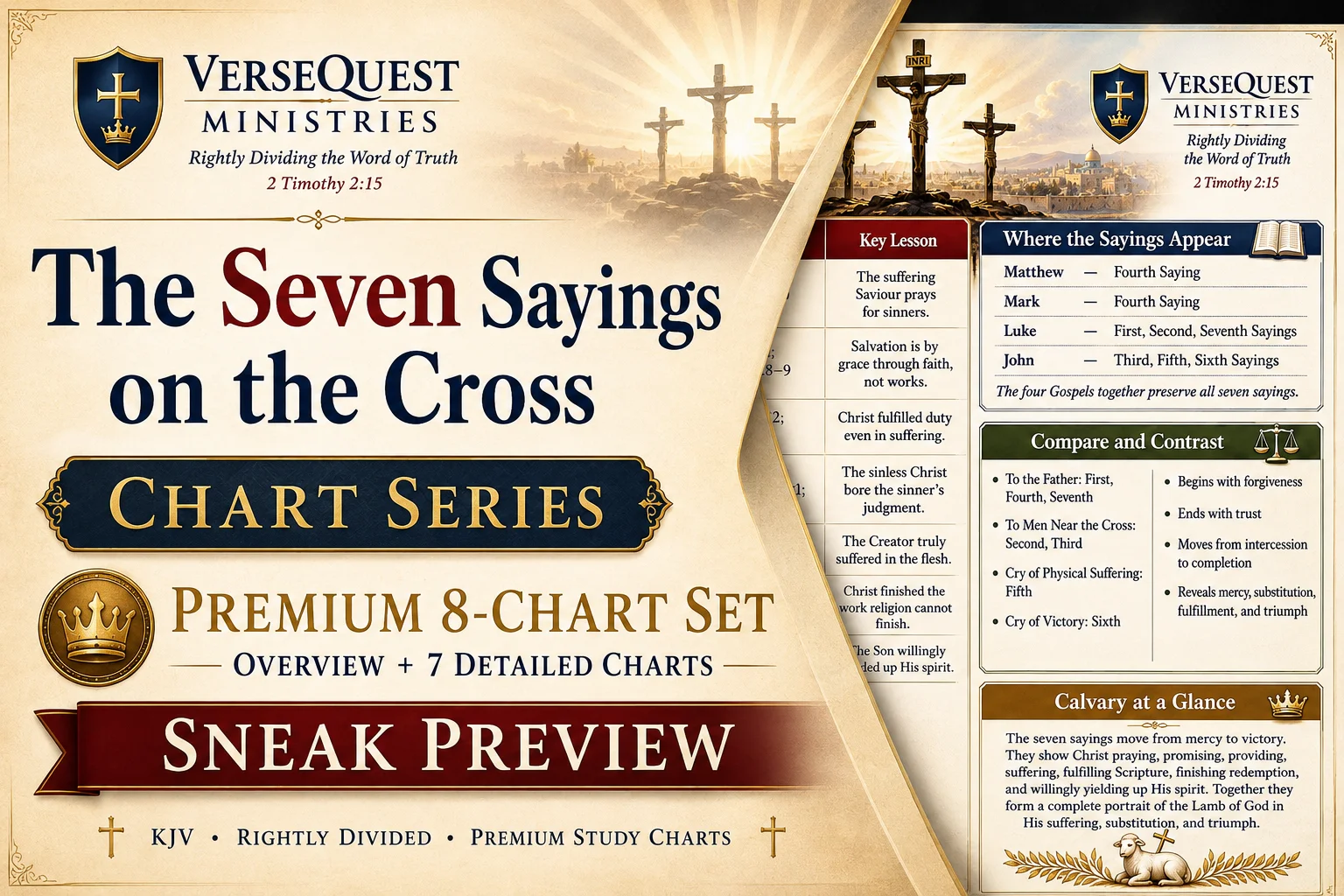
- The Seven Sayings on the Cross – Premium 8-Chart KJV Study Set
- A premium VerseQuest Ministries digital PDF study set on The Seven Sayings on the Cross, featuring an overview chart plus seven detailed KJV Bible study charts. This resource examines Calvary,…
- $12.99
- Add to cart
-
-
Bible Prophecy Charts
-
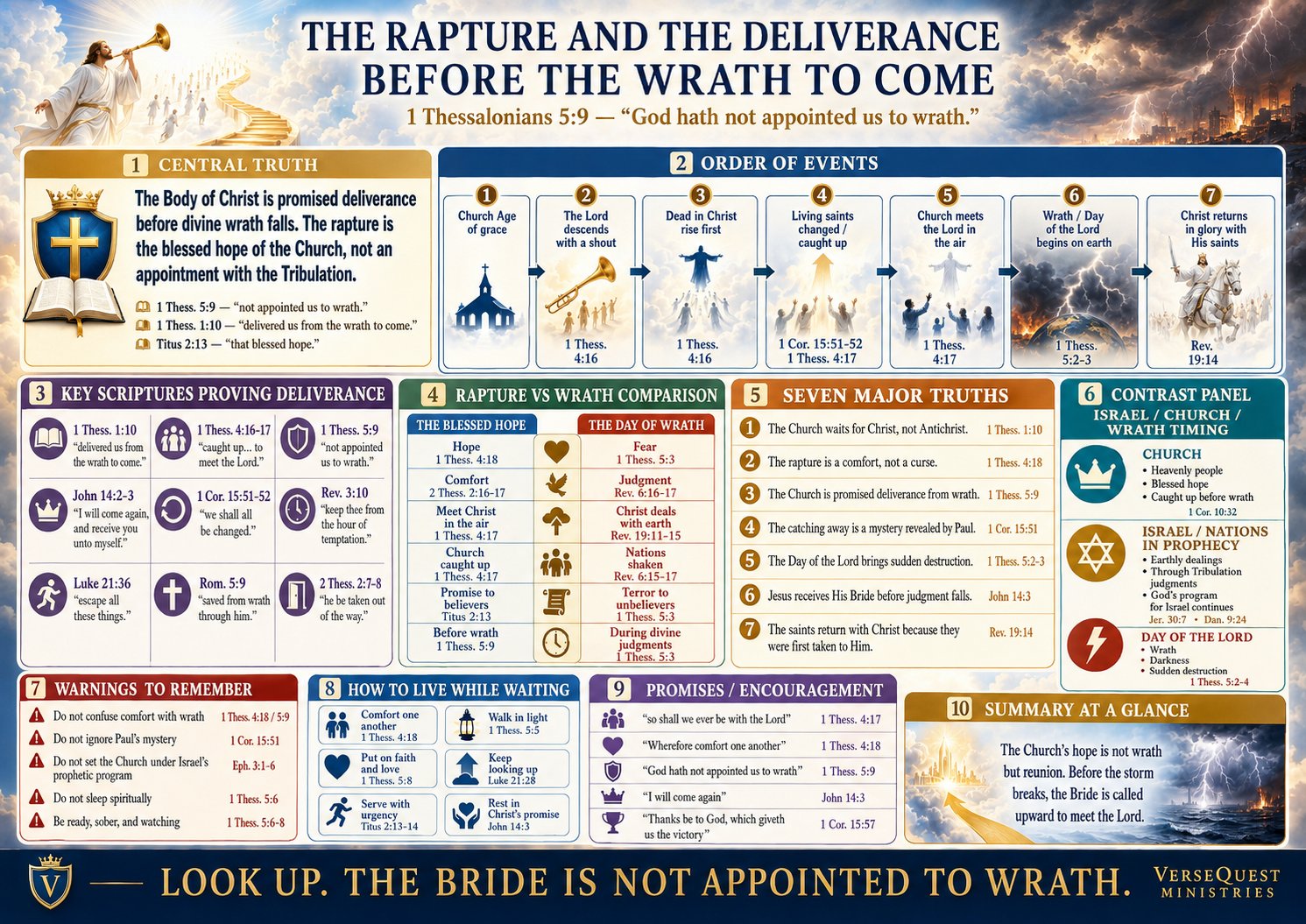
- The Rapture and the Deliverance Before the Wrath to Come – Printable Bible Study Chart
- Printable KJV Bible study chart on The Rapture and the Deliverance Before the Wrath to Come, showing from 1 Thessalonians 5:9 that the Church is not appointed to wrath. This…
- $4.99
- Add to cart
-
-
The Rapture
-
-67%
- Caught Up Before the Wrath – 66-Essay KJV Rapture Study
- Caught Up Before the Wrath is a 430-page premium KJV Bible study defending the pre-tribulation Rapture of the Church from a rightly divided, dispensational perspective. This 66-essay VerseQuest Ministries book…
- Original price was: $29.99.$9.99Current price is: $9.99.
- Add to cart
-
-67%
-
KJV Bible Study Resources
-
-60%
- Practical Christianity for Daily Battles – 329-Page KJV Study PDF
- A premium 329-page KJV study PDF with 40 full essays applying sound, rightly divided Bible doctrine to real daily Christian battles. Topics include temptation, anxiety, marriage, parenting, pornography, grief, church…
- Original price was: $24.99.$9.99Current price is: $9.99.
- Add to cart
-
-60%