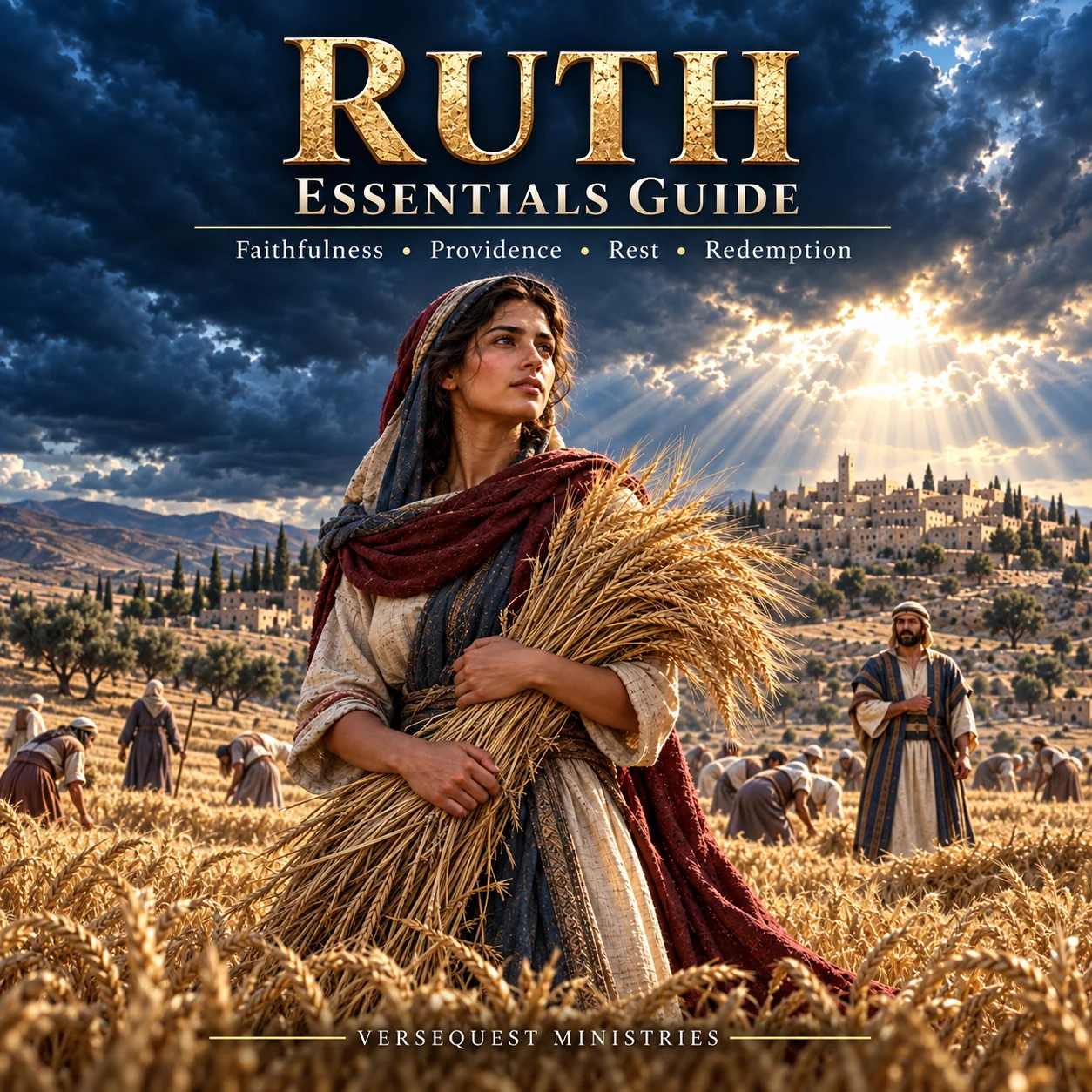
Ruth Essentials Guide — 84-Page KJV Bible Study PDF
The Ruth Essentials Guide is an 84-page downloadable and printable KJV Bible study created for beginners, growing Christians, teachers, and anyone who wants the essential truths of Ruth in one organized resource.
The guide includes the complete key passages, clear explanations, chapter studies, doctrinal observations, review questions, teaching points, and spaces for personal notes. It examines Ruth’s faithfulness, God’s providence, Boaz as the kinsman-redeemer, Naomi’s restoration, the legal redemption at the city gate, and Ruth’s place in the line of David and Jesus Christ.
This professionally designed guide provides a substantial foundation without requiring the reader to begin with a lengthy commentary. Price: $14.99.
$14.99
Description
The Ruth Essentials Guide is a professionally designed, 84-page downloadable and printable PDF that provides a clear, substantial, and beginner-friendly study of one of the most beautiful books in the King James Bible. It is written for new believers, growing Christians, Bible students, teachers, families, and anyone who wants to understand Ruth without first working through a lengthy commentary.
The Book of Ruth is much more than a moving account of loyalty and marriage. Set during the troubled period of the judges, it begins with famine, departure, death, and emptiness but ends with provision, redemption, a restored family, and the royal ancestry of David. This guide follows that entire movement carefully, helping the reader understand how God’s providence works through ordinary decisions, difficult circumstances, faithful obedience, and the responsibilities established in His law.
All four chapters of Ruth are covered, with the important King James Bible passages printed directly in the guide. Readers do not have to interrupt their study continually to search for the verses being discussed. Each lesson combines Scripture with plain explanations, key observations, memorable teaching points, review questions, doctrinal distinctions, practical applications, and dedicated space for personal notes.
The guide examines Ruth’s departure from Moab, her commitment to Naomi and the God of Israel, her arrival in Bethlehem, and her faithful labor in the field of Boaz. It explains the law of gleaning, the meaning of the harvest setting, the significance of Ruth finding favor, Naomi’s instructions concerning rest, the proceedings at the city gate, and the legal responsibilities of the kinsman-redeemer. It also follows Naomi’s movement from bitterness and emptiness to restoration and fulness.
Special attention is given to Boaz as a picture of the Lord Jesus Christ. Boaz possesses the relationship, resources, willingness, and legal ability required to redeem. The guide carefully distinguishes the historical events involving Israel from their typological and practical applications. Ruth’s reception into the covenant people and her place in the Messianic genealogy are presented without confusing Israel with the Church or replacing the literal meaning of the passage.
Readers will also explore the nearer kinsman, the significance of the public transaction at the gate, the removal of the shoe, the connection between Ruth and the virtuous woman of Proverbs 31, and the genealogy extending from Pharez to David. These studies reveal how this short Old Testament book connects the period of the judges with the coming kingdom and ultimately points forward to the Lord Jesus Christ.
The Ruth Essentials Guide is concise enough to remain approachable but detailed enough to serve as a dependable foundation. It can be used for personal study, discipleship, Sunday school, family Bible reading, small-group discussion, sermon preparation, classroom instruction, or as a quick-reference resource. It is especially useful for someone reading Ruth seriously for the first time or preparing to advance into a more detailed chapter-by-chapter or verse-by-verse study.
Faithfulness during spiritual decline — Ruth demonstrates personal faith and loyalty during the unstable period of the judges. Consequences of leaving the appointed place — Elimelech’s departure from Bethlehem introduces loss, death, and displacement. Repentance and return — Naomi turns back toward Bethlehem after hearing that the Lord has visited His people. Ruth’s commitment to Israel’s God — Ruth leaves Moab and identifies herself with Naomi, Israel, and the Lord. Providence in ordinary circumstances — Ruth’s arrival in the field of Boaz appears accidental from the human viewpoint but advances God’s purpose. The biblical law of gleaning — God’s law combines provision for the needy with opportunity for willing labor. Grace beyond legal obligation — Boaz fulfills the law while extending protection and generosity beyond its minimum requirements. The character of Boaz — Boaz is wealthy, honorable, compassionate, discerning, responsible, and willing to redeem. Ruth as a virtuous woman — Her reputation is established through faithfulness, humility, labor, purity, and obedience. Naomi’s emptiness and restoration — God changes her story from bereavement and bitterness to family, hope, and fulness. The kinsman-redeemer — Redemption requires relationship, resources, legal right, and willingness. The nearer kinsman — The unnamed relative possesses a prior claim but cannot complete the redemption without harming his own inheritance. Rest through redemption — Naomi seeks rest for Ruth, and that rest is secured through the actions of the redeemer. The city gate and lawful redemption — Boaz conducts the matter publicly, honestly, and according to the established order. Boaz as a type of Christ — His ability, willingness, kindness, and completed work provide a powerful picture of the Lord Jesus Christ. Israel and the Church rightly distinguished — The historical account belongs to Israel, while its typology and spiritual applications must be handled without replacement theology. From Moab to the royal line — Ruth’s history demonstrates how divine grace can bring an outsider into a place of remarkable blessing. The genealogy of David — Ruth forms an essential bridge between the judges and Israel’s coming monarchy. The Messianic line — The book ultimately contributes to the Scriptural record leading to Jesus Christ. God working through quiet obedience — Ruth contains no spectacular military deliverance, yet God’s hand directs every major development.
The central movement of Ruth is from emptiness to fulness through the providential work of God and the lawful work of a willing redeemer. The book begins with famine in Bethlehem, the “house of bread,” and with a family leaving the land of Israel for Moab. It ends in Bethlehem with harvest, marriage, a child, a restored household, and a genealogy leading to David. This deliberate contrast provides one of the book’s most memorable teaching structures.
Ruth’s declaration in Ruth 1 is more than an emotional expression of loyalty to Naomi. She chooses Naomi’s people, land, journey, and God. Her faith then becomes visible through consistent conduct. She labors, listens, obeys, maintains a good reputation, and treats Naomi faithfully. The Book of Ruth therefore presents faith as something that produces observable loyalty and action.
The statement that Ruth’s “hap” was to light upon the field of Boaz demonstrates providence without requiring a visible miracle. God’s hand may be active even when the circumstances appear ordinary. Ruth enters a field, meets a landowner, receives protection, and returns with grain. Those ordinary events become the means through which the Lord preserves a family line of enormous biblical importance.
Boaz does not merely feel compassion toward Ruth. He acts with knowledge, integrity, generosity, and respect for God’s order. He protects Ruth from danger, commands his servants to assist her, gives her food, provides additional grain, acknowledges her faith, and later accepts the responsibility of redemption. His kindness is never separated from righteousness.
The kinsman-redeemer must possess the proper relationship, the ability to redeem, the willingness to act, and the legal right to complete the transaction. Boaz fulfills these requirements. The nearer kinsman has the first opportunity but refuses when the complete responsibility threatens his own inheritance. Boaz then completes the transaction publicly before witnesses.
Boaz provides a powerful picture of Jesus Christ, but the type should be handled carefully. Ruth remains a historical book about real people within Israel’s national history. Its typology does not erase Israel or transfer every promise directly to the Church. The sound approach is to believe the history first, preserve its doctrinal setting, and then recognize the spiritual picture God has placed within it.
Ruth’s request that Boaz spread his skirt over her is an appeal for covenant protection and redemption, not an immoral advance. Both Ruth and Boaz act honorably. The scene emphasizes submission, responsibility, purity, and the willingness of the redeemer to act.
Naomi’s instruction to “sit still” teaches one of the book’s strongest practical lessons. Ruth has obeyed what she was told to do, but the completion of redemption belongs to Boaz. Once the matter is placed in the redeemer’s hands, he does not rest until it is finished. This provides a memorable picture of confidence in a completed work.
The public transaction at the city gate demonstrates that biblical redemption has a lawful foundation. Boaz does not seize what he wants or ignore the nearer relative. He settles the matter openly, calls witnesses, accepts the full cost, and preserves the name and inheritance of the dead.
The concluding genealogy is not an appendix without purpose. It reveals that God was preserving the line of David throughout the events of this quiet domestic story. The Lord’s work in Ruth reaches beyond one widow, one marriage, and one generation. It leads toward Israel’s king and ultimately toward the Lord Jesus Christ.
Subjects worthy of further study include the history of Moab, the law of gleaning, the meaning of the shoe in legal transactions, the distinction between land redemption and family responsibility, the relationship between Ruth and Proverbs 31, the genealogy of Pharez, and the appearance of Ruth in Matthew’s account of Christ’s lineage.
A useful summary of Ruth is: faith leaves Moab, providence guides the field, grace provides at the harvest, obedience seeks the redeemer, redemption is settled at the gate, and God turns emptiness into fulness.
For personal Bible study, the guide can be followed from beginning to end as an organized introduction to Ruth. The printed KJV passages, explanations, review questions, and note areas allow readers to study without requiring a separate collection of reference books.
For discipleship, it teaches foundational lessons concerning faithfulness, wise choices, work, purity, obedience, providence, redemption, and trust in God. Its approachable structure makes it suitable for new believers who may be unfamiliar with Old Testament history and customs.
Pastors, preachers, and Sunday school teachers can use the lesson divisions, doctrinal observations, typological studies, and teaching questions to develop sermons or classroom lessons. The special studies on Boaz, the nearer kinsman, the city gate, and the Messianic genealogy provide ready starting points for deeper instruction.
Families and small groups can read the printed passages together, review the explanations, discuss the questions, and record observations in the provided note spaces. The guide’s four-part movement makes Ruth especially suitable for a short group study.
Bible instructors can also use the resource to explain how to recognize types of Christ without replacing the historical meaning of the passage. It demonstrates how practical application, doctrinal truth, historical context, and prophetic significance can be studied together while maintaining proper biblical distinctions.
The King James Bible for continued reading and comparison of every referenced passage.
A complete KJV concordance for tracing redemption, redeem, kinsman, rest, gleaning, inheritance, widow, and stranger.
A Bible dictionary for studying ancient harvesting, marriage, inheritance, city-gate proceedings, and family customs.
A cross-reference Bible for following the lines of Pharez, Boaz, Obed, Jesse, David, and Jesus Christ.
A Bible map showing Moab, Bethlehem, the Dead Sea region, and the journey Ruth and Naomi undertook.
A timeline of the judges, Ruth, Samuel, Saul, and David.
A chart comparing the qualifications of Boaz with the redeeming work of Jesus Christ.
The Judges Essentials Guide for understanding the historical and spiritual conditions surrounding Ruth.
The Joshua Essentials Guide for studying Israel’s entrance into the land before the period of the judges.
Ruth Rightly Divided for readers who want to proceed into a more extensive study of the book.
Related products
-
Bible Overview Series
-

- The New Jerusalem Made Plain — 621-Page PDF Study
- The New Jerusalem Made Plain is a massive 621-page KJV/rightly divided PDF study on the literal holy city revealed in Revelation 21–22. This 100-essay book makes the New Jerusalem plain…
- $34.99
- Add to cart
-
-
KJV Bible Study Resources
-
-60%

- Practical Christianity for Daily Battles – 329-Page KJV Study PDF
- A premium 329-page KJV study PDF with 40 full essays applying sound, rightly divided Bible doctrine to real daily Christian battles. Topics include temptation, anxiety, marriage, parenting, pornography, grief, church…
- Original price was: $24.99.$9.99Current price is: $9.99.
- Add to cart
-
-60%
-
KJV Studies
-
-67%
- The Blood of Christ – 66-Study KJV Bible Doctrine PDF
- A 441-page premium VerseQuest PDF featuring 66 detailed KJV Bible studies on the blood of Jesus Christ. This powerful doctrinal resource covers redemption, justification, propitiation, cleansing, access to God, eternal…
- Original price was: $29.99.$9.99Current price is: $9.99.
- Add to cart
-
-67%
-
Doctrine Series
-
Prophecy Studies
-

- The Resurrection of Jesus Christ Made Plain – 501-Page KJV Bible Study
- A massive 501-page VerseQuest Ministries PDF Bible study defending and explaining the bodily resurrection of Jesus Christ from a KJV, rightly divided perspective. This 80-essay study covers the empty tomb,…
- $34.99
- Add to cart
-