
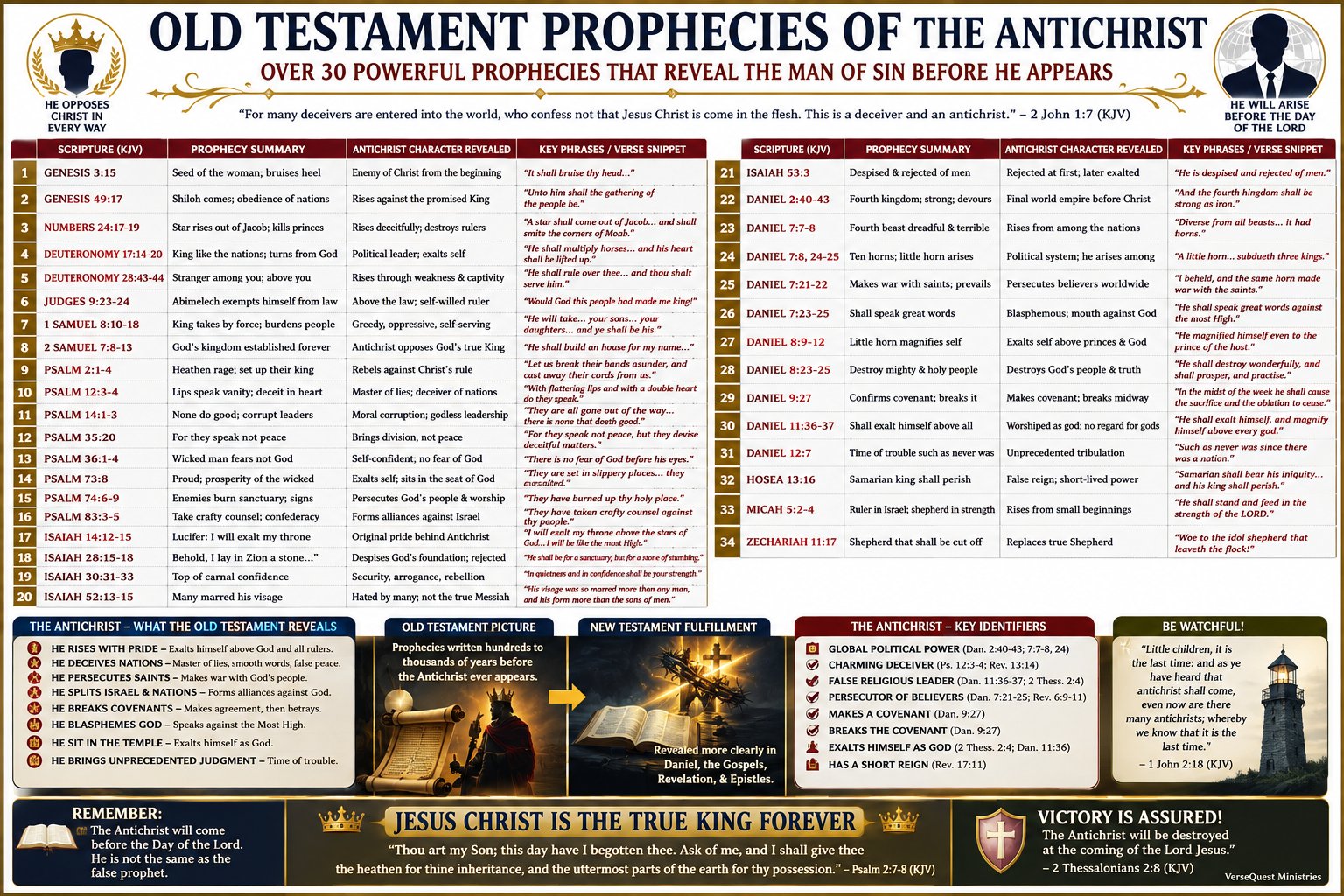
Old Testament Prophecies of the Antichrist – Over 30 Biblical Passages Revealing the Coming Man of Sin (KJV Bible Study Chart)
Study more than thirty Old Testament prophecies, patterns, and foreshadowings of the Antichrist with this detailed KJV chart covering the little horn, final world empire, false covenant, persecution, blasphemy, Tribulation, and Christ’s certain victory.
$3.99
Description
Old Testament Prophecies of the Antichrist is a detailed KJV Bible study chart tracing more than thirty prophecies, prophetic patterns, historical types, and doctrinal foreshadowings that reveal the character, career, kingdom, deception, persecution, blasphemy, covenant-breaking, and final destruction of the coming Antichrist.
Built around major passages from Genesis, Numbers, Deuteronomy, Judges, Samuel, Psalms, Isaiah, Daniel, Hosea, Micah, and Zechariah, this chart demonstrates that the Antichrist does not suddenly appear in the New Testament without an Old Testament foundation. His character and coming activity are progressively revealed throughout Scripture long before he is identified in the epistles and Revelation as the man of sin, the son of perdition, the beast, the wicked one, and the final enemy of Jesus Christ.
The chart carefully brings together direct predictive prophecy, prophetic descriptions of wicked rulers, historical types such as Abimelech, and patterns of rebellion that reach their ultimate expression in the final Antichrist. Not every passage carries the same degree of directness, but together they form a consistent biblical portrait of the counterfeit king who will arise before the Day of the Lord.
The Antichrist is not merely a symbol of general evil, an impersonal political philosophy, or every disagreeable ruler in history. Scripture presents a real future individual who will rise to power, deceive nations, oppose Israel, persecute saints, blaspheme God, exalt himself above all authority, enter into a covenant, break that covenant, desecrate the holy place, and finally be destroyed by the Lord Jesus Christ.
The chart begins with Genesis 3:15, where God announces the conflict between the seed of the woman and the seed of the serpent. The passage ultimately points to Jesus Christ’s victory over Satan, but it also establishes the warfare that runs through the entire Bible. The Antichrist stands as the final earthly political and religious expression of the serpent’s opposition to the promised Seed.
From the beginning, Satan has attempted to corrupt, counterfeit, persecute, and destroy the line through which the promised King would come. The Antichrist will represent the culmination of that opposition, placing himself against Christ’s rightful authority while imitating aspects of messianic rule.
Genesis 49:17 describes Dan as a serpent by the way and an adder in the path that bites the horse’s heels. This passage has long been examined in discussions concerning serpent imagery, betrayal, and possible tribal associations connected with the coming deceiver. It should be handled carefully, but it contributes to the chart’s wider study of the serpent-like character associated with opposition to God’s King.
Numbers 24:17–19 foretells a Star coming out of Jacob and a Sceptre rising out of Israel. This prophecy concerns the triumphant Messiah, but it also speaks of rulers and enemies being smitten before Him. The true King will destroy every counterfeit claimant, including the final ruler who opposes His dominion.
The Antichrist can be understood only by contrast with Jesus Christ. Christ is the promised Star, Sceptre, Shepherd, Prince, Son of David, and righteous King. The Antichrist is the counterfeit ruler who seeks the crown while opposing the One to whom the crown belongs.
Deuteronomy 17:14–20 gives God’s standards for Israel’s king. The king was not to multiply horses, wives, silver, or gold, and he was commanded to remain humble beneath the written law of God. The Antichrist will embody the opposite spirit: self-exaltation, lawlessness, accumulation of power, disregard for Scripture, and rule centred upon himself.
Deuteronomy 28:43–44 warns Israel of the stranger rising above the nation while Israel sinks beneath judgment. Within its immediate covenant context, the passage concerns the consequences of Israel’s disobedience. The larger pattern contributes to the picture of foreign domination and oppressive power that reaches a terrible climax during Israel’s future time of trouble.
The account of Abimelech in Judges 9 provides one of Scripture’s clearest historical pictures of a self-made, murderous usurper. Abimelech rose through manipulation, idolatrous money, family loyalty, hired men, and the slaughter of his brethren.
Jotham compared him to a bramble that promised shade but ultimately produced fire. Abimelech was not the final Antichrist, but his violent rise, false kingship, self-exaltation, oppression, and destruction provide a powerful type of the ruler who seizes authority apart from God.
The chart also draws from Israel’s demand for a king in 1 Samuel 8. Samuel warned that a self-serving king would take sons, daughters, fields, servants, harvests, and wealth for his own purposes.
The Antichrist will present himself as the answer to international disorder, yet his rule will become a devouring system of control. What begins with promises of security will lead to servitude, persecution, economic domination, and worship of the ruler himself.
Second Samuel 7:8–16 establishes God’s covenant with David and the promise of an enduring throne. This prophecy ultimately finds fulfillment in Jesus Christ, the true Son of David.
The Antichrist’s kingdom is therefore a counterfeit rebellion against the Davidic King. He does not merely seek political office; he attempts to occupy the place belonging to Christ and to receive the worship owed to God’s appointed Ruler.
The Psalms provide several major descriptions of the spirit and activity associated with the final wicked ruler. Psalm 2 presents the nations raging, rulers taking counsel, and earthly powers setting themselves against the LORD and His Anointed.
The rebellion seeks to cast away divine authority, but God has already established His King. Psalm 2 does not end with uncertainty concerning the outcome. The Son receives the nations as His inheritance and breaks rebellious power with a rod of iron.
The Antichrist may unite nations against Christ, but his international coalition cannot overturn the decree of God. Human government will finally discover that a confederacy against the Lord is not strength but organized suicide.
Psalm 12 speaks of flattering lips, double hearts, proud speech, and the boast that no lord will rule over the speaker. This language captures the spirit of the coming deceiver: manipulation through speech, freedom from restraint, contempt for divine authority, and confidence in the power of words.
The Antichrist will not rise through military power alone. Daniel and Revelation emphasize his mouth, words, boasts, diplomacy, covenants, and blasphemies. He will conquer minds before he controls nations.
Psalm 14 describes widespread corruption and the denial of God. The Antichrist’s system will not merely oppose certain religious institutions; it will express the final rebellion of fallen humanity against the authority, holiness, and truth of the Creator.
Psalm 35:20 speaks of those who do not speak peace but devise deceitful matters. The Antichrist will appear as a man of solutions, agreements, unity, diplomacy, and peace, yet his agreements conceal betrayal.
His peace is strategic rather than righteous. He uses security as bait, covenant as leverage, and agreement as preparation for domination.
Psalm 36 describes the wicked man as possessing no fear of God before his eyes. Self-flattery prevents him from recognizing his iniquity. This fearlessness before God forms a central feature of Antichrist character.
The final ruler will not merely disobey God privately. He will speak against the Most High, exalt himself above every god, and present himself as the object of worship.
Psalm 73 addresses the temporary prosperity and pride of the wicked. The wicked appear secure, powerful, admired, and untouched by ordinary trouble, but their end is destruction.
The Antichrist’s short reign will seem triumphant. He will possess extraordinary authority, international influence, religious admiration, military power, and economic control. Yet his apparent success will last only until God sets him in slippery places.
Psalm 74 describes enemies roaring within God’s sanctuary and setting up their signs. While the psalm concerns historical devastation, its sanctuary language contributes to the prophetic pattern of desecration and enemy signs associated with the future abomination of desolation.
The final Antichrist will intrude upon holy things, claim divine honours, and transform worship into submission to himself.
Psalm 83 presents a confederacy formed against God’s people. The nations take crafty counsel and seek to remove Israel from national existence.
This passage is important in understanding the enduring hostility directed toward Israel. The Antichrist will exploit alliances, regional hatred, political pressure, and international cooperation as part of his rise and campaign against God’s covenant purposes.
The chart includes Isaiah 14:12–15, where Lucifer declares, “I will ascend,” “I will exalt,” and “I will be like the most High.” The immediate passage exposes the pride behind the king of Babylon while also reaching into the original satanic rebellion.
The Antichrist will reproduce that same pattern on earth. He will not merely serve Satan politically; he will embody Satan’s ancient desire for self-exaltation and worship.
Lucifer’s repeated “I will” becomes the spiritual foundation of the Antichrist’s kingdom. God’s will is replaced by self-will, divine order by rebellion, worship of the Creator by worship of the creature, and truth by a counterfeit throne.
Isaiah 28:15–18 speaks of rulers who have made a covenant with death and an agreement with hell, only to have their refuge of lies swept away. The passage directly addresses the rulers of Jerusalem in Isaiah’s context, yet its language powerfully foreshadows false security, deceptive covenants, and trust in arrangements that cannot withstand divine judgment.
Israel’s final danger will not be merely the hostility of declared enemies. It will include misplaced confidence in a false protector whose covenant promises conceal destruction.
Isaiah 30:31–33 describes judgment upon Assyria and Tophet prepared for the king. Assyria and its rulers frequently function as prophetic patterns of oppressive Gentile power against Israel.
The Assyrian pattern—military arrogance, blasphemy, invasion, opposition to Jerusalem, and sudden divine destruction—provides important background for understanding the final northern and international enemy.
Isaiah 52:13–15 and Isaiah 53:3 belong directly to the suffering and exaltation of Jesus Christ. Their inclusion on the chart serves primarily as contrast. The true Messiah was marred, despised, rejected, and then exalted by God.
The Antichrist follows the opposite moral path. He is initially admired, received, and exalted by men, yet finally rejected and destroyed by God. Jesus Christ humbled Himself and was exalted; the Antichrist exalts himself and is brought down.
The heart of the Old Testament Antichrist portrait is found in Daniel. The book of Daniel supplies the most detailed prophetic foundation for the beast, the little horn, the final empire, the covenant, the abomination, the persecution of saints, and the self-exalting ruler.
Daniel 2:40–43 describes the fourth kingdom as strong as iron, crushing and breaking other powers. Its final stage contains iron mixed with miry clay, producing divided strength and instability.
The Antichrist will arise within the final form of this Gentile world system. His empire will possess immense force, but its unity will be unnatural, brittle, and dependent upon political consolidation.
The image of iron and clay reveals a kingdom that combines strength with internal weakness. The final world order may appear united, but its components do not truly cleave to one another.
Daniel 7:7–8 describes the dreadful fourth beast with iron teeth and ten horns. Among the horns arises a little horn possessing eyes like a man and a mouth speaking great things.
This little horn is one of the clearest Old Testament presentations of the coming Antichrist. He arises from among the final rulers, begins from an apparently smaller position, and expands through intelligence, speech, conquest, and political action.
Daniel 7:8 and 7:24–25 explain that the little horn subdues three kings, speaks great words against the Most High, wears out the saints, and seeks to change times and laws.
The Antichrist will not merely inherit authority peacefully. He will remove rivals and consolidate power. His political rise will involve calculated destruction of competing rulers.
His war against the saints reveals that his rule is religious as well as political. The final empire will demand ideological and spiritual submission, not merely civil cooperation.
His attempt to change times and laws shows the lawless character of his rule. He seeks to reorder reality according to his own authority, replacing God’s standards with an imposed global system.
Daniel 7:21–22 records the horn making war with the saints and prevailing temporarily until the Ancient of Days comes and judgment is given.
The Antichrist’s victories are real but temporary. God permits persecution for a determined period, yet heaven has fixed the end of his authority.
The saints may appear defeated on earth while the Antichrist appears invincible, but the heavenly court has already ruled against him. The final verdict belongs to the Ancient of Days.
Daniel 7:23–25 presents his blasphemous mouth and continuing opposition to God. Words are not a secondary part of his kingdom. His speech reveals his nature.
He will boast, deceive, redefine, accuse, flatter, threaten, and blaspheme. His mouth becomes one of the chief instruments through which he mobilizes nations and demands worship.
Daniel 8:9–12 introduces another little-horn prophecy. The immediate historical setting is strongly connected with the Greek empire and Antiochus Epiphanes, but that ruler’s desecration, persecution, self-magnification, and attack upon the sanctuary provide a major prophetic pattern of the final Antichrist.
Antiochus was not the last fulfillment of Antichrist prophecy. He was a historical preview of the coming ruler who will magnify himself, oppose the Prince, attack truth, and profane holy things.
Daniel 8:23–25 describes a king of fierce countenance who understands dark sentences, possesses mighty power, destroys wonderfully, prospers, practises, destroys the mighty and holy people, and causes craft to prosper through his hand.
Through peace he destroys many. He stands against the Prince of princes but is broken without hand.
This passage supplies several essential Antichrist identifiers. He is intelligent, spiritually dark, politically effective, destructive, deceitful, prosperous, self-exalting, hostile toward God’s people, and ultimately destroyed by divine rather than ordinary human power.
The statement that craft prospers in his hand reveals a kingdom built through calculated deception. The Antichrist will not appear initially as a clumsy monster announcing every evil purpose. He will appear capable, persuasive, strategic, and necessary.
The declaration that “by peace shall destroy many” is especially important. Peace will become one of his weapons. The world will be persuaded that submission brings safety, while resistance threatens stability.
Daniel 9:27 describes a coming prince who confirms a covenant with many for one week and then causes sacrifice and oblation to cease in the midst of the week.
This covenant and its breaking provide a central chronological marker in future prophecy. The agreement begins a defined seven-year period associated with Daniel’s seventieth week.
At the midpoint, the ruler reveals the true nature of his program. The covenant giver becomes the covenant breaker, protection becomes persecution, and promised stability becomes desolation.
The chart identifies this as one of the most important direct prophecies concerning the Antichrist. His career cannot be separated from Israel, the covenant, the restored sacrificial setting, and the abomination connected with the middle of the week.
Daniel 11:36–37 describes a king who does according to his will, exalts and magnifies himself above every god, speaks marvellous things against the God of gods, and prospers until the indignation is accomplished.
This is the biblical portrait of self-will reaching its final political and religious form. He recognizes no authority above himself and ultimately claims the place of God.
His disregard for gods does not mean he is merely secular. He becomes the focus of a counterfeit religious system in which the ruler himself receives worship.
Daniel 12:1 speaks of a time of trouble such as never was since there was a nation. This unprecedented Tribulation is connected with Israel, Michael, resurrection, and the final crisis before deliverance.
The Antichrist’s rise must be understood within this period. His reign belongs to the future time of Jacob’s trouble, not the ordinary course of the present Church Age.
The chart also includes Hosea 13:16, which describes Samaria’s judgment beneath invading power. Its immediate context concerns historical punishment, but the pattern of false rule, violence, and national devastation contributes to the larger prophetic warning concerning rebellion and oppressive kingship.
Micah 5:2–4 directly promises the true Ruler from Bethlehem whose goings forth are from everlasting. Like other Messianic passages in the chart, its chief purpose is contrast.
The Antichrist may arise from political obscurity and appear to answer the world’s desire for leadership, but he cannot match the eternal origin, righteous character, shepherding strength, and divine authority of Jesus Christ.
Christ is the true Shepherd-King who feeds His flock in the strength of the LORD. The Antichrist is the false shepherd who feeds upon the flock.
Zechariah 11:17 warns of the idol shepherd who leaves the flock. His arm and right eye come under judgment.
This passage provides one of the clearest prophetic descriptions of the worthless or false shepherd. He abandons responsibility, exploits the sheep, and stands as the opposite of the Good Shepherd.
Jesus Christ gives His life for the sheep. The Antichrist uses the sheep to preserve his life and increase his power.
The chart summarizes the Old Testament portrait of the Antichrist through several central truths. He rises in pride, deceives nations, persecutes saints, divides Israel and the nations, breaks covenants, blasphemes God, intrudes into the sanctuary, exalts himself as God, and brings unprecedented judgment.
Pride is the root of his rebellion. His career reflects Lucifer’s original desire to ascend and be exalted.
Deception is the method of his rise. He gains influence through diplomacy, intelligence, craft, flattering speech, promises, and solutions to crisis.
Persecution is the fruit of his rule. Those refusing his authority and worship become enemies of the global system.
Covenant-breaking reveals his faithlessness. His promises are useful only until his power is established.
Blasphemy reveals his ultimate identity. He does not merely disagree with biblical religion; he speaks directly against the Most High and demands the honour belonging to God.
The sanctuary crisis reveals his connection with Israel’s prophetic program. He stops sacrifice, desecrates the holy place, and places himself at the centre of worship.
His short reign reveals the limits of satanic power. Revelation later clarifies the forty-two months of his unrestricted beastly authority during the latter half of the Tribulation.
The chart connects these Old Testament foundations with New Testament fulfillment. Paul calls him “that man of sin,” “the son of perdition,” and “that Wicked.”
Second Thessalonians 2 explains that he opposes and exalts himself above all that is called God or worshipped, sits in the Temple of God, and claims to be God.
Revelation presents him as the beast rising from the nations, receiving authority from the dragon, possessing a blasphemous mouth, making war with the saints, demanding worship, and controlling economic participation.
The false prophet supports his religious system through signs, image worship, and the mark of the beast. The Antichrist and false prophet are distinct individuals and should not be confused.
The chart’s key identifiers include global political power, charismatic deception, false religious leadership, persecution of believers, covenant-making, covenant-breaking, self-exaltation as God, and a short final reign.
Yet the chart does not end by glorifying the enemy. The central contrast remains Jesus Christ, the true King forever.
Psalm 2 declares that God has set His King upon His holy hill. The nations belong to the Son, and no counterfeit ruler can steal His inheritance.
The Antichrist will rise before the Day of the Lord, but his rising is not victory. His career moves toward a divinely appointed collision with the Lord Jesus Christ.
Second Thessalonians 2:8 declares that the Lord will consume the Wicked with the spirit of His mouth and destroy him with the brightness of His coming.
Revelation 19 shows the beast and false prophet cast alive into the lake of fire when Jesus Christ returns in glory.
The Antichrist may possess armies, alliances, worshippers, technology, propaganda, wealth, and international control. Christ requires only His appearing.
The chart’s final message is therefore one of watchfulness without fear. Believers should recognize the prophetic pattern, understand the distinction between Christ and the counterfeit, reject deception, hold fast the written Word, and remember that victory is assured.
This resource is ideal for personal Bible study, Antichrist prophecy studies, Daniel classes, Old Testament prophecy surveys, Tribulation teaching, Israel-and-Church distinctions, Second Coming studies, eschatology courses, Sunday school, homeschool Bible curriculum, Bible institutes, pastoral training, sermon preparation, and believers seeking a visual overview of the Old Testament foundation for the coming man of sin.
Old Testament prophecies of the Antichrist, Antichrist in Daniel, man of sin, son of perdition, little horn, beast of Revelation, final world ruler, covenant with Israel, Daniel’s seventieth week, abomination of desolation, persecution of saints, blasphemy against God, false peace, global political power, Antichrist deception, false shepherd, counterfeit king, satanic pride, Tribulation prophecy, Second Coming of Jesus Christ, destruction of the Antichrist
The Old Testament establishes the prophetic foundation for the coming Antichrist long before the New Testament provides his fullest titles and final career.
The chart includes direct predictions, prophetic patterns, historical types, and passages that reveal the contrast between God’s true King and the final counterfeit.
Not every listed passage should be treated as equally direct. Daniel contains the clearest predictive material, while other passages supply patterns of pride, tyranny, deception, covenant-breaking, persecution, and false kingship.
Genesis 3:15 establishes the conflict between the seed of the woman and the serpent’s seed. The Antichrist belongs to the final earthly expression of satanic opposition to Christ.
Messianic prophecies help identify the Antichrist by contrast. Jesus Christ is the true King, Shepherd, Sceptre, Son of David, and Ruler from Bethlehem.
The Antichrist seeks the position belonging to Christ but possesses the opposite character.
Deuteronomy’s standards for Israel’s king expose the Antichrist’s self-exaltation, lawlessness, accumulation of power, and contempt for divine restraint.
Abimelech in Judges 9 is a major historical type of the murderous usurper who rises through corrupt money, manipulation, and bloodshed.
Israel’s demand for a self-serving king provides a pattern of oppressive government that takes from the people for the ruler’s benefit.
Psalm 2 reveals the international rebellion against the LORD and His Anointed.
The nations’ conspiracy cannot defeat the Son whom God has appointed as King.
The flattering lips and proud speech of Psalm 12 help illustrate the Antichrist’s use of deception and language.
Psalm 36’s wicked man possesses no fear of God, a central characteristic of the final blasphemous ruler.
Psalm 73 shows that wicked prosperity is temporary and ends beneath divine judgment.
Psalm 74’s sanctuary imagery contributes to the pattern of desecration fulfilled in the abomination of desolation.
Psalm 83 describes a confederacy formed against Israel and demonstrates the continuing connection between prophecy, international alliances, and hatred of God’s covenant people.
Isaiah 14 exposes the satanic pride behind the Antichrist: ascent, self-exaltation, throne-seeking, and desire to be like the Most High.
Isaiah 28 warns against false covenants and refuges of lies that cannot protect from judgment.
Assyria and its rulers frequently provide historical patterns of arrogant Gentile power opposing Israel.
Daniel 2 identifies the final form of Gentile imperial power through the image’s iron-and-clay feet and toes.
Daniel 7 presents the ten horns and the little horn arising among them.
The little horn removes three rulers, possesses extraordinary intelligence, and speaks great words.
He makes war against the saints and prevails temporarily.
His authority continues only until the Ancient of Days intervenes and the Kingdom is given according to God’s decree.
Daniel 8 uses Antiochus Epiphanes as an important historical pattern of the final Antichrist.
The fierce king prospers through deception, attacks truth, destroys holy people, and stands against the Prince of princes.
The Antichrist’s craft and diplomacy are as important to his rise as military power.
The statement “by peace shall destroy many” reveals that promised security becomes an instrument of conquest.
Daniel 9:27 connects the Antichrist with a seven-year covenant and its breaking at the midpoint.
The cessation of sacrifice and the abomination belong within Israel’s future prophetic setting.
Daniel 11:36–37 reveals the self-willed king magnifying himself above every god.
His self-exaltation reaches its ultimate form when he claims divine honours.
Daniel 12 connects the final crisis with Israel’s unprecedented time of trouble.
The Tribulation is not identical to the present Church Age and should be interpreted within Israel’s prophetic program.
Zechariah’s idol shepherd presents the opposite of Jesus Christ, the Good Shepherd.
The false shepherd abandons and exploits the flock; Christ gives His life for the sheep.
The New Testament identifies the final ruler as the Antichrist, man of sin, son of perdition, Wicked, and beast.
The Antichrist is distinct from the false prophet, although the false prophet promotes his worship and kingdom.
The Antichrist’s central characteristics include pride, deception, persecution, blasphemy, covenant-breaking, global authority, and self-deification.
His reign is powerful but short.
The Rapture of the Church, the rise of the Antichrist, Daniel’s seventieth week, the abomination, the Great Tribulation, and the Second Coming must be kept in their proper order.
The Antichrist is destroyed by Jesus Christ at His glorious appearing, not by gradual human political reform.
Prophecy should produce vigilance, doctrinal stability, courage, and confidence in Christ rather than sensational panic.
The final focus belongs to Jesus Christ. The counterfeit ruler passes away, but the true King reigns forever.
Antichrist Bible studies, Old Testament prophecy surveys, Daniel 2 and Daniel 7 teaching, Daniel 8 little-horn studies, Daniel 9:27 covenant lessons, Daniel 11 instruction, Tribulation prophecy, man-of-sin studies, Israel’s future, abomination-of-desolation teaching, false-messiah warnings, comparing Christ and Antichrist, Second Coming studies, Revelation classes, eschatology courses, Sunday school lessons, homeschool Bible curriculum, Bible institute instruction, pastoral training, sermon preparation
King James Bible, Strong’s Concordance, Thompson Chain-Reference Bible, Treasury of Scripture Knowledge, Nave’s Topical Bible, Bible atlas of ancient empires, Daniel prophecy timelines, Daniel 2 image charts, Daniel 7 beast comparisons, Daniel 9 seventy-weeks studies, Tribulation timelines, Antichrist character studies, Israel-and-Church comparison charts, Rapture-versus-Second-Coming resources, Revelation 13 study notes, Second Thessalonians 2 commentary materials, VerseQuest prophecy and right-division charts
Related products
-
The Rapture
-
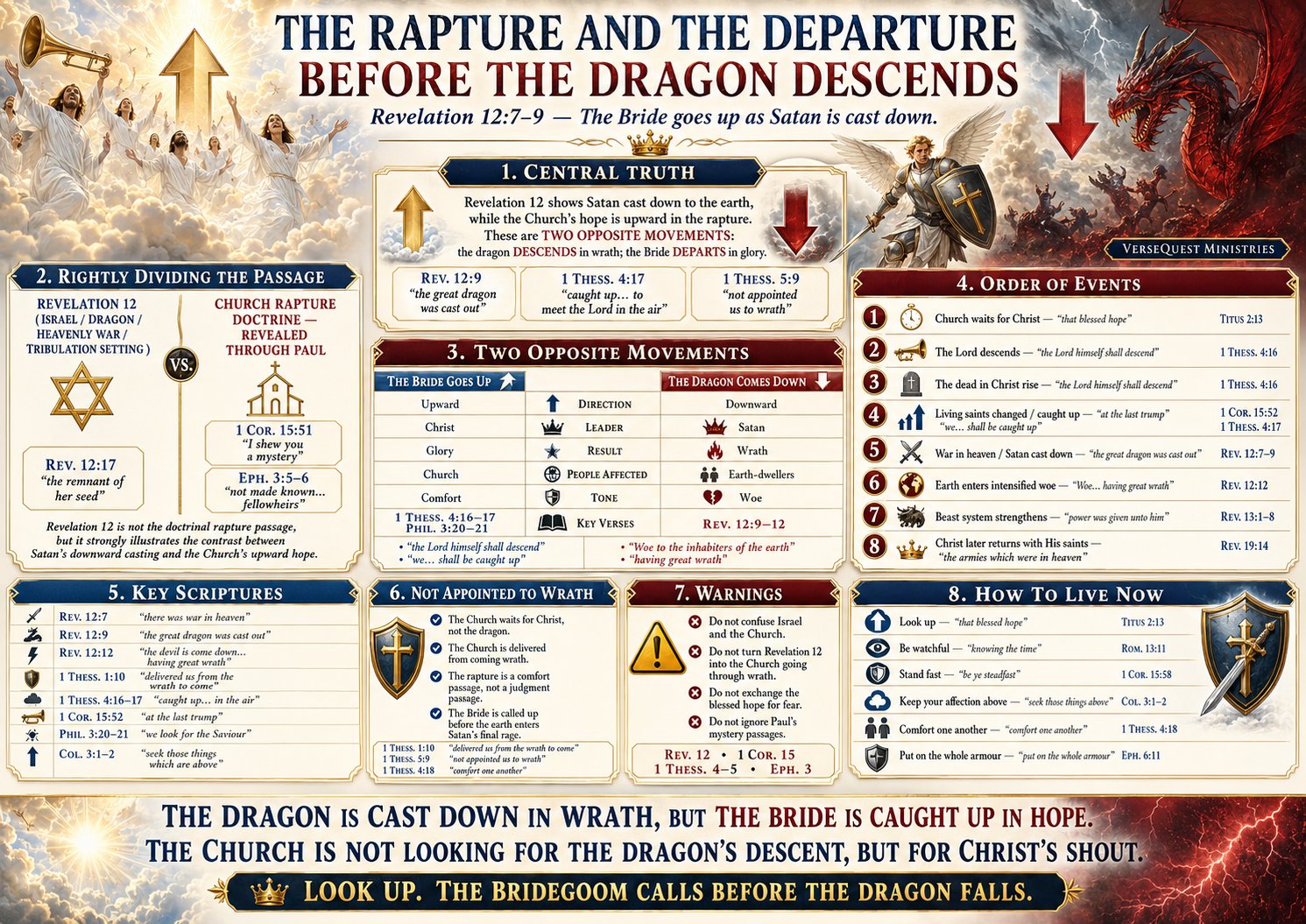
- The Rapture and the Departure Before the Dragon Descends – Printable Bible Study Chart
- Printable KJV Bible study chart on The Rapture and the Departure Before the Dragon Descends, showing the Bride caught up before Satan is cast down in wrath. This premium VerseQuest…
- $4.99
- Add to cart
-
-
Heaven
-
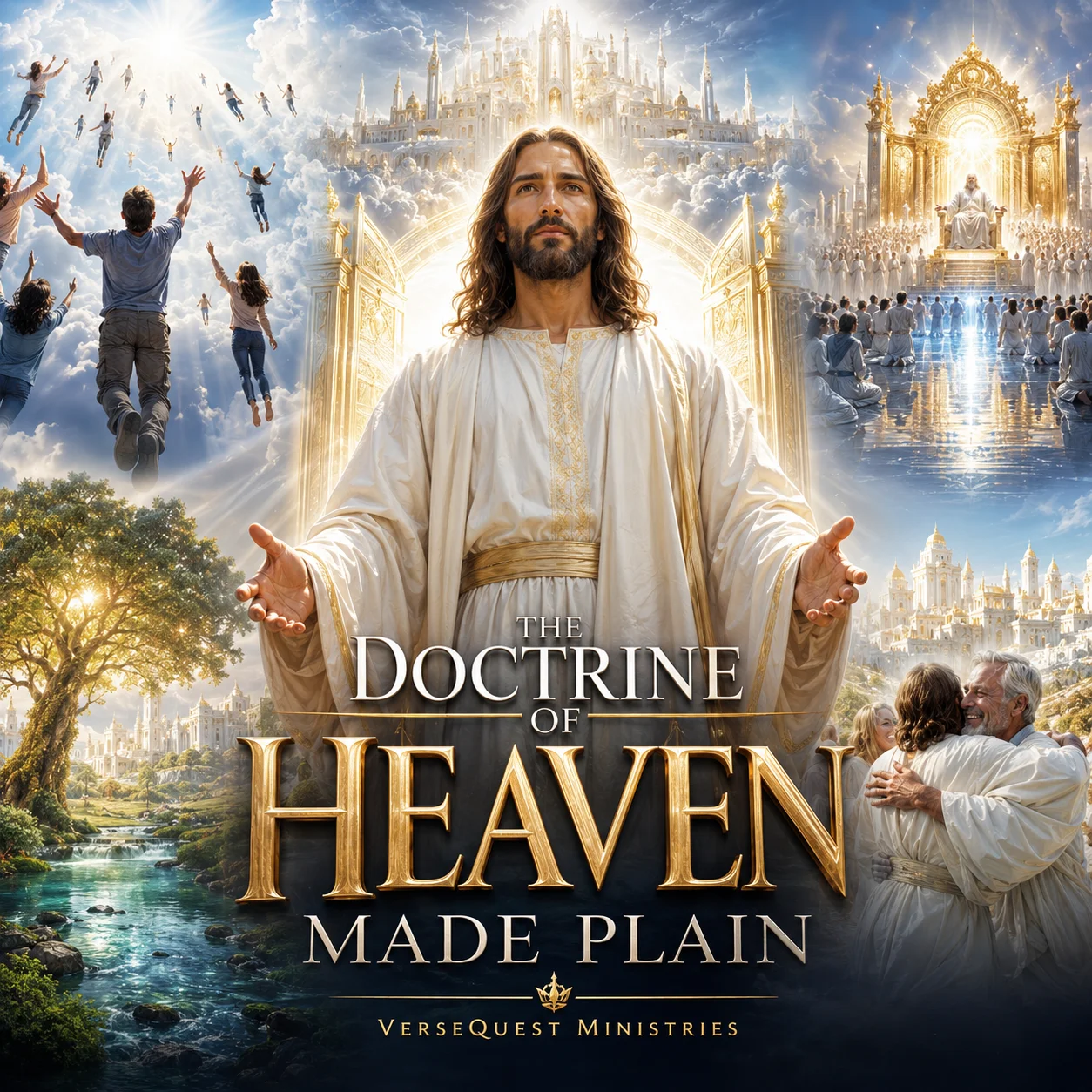
- The Doctrine of Heaven Made Plain — 599-Page KJV Bible Study PDF
- A massive 599-page KJV, rightly divided study on heaven, covering the present heaven, resurrection body, Rapture, Millennium, New Jerusalem, eternal state, hard questions, funeral lies, and cult errors.
- $34.99
- Add to cart
-
-
Bible Overview Series
-
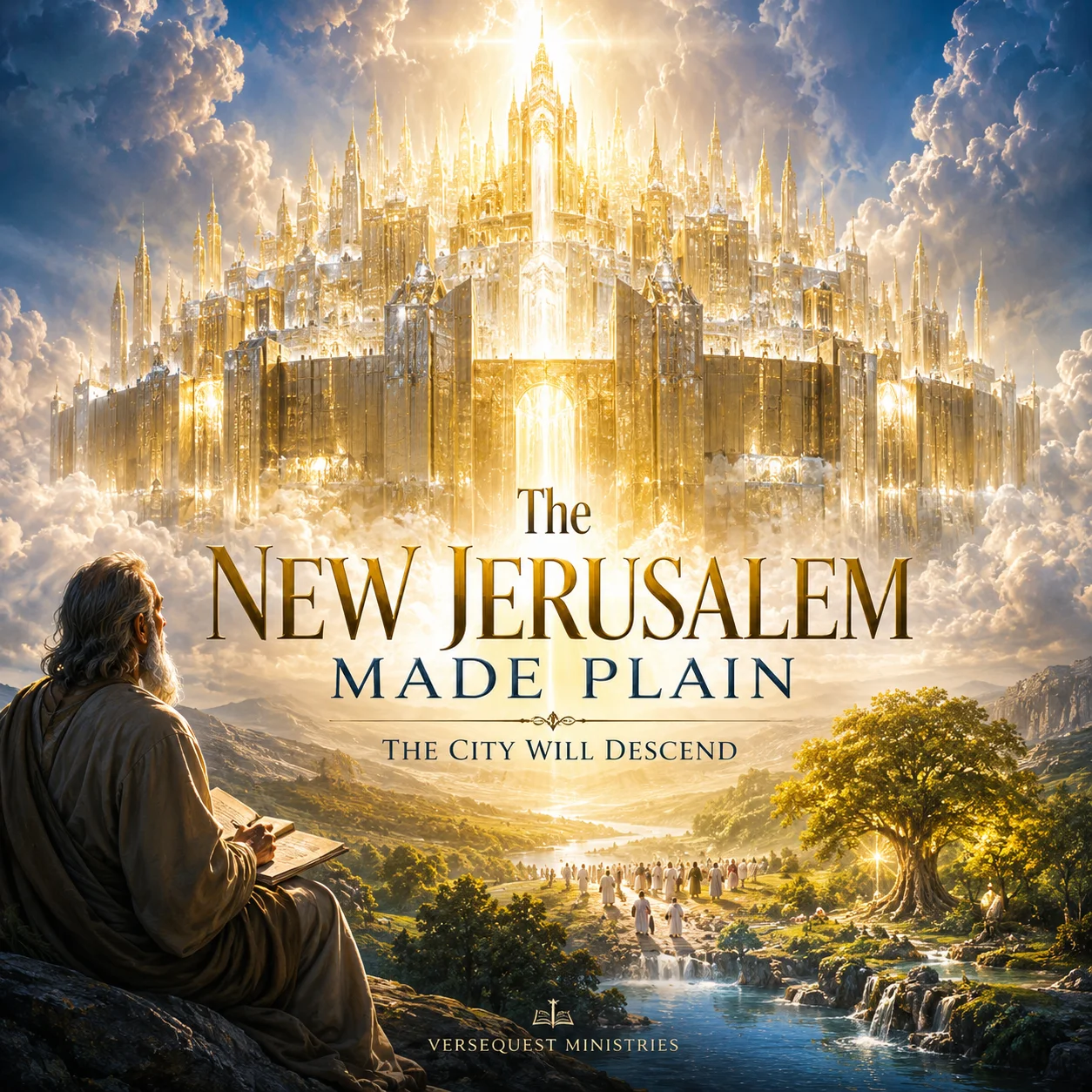
- The New Jerusalem Made Plain — 621-Page PDF Study
- The New Jerusalem Made Plain is a massive 621-page KJV/rightly divided PDF study on the literal holy city revealed in Revelation 21–22. This 100-essay book makes the New Jerusalem plain…
- $34.99
- Add to cart
-
-
Jesus Christ / Christology
-
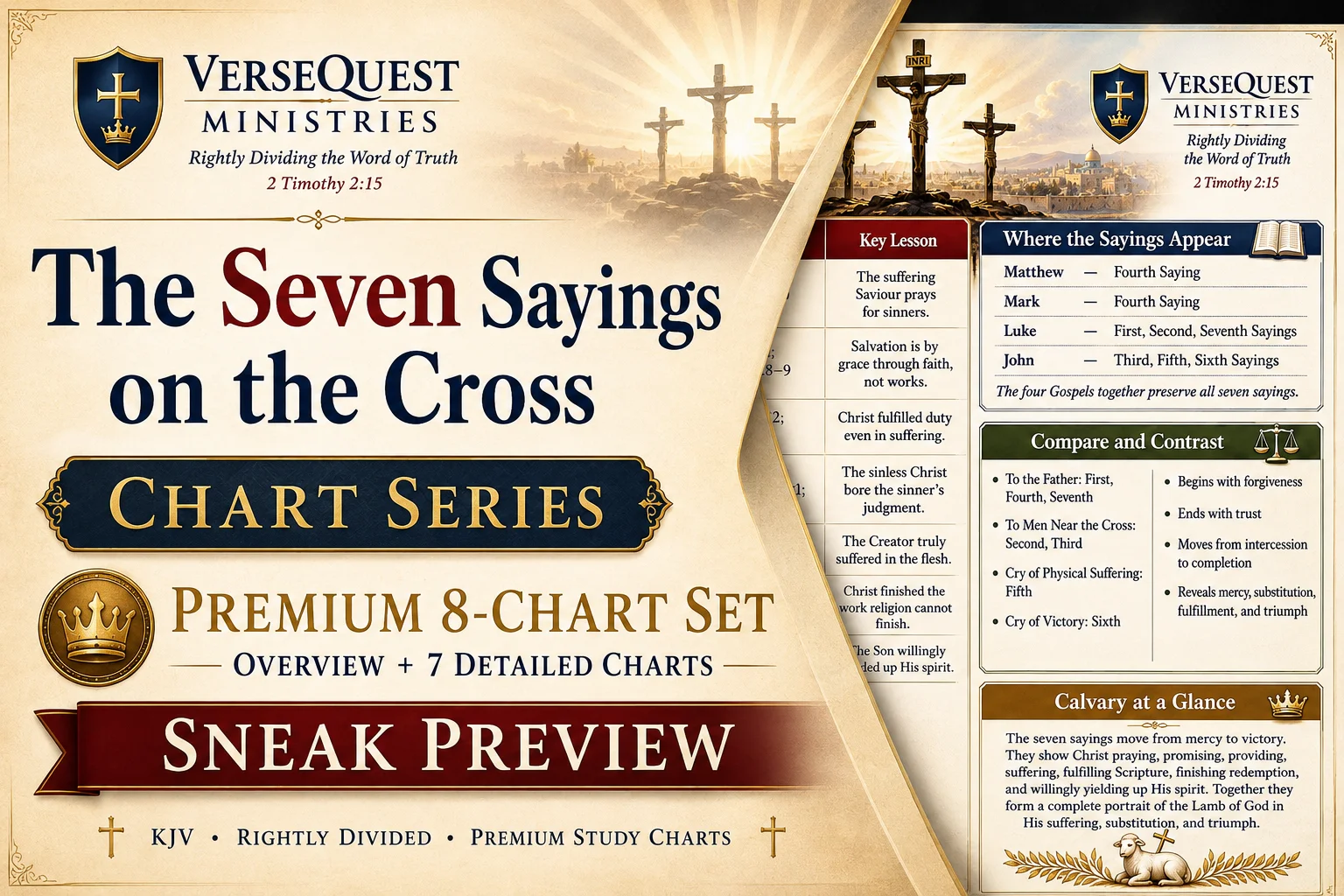
- The Seven Sayings on the Cross – Premium 8-Chart KJV Study Set
- A premium VerseQuest Ministries digital PDF study set on The Seven Sayings on the Cross, featuring an overview chart plus seven detailed KJV Bible study charts. This resource examines Calvary,…
- $12.99
- Add to cart
-
-
Jesus Christ
-
-67%
- The Millennium Made Plain – 416-Page KJV Study on Christ’s Future Reign
- A premium 416-page KJV, rightly divided Bible study on the literal future Millennial reign of Jesus Christ. The Millennium Made Plain explains Revelation 19–20, Israel’s restoration, Satan’s binding, the Kingdom…
- Original price was: $29.99.$9.99Current price is: $9.99.
- Add to cart
-
-67%