
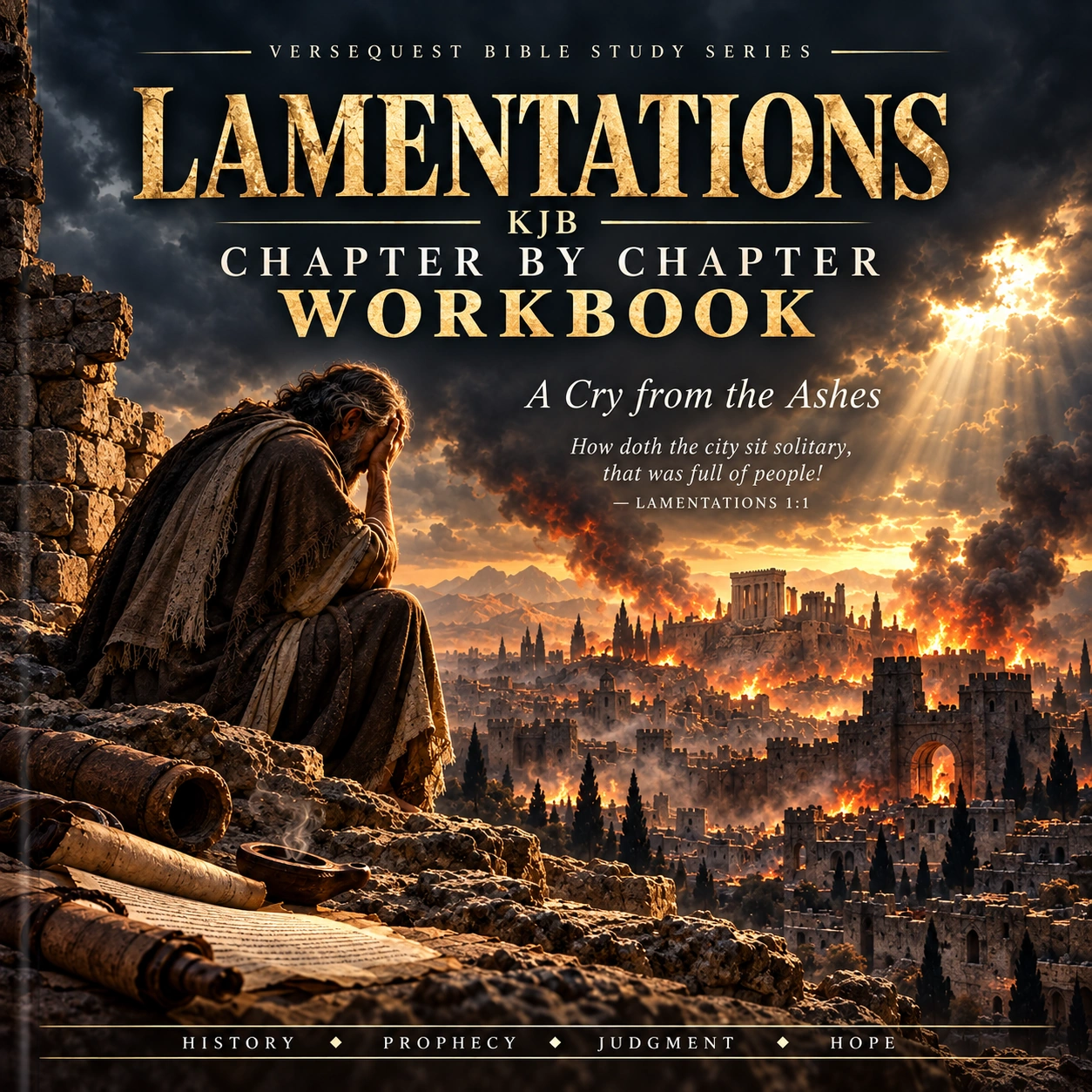
Lamentations KJB Chapter-by-Chapter Workbook — Complete 375-Page Bible Study Curriculum
The Lamentations KJB Chapter-by-Chapter Workbook is a complete 375-page downloadable Bible-study curriculum covering all five chapters of Lamentations in depth. Built for serious King James Bible students, it combines substantial VerseQuest commentary and study notes with chapter summaries, verse-range exposition, cross-reference work, doctrinal distinctions, prophetic studies, advanced topics, reviews, teaching tools, glossary studies, and guided personal note space.
Study Jerusalem’s destruction, covenant judgment, the failure of false prophets and leaders, famine and siege, the afflicted man of chapter 3, the mercies and compassions of the LORD, “Great is thy faithfulness,” self-examination, Edom, Israel’s prophetic future, and the final prayer for restoration.
Rather than giving the student hundreds of empty workbook pages, this course teaches first and then gives room to study further. It is designed for personal Bible study, pastors, preachers, Sunday school teachers, homeschool families, Bible classes, and ministry training.
375-page downloadable PDF — $24.99.
$24.99
Description
The Lamentations KJB Chapter-by-Chapter Workbook is a complete 375-page downloadable PDF Bible-study curriculum designed for readers who want to do far more than simply read through the five chapters of Lamentations. This workbook takes the student into the historical destruction of Jerusalem, the covenant consequences of Judah’s rebellion, the grief of a ruined city, the righteousness of God in judgment, the failure of false prophets and leaders, the suffering of the people, and the remarkable emergence of mercy, faithfulness, hope, prayer, and the desire for restoration.
Lamentations is a short book, but it is anything but a shallow book. Jerusalem has fallen. The sanctuary has been devastated. The streets that once held worshippers are empty. Children suffer during the siege. Priests and prophets have failed. Enemies rejoice. Jeremiah looks upon the wreckage of a nation that repeatedly ignored the warnings God had already given. Yet directly in the center of that devastation come some of the most beloved words in Scripture concerning the mercies, compassions, and faithfulness of the LORD. This workbook is constructed to help the student understand how those truths fit the actual context rather than removing them from the judgment surrounding them.
The course works systematically through all five chapters of Lamentations, giving substantial attention to each chapter’s movement, vocabulary, historical setting, doctrinal significance, cross-references, prophetic questions, difficult passages, major themes, and practical instruction. Chapter 1 examines the solitary and grieving city, the disappearance of her comforters, captivity, desecration, confession, and the declaration that “The LORD is righteous.” Chapter 2 confronts the anger of the LORD against Zion, the destruction of Jerusalem’s defenses and worship, the failure of false prophets, famine, suffering, and prayer under judgment. Chapter 3 becomes the theological center of the course as affliction, wormwood, darkness, and despair give way to remembrance, mercy, compassion, faithfulness, waiting, self-examination, repentance, and prayer.
Chapter 4 returns to the horrors of the siege, asking how the gold became dim and showing the terrible reversal that occurred in Jerusalem. The workbook studies famine, leadership failure, the sins of prophets and priests, failed human help, Edom, and the difficult language surrounding “the anointed of the LORD.” Chapter 5 closes the book with a national prayer in which the remnant asks God to remember their reproach, their lost inheritance, their servitude, their hunger, their mourning, and finally to turn them again unto Himself.
The workbook does not leave the reader with commentary alone. It combines substantial VerseQuest explanatory notes, chapter summaries, doctrinal observations, interpretation cautions, cross-reference trails, focused studies, lists, teaching points, reviews, advanced studies, charts, ministry-development material, glossary work, and guided personal-study areas. The student is given enough direction to understand what he is studying while still being required to open the King James Bible, investigate the passages, write his own observations, and build a permanent set of personal study notes.
A major emphasis throughout the workbook is right division. Lamentations concerns literal Jerusalem, Judah, Zion, the destruction caused by Babylon, and the consequences of rebellion under Israel’s covenant setting. The spiritual and practical lessons are powerful for every believer, but the historical identity of Jerusalem and Israel is never erased. The workbook also examines the prophetic applications that have been associated with Israel’s future Tribulation experience while carefully distinguishing historical fulfillment from later prophetic parallels and more speculative connections.
The literary construction of Lamentations receives special attention as well. Students examine the five-poem arrangement, the 22-verse structure of chapters 1, 2, 4, and 5, the remarkable 66-verse structure of chapter 3, the alphabetic nature of the poetry, repeated images, changes in speaker, and the progression from desolation and judgment toward remembrance, hope, prayer, and restoration.
Beyond the five chapter studies, the workbook contains numerous advanced studies examining subjects such as Leviticus 26 and Deuteronomy 28, Jerusalem’s destruction, Zion, covenant judgment, divine anger and human responsibility, false prophets, priestly failure, famine, comforters, the afflicted man, wormwood, the mercies of God, “Great is thy faithfulness,” waiting upon the LORD, self-examination, Edom, the final prayer of the remnant, historical fulfillment, Tribulation applications, and the proper relationship between observation, interpretation, application, and speculation.
The course also contains cumulative review material, ministry and teaching tools, glossary studies, a final synthesis project, personal reflection material, and a certificate of completion. It can therefore function not merely as a workbook to finish once, but as a permanent reference volume for later sermons, Bible lessons, personal study, Sunday school teaching, homeschool assignments, and ministry preparation.
This is a digital downloadable PDF designed for use on a computer or tablet or for printing according to the buyer’s needs. At 375 pages for $24.99, it is intended to provide a complete course through one of Scripture’s most neglected yet spiritually and doctrinally powerful books.
Jerusalem's Desolation — The transformation of a once-great city into a solitary, grieving, humiliated city lies at the heart of the book. Covenant Judgment — Lamentations must be understood against the warnings already given to Israel in the law. The catastrophe did not arrive without warning. The Righteousness of God — The suffering is terrible, yet Lamentations refuses to accuse the LORD of injustice. Jerusalem confesses, "The LORD is righteous." Sin and Consequence — The poems repeatedly connect national rebellion with national destruction. The Fall of Zion — Walls, gates, sanctuary, assemblies, princes, priests, prophets, families, and public life all collapse under judgment. The Loss of Comforters — One of chapter 1's most painful repeated ideas is the absence of anyone able to provide true comfort. False Prophets and Failed Leadership — Lamentations condemns religious leadership that failed to expose sin and instead offered vain and foolish visions. The Horror of Siege — Hunger, death, ruined streets, desperate families, and social breakdown reveal the seriousness of national judgment. The Afflicted Man — Lamentations 3 places personal suffering within the larger national catastrophe. Wormwood and Bitterness — The imagery of bitterness emphasizes how deeply judgment and grief penetrate the sufferer's experience. Remembering as the Turning Point — Hope appears when truth about God is deliberately recalled in the middle of devastation. The Mercies of the LORD — God's mercies remain the reason the people are not utterly consumed. The Compassions of God — Divine compassion is not denied by judgment; both appear within the same inspired book. Great Is Thy Faithfulness — God's character remains unchanged even when everything visible around the prophet appears destroyed. Waiting upon the LORD — Lamentations teaches patient dependence upon God without pretending the circumstances are painless. Self-Examination and Repentance — "Let us search and try our ways" directs suffering people toward honest spiritual examination rather than mere accusation. Prayer under Judgment — Lamentations demonstrates that the proper response to judgment includes confession, lament, petition, and appeal to God. Israel and Right Division — Jerusalem, Zion, Judah, captivity, covenant judgment, and national restoration retain their literal historical identity. Historical and Prophetic Horizons — The Babylonian destruction is the controlling historical setting, while possible future Tribulation parallels must be examined carefully rather than assumed. Edom and the Nations — The book does not end national judgment with Jerusalem. Those who rejoice over Zion's destruction remain accountable to God. The Eternal Throne of the LORD — Human kingdoms collapse, but the LORD remains forever. Restoration — The closing request, "Turn thou us unto thee, O LORD," demonstrates that the book ends looking toward God as the only true source of national renewal. Biblical Grief — Lamentations proves that grief is not automatically unbelief. Faith can weep without accusing God falsely. Hope in the Ashes — Biblical hope does not deny rubble; it remembers God's character while sitting among it.
Lamentations should first be read as the inspired aftermath of Jerusalem’s destruction. The city did not simply suffer a military reversal. Scripture interprets the catastrophe as covenant judgment after repeated rebellion, idolatry, false prophecy, rejected warnings, and refusal to turn to the LORD. That distinction is essential: Babylon was the human instrument, but the book repeatedly places the events beneath the sovereign judgment of God.
The five chapters form a deliberate progression. Chapter 1 looks at the lonely city and repeatedly emphasizes grief, captivity, betrayal, and the absence of comfort. Chapter 2 directs attention even more forcefully toward the LORD’s anger and the destruction of Zion’s defenses, worship, leadership, and false confidence. Chapter 3 moves inward to the experience of the afflicted man, then reaches the great doctrinal turning point of the book. Chapter 4 returns to the siege and the reversal of Zion’s former glory. Chapter 5 gathers the suffering community into a final prayer for remembrance and restoration.
The central doctrinal tension of the book is that God’s judgment and God’s mercy are both true. Lamentations does not preserve hope by pretending Jerusalem’s sins did not deserve judgment. Neither does it interpret judgment as evidence that God’s mercy or faithfulness ceased to exist.
Lamentations 1:18 supplies one of the book’s governing statements: “The LORD is righteous.” That confession controls how the destruction is interpreted. The people grieve, but Scripture does not allow the grief to become an accusation that God acted unjustly.
Lamentations 2 exposes the spiritual catastrophe behind the physical catastrophe. The false prophets had “seen vain and foolish things” and had not uncovered the people’s iniquity in a way that might have turned away captivity. Religious leadership that refuses to confront sin does not protect a people from judgment; it helps blind them to the danger.
Chapter 3 demonstrates that hope can exist without denial. The afflicted man remembers bitterness and suffering, but the turning point occurs when he deliberately recalls the truth about the LORD. Biblical hope is therefore not emotional optimism. It is confidence grounded in God’s revealed character.
“It is of the LORD’S mercies that we are not consumed” does not mean judgment was imaginary. It means that even while judgment is occurring, complete annihilation has not taken place. Mercy appears against the background of deserved judgment.
“Great is thy faithfulness” carries unusual force precisely because of where it appears. Jeremiah is not speaking from comfort, national prosperity, or visible success. Faithfulness is confessed while Jerusalem lies devastated. God’s faithfulness is therefore measured by His character and His word, not by whether circumstances presently feel favorable.
The instruction to “search and try our ways” keeps suffering from becoming merely outward-looking. Lamentations does not permit the people to blame Babylon while ignoring Judah’s own rebellion. Biblical lament includes self-examination.
The famine and horrors described in the book should be compared with the covenant warnings already given in the law. Lamentations therefore becomes a terrifying demonstration that divine warnings should not be treated as empty threats.
The prophetic applications in the Reference Bible notes deserve investigation, especially parallels between Jerusalem’s historical suffering and Israel’s future Tribulation. However, historical fulfillment remains explicit. Future connections should be classified according to the actual strength of the cross-reference rather than simply assumed.
Lamentations 4:20 deserves particularly careful treatment. The identity and prophetic significance of “the anointed of the LORD” should be examined from the immediate historical setting first. Proposed future or Tribulation connections may be studied, but they should not be stated with greater certainty than Scripture permits.
Chapter 5 reminds the student that restoration is ultimately dependent upon God. The prayer does not end with a human reconstruction program. It asks, “Turn thou us unto thee, O LORD, and we shall be turned.”
A memorable summary of the entire book is:
Sin → Warning → Refusal → Judgment → Desolation → Confession → Remembrance → Hope → Prayer → Restoration
A major question for further study is how the historical fall of Jerusalem anticipates later prophetic judgments without erasing the original events of 586 B.C.
Another important study question is how Lamentations balances divine sovereignty and human responsibility. The LORD performs judgment, yet Judah remains accountable for the rebellion that brought the judgment.
Students should also compare Jeremiah’s tears with Christ’s tears over Jerusalem. The connection helps demonstrate that mourning over judgment does not imply disagreement with God’s righteousness.
Above all, Lamentations teaches that biblical grief tells the truth about both the ruins and the God who remains when everything else has fallen.
This workbook is especially suited for personal Bible study because it combines substantial VerseQuest instruction with guided areas for the student to build his own notes, cross-reference chains, outlines, word studies, conclusions, and teaching material. A reader can work through the course progressively and finish with a personalized reference volume rather than merely a completed set of questions.
For pastors and preachers, the workbook provides material for a five-chapter sermon series as well as dozens of smaller studies dealing with judgment, national sin, false prophets, grief, mercy, faithfulness, repentance, waiting upon God, prayer, Jerusalem, the Tribulation, and restoration. Teaching-development pages can be used to turn study into sermon outlines or Bible messages.
For Sunday school teachers and small-group leaders, each chapter contains enough material to support several lessons. The chapter summaries, focused studies, cross-references, doctrinal distinctions, review material, and teaching questions can be adapted to a multiweek study of Lamentations.
For families and homeschool settings, the workbook can serve as a structured Old Testament curriculum. Students can study historical context, literary structure, vocabulary, cause and consequence, covenant judgment, cross-references, interpretation, and application while developing independent Bible-study habits.
For Bible institutes and ministry training, the workbook provides opportunities to evaluate a student's ability to observe the text, preserve dispensational distinctions, compare Scripture with Scripture, distinguish historical fulfillment from prophetic application, explain difficult passages, and teach the book coherently.
The most important companion resource is an Authorized King James Bible, preferably one with generous margins for notes. A good concordance is valuable for tracing repeated terms such as Zion, Jerusalem, anger, affliction, comfort, mercy, compassion, faithfulness, hope, judgment, and restore.
A Bible dictionary can help students research Jerusalem, Babylon, Nebuchadnezzar, Zion, Jeremiah, Edom, the temple, the Babylonian captivity, and the final kings of Judah. A Bible atlas or map of Jerusalem, Judah, and the Babylonian Empire is useful for visualizing the geographical and political setting of the book.
Cross-reference tools are especially valuable when comparing Lamentations with Leviticus 26, Deuteronomy 28–30, 2 Kings 24–25, 2 Chronicles 36, Psalms 74, 79, and 137, Jeremiah 7, 25, 29–33, 37–39, and 52, Daniel 9, Matthew 23, and Luke 19.
The Jeremiah KJV Chapter-by-Chapter Workbook is a natural VerseQuest companion because it studies the prophetic warnings, final kings of Judah, Babylonian invasion, fall of Jerusalem, captivity, Jeremiah's sufferings, future restoration, and prophetic material that form the historical and doctrinal background of Lamentations.
A study of Isaiah is also useful for comparing Jerusalem's judgment with prophetic promises concerning Zion, Israel's restoration, the Second Advent, and the future kingdom.
Related products
-
Premium VerseQuest Books
-
-75%

- Christ in the Old Testament Made Plain — 100-Essay KJV Study PDF
- A massive 670-page premium KJV Bible study PDF featuring 100 detailed essays showing Jesus Christ throughout the Old Testament in promise, type, sacrifice, Christophany, prophecy, suffering, resurrection, priesthood, and future…
- Original price was: $39.99.$9.99Current price is: $9.99.
- Add to cart
-
-75%
-
Rome Bible study
-

- Rome Ruin And Religion PDF Book – 379 Page KJV Bible Study
- Rome Ruin And Religion is a 379-page VerseQuest PDF book exposing pagan Rome, failed gods, Catholic error, priestcraft, sacred tradition, sacramental salvation, and the collapse of man’s cities under the…
- $9.99
- Add to cart
-
-
Pre-Wrath Rapture
-
- The Pre-Wrath Rapture Exposed: A 45-Essay Defense of the Blessed Hope — 356-Page PDF Book
- The Pre-Wrath Rapture Exposed is a comprehensive 356-page downloadable PDF book presenting a KJV-centered, rightly divided defense of the pretribulation Rapture. Through an introduction, 45 detailed essays, a substantial conclusion,…
- $19.99
- Add to cart
-
-
Revelation
-
-71%
- Moses and Elijah: The Two Witnesses Made Plain
- Moses and Elijah: The Two Witnesses Made Plain is a 636-page premium VerseQuest PDF study proving from Scripture that the Two Witnesses of Revelation 11 are Moses and Elijah. This…
- Original price was: $34.99.$9.99Current price is: $9.99.
- Add to cart
-
-71%
-
VerseQuest Premium Library
-
-67%

- The Book of Psalms Made Plain – 383-Page KJV Psalm Study
- The Book of Psalms Made Plain is a 383-page premium KJV Bible study featuring 54 detailed essays through the major themes, doctrines, prophecies, prayers, laments, and praises of the Psalms.…
- Original price was: $29.99.$9.99Current price is: $9.99.
- Add to cart
-
-67%