
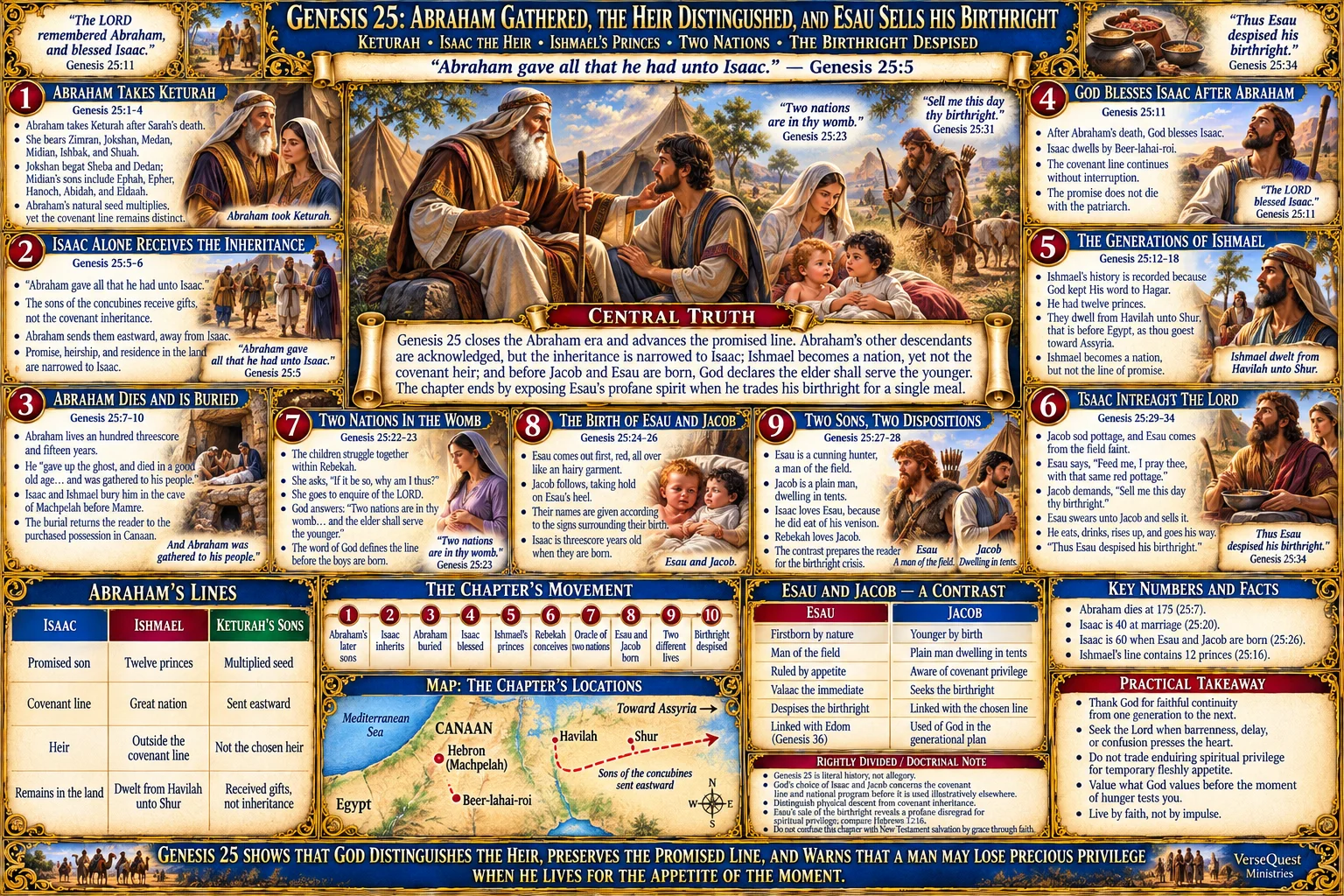
Genesis 25 – Abraham Gathered, Isaac the Heir, Two Nations in Rebekah, and Esau Sells His Birthright (KJV Bible Study Chart)
Explore Genesis 25 with this detailed KJV Bible study chart tracing Abraham’s later descendants, Isaac’s unique inheritance, Abraham’s death and burial at Machpelah, and the twelve princes descended from Ishmael. Follow Isaac as he prays for barren Rebekah and God answers with twins, declaring before their birth that “the elder shall serve the younger.” The chart compares Jacob and Esau, their different dispositions, the parental favoritism of Isaac and Rebekah, and the decisive moment when Esau trades his birthright for red pottage. Scripture’s verdict—“Thus Esau despised his birthright”—provides a lasting warning against exchanging enduring privilege for immediate appetite. Ideal for Bible study, homeschool, Sunday school, sermon preparation, Romans 9 studies, Hebrews 12 studies, and patriarchal teaching.
$4.99
Description
Genesis 25: Abraham Gathered, the Heir Distinguished, and Esau Sells His Birthright is a detailed KJV Bible study chart tracing the close of Abraham’s earthly life and the advancement of God’s covenant purpose through Isaac, Jacob, and the generations that follow. The chapter moves through Abraham’s later descendants, his death and burial, Ishmael’s twelve princes, Isaac and Rebekah’s answered prayer, the birth of Esau and Jacob, and the moment when Esau trades his birthright for a meal.
Genesis first records Abraham’s sons through Keturah. These descendants multiply Abraham’s natural seed, but they are carefully distinguished from Isaac’s covenant position. Abraham gives gifts to the sons of his concubines and sends them eastward, while “Abraham gave all that he had unto Isaac.” The inheritance and covenant line are therefore narrowed through the promised son.
Abraham dies at one hundred seventy-five years old, “in a good old age”, and is gathered to his people. Isaac and Ishmael bury their father in the cave of Machpelah, the burial possession Abraham purchased in Genesis 23. After Abraham’s death, God blesses Isaac, demonstrating that God’s promise does not die with the patriarch who first received it.
Genesis then records Ishmael’s generations. He fathers twelve princes exactly as God had promised, and his descendants become a significant people. Ishmael receives genuine national blessing, but Scripture continues distinguishing his line from the covenant succession through Isaac.
Isaac and Rebekah face barrenness, and Isaac “intreated the LORD for his wife.” God answers prayer, but Rebekah’s pregnancy becomes difficult because the children struggle within her. When she inquires of the LORD, God reveals the future before the boys are born: “Two nations are in thy womb,” and “the elder shall serve the younger.” God’s purpose concerning the covenant line precedes human achievement.
Esau is born first, followed by Jacob holding his brother’s heel. Their dispositions soon differ. Esau becomes a cunning hunter and man of the field, while Jacob is described as “a plain man, dwelling in tents.” Parental favoritism also appears: Isaac loves Esau because of his venison, while Rebekah loves Jacob.
The chapter closes with Esau returning faint from the field while Jacob prepares pottage. Jacob demands the birthright in exchange for food, and Esau swears it away. Scripture’s verdict is unmistakable: “Thus Esau despised his birthright.” Hebrews later calls him a profane person for selling his birthright for one morsel of meat.
Genesis 25 therefore warns against exchanging enduring privilege for immediate appetite. Abraham passes from the scene, but God’s covenant continues. The promised line is preserved through Isaac, narrowed toward Jacob, and carried forward entirely according to God’s Word.
Genesis 25, Abraham, Keturah, Isaac, Ishmael, twelve princes, Abraham’s death, cave of Machpelah, covenant heir, Rebekah barren, Isaac prayed, answered prayer, two nations, Jacob and Esau, elder serves younger, Edom, birthright, Esau sells birthright, red pottage, Jacob dwelling in tents, Esau hunter, covenant line, promised seed, immediate appetite, spiritual privilege
Genesis 25 closes the Abraham era while showing that God’s covenant purpose continues beyond Abraham’s death. The chapter first records Abraham’s sons through Keturah. These descendants become important peoples, but Genesis carefully separates them from Isaac’s position. Abraham gives gifts to the sons of his concubines and sends them eastward, while “Abraham gave all that he had unto Isaac.” Natural descent from Abraham therefore does not place every son in the same covenant role.
Abraham dies at one hundred seventy-five years old, “an old man, and full of years,” and is buried by Isaac and Ishmael in Machpelah. The burial place connects Genesis 25 directly with the lawful purchase of Genesis 23. After Abraham dies, “God blessed his son Isaac.” The covenant promise does not depend upon Abraham remaining alive; the God who gave it carries it into the next generation.
Ishmael’s genealogy follows and records twelve princes, fulfilling God’s earlier promise concerning him. Ishmael becomes a great people, but Genesis distinguishes national blessing from covenant succession. Isaac remains the promised heir through whom the covenant line proceeds.
Genesis 25:21 then introduces another threat to the promised line: Rebekah is barren. Isaac “intreated the LORD for his wife,” and the LORD answers him. This is an important testimony to prayer. Human barrenness cannot frustrate divine promise, yet God uses prayer as part of His providential working.
When the children struggle within Rebekah, she inquires of the LORD. God reveals that two nations and two peoples are represented in her womb and declares, “the elder shall serve the younger.” This revelation comes before Jacob and Esau perform either good or evil, a fact Paul later uses in Romans 9 while discussing God’s sovereign purpose in election and the historical covenant line.
Esau emerges first, with Jacob following and taking hold of his heel. Esau becomes a skilled hunter and man of the field; Jacob is described as “a plain man, dwelling in tents.” The household also develops unhealthy favoritism: Isaac loves Esau because of his venison, while Rebekah loves Jacob. That division will produce serious complications in Genesis 27.
The chapter reaches its moral climax when Esau returns faint from the field and demands Jacob’s red pottage. Jacob requires the birthright in exchange. Esau reasons according to immediate appetite and asks what good the birthright will do him if he dies. He swears away the privilege, eats, drinks, rises, and leaves.
Scripture then gives the divine interpretation: “Thus Esau despised his birthright.” Hebrews 12 calls Esau “a profane person” who sold his birthright for one morsel of meat. The warning reaches beyond hunger: a man can treat permanent privilege as worthless because the appetite of the present moment appears more urgent. Genesis 25 therefore contrasts enduring promise with temporary appetite and shows God preserving His covenant line from Abraham through Isaac toward Jacob.
Genesis 25 is useful for teaching continuity of God’s promises from one generation to another, the distinction between natural descendants and the covenant heir, answered prayer, divine sovereignty, parental favoritism, character formation, and the danger of sacrificing permanent spiritual privilege for temporary physical satisfaction. It also provides foundational material for Romans 9, Hebrews 12, Edom studies, patriarchal history, and the developing contrast between Jacob and Esau. The chart is well suited for personal Bible study, Sunday school, homeschool instruction, Bible institutes, sermon preparation, dispensational studies, family teaching, and lessons on priorities, appetite, inheritance, and God’s faithfulness.
King James Bible, Strong’s Concordance, Thompson Chain-Reference Bible, Treasury of Scripture Knowledge, Nave’s Topical Bible, Genesis 24–27 study notes, Abrahamic covenant charts, Isaac and Ishmael comparison studies, Jacob and Esau charts, patriarchal genealogy charts, Romans 9 studies, Hebrews 12 birthright studies, Edom Scripture studies, maps of Hebron Beer-lahai-roi Havilah and Shur, Abraham family-line charts, VerseQuest Genesis charts
Related products
-
Premium VerseQuest Books
-
-75%
- Christ in the Old Testament Made Plain — 100-Essay KJV Study PDF
- A massive 670-page premium KJV Bible study PDF featuring 100 detailed essays showing Jesus Christ throughout the Old Testament in promise, type, sacrifice, Christophany, prophecy, suffering, resurrection, priesthood, and future…
- Original price was: $39.99.$9.99Current price is: $9.99.
- Add to cart
-
-75%
-
Doctrine Series
-
- The Lost Tribes Myth Exposed (213-Page Premium Study)
- A 213-page premium KJV study exposing the Lost Tribes myth, tribal identity errors, prophecy abuse, race theories, and false Israel claims through 35 detailed essays.
- $24.99
- Add to cart
-
-
The Rapture
-
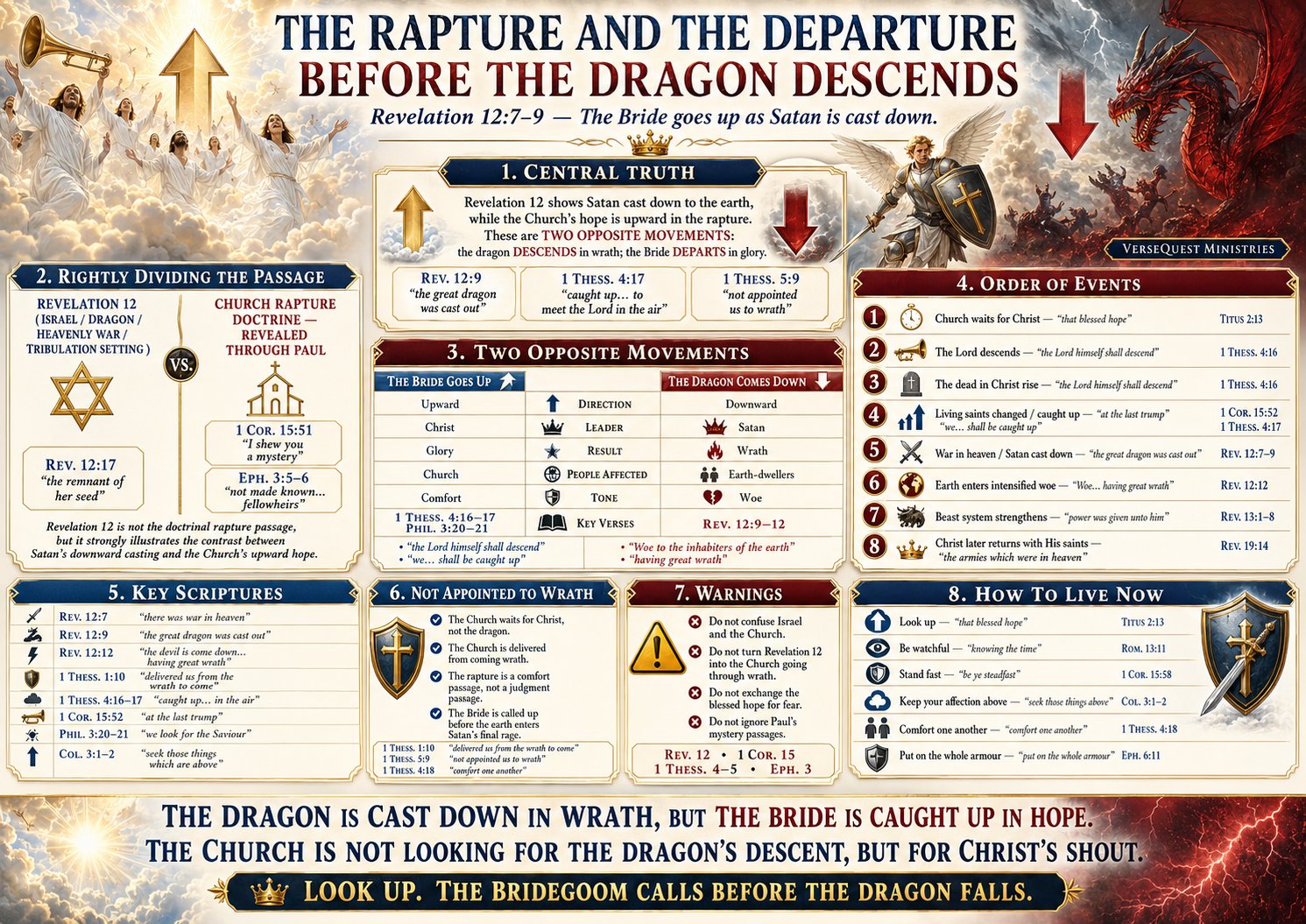
- The Rapture and the Departure Before the Dragon Descends – Printable Bible Study Chart
- Printable KJV Bible study chart on The Rapture and the Departure Before the Dragon Descends, showing the Bride caught up before Satan is cast down in wrath. This premium VerseQuest…
- $4.99
- Add to cart
-
-
Bible Overview Series
-
- The New Jerusalem Made Plain — 621-Page PDF Study
- The New Jerusalem Made Plain is a massive 621-page KJV/rightly divided PDF study on the literal holy city revealed in Revelation 21–22. This 100-essay book makes the New Jerusalem plain…
- $34.99
- Add to cart
-
-
Prophecy Studies
-

- The Resurrection of Jesus Christ Made Plain – 501-Page KJV Bible Study
- A massive 501-page VerseQuest Ministries PDF Bible study defending and explaining the bodily resurrection of Jesus Christ from a KJV, rightly divided perspective. This 80-essay study covers the empty tomb,…
- $34.99
- Add to cart
-