
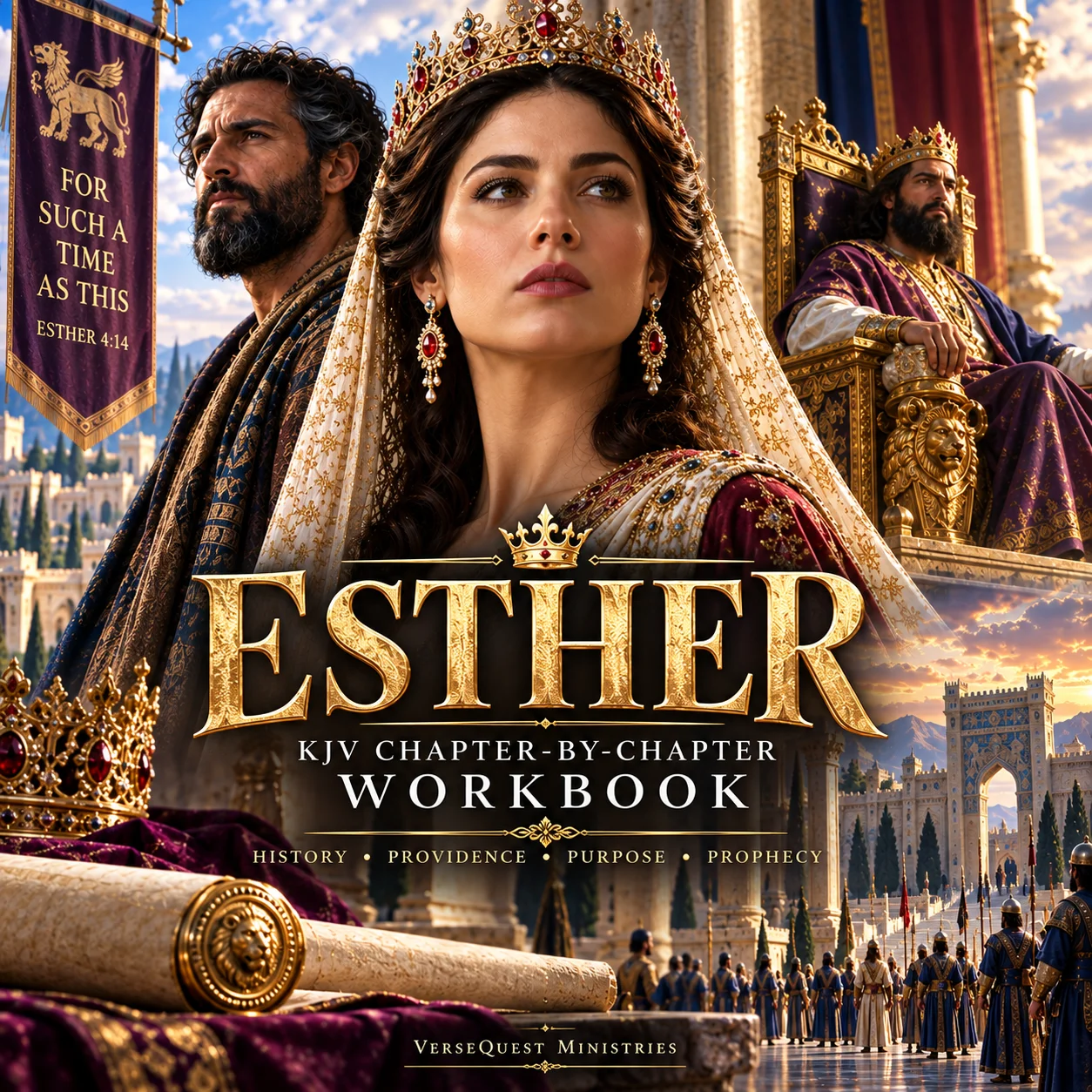
Esther KJV Chapter-by-Chapter Workbook
The Esther KJV Chapter-by-Chapter Workbook is a detailed, interactive downloadable PDF designed to help Bible students slow down, read the text carefully, examine the details, compare Scripture with Scripture, and make the Book of Esther their own through guided study and written responses.
Rather than simply telling you what Esther means, this workbook teaches you how to study it. Work chapter by chapter through Esther’s ten chapters while tracing the Persian setting, Esther and Mordecai, Haman’s conspiracy, the threatened destruction of the Jews, the remarkable reversals throughout the narrative, the institution of Purim, and the providential hand of God working behind events even though the name of God never appears in the book.
The workbook combines substantial Bible-study material with opportunities for personal observations, chapter analysis, key passages, doctrinal and prophetic connections, cross-references, study questions, applications, and space to record what you discover. It is built around the King James Bible and approached from a Bible-believing, rightly divided perspective.
An excellent resource for individual Bible study, homeschool Bible curriculum, family study, Sunday school, church classes, Bible institutes, small groups, teachers, pastors, and anyone who wants to do more than simply read Esther—they want to study it, mark it, understand it, and remember it.
Digital Download — PDF Format
Price: $24.99
$24.99
Description
The Esther KJV Chapter-by-Chapter Workbook is a complete 375-page downloadable and printable PDF Bible-study workbook designed to take the student through all ten chapters of Esther in a serious, interactive, King James Bible study. Rather than simply reading somebody else’s conclusions, the student is repeatedly brought back to the Biblical text to read, mark, compare, cross-reference, answer questions, record observations, develop conclusions, and make the study his own.
Esther is one of the most remarkable books in the Old Testament. The name of God does not appear explicitly in its ten chapters, yet His providential hand can be traced throughout the entire narrative. A Jewish orphan becomes queen. Mordecai uncovers a conspiracy and receives no immediate reward. Haman rises to power and devises a decree intended to destroy the Jews. Esther must decide whether she will risk her position and her life. A sleepless night changes the direction of the story. The man preparing Mordecai’s destruction is forced to honor him publicly. The gallows prepared for Mordecai receive Haman instead. A decree of destruction is answered by another decree, mourning becomes rejoicing, and Mordecai ends the book exalted beside the Gentile king.
This workbook slows the narrative down so those details are not merely noticed but studied. Each chapter receives an extensive study section built around the actual words, movements, people, places, decisions, contrasts, reversals, historical setting, doctrinal considerations, cross-references, and practical lessons found in the KJV text. Students are guided through chapter structure, verse mining, important words in context, cross-reference work, doctrinal observations, right-division questions, personal study responses, review material, and opportunities for their own notes and conclusions.
Particular attention is given to the great theme running beneath Esther: providence behind the throne. The workbook teaches the student to recognize providential patterns without carelessly turning every circumstance into a private revelation from God. It asks the student to observe what actually happened, examine the timing, compare Scripture with Scripture, and distinguish what the Bible explicitly says from conclusions drawn from the circumstances.
The historical and dispensational setting is also taken seriously. Esther concerns the Jewish people living under Gentile rule, and the workbook preserves that setting rather than turning Israel into the New Testament Church. At the same time, legitimate spiritual applications, Biblical types, prophetic comparisons, and practical lessons are examined carefully. This gives the student practice in both Bible interpretation and Bible application—learning not only what can be applied, but also what must remain where God placed it.
The workbook follows Esther from the enormous Persian court of Ahasuerus and the removal of Vashti through Esther’s elevation, Mordecai’s refusal to bow before Haman, Haman’s genocidal decree, Esther’s fast and courageous approach to the king, the providential reversal surrounding Mordecai, Haman’s downfall, the Jews’ deliverance, the establishment of Purim, and Mordecai’s final exaltation.
The 375-page course also goes beyond the individual chapter studies with introductory and completion material, review work, indexes, master studies, examination material, a teaching project, and a certificate. Writing and response areas are intentionally incorporated throughout so the resource functions as a true workbook rather than merely another book to read.
It can be worked through as a structured 10-week individual Bible course, used by families and homeschool students, adapted for Sunday school and small-group instruction, or employed by pastors and teachers preparing lessons from Esther. It is designed for the student who wants to sit down with an open King James Bible and actually learn how to study a book of Scripture carefully from beginning to end.
The Providence of God — God's name is not explicitly written in Esther, yet the timing and arrangement of events repeatedly demonstrate providential working behind the visible story. The Preservation of the Jews — The attempted destruction of the Jewish people becomes the central crisis of the book. Israel Under Gentile Dominion — Esther takes place within the Persian Empire and must be interpreted within that historical setting. Esther's Courage and Intercession — Esther moves from concealed identity to risking her life on behalf of her people. Mordecai's Faithfulness — Mordecai's actions, warnings, service, refusal to bow, delayed recognition, and eventual exaltation form a major narrative line. Haman and the Agagite Conflict — Haman's identity opens an important line of study back through Agag and Amalek. Pride Before Destruction — Haman's enormous pride contributes directly to his humiliation and destruction. Providential Timing — Banquets, decrees, conversations, records, sleeplessness, and apparently ordinary events converge at precisely significant moments. Reversal — Esther repeatedly turns circumstances upside down: the condemned are delivered, the exalted enemy falls, the forgotten servant is honored, and mourning becomes joy. Prayer, Fasting, and Crisis — Esther's response to danger demonstrates the seriousness with which the Jewish people confronted the threat before them. Government and Irrevocable Law — Persian decrees and royal authority become essential components of both the crisis and its resolution. The Golden Sceptre and Access to the King — Esther's approach to the throne provides one of the book's most dramatic studies of risk, favor, authority, and intercession. The Gallows of Haman — The instrument intended for Mordecai becomes the means of Haman's own destruction. The King's Records — Mordecai's forgotten service illustrates how seemingly insignificant events may later become decisive. The Feast of Purim — Esther explains the historical origin of Purim and the remembrance of Jewish deliverance. Israel and the Church Distinguished — The Jewish historical and covenant setting is preserved while appropriate spiritual applications are considered separately. Typology and Prophetic Comparison — Possible types and prophetic parallels are examined without replacing the plain historical meaning of the text. Faithfulness Under Gentile Rule — Esther and Mordecai demonstrate the difficulties faced by Jews living within a powerful Gentile empire. The Danger of Compromise and Pride — The narrative supplies numerous lessons concerning position, influence, fear, obedience, ambition, and responsibility. Learning to Study Scripture — The workbook deliberately trains the student to read closely, compare Scripture with Scripture, formulate conclusions, and support those conclusions from the KJV.
Central Argument: Esther records the preservation of the Jewish people within a Gentile empire and demonstrates how God’s providential purposes may operate through ordinary events, human decisions, governmental actions, timing, reversals, and circumstances even when His name is not explicitly mentioned.
Major Observations:
- Esther contains ten chapters and develops as a tightly connected narrative in which earlier details repeatedly become important later.
- God’s name is not explicitly present in the text, making providence one of the book’s central study questions.
- The Persian setting is essential. The student should understand Esther historically before attempting devotional or prophetic applications.
- Esther belongs naturally beside Ezra and Nehemiah, but it presents another side of the Persian-period Jewish experience.
- Mordecai’s unrewarded action in chapter 2 becomes critical in chapter 6. The delay is part of the narrative’s providential structure.
- Haman does not merely hate Mordecai. His anger expands into a proposed destruction of an entire people.
- Haman’s designation as an Agagite invites comparison with the earlier Biblical history of Amalek and Agag.
- Esther 4 represents the decisive turning point in Esther’s personal responsibility.
- The king’s sleepless night in Esther 6 is one of the clearest examples of providential timing in the narrative.
- Haman builds the instrument intended for Mordecai’s destruction and dies upon it himself.
- The original Persian decree creates a legal problem that is answered through another royal decree.
- Esther’s deliverance does not eliminate human responsibility. The Jews must act upon the authority granted to them.
- Purim memorializes the reversal from threatened destruction to deliverance.
- Mordecai begins as a relatively obscure Jew at the king’s gate and ends next unto the king.
- Historical interpretation, spiritual application, doctrinal teaching, and prophetic typology should not be treated as though they were identical categories.
- Israel should remain Israel in the interpretation of Esther. Applications to New Testament believers do not erase the book’s Jewish setting.
- Providence should never become an excuse for inventing private revelation. The student should distinguish what Scripture states from what he infers from circumstances.
Questions Worth Further Study: Why is God’s name absent from Esther? Why are Esther and Mordecai living within the Persian Empire rather than among the returned remnant? What is the Biblical significance of Haman being called an Agagite? How do the three major royal decrees control the movement of the story? Why is Mordecai’s earlier service left unrewarded until chapter 6? How does the book distinguish providence from miraculous intervention? What does Purim memorialize? What legitimate prophetic comparisons can be made without destroying the historical meaning of the passage?
Personal Bible Study: Work through Esther chapter by chapter with an open KJV, completing the reading, verse-mining, cross-reference, observation, response, and review exercises.
Homeschool and Family Study: The material can function as a structured Bible curriculum. Younger students can work through selected questions orally while older students can complete written responses and Scripture work.
Sunday School: Each chapter contains enough material to develop multiple lessons rather than reducing Esther to a single lesson about courage.
Small Groups and Bible Studies: Members can complete portions independently and then use the chapter questions, observations, cross-references, and applications for group discussion.
Sermon and Lesson Preparation: Pastors and teachers can use the chapter structures, historical observations, themes, cross-references, doctrinal distinctions, and study questions as preparation material.
Bible Institute and Ministry Training: The workbook can help teach students how to approach an entire Biblical book systematically rather than collecting isolated sermon thoughts.
Discipleship: Esther provides opportunities to teach faithfulness, providence, courage, responsibility, pride, opposition, intercession, and trusting God when His work is not immediately visible.
Teaching Practice: The included teaching project encourages the student to move beyond receiving information and organize Biblical material well enough to communicate it to someone else.
A King James Bible should remain the primary companion to the workbook. A strong concordance and Bible dictionary can help with names, locations, Persian terminology, repeated words, and historical references. A KJV cross-reference Bible is particularly useful because Esther connects naturally with Genesis, Exodus, Deuteronomy, Samuel, Chronicles, Ezra, Nehemiah, Daniel, and numerous prophetic passages.
Maps of the Medo-Persian Empire, a timeline of the Babylonian captivity and Persian period, and studies of Shushan, Jerusalem, Babylon, and the Persian provinces can help the student visualize Esther's historical world.
For continued VerseQuest study, the 2 Chronicles KJV Chapter-by-Chapter Workbook, Ezra KJV Chapter-by-Chapter Workbook, and Nehemiah KJV Chapter-by-Chapter Workbook naturally complement Esther. Together, these books help the student trace the captivity, Persian period, Jewish return, rebuilding, restoration, and the experiences of the Jews who remained within Gentile territory.
Related products
-
Premium Studies
-
-25%
- The Doctrine of Hell — Premium Essay Series PDF
- A 383-page premium VerseQuest PDF study book containing 54 KJV essays on hell, fire, darkness, judgment, the lake of fire, the second death, and Jesus Christ as the only escape.
- Original price was: $39.99.$29.99Current price is: $29.99.
- Add to cart
-
-25%
-
Prophecy Studies
-

- The Resurrection of Jesus Christ Made Plain – 501-Page KJV Bible Study
- A massive 501-page VerseQuest Ministries PDF Bible study defending and explaining the bodily resurrection of Jesus Christ from a KJV, rightly divided perspective. This 80-essay study covers the empty tomb,…
- $34.99
- Add to cart
-
-
Bible Prophecy Charts
-
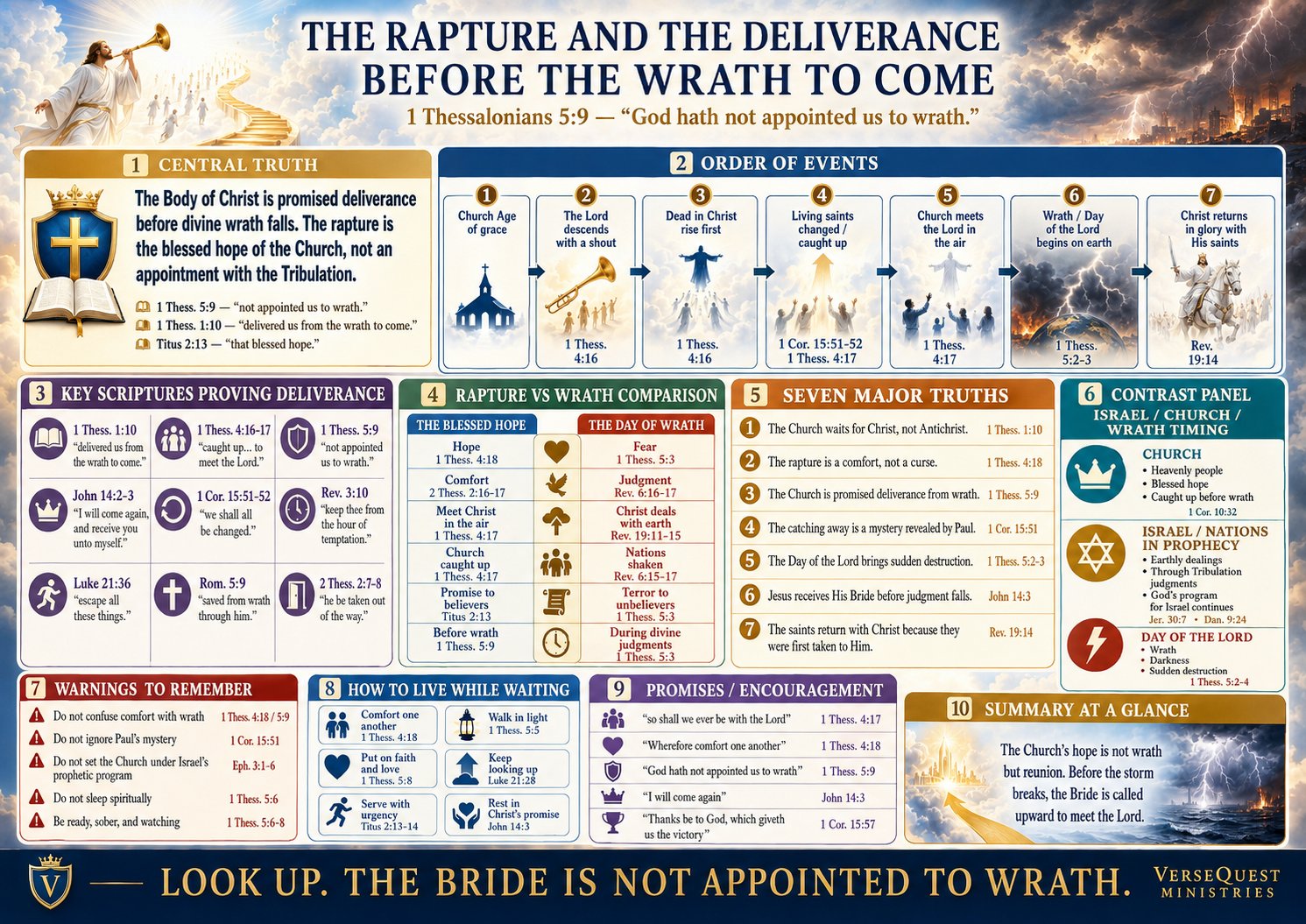
- The Rapture and the Deliverance Before the Wrath to Come – Printable Bible Study Chart
- Printable KJV Bible study chart on The Rapture and the Deliverance Before the Wrath to Come, showing from 1 Thessalonians 5:9 that the Church is not appointed to wrath. This…
- $4.99
- Add to cart
-
-
Doctrine Series
-
- The Lost Tribes Myth Exposed (213-Page Premium Study)
- A 213-page premium KJV study exposing the Lost Tribes myth, tribal identity errors, prophecy abuse, race theories, and false Israel claims through 35 detailed essays.
- $24.99
- Add to cart
-
-
KJV Bible Study Resources
-
-60%
- Practical Christianity for Daily Battles – 329-Page KJV Study PDF
- A premium 329-page KJV study PDF with 40 full essays applying sound, rightly divided Bible doctrine to real daily Christian battles. Topics include temptation, anxiety, marriage, parenting, pornography, grief, church…
- Original price was: $24.99.$9.99Current price is: $9.99.
- Add to cart
-
-60%