
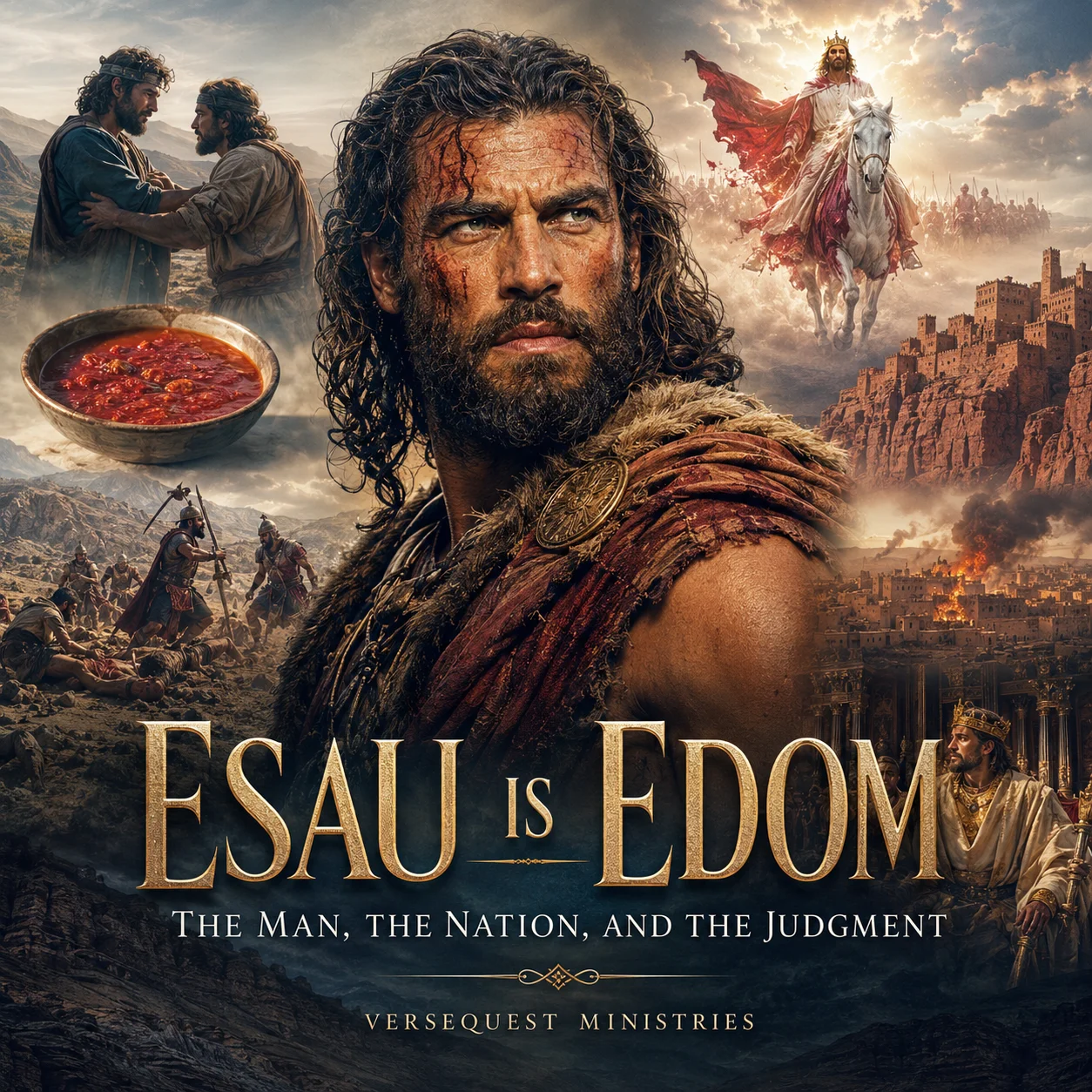
Esau Is Edom Bible Study – Genesis 36, Edomites, Petra, Herod, and Prophecy
Discover the biblical history of Esau and Edom in this extensive 300-page King James Bible study. This thirty-essay collection traces Esau from the sale of his birthright through Genesis 36, Mount Seir, Amalek, Edom’s kings, Israel’s conflicts, prophetic judgment, Petra, Idumaea, the house of Herod, Romans 9, Hebrews 12, and Isaiah 63.
Written from a KJV Bible-believing and rightly divided perspective, this downloadable PDF separates what Scripture clearly states from historical evidence, uncertain traditions, racial speculation, and careless proof-texting.
Original price was: $19.99.$9.99Current price is: $9.99.
Description
Esau Did Not Disappear—He Became a Nation
Most Bible readers remember Esau as the hungry hunter who sold his birthright for a bowl of red pottage. Far fewer follow his history into Genesis 36, where Scripture repeatedly declares, “Esau is Edom.”
Esau’s marriages became households. His sons became clans. His descendants became dukes and kings. His family occupied Mount Seir, produced Amalek, confronted Israel, resisted the kingdom of David, rejoiced over Jerusalem’s destruction, and became the subject of some of the Bible’s strongest prophetic judgments.
Esau Is Edom: The Man, the Nation, and the Judgment is a comprehensive 300-page study tracing that history from Genesis through the prophets and into the New Testament.
Genesis 36 Is Not a Chapter of Meaningless Names
Genesis 36 is one of the most frequently skipped chapters in the Bible. Yet it contains the national birth record of Edom, the ancestry of Amalek, the history of the Horites, multiple lists of Edomite chiefs, and the names of kings who ruled before Israel possessed a human monarchy.
This book carefully examines the people, names, marriages, territories, political developments, and family connections recorded in the chapter. It also distinguishes between Esau’s descendants and the earlier inhabitants of Mount Seir instead of carelessly treating every person in the chapter as an Edomite.
The study demonstrates why biblical genealogies matter and how names recorded in Genesis later explain wars, kingdoms, prophecies, and judgments found throughout Scripture.
Follow Esau and Edom Through the Entire Bible
The thirty studies in this collection trace:
- Esau’s birth and the two nations in Rebekah’s womb
- The sale of the birthright for red pottage
- Esau’s pursuit of the blessing
- His tears, resentment, and murderous intentions
- The wives who grieved Isaac and Rebekah
- Jacob’s fear and Esau’s unexpected reconciliation
- Esau’s prosperity and move to Mount Seir
- The Horites who occupied Seir before Edom
- The women who connected Esau’s family with Seir
- The different lists of dukes in Genesis 36
- The kings of Edom who reigned before Israel had a king
- The birth of Amalek through Eliphaz and Timna
- Amalek’s attack upon Israel’s weak and weary
- Edom’s refusal to permit Israel passage
- God’s command, “Meddle not with them”
- God’s command not to abhor an Edomite
- David’s conquest and occupation of Edom
- Hadad the Edomite’s return as Solomon’s adversary
- Edom’s revolt during the reign of Jehoram
- Edom’s betrayal during Jerusalem’s destruction
- The pride of Edom in the clefts of the rock
- The prophetic judgment described by Obadiah
- Christ coming from Edom in Isaiah 63
- Petra, Sela, the Nabataeans, and later regional history
- Idumaea and the rise of the Herodian dynasty
- Herod’s repeated confrontation with Christ and the apostles
- “Jacob have I loved, but Esau have I hated”
- Romans 9, national election, and the covenant line
- Hebrews 12 and Esau as a profane person
- The promise continuing through Jacob toward Jesus Christ
Scripture, History, and Speculation Kept Separate
Many studies of Esau and Edom mix biblical truth with uncertain genealogy, imaginative name meanings, selective numerology, modern political theories, and racial speculation.
This book follows a more careful standard:
What the King James Bible explicitly states
What responsible history reasonably supports
What remains uncertain, debated, or unproved
The book addresses questions involving Petra, Sela, the Nabataeans, Idumaea, the Horites, and the house of Herod without pretending every historical question has an absolute answer.
It also explains why Edom, Ishmael, Amalek, Moab, Midian, the Nabataeans, Arabs, and Muslims should not be carelessly combined into one ancestry. Scripture distinguishes these peoples, and responsible Bible study should do the same.
Romans 9 Without Calvinistic Proof-Texting
The final study examines one of the most misused statements in Scripture:
“Jacob have I loved, but Esau have I hated.”
The words first appear in Malachi centuries after Jacob and Esau had died. The passage immediately concerns Israel and Edom as nations, including Esau’s mountains, heritage, rebuilding, and judgment.
Romans 9 uses Jacob and Esau to defend God’s sovereign right to choose the covenant and Messianic line. It does not teach that God arbitrarily created one unborn infant for heaven and another for hell without meaningful regard for faith, unbelief, gospel response, or personal responsibility.
Hebrews 12 then gives the personal warning by identifying Esau as a profane man who sold his birthright for one morsel of meat.
The book allows Malachi, Romans, and Hebrews to speak within their proper settings without surrendering the passages to Calvinism, racial hatred, or careless proof-texting.
Christ Is the Center of the Study
The history does not ultimately end with Esau, Edom, Mount Seir, Petra, or Herod.
The promise continued through Abraham, Isaac, Jacob, Judah, and David until Jesus Christ entered the world. Herod attempted to destroy Him, Rome crucified Him, and the grave could not hold Him.
Isaiah 63 presents the glorious figure coming from Edom with dyed garments from Bozrah, speaking in righteousness and mighty to save. The rejected birthright, the proud mountain, the Edomite kingdom, and the house of Herod all lead toward the final revelation of the rightful King.
Esau had the pottage. Edom had the mountain. Herod had Rome. Jesus Christ has the kingdom.
Esau, Edom, Jacob, Israel, Genesis 36, birthright, red pottage, Mount Seir, Edomites, Horites, Amalek, Timna, Eliphaz, dukes of Edom, kings of Edom, Israel and Edom, the king’s highway, David’s kingdom, Hadad the Edomite, Jerusalem’s destruction, Obadiah, pride, brotherly violence, judgment, Petra, Sela, Nabataeans, Idumaea, Herod the Great, Herod Antipas, Agrippa I, Agrippa II, Romans 9, Hebrews 12, Malachi 1, Isaiah 63, covenant election, personal responsibility, biblical genealogy, Bible prophecy, Second Advent, Jesus Christ
Read Genesis 25, Genesis 27, Genesis 33, and Genesis 36 before beginning the full series.
Keep a written distinction between Esau the individual, Edom the nation, Amalek as one branch of Esau’s extended house, the Horites as earlier inhabitants of Seir, the Nabataeans as a later Arabian regional power, and Idumaea as a later historical development.
When studying “Jacob have I loved, but Esau have I hated,” begin with Malachi 1 before interpreting the quotation in Romans 9.
Compare Romans 9 with Romans 10 and Romans 11 so that election, gospel responsibility, Israel’s unbelief, the Gentile warning, and Israel’s future restoration remain within the full argument.
Compare Isaiah 63 with Revelation 14 and Revelation 19 while preserving the distinct details and settings of each passage.
Mark every statement in the book according to three categories:
- Clearly stated by Scripture
- Supported by responsible historical evidence
- Possible, debated, or uncertain
Do not exchange permanent spiritual privilege for temporary physical appetite.
Material prosperity does not necessarily prove divine approval.
Tears over consequences are not always evidence of repentance.
Family decisions can produce consequences lasting for generations.
Biblical genealogy helps explain later national history and prophecy.
God assigns boundaries and expects those boundaries to be respected.
Brotherhood increases accountability rather than eliminating it.
A nation’s strength cannot shelter it from divine judgment.
Pride often grows from real advantages that become substitutes for God.
Ancient national judgment should not be turned into modern racial hatred.
Scripture, history, and speculation must remain clearly distinguished.
Divine election does not eliminate personal responsibility.
God’s covenant purposes do not depend upon human superiority.
The promise of God continued through Jacob’s line toward Jesus Christ.
Present appetite must never be allowed to determine eternal values.
Primary Resource:
The King James Bible
Recommended Biblical Books for Continued Study:
Genesis, Exodus, Numbers, Deuteronomy, 1 Samuel, 2 Samuel, 1 Kings, 2 Kings, 2 Chronicles, Psalms, Isaiah, Jeremiah, Ezekiel, Amos, Obadiah, Malachi, Matthew, Mark, Luke, Acts, Romans, Hebrews, Revelation
Recommended Companion Studies:
Studies on Jacob and Esau, Genesis 36 genealogies, Amalek in Scripture, the book of Obadiah, Mount Seir, Israel and Edom, Isaiah 63, Romans 9–11, the Herodian dynasty, and the Second Advent of Jesus Christ
Related products
-
Genesis 36
-
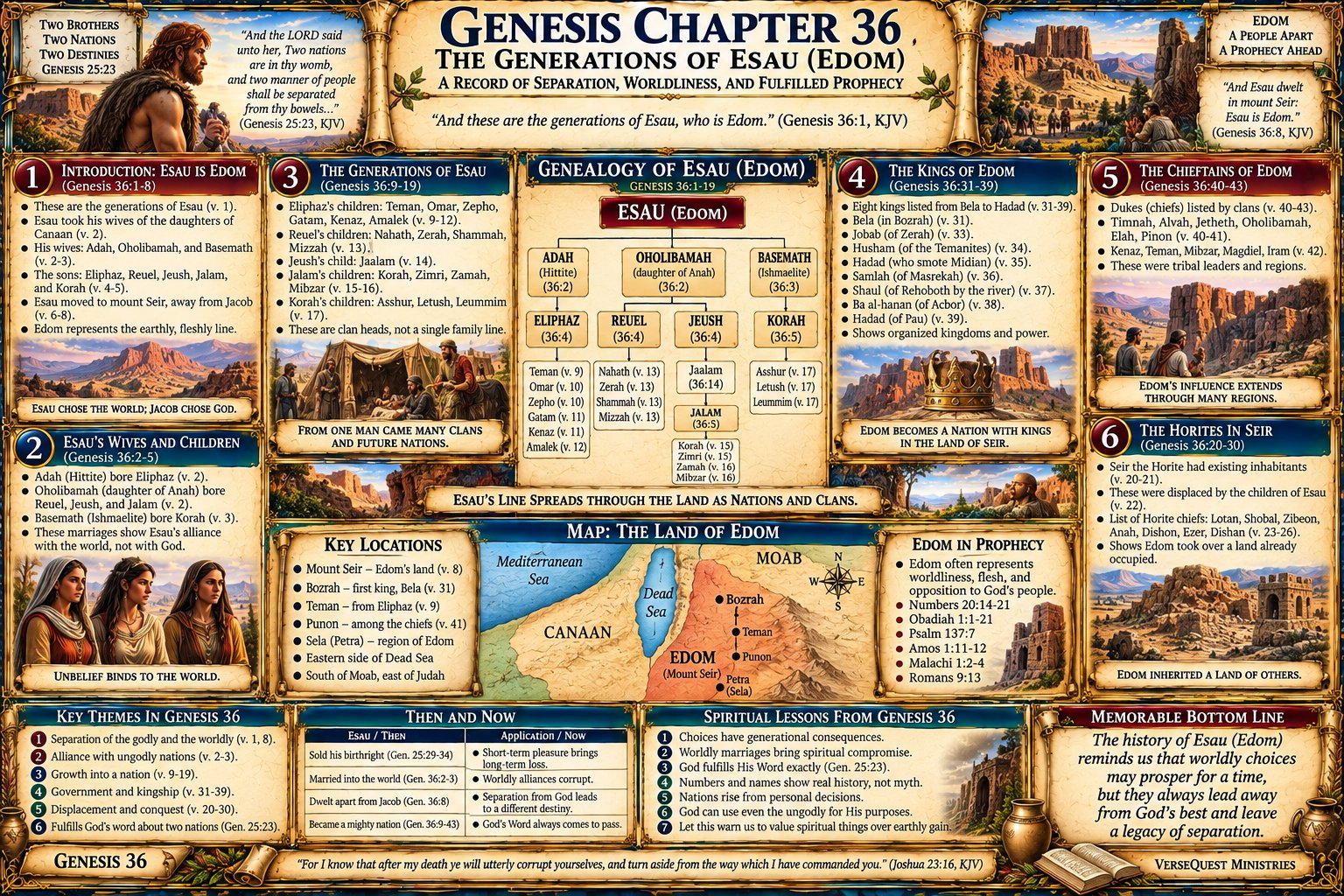
- Genesis 36 – The Generations of Esau and Edom: Mount Seir, Chiefs, Kings, Horites, and the Nation Descended from Esau (KJV Bible Study Chart)
- Explore Genesis 36 with this detailed KJV Bible study chart tracing Esau’s descendants and the rise of the nation of Edom in Mount Seir. Follow the family lines of Adah,…
- $4.99
- Add to cart
-