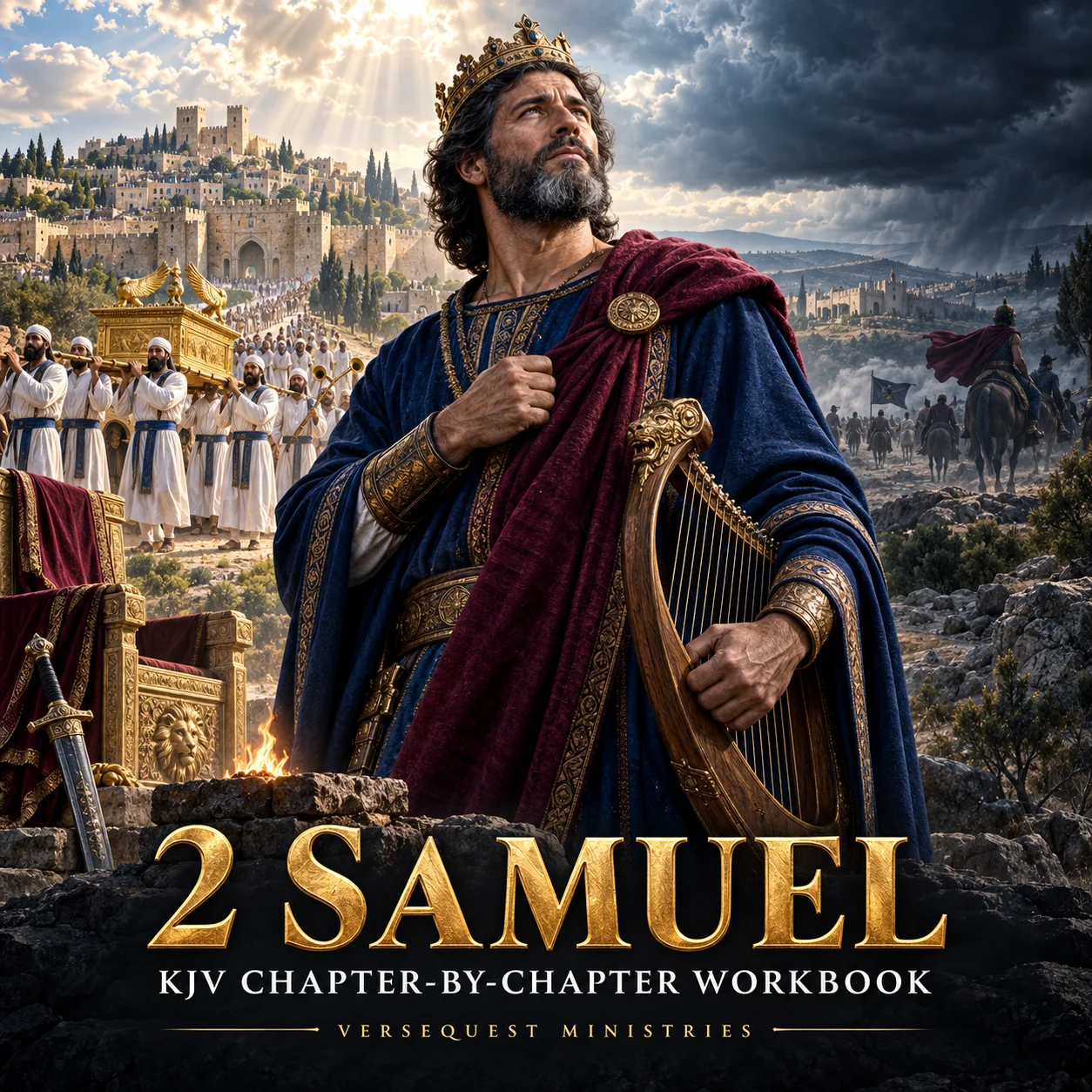
2 Samuel KJV Chapter-by-Chapter Workbook
The 2 Samuel KJV Chapter-by-Chapter Workbook is a complete 429-page downloadable Bible curriculum covering all 24 chapters of Second Samuel from a Bible-believing, King James Bible-centered, rightly divided perspective.
Every chapter includes ten student-study pages followed by a Teacher and Leader Guide and suggested answers. Students will examine David’s rise from Hebron to Jerusalem, the ark, the Davidic covenant, Mephibosheth, David’s sin and repentance, Nathan’s rebuke, Tamar and Amnon, Absalom’s rebellion, David’s exile and return, the Gibeonite famine, the remaining giants, David’s song, his mighty men, the census, and the altar at Araunah’s threshingfloor.
The workbook also includes multiple learning tracks, twenty-four-week and twelve-week schedules, a forty-eight-lesson teaching plan, five cumulative reviews, eighteen advanced studies with research worksheets, ten master charts, an eight-part final assessment, answer guides, a KJV glossary, subject and Scripture indexes, a teaching project, evaluation rubric, bookmarks, and a certificate of completion.
The PDF may be printed for handwritten study or used digitally with compatible PDF software. It is ideal for personal study, homeschool, Sunday school, church classes, small groups, Bible institutes, leadership training, and serious ministry preparation.
$19.99
Description
The 2 Samuel KJV Chapter-by-Chapter Workbook is a complete 429-page downloadable Bible curriculum designed to guide students carefully through all 24 chapters of Second Samuel. This extensive course follows David from the aftermath of Saul’s death through the establishment of his kingdom, the capture of Jerusalem, the arrival of the ark in Zion, the Davidic covenant, military victory, grievous personal failure, judgment within his household, Absalom’s rebellion, David’s restoration, his final song and last words, and the purchase of the threshingfloor where judgment is stayed.
Second Samuel presents David neither as a flawless hero nor merely as a fallen man. He is the LORD’s anointed king, a recipient of an everlasting covenant, a courageous warrior, a worshipper, a merciful ruler, a sinner, a penitent, a chastened father, and a prophetic figure whose throne points beyond himself to Jesus Christ. The workbook helps students hold these truths together without excusing David’s sins, denying his genuine faith, or forcing every detail of his life into an uncontrolled allegory.
The opening chapters examine David’s response to the deaths of Saul and Jonathan, his anointing over Judah at Hebron, the divided kingdom under Ish-bosheth, the political strength and changing allegiance of Abner, Joab’s revenge, and the murders by which opportunistic men attempt to advance themselves. David repeatedly refuses to establish his throne through private assassination. The gradual unification of the kingdom demonstrates that a promise from God may unfold through waiting, opposition, human responsibility, and providential preparation.
Students then follow David as he is anointed king over all Israel, captures Jerusalem, establishes Zion as the royal center, defeats the Philistines, and brings the ark toward the city. The workbook gives careful attention to Uzzah’s death, the error of transporting the ark upon a new cart, the revealed responsibilities of the Levites, David’s fear, the blessing upon the house of Obed-edom, and the ark’s eventual entrance into Jerusalem with sacrifice, rejoicing, and reverence.
Second Samuel 7 receives special attention as one of the great covenant chapters of Scripture. The workbook distinguishes David’s desire to build a house for the LORD from the LORD’s promise to build David a house. Students will examine the promised seed, kingdom, throne, father-son relationship, chastening provision, and everlasting fulfillment. The course carefully distinguishes the near historical fulfillment associated with Solomon from the final, sinless, everlasting fulfillment in the Lord Jesus Christ. Israel’s throne and national kingdom are preserved in their proper context rather than transferred to the Body of Christ.
The expansion of David’s kingdom is studied alongside his administration of judgment and justice, his covenant kindness toward Mephibosheth for Jonathan’s sake, and the courage of Joab and Abishai in war. These chapters reveal that biblical leadership involves more than military ability. It requires covenant faithfulness, justice, restraint, responsibility, reverence, and the willingness to serve under divine authority.
The workbook treats David’s sin with Bath-sheba and the arranged death of Uriah with the seriousness demanded by the text. David’s authority, deliberate choices, deception, abuse of power, and attempt to conceal his actions are clearly traced. Bath-sheba is not blamed for David’s conduct, and David’s later repentance is not used to erase the terrible earthly consequences of his choices. Nathan’s parable and declaration—“Thou art the man”—expose the king before the word of the LORD, while David’s confession, divine forgiveness, and continuing chastisement demonstrate the distinction between forgiven guilt and governmental consequences.
The sword within David’s household is followed through the accounts of Amnon, Tamar, Absalom, Jonadab, Joab, Ahithophel, and the divided royal family. The workbook addresses Amnon’s calculated wickedness, Tamar’s protest and desolation, David’s anger and failure to administer decisive justice, Absalom’s revenge, his exile, his return without genuine reconciliation, his manipulation of public opinion, and his eventual rebellion. Difficult and painful chapters are handled honestly without sensationalism, victim-blaming, or the confusion of vengeance with lawful justice.
David’s flight from Jerusalem reveals a humbled king surrounded by both loyal servants and calculating opportunists. Students will examine Ittai’s loyalty, Zadok and Abiathar with the ark, Hushai’s dangerous assignment, Ahithophel’s betrayal, Ziba’s accusation, Shimei’s cursing, Abishai’s desire for immediate vengeance, and David’s willingness to submit himself to the LORD’s judgment. The defeat of Ahithophel’s counsel, Absalom’s death, and David’s overwhelming grief demonstrate the collision between royal responsibility and parental sorrow.
The closing chapters examine David’s return to Jerusalem, continuing tribal tensions, Sheba’s rebellion, Joab’s murder of Amasa, the wisdom that preserves Abel, the famine connected with Saul’s treatment of the Gibeonites, Rizpah’s vigil, the remaining Philistine giants, David’s song of deliverance, his last words, the record of his mighty men, and the census that brings national judgment. The book concludes at Araunah’s threshingfloor, where David refuses to offer unto the LORD that which costs him nothing. The accepted sacrifice and the staying of the plague connect the conclusion of Second Samuel with the future site of Solomon’s temple.
Every chapter receives a consistent twelve-page treatment. The first ten pages guide the student through chapter focus and structure, exposition, people and motives, KJV vocabulary, doctrine and right division, cross-reference chains, difficult passages, special studies, written exercises, review, and teach-back preparation. The final two pages provide a coordinated Teacher and Leader Guide followed by suggested answers, interpretive controls, and a model chapter summary.
The additional curriculum transforms the workbook into a complete course rather than a simple collection of study questions. It includes course instructions, learning tracks, course outcomes, interpretive principles, a historical overview, a seven-part structure of Second Samuel, geography and character studies, a twenty-four-week schedule, a twelve-week schedule, and a forty-eight-lesson teaching plan.
Five cumulative review units reinforce the major movements of the book. Eighteen advanced verse and doctrine studies investigate subjects such as Saul’s death and the Amalekite’s claim, David’s delayed throne, Joab’s complicated character, David’s anointings, the ark and Uzzah, the Davidic covenant, Mephibosheth and Ziba, David’s repentance, fourfold restitution, Tamar and failed justice, Absalom’s manipulation, and other important textual and doctrinal questions. Each advanced study includes a coordinated research worksheet requiring students to distinguish explicit statement, necessary inference, plausible inference, and speculation.
Ten master charts organize major people, events, covenant relationships, geographic movements, rebellions, consequences, and doctrinal distinctions. Each chart is followed by a reconstruction worksheet that requires students to reproduce and explain the material rather than merely look at a finished chart.
The course concludes with an eight-part final assessment covering chapter movements, principal people, covenant and kingdom, sin and consequences, difficult passages, cross-references, synthesis and application, and teaching preparation. A six-page answer guide supplies model elements and interpretive controls. The workbook also includes an eight-page KJV glossary, a six-page selected subject index, an eight-page selected Scripture index, a final teaching project, project requirements, an evaluation rubric, further-study recommendations, a final challenge, and a certificate of completion.
This downloadable PDF contains searchable text and organized navigation bookmarks. It may be printed for handwritten study or used on a computer or tablet. Readers using compatible PDF software may highlight material, insert comments, draw markings, and add digital notes or text boxes.
The 2 Samuel KJV Chapter-by-Chapter Workbook is suitable for serious personal Bible study, homeschool families, Sunday school classes, Christian schools, church Bible-study groups, discipleship programs, Bible institutes, pastors, preachers, teachers, prison ministries, recovery ministries, and leadership training. It is a working Bible curriculum intended to help students open their King James Bible, examine the actual words, compare Scripture with Scripture, recognize doctrinal distinctions, answer difficult questions responsibly, and develop the ability to explain and teach Second Samuel faithfully.
The transition from Saul to David — Second Samuel begins after Saul’s death and records the gradual establishment of David’s promised kingdom. David’s lament for Saul and Jonathan — David refuses to rejoice over personal advancement purchased through national tragedy. The Amalekite’s self-serving testimony — The messenger attempts to gain favor through a report that conflicts with the inspired narrative of Saul’s death. David’s refusal to build his throne through murder — The Amalekite, Rechab, and Baanah learn that David will not reward men who claim to remove his rivals. The divided kingdom — David reigns over Judah in Hebron while Abner maintains the northern tribes under Ish-bosheth. Promise unfolding through patience — David does not force the complete fulfillment of his anointing through indiscriminate violence. Joab’s strength and moral hardness — Joab repeatedly combines military usefulness and personal loyalty with revenge, manipulation, and bloodshed. Jerusalem and Zion — The captured stronghold becomes Israel’s royal capital and the city associated with David’s throne. The ark brought to Jerusalem — The movement of the ark emphasizes reverence, revealed order, worship, sacrifice, and the holiness of God. Uzzah and the new cart — Good intentions do not replace obedience to God’s revealed order. David’s worship before the LORD — David’s rejoicing demonstrates public humility and gratitude rather than concern for royal appearance. The Davidic covenant — The LORD promises David a house, seed, kingdom, and throne with an everlasting fulfillment. Solomon and Christ distinguished — Solomon fulfills important near elements of the covenant, while Jesus Christ supplies its final sinless and everlasting fulfillment. Israel’s kingdom and the Body of Christ distinguished — David’s national throne, land, warfare, and royal administration must not be transferred to the Church. Judgment and justice in government — David’s administration is measured by righteousness rather than conquest alone. Covenant kindness toward Mephibosheth — David remembers his covenant with Jonathan and grants Mephibosheth a permanent place at the royal table. Courage under divided pressure — Joab’s battlefield statement joins personal responsibility, mutual support, and submission to the LORD’s will. The abuse of royal power — David’s sin with Bath-sheba demonstrates how authority can be misused for personal desire and concealment. Uriah’s integrity — Uriah’s conduct sharply contrasts with David’s deception and moral collapse. The word of God confronting the king — Nathan’s declaration exposes the man whom political power had temporarily protected. Confession, forgiveness, and consequences — David is forgiven, but the sword and governmental consequences are not removed from his house. The death of David’s child — The passage demands careful interpretation and should not be made the sole foundation for a universal doctrine. Fourfold restitution and the sword — David’s own sentence and Nathan’s prophecy form an important framework for the later ruin within his household. Tamar’s protest and desolation — Scripture records her words, innocence, resistance, and grief while placing guilt upon Amnon. Failed justice within the royal house — David’s passivity allows wickedness, resentment, and private revenge to grow. Absalom’s outward beauty and inward rebellion — Personal appearance, charisma, accessibility, and public promises conceal ambition and treachery. Reconciliation without repentance — Absalom’s physical return does not produce genuine spiritual or relational restoration. The theft of Israel’s hearts — Absalom manufactures dissatisfaction and uses religious language to legitimize political rebellion. David’s humbled flight — The established king leaves Jerusalem in sorrow and submits himself to the LORD’s sovereign decision. Loyalty during adversity — Ittai, Hushai, Zadok, Abiathar, Barzillai, and others reveal their character when David’s position appears weakest. Ahithophel’s counsel and downfall — Human wisdom cannot overthrow the LORD’s determined purpose. Shimei’s cursing — David accepts humiliation without pretending that every word or action permitted by God is morally approved by God. Absalom’s death and David’s grief — The king’s private sorrow collides with his public responsibility to the people who defended his throne. The king’s return — David’s restoration exposes unresolved accusations, divided loyalties, political calculation, and tribal tension. Sheba’s rebellion — A single rebel exploits the continuing fracture between Judah and Israel. The wisdom that saves Abel — A wise woman separates the guilty rebel from the city and prevents unnecessary destruction. Covenant bloodguilt and the Gibeonites — Saul’s violation of Israel’s oath produces consequences that outlive the original offender. Rizpah’s vigil — Her endurance gives human weight to a severe episode of covenant judgment. The remnant of the giants — David’s servants continue the conflict against Philistine champions when David’s own physical strength declines. David’s song of deliverance — The LORD is celebrated as rock, fortress, shield, refuge, lamp, and tower of salvation. David’s statement of cleanness — The language must be interpreted within the song’s historical and covenant setting rather than as a claim of lifelong sinless perfection. The just ruler — David’s last words describe government ruled in the fear of God and look beyond imperfect human administration. The everlasting covenant — David rests his final hope in what God has ordered and made sure. The mighty men — The kingdom’s victories involve courageous servants whose names and deeds are remembered. The sin of numbering Israel — The census reveals pride, misplaced confidence, moral agency, satanic provocation, and divine judicial permission. David’s costly sacrifice — David refuses to offer unto the LORD that which costs him nothing. The threshingfloor and future temple site — The book ends where judgment is stayed and the location of Israel’s future temple is identified. David as a controlled type of Christ — David may foreshadow Christ as anointed king, rejected ruler, victorious deliverer, and covenant head, but David’s sins prohibit careless comparison. The sure purpose of God through imperfect people — Human failure brings real consequences without overturning the covenant purpose established by the LORD.
- Central argument: Second Samuel demonstrates how the LORD establishes David’s kingdom and confirms an everlasting covenant while exposing the king’s sin, preserving divine justice, administering chastisement, and carrying the promised throne forward toward Jesus Christ.
- Opening and conclusion: The book opens with David lamenting the fallen king and closes with David offering sacrifice at the threshingfloor where national judgment is stayed.
- Major movement: Division leads to unification, unification to establishment, establishment to covenant, covenant privilege to royal failure, failure to household judgment, rebellion to exile, exile to restoration, and restoration to final testimony and sacrifice.
- Historical setting: David reigns first over Judah from Hebron for seven years and six months and then over all Israel from Jerusalem for thirty-three years.
- David and Saul’s death: David’s response proves that he does not consider Saul’s death merely an opportunity for personal advancement.
- The Amalekite’s claim: His account should be distinguished from the inspired narrator’s account in 1 Samuel 31.
- David’s delayed throne: Divine designation does not excuse self-installation, political murder, or impatience.
- Abner and Ish-bosheth: The northern kingdom depends heavily upon Abner’s military power, leaving Ish-bosheth politically weak.
- Joab’s recurring problem: Joab repeatedly accomplishes necessary military work through methods stained by personal vengeance and unlawful violence.
- Jerusalem: The capture of Zion gives the united kingdom a new political and geographic center not previously controlled by either Judah’s or Saul’s royal establishment.
- The ark: David’s desire to honor the ark must be governed by the LORD’s revealed order.
- Uzzah: Sincerity and urgency do not make disobedience safe.
- Michal: Her contempt exposes a heart concerned with royal appearance rather than David’s worship before the LORD.
- The covenant: David proposes to build a house for God, but God promises to build David a house.
- The promised seed: The covenant contains historical elements fulfilled through Solomon and an everlasting royal fulfillment realized in Jesus Christ.
- The chastening clause: The possibility of iniquity belongs to the fallible historical seed and must not be imposed upon the sinless Son of God.
- Kingdom distinction: The Davidic covenant concerns David’s house, Israel’s kingdom, and a real throne; it is not a symbolic promise that the Body of Christ replaces Israel.
- Mephibosheth: David’s kindness rests upon his covenant with Jonathan rather than Mephibosheth’s ability to repay him.
- Ziba: His later accusation requires careful comparison with Mephibosheth’s explanation after David returns.
- David and Bath-sheba: The king bears responsibility for seeing, sending, taking, concealing, and arranging Uriah’s death.
- Uriah: His discipline and loyalty intensify the exposure of David’s conduct.
- Nathan: Faithful ministry requires the courage to bring the word of God even to the highest human authority.
- David’s confession: “I have sinned against the LORD” is direct and personal, but the brevity of the confession does not minimize the depth of the repentance revealed elsewhere.
- Forgiveness and consequences: The LORD puts away David’s sin, yet the sword remains within his household.
- The child’s death: David’s statement that he will go to the child supplies hope but should be handled alongside the whole counsel of Scripture.
- Tamar: Her words and resistance establish her innocence and expose the calculated wickedness of Amnon.
- David’s inaction: Anger without the administration of justice leaves room for private revenge.
- Absalom: He combines beauty, charisma, calculated accessibility, promises, religious language, and political ambition.
- Reconciliation: Bringing a person back geographically does not settle guilt, restore trust, or produce repentance.
- Stolen hearts: Absalom wins influence by exaggerating grievances and presenting himself as the solution.
- The forty-year notice: The KJV reading in 2 Samuel 15:7 should be preserved even where the precise chronological calculation remains difficult.
- David’s flight: His departure from Jerusalem displays sorrow, humility, concern for the city, and submission to the LORD’s decision.
- Shimei: God may permit or judicially employ a man’s wicked act without morally approving the wickedness.
- Ahithophel: Brilliant counsel cannot prevail when the LORD has determined to defeat it.
- Absalom’s death: Joab secures the kingdom militarily while deliberately disregarding David’s command concerning Absalom.
- David’s grief: Personal sorrow becomes a public leadership crisis when the king appears to dishonor those who risked their lives for him.
- The return: Restoration to Jerusalem does not instantly remove tribal distrust, political rivalry, or unresolved accusations.
- Sheba: Rebellion grows quickly where division has not been fully healed.
- The wise woman: Wisdom preserves the innocent by identifying the actual source of the conflict.
- The Gibeonites: Joshua 9 is essential for understanding why Saul’s bloodguilt becomes a covenant issue.
- Rizpah: Her prolonged vigil brings grief and human dignity into the account of severe national judgment.
- The giants: The parallel records should be compared carefully without casually correcting either account.
- David’s cleanness: The words of 2 Samuel 22 belong to a song of historical deliverance and covenant conduct, not a denial of David’s recorded sins.
- The last words: The ideal of a just ruler exposes the limitations of every fallen king and anticipates the righteous rule of Christ.
- The mighty men: God’s work through David includes the courage, loyalty, and sacrifice of named servants.
- The census: Second Samuel emphasizes the LORD’s judicial anger, while First Chronicles identifies Satan’s provoking agency; David remains morally accountable for his choice.
- Seven years and three years: The famine notices connected with the census should be studied carefully without assuming that the KJV text requires correction.
- The altar: David refuses a costless sacrifice and purchases the threshingfloor lawfully.
- The temple connection: First Chronicles identifies the location as the future site connected with the house of the LORD.
- Controlled typology: David may picture Christ in anointing, rejection, kingship, conquest, covenant, and return, but David’s adultery, deception, bloodshed, and parental failures cannot be transferred to Christ.
- Important distinction: Forgiveness restores fellowship with God, but it does not automatically erase every earthly result produced by sin.
- Important distinction: Providence does not cancel human responsibility, and human failure does not overthrow the sovereign covenant purpose of God.
- Question for further study: How does David’s response to Saul’s death prepare the reader to understand his approach to kingship?
- Question for further study: What does Joab’s life teach about the difference between effectiveness and faithfulness?
- Question for further study: Which promises in 2 Samuel 7 apply directly to Solomon, which extend beyond Solomon, and which are fulfilled only in Jesus Christ?
- Question for further study: How does Absalom use image, accessibility, grievance, religious speech, and promises to manufacture political loyalty?
- Question for further study: How do Psalms 32 and 51 deepen the reader’s understanding of David’s confession in 2 Samuel 12?
- Question for further study: What does the movement from the ark in Jerusalem to the altar at the threshingfloor contribute to the book’s theological structure?
- Memorable teaching point: God gave David a throne, but the throne never gave David permission to disobey the word of God.
- Memorable teaching point: David’s sin was forgiven, but forgiveness did not make the sword disappear from his house.
- Memorable teaching point: Absalom looked like a king, spoke like a reformer, and acted like a rebel.
- Memorable teaching point: Joab could win a battle and still wound the kingdom.
- Memorable teaching point: The book that begins beside the fallen house of Saul ends beside an altar where judgment is stayed.
- Memorable teaching point: David’s greatest security was not his army, his city, or even his personal record; it was the everlasting covenant that God had ordered and made sure.
For personal Bible study, the workbook provides a disciplined method for working through every chapter of Second Samuel. Students can identify chapter movements, trace motives and consequences, develop KJV vocabulary, construct cross-reference chains, examine difficult passages, complete written exercises, and produce their own chapter summaries before consulting the suggested answers.
For homeschool families, the workbook can function as a complete Old Testament Bible course. Families may follow the twenty-four-week schedule, the twelve-week intensive schedule, or divide the forty-eight-lesson teaching plan across a longer school term. The learning tracks allow parents to choose essential, standard, or more advanced assignments according to the student’s age and ability.
For Sunday school and church Bible classes, teachers can assign the chapter reading and selected student pages before class. Each Teacher and Leader Guide supplies learning outcomes, suggested teaching flow, interpretive cautions, and an extension assignment. The cumulative reviews and master charts can be used to reinforce major movements between teaching units.
For small groups and discipleship, participants can read the assigned chapter, complete observation and doctrine pages, compare answers, discuss the difficult passage, and rotate teach-back assignments. The accounts of leadership, temptation, abuse of power, confession, family conflict, loyalty, betrayal, forgiveness, consequences, grief, and restoration provide substantial material for responsible discussion.
For pastors, preachers, and Bible teachers, the chapter outlines, doctrinal propositions, KJV vocabulary, cross-reference chains, character studies, advanced research sections, and master charts provide an organized foundation for sermons, teaching series, leadership studies, biographical messages, and Old Testament surveys. The workbook supplies structure while keeping the open Bible—not the workbook—as the final authority.
For Bible institutes and ministry training, students may complete every page, defend conclusions concerning difficult passages, reconstruct the master charts, complete the final assessment, and prepare the required teaching project. The material trains students to distinguish history, doctrine, prophecy, typology, moral application, necessary inference, plausible inference, and unsupported speculation.
For leadership training, the workbook provides detailed case studies involving David, Joab, Abner, Nathan, Absalom, Ahithophel, Hushai, Ittai, Barzillai, and the wise woman of Abel. These accounts allow students to evaluate courage, loyalty, manipulation, accountability, justice, mercy, public responsibility, private character, and the dangers of power without restraint.
For prison, recovery, counseling, and care ministries, carefully selected chapters may support studies concerning destructive choices, hidden sin, confession, consequences, grief, family damage, manipulation, anger, revenge, restored responsibility, and the mercy of God. Teachers should preserve the historical and doctrinal setting while making careful practical applications.
A King James Bible with readable reference formatting
An exhaustive concordance keyed to the King James Bible
A reliable KJV Bible dictionary for royal offices, military terms, ancient customs, measurements, and geographical names
A cross-reference Bible or treasury of Scripture cross-references
A map showing Judah, Israel, Hebron, Jerusalem, Mahanaim, Gibeon, Rabbah, Geshur, the Jordan, and Abel
A timeline connecting First Samuel, Second Samuel, First Kings, and First Chronicles
A comparative study of Saul’s death using 1 Samuel 31, 2 Samuel 1, and 1 Chronicles 10
A study of the ark using Exodus 25, Numbers 4, Numbers 7, 1 Samuel 4–7, 2 Samuel 6, and 1 Chronicles 13–16
A Davidic covenant study using 2 Samuel 7, 1 Chronicles 17, Psalms 89 and 132, Isaiah 9 and 11, Jeremiah 23 and 33, Luke 1, Acts 2 and 13, and Revelation 22
A study of David’s repentance using 2 Samuel 11–12 and Psalms 32 and 51
A comparison of David’s song in 2 Samuel 22 with Psalm 18
A study of Absalom’s rebellion across 2 Samuel 13–19
A character study of Joab across Second Samuel and 1 Kings 2
A covenant-kindness study using 1 Samuel 18 and 20 with 2 Samuel 9, 16, 19, and 21
A study of the census using 2 Samuel 24 and 1 Chronicles 21
A study of the future temple site using 2 Samuel 24, 1 Chronicles 21–22, and 2 Chronicles 3
1 Samuel KJV Chapter-by-Chapter Workbook for the historical record leading directly into Second Samuel
Through the Bible with VerseQuest for a broader survey of all 66 books of the King James Bible
Related products
-
Doctrine Series
-
Doctrine Series
-
-14%
- Judas Iscariot and the Coming Antichrist – Premium KJV Prophecy Study
- A massive 459-page premium KJV prophecy study tracing the biblical connection between Judas Iscariot, the son of perdition, and the coming Antichrist. This detailed VerseQuest Ministries PDF examines Judas’ betrayal,…
- Original price was: $34.99.$29.99Current price is: $29.99.
- Add to cart
-
-14%
-
VerseQuest Premium Library
-
-67%
- The Book of Psalms Made Plain – 383-Page KJV Psalm Study
- The Book of Psalms Made Plain is a 383-page premium KJV Bible study featuring 54 detailed essays through the major themes, doctrines, prophecies, prayers, laments, and praises of the Psalms.…
- Original price was: $29.99.$9.99Current price is: $9.99.
- Add to cart
-
-67%
-
Prophecy Studies
-
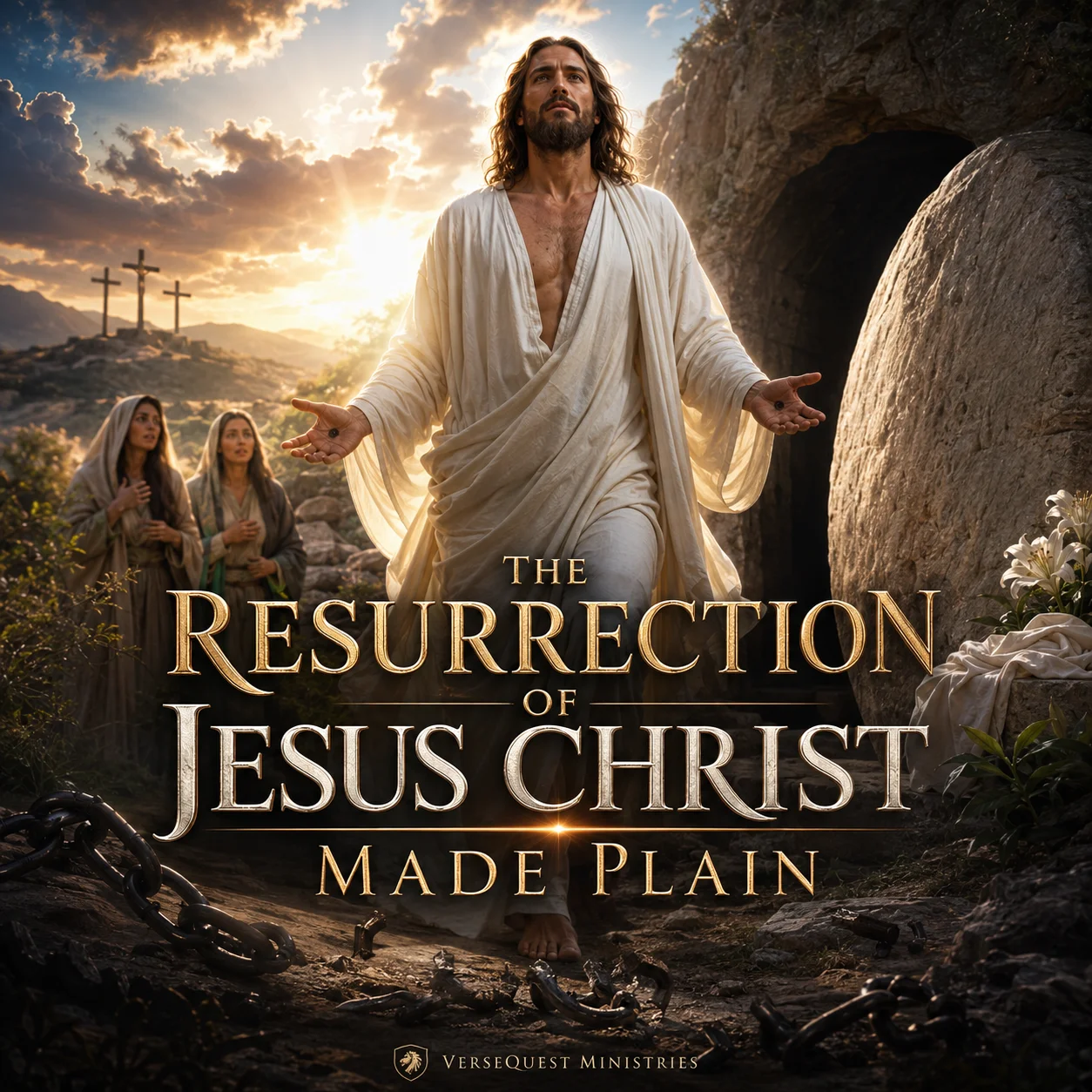
- The Resurrection of Jesus Christ Made Plain – 501-Page KJV Bible Study
- A massive 501-page VerseQuest Ministries PDF Bible study defending and explaining the bodily resurrection of Jesus Christ from a KJV, rightly divided perspective. This 80-essay study covers the empty tomb,…
- $34.99
- Add to cart
-
-
Angels
-
-67%
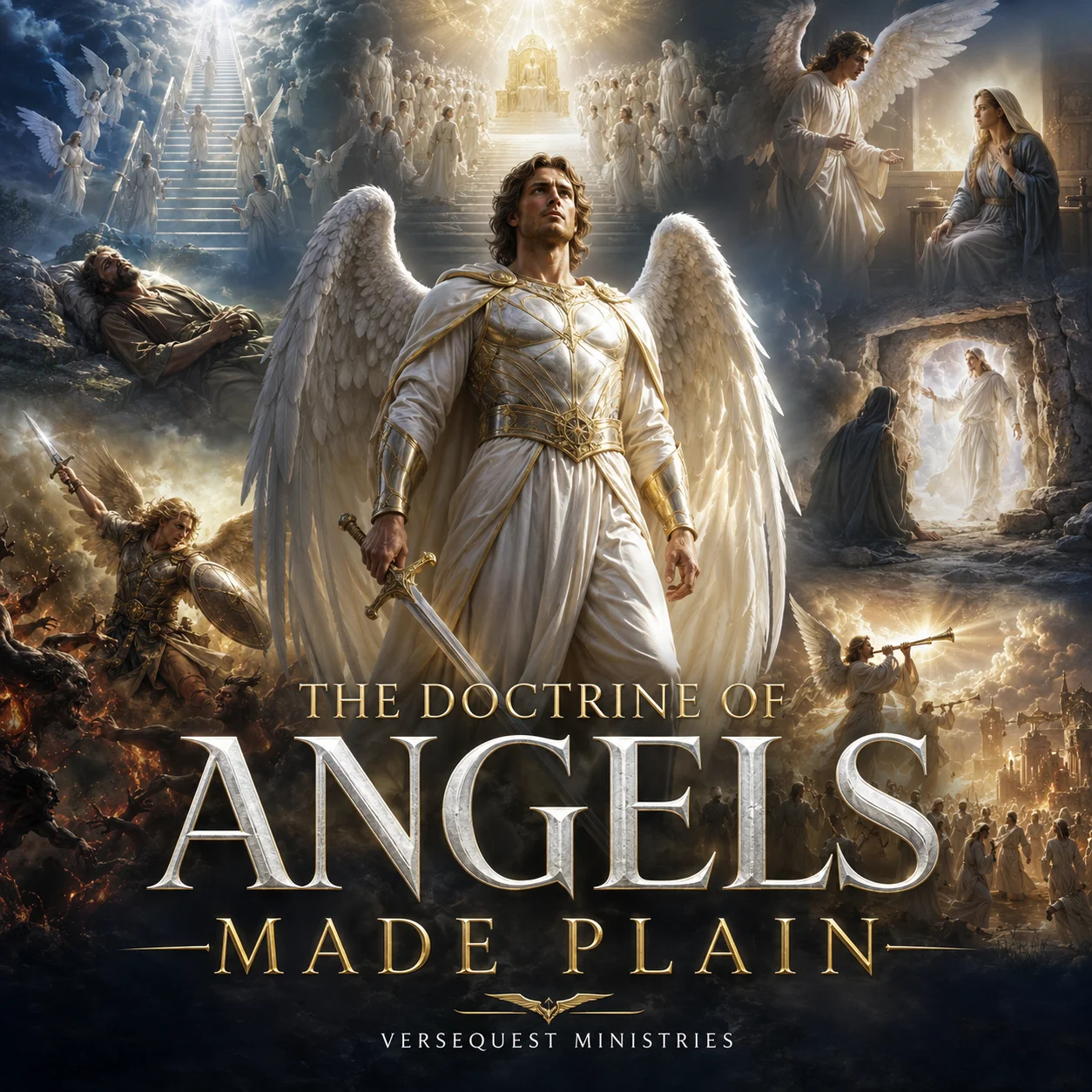
- The Doctrine of Angels Made Plain – 620-Page KJV Bible Study PDF
- The Doctrine of Angels Made Plain is a 620-page KJV Bible study that traces angels from Genesis to Revelation. This premium VerseQuest PDF explains holy angels, Christ’s supremacy over angels,…
- Original price was: $29.99.$9.99Current price is: $9.99.
- Add to cart
-
-67%