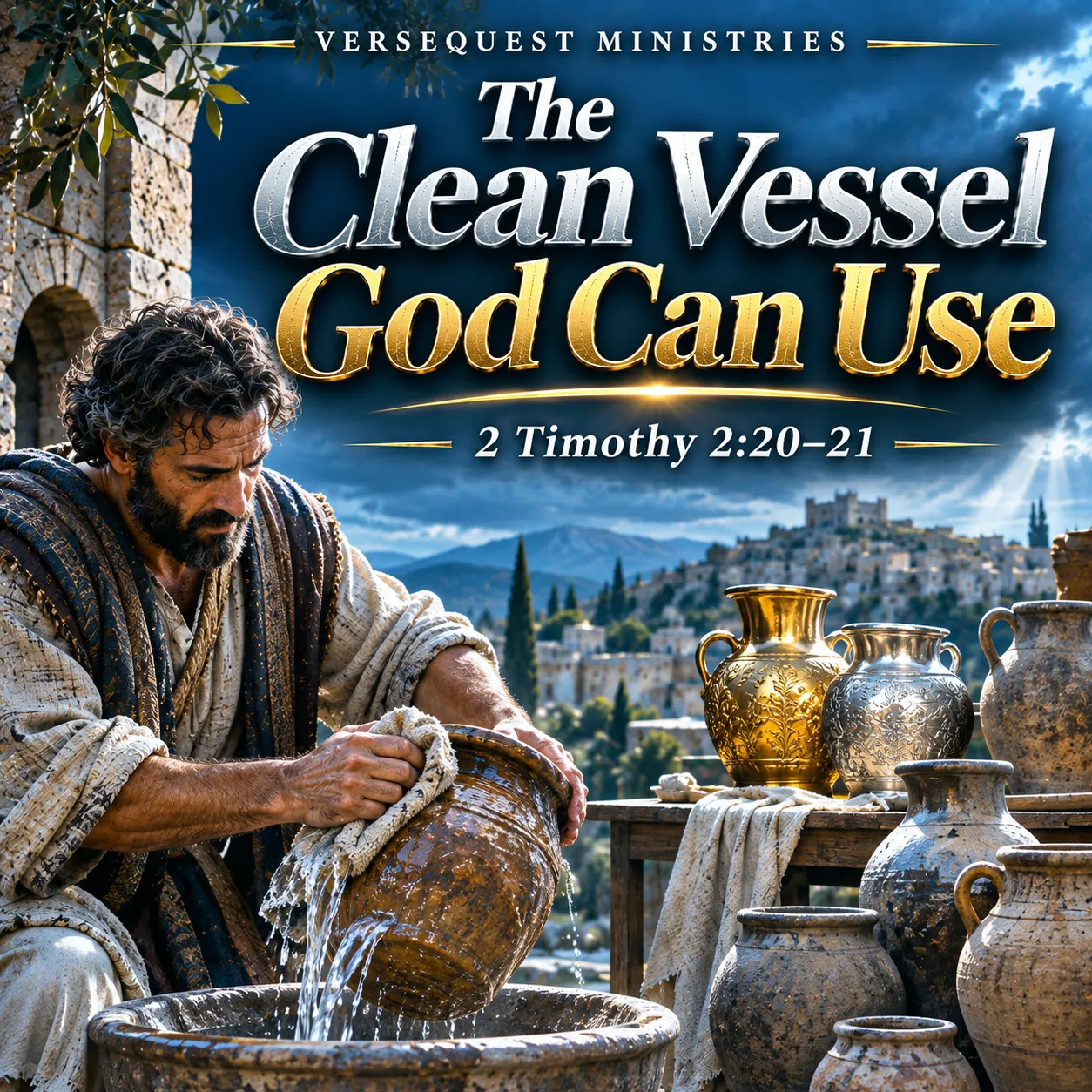
Sermon Title:
The Clean Vessel God Can Use
Key Passage:
2 Timothy 2:20–21
“But in a great house there are not only vessels of gold and of silver, but also of wood and of earth; and some to honour, and some to dishonour. If a man therefore purge himself from these, he shall be a vessel unto honour, sanctified, and meet for the master’s use, and prepared unto every good work.” (2 Timothy 2:20–21)
Series:
The Book God Gave
Topic:
The Believer’s Responsibility to Separate From Doctrinal Error and Iniquity, Pursue Biblical Holiness, and Become a Sanctified Vessel Prepared for the Master’s Use
Book:
2 Timothy
Speaker:
Paul Tackett
Suggested Sermon Text:
2 Timothy 1:6–14; 2 Timothy 2:1–26; 2 Timothy 3:1–17; 2 Timothy 4:1–8; 1 Timothy 3:8–16; 1 Timothy 4:6–16; 1 Timothy 6:3–12; Romans 3:21–28; Romans 6:1–23; Romans 8:1–14; Romans 12:1–2; 1 Corinthians 3:11–15; 1 Corinthians 6:9–20; 2 Corinthians 4:7–12; 2 Corinthians 5:14–21; 2 Corinthians 6:14–18; 2 Corinthians 7:1; Galatians 2:20; Galatians 5:16–26; Ephesians 2:8–10; Ephesians 4:17–32; Ephesians 5:25–27; Philippians 2:12–16; Colossians 1:9–14; Colossians 3:1–17; Titus 2:11–14; Titus 3:5–8; Hebrews 12:1–3; 1 Peter 1:13–16.
Short Sermon Description:
Second Timothy 2:20–21 presents one of the Apostle Paul’s most searching illustrations concerning Christian usefulness: the great house containing vessels of different materials, some unto honour and others unto dishonour. This sermon examines what it means to become “a vessel unto honour, sanctified, and meet for the master’s use, and prepared unto every good work,” carefully placing the passage within Paul’s warnings concerning false doctrine, profane and vain babblings, the corruption of truth, and the destructive influence of teachers who claimed that the resurrection was already past. It explains why the command to purge oneself must be understood in relation to doctrinal separation and practical holiness rather than reduced to a general illustration about personal cleanliness. The message distinguishes the believer’s salvation by grace from his usefulness in Christian service, showing that cleansing does not purchase eternal life but prepares a saved man for honorable service to the Lord. Special attention is given to the necessity of rightly dividing Scripture, departing from iniquity, fleeing youthful lusts, pursuing righteousness, faith, charity, and peace, and maintaining a pure heart before God. The sermon also examines why usefulness requires more than religious talent, education, popularity, or natural ability, and why the servant of the Lord must combine sound doctrine with patience, gentleness, and meekness when instructing those who oppose the truth. Drawing upon 2 Timothy 2:14–26, Romans 6, 2 Corinthians 7, Ephesians 4, and Titus 2, the outline provides a detailed, rightly divided treatment of separation, sanctification, doctrinal purity, spiritual maturity, the believer’s testimony, and preparation for Christian service. Preachers, teachers, and Bible students will gain a comprehensive, sermon-ready framework for teaching the difference between belonging to the Lord and being useful in His service, while emphasizing that genuine Christian holiness is the response to redemption rather than a substitute for the finished work of Jesus Christ.
THE CLEAN VESSEL GOD CAN USE
Introduction
There is something remarkable about a man who wants God to use him but has little interest in becoming the kind of vessel God says is suitable for His use. He wants an opportunity to preach, but he does not want his doctrine examined. He wants people to respect his ministry, but he becomes offended when somebody corrects his conduct. He wants spiritual influence, but he refuses to separate from influences that are corrupting his thinking. He wants the blessing of God upon his work, but he insists upon retaining personal habits, attitudes, and associations that Scripture plainly warns against. Then he wonders why his religious activity produces so little genuine spiritual fruit. Second Timothy 2:21 confronts that contradiction with an illustration so simple that even a child can understand it: “If a man therefore purge himself from these, he shall be a vessel unto honour, sanctified, and meet for the master’s use, and prepared unto every good work.” Paul does not ask whether the vessel possesses an impressive appearance, a celebrated history, or an expensive label. He addresses whether it is suitable for honorable use. A man may polish the outside of a dirty cup until it shines like silver, but nobody with any sense wants to drink from it until the inside has been cleaned. Likewise, a Christian may develop impressive external abilities while neglecting the very doctrinal and moral purity necessary for faithful service. The question is not merely whether a man wants to be used. The question is whether he is willing to be cleansed from what makes his service dishonorable.
But this passage contains much more than a pleasant religious illustration about washing dishes. Paul is writing his final epistle to Timothy, warning about doctrinal corruption, false teachers, spiritual compromise, and the increasing difficulties associated with the last days. Immediately before introducing the vessels, Paul commands Timothy to study and rightly divide the word of truth. He warns against profane and vain babblings. He identifies Hymenaeus and Philetus, who had erred concerning the truth by teaching that the resurrection was past already. Their teaching was not harmless speculation. Paul says it was overthrowing the faith of some. Then he declares, “Nevertheless the foundation of God standeth sure,” and commands everyone naming the name of Christ to depart from iniquity. Only then does he introduce the great house containing vessels unto honour and dishonour. That context cannot be ignored. The cleansing Paul describes is directly related to separating from doctrinal corruption and iniquity. A preacher who reduces the passage to a generic motivational speech about becoming a better person has missed the warning that makes the illustration necessary. God is concerned with the truth inside the vessel as well as the behavior outside it. The man who fills himself with false doctrine while maintaining a respectable appearance is not a clean vessel merely because he avoids a few publicly scandalous sins.
There is also a vital distinction between salvation and service. Paul is not teaching that a sinner must purge himself sufficiently before Jesus Christ will save him. Salvation comes through the finished work of the Lord Jesus Christ, who died for our sins, was buried, and rose again the third day according to the Scriptures. The sinner receives eternal life through faith in the Saviour, not through his ability to cleanse his own fallen nature. Ephesians 2:8–9 declares that salvation is by grace through faith, not of works. Yet the following verse explains that believers are created in Christ Jesus unto good works. Second Timothy 2:21 concerns becoming a vessel prepared for those works, not purchasing the salvation that makes Christian service possible. A saved man may possess eternal life while remaining practically unfit for certain honorable responsibilities because of doctrinal error, fleshly conduct, or persistent disobedience. That does not mean Christ’s finished work has failed. It means the believer’s walk has failed to agree with the position God has already given him. The Lord does not require a sinner to become a clean vessel before He can save him, but He certainly instructs the saved man to separate from what makes him unfit for honorable service. That is the truth we must examine if we want to understand what it means to become a clean vessel God can use.
I. THE GREAT HOUSE CONTAINS VESSELS FOR HONOUR AND DISHONOUR
Key Text: 2 Timothy 2:20
Supporting Texts: 2 Timothy 2:14–21; 1 Corinthians 3:11–15; 1 Corinthians 12:12–27; 2 Corinthians 5:10; Romans 12:3–8
Paul begins the illustration with the words, “But in a great house there are not only vessels of gold and of silver, but also of wood and of earth; and some to honour, and some to dishonour.” The picture is drawn from ordinary household life. A great house contains many kinds of vessels. Some are valuable, others inexpensive. Some are suited for honorable purposes, while others are associated with common or dishonorable uses. The owner does not employ every vessel for the same purpose. A vessel used for refuse is not brought directly to the table for serving honored guests. A container may belong inside the house without being suitable for every activity conducted there. Paul uses that familiar distinction to teach Timothy about spiritual usefulness in the midst of a religious environment where sound doctrine and corrupt teaching are both encountered. The image is not given merely to encourage Christians to become more impressive. Its central concern is whether a man is a vessel unto honour or dishonour before the Master.
We should also be careful not to force details upon the illustration that Paul does not establish. He mentions gold, silver, wood, and earth, but the text does not provide a rigid identification of every material with a particular class of Christians. We should not simply announce that gold represents pastors, silver represents missionaries, wood represents ordinary believers, and earth represents some inferior group of church members. The passage provides no such classification. Neither does the expense of the material automatically settle the spiritual question. Paul directs attention toward the distinction between honorable and dishonorable use and then explains how a man may become a vessel unto honour. The essential issue is fitness for the Master’s purpose. The preceding references to doctrinal corruption also warn us against reducing the great house to a guaranteed inventory of only regenerate members of the body of Christ. The wider professing religious environment includes genuine believers and those who mishandle or corrupt the truth. The illustration must be allowed to serve Paul’s actual warning rather than becoming an excuse to invent an elaborate system of spiritual rankings.
There is a practical lesson for every Christian. The Lord’s people possess different gifts, abilities, opportunities, and responsibilities. First Corinthians 12 teaches that the body contains many members, and every member does not perform the same function. Yet the most visible position is not necessarily the most honorable service. A person may speak before thousands while dishonoring Christ through false doctrine or corrupt conduct. Another believer may serve quietly, faithfully, and honestly without receiving public recognition. God does not measure usefulness according to the applause surrounding a vessel. The Master determines its proper use. The Christian should therefore stop confusing prominence with honor and obscurity with failure. A vessel does not become honorable because it sits where everybody can see it. It becomes honorable because it is suited to the purpose of the One who owns the house.
Main Truth: The great house illustrates the distinction between honorable and dishonorable usefulness, showing that fitness for the Master’s service matters more than outward prominence, material value, or religious reputation.
II. THE FOUNDATION OF GOD STANDS SURE WHILE THE BELIEVER IS COMMANDED TO DEPART FROM INIQUITY
Key Text: 2 Timothy 2:19
Supporting Texts: 2 Timothy 2:16–21; Ephesians 1:13–14; Ephesians 4:30; Romans 8:31–39; Romans 6:1–14
Before Paul speaks about cleansing the vessel, he declares, “Nevertheless the foundation of God standeth sure, having this seal, The Lord knoweth them that are his.” That statement appears immediately after his warning concerning Hymenaeus and Philetus, whose false doctrine was overthrowing the faith of some. Paul is not suggesting that the errors of men can overthrow the foundation established by God. The truth remains secure even when false teachers corrupt their understanding of it. Human confusion does not make divine revelation uncertain. Religious organizations may compromise. Teachers may fall into error. Congregations may become divided by false doctrine. But the Lord knows those who belong to Him. The foundation of God does not become unstable because men have become unstable in their teaching. That distinction matters especially when false doctrine creates confusion concerning salvation, the resurrection, and the believer’s standing in Jesus Christ.
Paul then places another declaration beside the first: “And, Let every one that nameth the name of Christ depart from iniquity.” Notice the relationship. The Lord knows those who are His, and those who name His name are commanded to depart from iniquity. These are not contradictory statements. One establishes divine certainty; the other establishes human responsibility. The security of those belonging to Christ must never become an excuse for remaining deliberately attached to sin or doctrinal corruption. The same apostle who preached justification by faith also commanded believers to deny ungodliness, flee youthful lusts, and separate from error. Romans 6:1 asks whether Christians should continue in sin so grace may abound. The answer remains, “God forbid.” Salvation does not become more secure because the believer disobeys, nor does obedience purchase the security Christ provides. The two matters must remain properly distinguished.
That distinction is especially important when preaching about the clean vessel. If a man teaches that every failure in Christian service proves the individual has lost salvation, he has confused the believer’s standing with his stewardship. But if another man teaches that because salvation is secure, the believer’s conduct no longer matters, he has also contradicted Paul. The foundation stands sure, and the command to depart from iniquity remains in force. The saved man ought to conduct himself in a way that agrees with the Saviour who purchased him. If he discovers dishonesty, false teaching, impurity, bitterness, or other forms of iniquity in his life, the proper response is not to defend them with eternal security. It is to depart from them because he belongs to Jesus Christ. God’s certainty concerning His people is not permission for His people to become careless concerning God’s truth.
Main Truth: The foundation of God remains sure, but everyone who names the name of Christ is responsible to depart from iniquity rather than using assurance of salvation as an excuse for disobedience.
III. “PURGE HIMSELF FROM THESE” REQUIRES SEPARATION FROM CORRUPT DOCTRINE AND DISHONOUR
Key Text: 2 Timothy 2:21
Supporting Texts: 2 Timothy 2:14–18; 2 Timothy 2:23–26; 1 Timothy 6:3–5; Romans 16:17–18; 2 Corinthians 6:14–18; Titus 3:9–11
Paul writes, “If a man therefore purge himself from these.” That expression is the turning point of the entire illustration. The word “therefore” directs attention toward the preceding discussion, and the word “these” cannot be responsibly separated from its context. Paul has warned Timothy against striving about words to no profit, profane and vain babblings, false teaching concerning the resurrection, and the destructive influence of those who have erred from the truth. He has declared that everyone naming Christ should depart from iniquity. Then he speaks about vessels unto dishonour. Consequently, purging oneself must include separation from doctrinal corruption and the dishonorable influences associated with it. This passage is not merely instructing Christians to remove a few unpleasant personality traits. It is warning them that false doctrine corrupts spiritual usefulness. A vessel filled with error cannot properly serve the Master whose word it misrepresents.
Second Timothy 2:17–18 names Hymenaeus and Philetus and explains their specific error: “Who concerning the truth have erred, saying that the resurrection is past already; and overthrow the faith of some.” These men were not merely disagreeing over an insignificant preference concerning religious custom. They were corrupting a foundational doctrine and damaging the faith of their hearers. Paul did not respond by declaring that doctrinal distinctions were unimportant as long as everybody remained friendly. He identified the error and warned Timothy about its consequences. That is instructive for an age in which doctrinal correction is frequently dismissed as unloving simply because correction makes people uncomfortable. Christian charity does not require pretending that dangerous falsehood is harmless. A teacher who continually undermines the truth is not made spiritually useful by receiving a larger audience or a more impressive platform. False doctrine does not become true because the person teaching it possesses an agreeable personality.
Yet biblical separation must not become an excuse for fleshly pride, needless quarrels, or hostility toward everyone who disagrees over a secondary issue. The same chapter that commands purging also tells Timothy to avoid foolish and unlearned questions and to instruct opponents with meekness. The purpose of separation is faithfulness to God, not the satisfaction of personal superiority. Romans 16:17 warns believers to mark and avoid those who cause divisions and offenses contrary to the doctrine they have learned. That is a serious responsibility, but it must be exercised according to Scripture rather than personal grudges. The believer must distinguish between genuine doctrinal corruption, matters requiring patient instruction, and ordinary differences that do not justify treating fellow Christians as enemies. A clean vessel is not a man who has learned to despise everybody outside his own circle. It is a man who refuses to carry corruption into the Master’s service while remaining governed by the Master’s truth.
Main Truth: Purging oneself includes separation from false doctrine, dishonorable spiritual influences, and iniquity while maintaining biblical discernment, humility, and charity.
IV. SANCTIFICATION MEANS BEING SET APART FOR THE LORD, NOT PERFORMING RELIGIOUS PERFECTION
Key Text: 2 Timothy 2:21
Supporting Texts: 1 Corinthians 6:11; 1 Corinthians 6:19–20; Romans 6:11–13; Romans 12:1–2; 2 Corinthians 7:1; 1 Thessalonians 4:3–7
Paul says the cleansed vessel shall be “sanctified.” That word concerns separation unto God and His purposes. It does not mean the believer has become a sinless deity, that the flesh has lost its ability to tempt, or that every weakness has disappeared. Scripture distinguishes the believer’s standing in Christ from the practical holiness expected in his daily walk. First Corinthians 6:11 speaks of believers as washed, sanctified, and justified in the name of the Lord Jesus and by the Spirit of our God. That is part of what God has accomplished in salvation. Yet Paul also commands saved people to flee fornication, glorify God in their bodies, and refuse to yield themselves to sin. A man who is sanctified in Christ is called to live as one who has been set apart for the Lord. His position supplies the foundation for his practice. Practical holiness does not manufacture the position Christ already provides.
Second Corinthians 7:1 gives a fitting application: “let us cleanse ourselves from all filthiness of the flesh and spirit, perfecting holiness in the fear of God.” Paul does not address sinless angels or believers who have already arrived at flawless practical perfection. He addresses people who need to take seriously their responsibility to live cleanly before the Lord. That cleansing reaches farther than avoiding obviously scandalous behavior. The believer must examine his thoughts, motives, habits, attitudes, doctrine, speech, relationships, and treatment of others. Bitterness can defile a ministry just as surely as dishonesty. Pride can corrupt teaching just as surely as greed. False doctrine can damage a congregation just as surely as openly immoral conduct. The Christian who is concerned only with public appearance while protecting private corruption has misunderstood holiness. A vessel may look beautiful from a distance and still require serious cleansing within.
Sanctification must also be distinguished from religious asceticism and self-righteousness. Paul is not telling Timothy to earn usefulness by inventing restrictions God never commanded, punishing his physical body, or separating himself from every ordinary pleasure of life. Genuine holiness involves separation from what contradicts God and dedication to what honors Him. A Christian may enjoy legitimate blessings with thanksgiving while refusing the lusts and iniquity Scripture condemns. He may remain in contact with lost people for gospel witness without adopting their ungodly practices. He may serve in a difficult environment without allowing that environment to govern his doctrine or conduct. God does not sanctify His people so they can spend their lives admiring how separated they appear. He calls them to be set apart for the honorable purposes of the Lord who purchased them.
Main Truth: Practical sanctification means living as one set apart unto God through doctrinal purity, holiness, obedience, and separation from sin without confusing spiritual growth with sinless perfection or works-based salvation.
V. “MEET FOR THE MASTER’S USE” MAKES FITNESS FOR SERVICE MORE IMPORTANT THAN NATURAL TALENT
Key Text: 2 Timothy 2:21
Supporting Texts: 1 Corinthians 1:26–31; 1 Corinthians 4:1–2; 2 Corinthians 3:5–6; 2 Corinthians 4:7; Philippians 3:3; 1 Timothy 4:12–16
Paul continues, “and meet for the master’s use.” The word “meet” communicates suitability or fitness for the purpose intended. A vessel must be appropriate for the use assigned by its owner. That is a remarkably humbling picture of Christian ministry. The believer is not the Master. The believer is the vessel. He does not possess the right to redefine the Master’s purposes, replace the Master’s instructions, or determine that personal talent makes obedience unnecessary. The Lord determines the use, and the vessel ought to be suited to that use. A man may possess extraordinary intelligence, natural leadership ability, public speaking skill, financial resources, or organizational experience while remaining spiritually unfit for certain responsibilities because he refuses to submit his doctrine and conduct to Scripture. Natural ability is not identical to spiritual qualification. The flesh can perform impressive religious activities without producing genuine usefulness to Jesus Christ.
Second Corinthians 4:7 provides another remarkable illustration: “But we have this treasure in earthen vessels, that the excellency of the power may be of God, and not of us.” Notice where the glory belongs. The treasure is greater than the vessel. The power belongs to God rather than the servant. This destroys the idea that Christian ministry should revolve around impressing people with the personality of the preacher. The Lord may use a man with limited education, modest resources, physical weakness, or little public recognition while that man’s doctrine remains faithful and his conduct remains submitted to Scripture. Conversely, an impressive religious personality may draw enormous attention while accomplishing little of lasting spiritual value because the work has become centered upon himself. The vessel is not the treasure. The servant is not the Saviour. The ministry is not the Master.
This does not mean preparation, study, discipline, and responsible development of abilities are unimportant. Paul commands Timothy to study, rightly divide Scripture, exercise himself unto godliness, and give attendance to reading, exhortation, and doctrine. A man who refuses to prepare should not call laziness spiritual dependence. But neither should he imagine that preparation gives him permission to compromise the truth. The Lord’s servant must possess both sound doctrine and conduct consistent with that doctrine. First Corinthians 4:2 declares, “Moreover it is required in stewards, that a man be found faithful.” Faithfulness is not a fashionable substitute for competence; it is an essential qualification that natural ability cannot replace. The Lord is not searching for a vessel impressive enough to make the Master look good. He is calling for a vessel faithful enough that the Master’s truth is not dishonored by the servant carrying it.
Main Truth: A vessel meet for the Master’s use is spiritually suitable for the service God assigns, with faithfulness, sound doctrine, and holy conduct taking precedence over natural talent, prominence, or religious reputation.
VI. “PREPARED UNTO EVERY GOOD WORK” MEANS THE VESSEL MUST BE READY BEFORE THE OPPORTUNITY ARRIVES
Key Text: 2 Timothy 2:21
Supporting Texts: Ephesians 2:8–10; Titus 2:11–14; Titus 3:8, 14; 2 Timothy 3:16–17; Colossians 1:9–10; 1 Corinthians 15:58
Paul concludes the description of the honorable vessel with the expression “prepared unto every good work.” That statement deserves particular attention because Christian usefulness involves both willingness and readiness. A man may sincerely desire to serve the Lord while remaining unwilling to prepare himself for the responsibilities associated with that service. He wants opportunities to teach Scripture but neglects serious Bible study. He desires to counsel troubled believers but has not learned to distinguish sound doctrine from religious speculation. He wants to preach the gospel but cannot explain the death, burial, and resurrection of Jesus Christ clearly. He desires spiritual responsibility but resents correction whenever somebody identifies an area where his conduct needs improvement. There is a difference between enthusiasm for an opportunity and preparation for that opportunity. Paul does not describe the vessel as merely interested in good works. He describes it as prepared. The Lord’s servant should desire to be ready when opportunities for honorable service appear.
Second Timothy 3:16–17 explains how Scripture prepares the believer: “All scripture is given by inspiration of God, and is profitable for doctrine, for reproof, for correction, for instruction in righteousness: That the man of God may be perfect, throughly furnished unto all good works.” Notice the connection between the two chapters. In chapter 2, the vessel must be prepared unto every good work. In chapter 3, the man of God is furnished unto all good works through inspired Scripture. The Bible supplies the doctrine that must be believed, the reproof that exposes error, the correction that restores what has gone wrong, and the instruction that trains the believer in righteousness. The Christian who wants to be useful but refuses the corrective ministry of Scripture is rejecting the very instrument God has provided for his preparation. A man cannot continually refuse doctrine, despise reproof, resist correction, and neglect instruction while claiming that he is eager to become thoroughly furnished for the Master’s use.
Preparation also reaches beyond formal ministry. The Christian should be ready to speak truthfully when dishonesty would be advantageous, forgive when bitterness would be easier, help someone in genuine need, share the gospel when an opportunity appears, and remain faithful when circumstances become difficult. Titus 3:14 says, “And let ours also learn to maintain good works for necessary uses, that they be not unfruitful.” That is Christianity with its sleeves rolled up. Sound doctrine should produce practical usefulness. Yet this readiness must never be confused with purchasing salvation. Ephesians 2:10 describes good works as the intended result of being created in Christ Jesus. The believer serves because God has already saved him by grace, not because he hopes to accumulate enough works to complete redemption. The time to prepare a vessel is not after the Master has already called for it. The time to become familiar with the Book, submit to correction, and practice faithful obedience is now.
Main Truth: The clean vessel is prepared for honorable service through Scripture, doctrinal understanding, spiritual discipline, and practical obedience so that opportunities for good works may be met faithfully.
VII. THE CLEAN VESSEL MUST FLEE YOUTHFUL LUSTS AND FOLLOW RIGHTEOUSNESS
Key Text: 2 Timothy 2:22
Supporting Texts: Romans 6:11–14; Romans 13:14; Galatians 5:16–25; Colossians 3:5–14; 1 Corinthians 6:18–20; Titus 2:11–12
Immediately after describing the honorable vessel, Paul gives Timothy a direct command: “Flee also youthful lusts.” That instruction continues the practical application of cleansing. The servant of the Lord must not merely separate from doctrinal corruption while permitting fleshly desires to govern his personal life. Sound doctrine and holy conduct belong together. Youthful lusts can certainly include sexual temptation, but the expression should not be reduced to that subject alone. Youthful desires may also include impatience, pride, uncontrolled ambition, a craving for recognition, argumentative excitement, and the desire to demonstrate superiority. The context of 2 Timothy 2 repeatedly warns against unprofitable disputes, foolish questions, and strife. A young servant may be particularly tempted to prove himself through aggressive arguments, public victories, and an inflated sense of his own importance. Yet the same fleshly desires can continue well beyond youth. A man does not automatically become spiritually mature merely because his hair becomes gray. The flesh never graduates from being flesh.
Notice that Paul says “flee.” He does not instruct Timothy to negotiate indefinitely with sinful desires, entertain them until they become manageable, or approach them as closely as possible while attempting to maintain a religious appearance. He tells him to get away from them. Romans 13:14 gives the same practical principle: “make not provision for the flesh, to fulfil the lusts thereof.” The Christian should not continually supply his old nature with opportunities for disobedience and then complain that spiritual victory remains difficult. If certain influences encourage lust, they should be refused. If certain conversations continually produce gossip, bitterness, or sinful argument, the believer should stop nourishing them. If pride becomes strongest when public recognition is available, he should examine his motives before pursuing more attention. If covetousness grows through continual comparison, he should stop feeding the appetite. Such decisions are not attempts to earn eternal life. They are practical responses to the commands of God. The flesh does not need a more comfortable environment in which to remain corrupt. It needs to be denied the provisions that strengthen its rebellion.
But Paul does not stop with fleeing. The remainder of verse 22 says, “but follow righteousness, faith, charity, peace, with them that call on the Lord out of a pure heart.” There is the positive direction of Christian growth. The believer is not commanded merely to become an expert at avoiding things. He must actively pursue what honors Jesus Christ. Righteousness governs conduct. Faith directs confidence toward God and His word. Charity governs the believer’s treatment of others. Peace restrains unnecessary conflict and encourages godly relationships. Notice also the company Paul identifies: those who call upon the Lord out of a pure heart. Christian separation is not an invitation to become isolated, proud, suspicious, and incapable of fellowship. It is the rejection of corrupting influences so that fellowship with those pursuing righteousness may be strengthened. A clean vessel is not one that merely empties itself of what is wrong. It must also be devoted to what is right.
Main Truth: Becoming a vessel unto honour requires believers to flee fleshly lusts and deliberately pursue righteousness, faith, charity, peace, and fellowship with those who sincerely seek the Lord.
VIII. A CLEAN VESSEL MUST HANDLE THE TRUTH WITH GENTLENESS, PATIENCE, AND MEEKNESS
Key Text: 2 Timothy 2:23–26
Supporting Texts: 2 Timothy 2:14–16; Galatians 6:1; Ephesians 4:15, 29–32; Colossians 4:5–6; Titus 1:9–13; 1 Corinthians 13:1–7
Paul now moves from the purity of the vessel to the manner in which the vessel should be used. Verse 23 commands, “But foolish and unlearned questions avoid, knowing that they do gender strifes.” Then verse 24 declares, “And the servant of the Lord must not strive; but be gentle unto all men, apt to teach, patient.” Those statements belong to the same discussion as the clean vessel. The man who has purged himself from false doctrine must not become addicted to fleshly controversy in the process. There is a difference between faithfully defending biblical truth and enjoying the excitement of constant religious fighting. Some men begin studying Scripture because they desire to know the Lord, but eventually become so consumed with arguments that nearly every conversation turns into an opportunity to humiliate somebody. They can explain the errors of other people in extraordinary detail while displaying almost no patience, gentleness, or charity themselves. Paul does not congratulate that conduct. He says the servant of the Lord must not strive. Truth must be defended, but the flesh must not be allowed to enjoy itself under the disguise of defending truth.
The next verse explains the proper manner of correction: “In meekness instructing those that oppose themselves; if God peradventure will give them repentance to the acknowledging of the truth.” Notice that Paul does not abandon correction. He commands instruction. He recognizes that people can oppose themselves through error and that they need to come to an acknowledgment of the truth. Consequently, gentleness does not mean refusing to identify false doctrine. Patience does not mean allowing error to continue without instruction. Meekness does not mean pretending that every religious opinion possesses equal authority. Scripture is the standard, and false teaching must be answered. Yet the servant’s manner should remain consistent with the character of the Lord he represents. The objective is restoration to truth, not the satisfaction of the teacher’s pride. A preacher may be doctrinally correct while correcting somebody in a fleshly manner. The presence of truth in his argument does not automatically sanctify his anger, sarcasm, contempt, or personal ambition.
Verse 26 adds that those caught in error may “recover themselves out of the snare of the devil.” That gives the servant an important perspective. The person needing correction is not merely an opponent to be defeated in a public contest. He is someone who may need rescue from dangerous deception. The Christian should therefore approach doctrinal correction seriously, prayerfully, and with a genuine desire that truth be understood. Sometimes a sharp rebuke is appropriate because the biblical circumstances demand it, as Titus 1 demonstrates. But sharpness must serve the correction of error rather than personal revenge. The servant must discern when to instruct patiently, when to refuse an unprofitable dispute, and when to mark dangerous false doctrine. All three responsibilities appear in Scripture. A man who can identify every dirty vessel in the house but cannot handle another person without displaying his own flesh has more cleansing to do than he realizes.
Main Truth: The clean vessel must combine sound doctrine and separation from error with gentle instruction, patience, meekness, and a genuine desire to restore those entangled in false teaching.
IX. THE CLEAN VESSEL MUST REMAIN FAITHFUL BECAUSE USEFULNESS IS STEWARDSHIP, NOT SELF-GLORY
Key Text: 2 Timothy 2:20–21
Supporting Texts: 1 Corinthians 3:11–15; 1 Corinthians 4:1–5; 2 Corinthians 5:9–10; Colossians 1:9–18; 2 Timothy 4:1–8; 1 Corinthians 15:58
The purpose of cleansing the vessel is not to create another opportunity for religious pride. Paul says the vessel is prepared for “the master’s use.” That phrase establishes ownership and purpose. The vessel does not exist to become famous. It exists to serve the Master. A Christian may become so interested in having a ministry that he eventually forgets why ministry exists. He begins measuring success by audience size, financial resources, public recognition, institutional growth, and the number of people who admire his work. Those things may sometimes accompany useful service, but none constitutes the biblical definition of faithfulness. First Corinthians 4:2 declares, “Moreover it is required in stewards, that a man be found faithful.” A steward does not own the household he manages. He is entrusted with responsibilities belonging to another. Likewise, the believer’s time, opportunities, abilities, knowledge, and ministry responsibilities belong ultimately to the Lord. The clean vessel must therefore remain more interested in faithfully serving the Master than in attracting attention to itself.
First Corinthians 3:11–15 reveals that Christian works will be examined. Paul identifies Jesus Christ as the only foundation and explains that believers may build upon that foundation with differing materials. The work will be tested, and its quality will be revealed. Verse 15 is especially important: “If any man’s work shall be burned, he shall suffer loss: but he himself shall be saved; yet so as by fire.” That statement distinguishes loss of reward from loss of salvation. The Christian’s standing rests upon Jesus Christ, but his service matters. Second Corinthians 5:10 similarly teaches that believers must appear before the Judgment Seat of Christ. The Lord’s examination is not determined by the world’s applause or the believer’s ability to construct an impressive public reputation. The Master knows the quality of the work. He knows the motives behind it. He knows whether truth was faithfully handled, whether correction was received, whether conduct dishonored His name, and whether service was performed for His glory or the gratification of the flesh.
Near the end of his earthly ministry, Paul declared in 2 Timothy 4:7, “I have fought a good fight, I have finished my course, I have kept the faith.” That is a fitting conclusion to the subject of the clean vessel. Paul did not congratulate himself for becoming the most celebrated religious personality of his generation. He spoke of fighting faithfully, finishing his course, and keeping the faith. The servant of Jesus Christ should desire the same outcome. A man may begin with tremendous enthusiasm but gradually compromise doctrine because error appears profitable. Another may become bitter through opposition and allow his ministry to become an instrument of personal retaliation. Another may grow proud of his theological knowledge and stop accepting correction. The Christian must continue watching his doctrine and conduct because usefulness requires continuing faithfulness. The clean vessel does not receive the glory for the work accomplished through it. The glory belongs to the Master who owned it, prepared it, filled it, and employed it for His purpose.
Main Truth: Christian usefulness is a stewardship entrusted by Jesus Christ, and the believer must remain faithful in doctrine, conduct, and service while seeking the Master’s approval rather than personal recognition.
Conclusion
Second Timothy 2:20–21 presents a serious challenge to every believer who desires to be useful in the service of Jesus Christ. “If a man therefore purge himself from these, he shall be a vessel unto honour, sanctified, and meet for the master’s use, and prepared unto every good work.” The illustration is simple, but its doctrinal setting must not be ignored. Paul has been warning Timothy concerning false teaching, corrupt religious discussions, doctrinal error about the resurrection, and the spiritual damage caused by men who have departed from the truth. He declares that the foundation of God stands sure and commands everyone naming Christ to depart from iniquity. Then he identifies the need for cleansing. The clean vessel is therefore not merely a religious symbol of outward respectability. It represents the responsibility to separate from dishonorable influences, maintain sound doctrine, pursue holiness, and become spiritually suitable for the Master’s work. The vessel must be cleansed from what corrupts its usefulness, set apart unto the Lord, and prepared for honorable service. God does not call His servants to invent their own standards of purity, but neither does He permit them to disregard the standards He has already revealed.
The passage also exposes two opposite errors concerning Christian usefulness. Legalism turns the command to cleanse oneself into another condition for obtaining or retaining eternal salvation. That contradicts the finished work of Jesus Christ and the gospel of grace. The sinner is saved through faith in the death, burial, and resurrection of the Lord Jesus Christ, not through his success in making himself spiritually acceptable. Carnality moves in the opposite direction and argues that because salvation is secure, practical holiness and doctrinal purity no longer matter. That contradicts Paul’s command to purge oneself, flee youthful lusts, depart from iniquity, and pursue righteousness. The same apostle who teaches salvation apart from works commands believers to prepare themselves unto every good work. Those doctrines are not enemies when they are rightly divided. Salvation establishes the believer’s standing in Christ. Practical sanctification concerns the conduct of the saved man. Christian service concerns the stewardship entrusted to him. Future rewards concern the Master’s examination of that service. The believer should never confuse these matters, because confusion can produce either religious bondage or fleshly carelessness. Christ’s finished work determines how the sinner is saved; the believer’s obedience affects how faithfully he serves the Saviour who saved him.
So take the King James Bible and allow 2 Timothy 2 to examine the vessel you are presenting before the Lord. Have you become careless concerning the doctrine you believe and teach? Are you entertaining religious influences that continually undermine the truth? Have you allowed pride, bitterness, covetousness, lust, dishonesty, or selfish ambition to remain comfortable because your public religious reputation has not yet been damaged? Are you more concerned with receiving opportunities than with becoming prepared for them? Do you desire the Master’s usefulness while resisting the Master’s correction? Do you argue with unnecessary harshness while claiming to defend the word of God? If so, the answer is not another attempt to impress God through fleshly self-reformation. Return to what Scripture says. Remember the salvation Christ has already purchased. Acknowledge what is wrong. Separate from corrupting doctrine. Depart from iniquity. Flee youthful lusts. Follow righteousness, faith, charity, and peace. Study to show yourself approved unto God. Rightly divide the word of truth. Receive biblical correction with humility. Treat those needing instruction with patience and meekness. And prepare yourself for the opportunities the Lord may place before you. The Master does not need a vessel that spends its life explaining how valuable it is. He calls for a vessel that is clean, faithful, prepared, and ready for His use.
Final Call
If you are lost, you cannot save yourself by becoming a clean vessel through moral reform, religious separation, church membership, baptism, good works, self-discipline, or personal dedication. The sinner does not possess the power to cleanse his own soul from guilt through human effort. You need the Lord Jesus Christ. The gospel declares that “Christ died for our sins according to the scriptures; And that he was buried, and that he rose again the third day according to the scriptures” (1 Corinthians 15:3–4). Christ shed His blood for sinners and accomplished redemption through His finished work. Romans 4:5 declares that God justifies the ungodly who believe on Him. Acts 16:31 says, “Believe on the Lord Jesus Christ, and thou shalt be saved.” Do not attempt to become morally clean enough to deserve salvation. You cannot earn what Christ has already purchased. Believe the gospel. Trust the finished work of Jesus Christ. Receive eternal life through faith in the risen Saviour. Salvation is the work of Christ received by faith, not the reward for successfully cleaning yourself.
If you are saved, remember that your life now belongs to the Lord who purchased you. Your standing before God rests upon Jesus Christ, and your eternal security does not depend upon achieving sinless perfection in the flesh. But those truths are not permission to disregard your usefulness in His service. The Master has provided His word, His Spirit, His grace, and clear instruction concerning the kind of servant He desires. Stop making excuses for what Scripture commands you to abandon. Stop protecting doctrinal error because the people teaching it happen to be popular. Stop permitting pride or unnecessary strife to govern your defense of the truth. Study the Book. Rightly divide it. Depart from iniquity. Purge yourself from corrupting influences. Flee fleshly lusts. Follow righteousness, faith, charity, and peace. Receive correction. Maintain a pure testimony. Be gentle and patient when instructing others. And do not measure your usefulness by how impressive you appear to men. Seek to become the kind of vessel the Lord can employ without your doctrine contradicting His truth or your conduct dishonoring His name. You belong to the Master who redeemed you. Now live as a vessel prepared for His honorable use.
Closing Verse:
“If a man therefore purge himself from these, he shall be a vessel unto honour, sanctified, and meet for the master’s use, and prepared unto every good work.” (2 Timothy 2:21)
Closing Statement:
God does not need a golden vessel full of corruption when He can use an earthen vessel filled with His truth—the honour is not in how impressive the vessel appears, but in how faithfully it serves the Master who owns it.