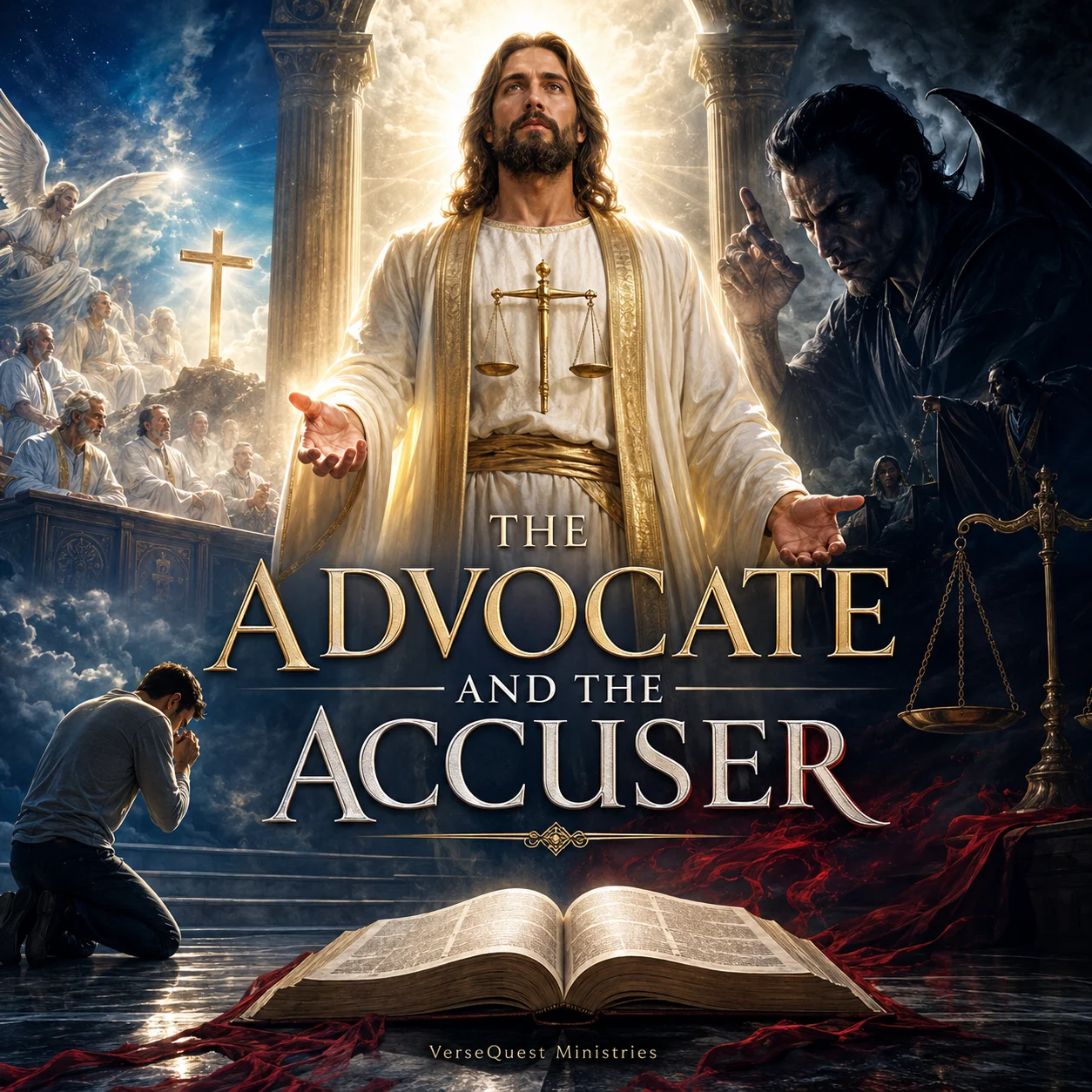
The Advocate and the Accuser
When Satan Brings the Charge and Christ Stands for the Saint
Sermon Title:
The Advocate and the Accuser: When Satan Brings the Charge and Christ Stands for the Saint
Key Passage:
1 John 2:1 — “My little children, these things write I unto you, that ye sin not. And if any man sin, we have an advocate with the Father, Jesus Christ the righteous.”
Revelation 12:10 — “And I heard a loud voice saying in heaven, Now is come salvation, and strength, and the kingdom of our God, and the power of his Christ: for the accuser of our brethren is cast down, which accused them before our God day and night.”
Series:
Foundations of the Gospel of Grace
Topic:
Jesus Christ as the Believer’s Advocate and Satan as the Accuser of the Brethren
Book:
1 John, Revelation, Romans, Job, Zechariah, Hebrews, Luke, Ephesians, Colossians, 2 Corinthians
Speaker:
Paul Tackett
Suggested Sermon Text:
1 John 2:1–2; Revelation 12:7–12; Romans 8:31–39; Job 1:6–12; Job 2:1–7; Zechariah 3:1–5; Hebrews 7:25; Hebrews 9:24; Luke 22:31–32; Ephesians 1:7; Ephesians 4:30; Colossians 2:13–15; 2 Corinthians 5:21; 1 Peter 5:8; 1 Corinthians 15:1–4
Short Sermon Description:
This detailed VerseQuest Ministries sermon outline explains the contrast between Jesus Christ the righteous as the believer’s Advocate and Satan as the accuser of the brethren. First John 2:1 teaches that God does not write to believers so they may sin, but if any man sin, the believer has an Advocate with the Father. Revelation 12:10 reveals Satan’s role as the accuser who accuses the brethren before God day and night until he is finally cast down. This sermon shows that the believer’s hope is not in denying sin, hiding sin, excusing sin, or answering Satan with personal merit, but in the finished work, righteousness, blood, and intercession of Jesus Christ. It distinguishes Christ’s advocacy from a license to sin, Satan’s accusations from the Spirit’s conviction, chastening from condemnation, and the prophetic setting of Revelation 12 from the believer’s present standing in Christ. Designed for pastors, preachers, teachers, Bible students, and believers, this outline magnifies the righteousness of Christ, the believer’s security, the defeat of the accuser, and the victory of grace over guilt.
The Advocate and the Accuser
When Satan Brings the Charge and Christ Stands for the Saint
Introduction
There are two great figures in this sermon who must never be confused: the Advocate and the accuser. The Advocate is Jesus Christ the righteous. The accuser is Satan, the adversary, the old serpent, the Devil, the slanderer of the brethren. One stands for the believer. The other speaks against him. One points to righteousness, blood, propitiation, and finished redemption. The other points to sin, failure, guilt, weakness, and shame. One has nail prints in His hands. The other has venom in his mouth. One answers before the Father. The other accuses before God day and night. The believer who does not understand this warfare will either excuse sin carelessly or drown in guilt needlessly.
First John 2:1 is not a soft verse for loose living. John says, “these things write I unto you, that ye sin not.” God’s goal for His people is holiness, not moral shrugging. Grace does not wink at sin. The cross proves God does not wink at sin. But the verse does not end with despair. It says, “And if any man sin, we have an advocate with the Father, Jesus Christ the righteous.” That is not permission to sin; that is provision when a believer sins. God knows how to deal with the failure of His children without handing them over to the devil’s courtroom. The believer does not answer accusation by bragging on his own record. He answers by pointing to Christ.
Revelation 12:10 shows the accuser’s work and his future doom. Satan accuses the brethren before God day and night, but he will be cast down. In the prophetic context, Revelation 12 is dealing with Israel, the man child, Michael and his angels, war in heaven, and the Devil’s intensified wrath during the coming tribulation period. But the character of Satan as accuser is seen throughout Scripture. He accused Job. He resisted Joshua the high priest. He desired to sift Peter. He walks about as a roaring lion seeking whom he may devour. The Bible believer must know the difference between the condemning voice of the accuser and the correcting work of God. Satan accuses to destroy. The Spirit convicts to restore. Christ advocates on the basis of righteousness, not excuses. That is where the saint’s hope stands.
I. The Advocate Is Provided Because Believers Still Need Help
Key Text: 1 John 2:1
Supporting Texts: 1 John 1:8–10; Romans 7:18–25; Galatians 5:16–17
John writes, “My little children, these things write I unto you, that ye sin not.” That first clause must be taken seriously. The Bible never teaches that salvation gives a man permission to live carelessly. God’s desire for His people is not that they become comfortable with sin, clever with excuses, and fluent in grace language while walking after the flesh. The command is clear: “that ye sin not.” Any doctrine of grace that makes sin small has not been learned from the cross. Calvary does not minimize sin; it reveals how terrible sin is.
But John is also honest about the believer’s need. “And if any man sin.” He does not say, “when sin becomes impossible.” He does not say, “if a real believer becomes sinless in the flesh.” First John 1 already says if we say that we have no sin, we deceive ourselves, and the truth is not in us. If we say we have not sinned, we make Him a liar. The believer still has flesh. Romans 7 exposes the conflict. Galatians 5 says the flesh lusteth against the Spirit, and the Spirit against the flesh. The saved man is not sinless in practice, but he has a real Advocate when sin occurs.
That is why this doctrine is so necessary. Without an Advocate, every believer would be ruined the moment he failed. Without an Advocate, Satan’s accusations would stand unanswered. Without an Advocate, fellowship would collapse under the weight of guilt. But God has provided help in Jesus Christ. The Christian life is not built on denying sin, pretending perfection, or decorating hypocrisy. It is built on truth, confession, cleansing, advocacy, and the righteousness of Jesus Christ.
Main Truth:
God calls believers not to sin, yet provides Jesus Christ the righteous as Advocate when they fail.
II. The Advocate Is Jesus Christ the Righteous
Key Text: 1 John 2:1
Supporting Texts: 2 Corinthians 5:21; Hebrews 7:26; Romans 3:21–26
John identifies the Advocate: “Jesus Christ the righteous.” That title matters. The believer’s Advocate does not plead from weakness, sentiment, compromise, or excuse-making. He pleads from righteousness. He is not an advocate trying to convince God to overlook sin. He is the righteous One who has already satisfied God concerning sin. The believer’s case is not defended by lowering the standard, but by the righteous Saviour who met the standard and bore the judgment.
Second Corinthians 5:21 says Christ knew no sin, yet was made sin for us, that we might be made the righteousness of God in Him. Hebrews 7:26 calls Him holy, harmless, undefiled, separate from sinners. Romans 3 says God set Him forth to be a propitiation through faith in His blood, that God might be just and the justifier of him which believeth in Jesus. Christ’s advocacy rests on His person and His work. He is righteous in Himself, and He has provided righteousness for the believer.
This destroys every false hope. The believer is not defended by his sincerity, religious performance, baptism, church attendance, promises, tears, penance, or moral comparison. When Satan points to real failures, the believer has no answer in himself. The answer is not, “I did not sin.” The answer is, “Jesus Christ the righteous stands for me.” The Advocate is not arguing that the believer is impressive. He is standing on the fact that He Himself is righteous, His blood has been shed, and the believer is in Him.
Main Truth:
The believer’s Advocate is Jesus Christ the righteous, whose sinless person and finished work answer every charge.
III. The Advocate Stands With the Father
Key Text: 1 John 2:1
Supporting Texts: Hebrews 9:24; Romans 8:34; Hebrews 7:25
John says, “we have an advocate with the Father.” That phrase is precious. The believer’s Advocate is not far away, uninvolved, or unaware. He is “with the Father.” Hebrews 9:24 says Christ is entered into heaven itself, now to appear in the presence of God for us. Romans 8:34 says Christ died, rose again, is even at the right hand of God, and maketh intercession for us. Hebrews 7:25 says He ever liveth to make intercession for them that come unto God by Him.
Christ’s advocacy is not a repeated sacrifice. Hebrews is clear that Christ offered one sacrifice for sins forever. He does not keep dying. He does not re-offer Himself through a religious system. He does not continue Calvary on an altar made by men. His advocacy is based on a finished sacrifice. The One who appears for us is the One who already cried, “It is finished.” The Advocate in heaven stands on the completed work of the cross.
This means the believer’s help is higher than the accuser’s reach. Satan may accuse, conscience may ache, enemies may slander, and legalists may condemn, but the believer has an Advocate with the Father. The Father is not reluctant to receive the Son’s advocacy. The Son is the Beloved. The believer is accepted in the Beloved. The advocacy of Christ is not Christ persuading an unwilling Father to be merciful; it is the Son’s righteous ministry in the presence of the Father on behalf of those who belong to Him.
Main Truth:
Jesus Christ advocates for believers in the presence of the Father on the basis of His finished sacrifice and risen life.
IV. The Advocate Is Also the Propitiation
Key Text: 1 John 2:2
Supporting Texts: Romans 3:25; Hebrews 2:17; 1 John 4:10
John immediately adds, “And he is the propitiation for our sins.” That is the basis of advocacy. Christ does not stand before the Father with empty words. He stands as the One whose sacrifice satisfied divine justice. Propitiation means God’s righteous demands against sin have been fully met. The wrath sin deserved was answered by the blood and death of Jesus Christ. The Advocate is not merely a speaker; He is the sacrifice.
Romans 3:25 says God set forth Christ to be a propitiation through faith in His blood. First John 4:10 says God sent His Son to be the propitiation for our sins. Hebrews 2:17 says Christ made reconciliation for the sins of the people. This is not a light doctrine. It means God does not forgive by pretending sin does not matter. He forgives because sin has been dealt with righteously in Christ. The cross is the reason advocacy has power.
This keeps the believer from two errors. The first is despair, as though his sin is stronger than Christ’s blood. The second is carelessness, as though advocacy means sin is no serious matter. The fact that Christ is propitiation proves sin was deadly enough to require blood. But it also proves that blood was enough. The accuser wants the believer either arrogant in sin or crushed by sin. Christ’s propitiation teaches the believer to confess sin honestly and rest in the sufficiency of the sacrifice.
Main Truth:
Christ can advocate for the believer because He Himself is the propitiation who satisfied God concerning sin.
V. The Accuser’s Work Is to Charge the Brethren
Key Text: Revelation 12:10
Supporting Texts: Job 1:6–12; Job 2:1–7; Zechariah 3:1; 1 Peter 5:8
Revelation 12:10 calls Satan “the accuser of our brethren,” and says he accused them before God day and night. The Devil is not merely a tempter. He is an accuser. He entices a man toward sin, and then once the man sins, he turns around and prosecutes him. That is how the Devil works. He sets the trap, points to the blood, and then pretends to be concerned with justice. He is a murderer wearing a courtroom robe.
Job 1 and 2 show Satan appearing before God to accuse Job’s motives. He claimed Job served God only because God blessed him. Zechariah 3 shows Satan standing at Joshua’s right hand to resist him. First Peter 5:8 says the adversary walks about as a roaring lion, seeking whom he may devour. The Devil studies weakness, watches opportunity, and weaponizes guilt. He is not interested in truth for restoration. He is interested in accusation for destruction.
The believer must recognize Satan’s method. The accuser may use real sins, exaggerated sins, remembered sins, confessed sins, forgiven sins, or accusations that are simply lies. He does not care which tool works, as long as the believer is pulled away from Christ. If he cannot keep a sinner from getting saved, he will try to keep a saint from standing in grace. He wants the believer either proud enough to ignore sin or condemned enough to quit.
Main Truth:
Satan accuses the brethren to destroy assurance, fellowship, usefulness, and confidence in Christ.
VI. The Accuser Cannot Overrule God’s Justification
Key Text: Romans 8:33–34
Supporting Texts: Romans 8:1; Colossians 2:13–14; Ephesians 1:7
Romans 8 asks, “Who shall lay any thing to the charge of God’s elect? It is God that justifieth.” That is heaven’s answer to accusation. The issue is not whether the believer has never failed. The issue is whether God has justified him in Christ. If God has justified, no charge can overturn His verdict. Satan may accuse, but he cannot outrank the Judge. Religion may threaten, but it cannot reverse God’s sentence of righteousness in Christ.
Romans 8:34 points to Christ who died, rose again, and makes intercession. That is the believer’s defense. Colossians 2 says God forgave all trespasses, blotted out the handwriting of ordinances that was against us, took it out of the way, and nailed it to Christ’s cross. Ephesians 1:7 says believers have redemption through His blood, the forgiveness of sins. The charges Satan loves to wave have already been answered by blood and nailed to the cross.
This does not make sin harmless. It makes Christ sufficient. The believer should confess sin and walk in the light, but he should not let the accuser drag him back into a courtroom God has already settled. A justified man can be chastened by the Father, corrected by the word, convicted by the Spirit, and examined at the judgment seat of Christ, but he cannot be eternally condemned with the world. God’s justification is stronger than Satan’s accusation.
Main Truth:
The accuser cannot overturn the believer’s standing because God has justified him in Jesus Christ.
VII. The Spirit Convicts, but Satan Condemns
Key Text: John 16:8
Supporting Texts: 1 John 1:9; Romans 8:1; 2 Corinthians 7:10
The believer must learn the difference between the Spirit’s conviction and Satan’s condemnation. The Holy Spirit deals with sin to bring confession, cleansing, restoration, correction, and obedience. Satan deals with sin to bring despair, hiding, shame, bitterness, quitting, and distance from God. The Spirit points to the word and brings the believer back into fellowship. The accuser points to failure and says there is no use getting up.
First John 1:9 says if we confess our sins, God is faithful and just to forgive us our sins and to cleanse us from all unrighteousness. That is the path of restoration. Romans 8:1 says there is no condemnation to them which are in Christ Jesus. Second Corinthians 7:10 says godly sorrow worketh repentance to salvation not to be repented of, but the sorrow of the world worketh death. Not all sorrow is holy. Some sorrow is the devil’s rope around the neck.
When the Spirit convicts, He is specific, truthful, and restorative. When Satan condemns, he is vague, crushing, and Christ-obscuring. The Spirit says, “Confess that sin and walk in the light.” Satan says, “You are finished; God is done with you.” The Spirit magnifies Christ’s holiness and provision. Satan magnifies the believer’s failure until Christ is hidden behind it. The Bible believer must answer condemnation with Scripture and respond to conviction with confession.
Main Truth:
The Holy Spirit convicts to restore the believer, while Satan condemns to destroy the believer’s assurance and usefulness.
VIII. The Advocate Does Not Excuse Sin but Restores Fellowship
Key Text: 1 John 2:1
Supporting Texts: 1 John 1:7–9; Psalm 51:1–12; Proverbs 28:13
John’s doctrine of advocacy must not be twisted into loose living. He writes “that ye sin not.” Christ’s advocacy is not sin’s permission slip. It is God’s provision for maintaining fellowship when a believer sins. The goal is not to make the believer casual about sin, but honest about sin and confident in Christ’s provision. A man who uses advocacy as an excuse to continue in sin has not understood the Advocate.
First John 1:7 says the blood of Jesus Christ His Son cleanseth us from all sin. First John 1:9 calls for confession. Proverbs 28:13 says he that covereth his sins shall not prosper, but whoso confesseth and forsaketh them shall have mercy. David’s repentance in Psalm 51 shows the brokenness of a man who knows sin has wounded fellowship with God. Grace does not teach a man to hide sin. Grace teaches him to bring it into the light.
The Advocate restores fellowship on righteous grounds. The believer does not come back by punishing himself enough, weeping impressively enough, or promising loudly enough. He comes by confession, because Christ’s blood and righteousness are sufficient. God is faithful and just to forgive because Christ has already dealt with sin. That produces humility, not carelessness. The better a man understands Christ’s advocacy, the more he should hate sin that grieves such a Saviour.
Main Truth:
Christ’s advocacy is not a license to sin, but God’s righteous provision for confession, cleansing, and restored fellowship.
IX. The Accuser Will Be Cast Down and Christ Will Reign
Key Text: Revelation 12:10
Supporting Texts: Revelation 12:7–12; Romans 16:20; Revelation 20:10; Philippians 2:9–11
Revelation 12 looks forward to the day when the accuser is cast down. Michael and his angels fight against the dragon, and the dragon is cast out. The voice in heaven announces, “Now is come salvation, and strength, and the kingdom of our God, and the power of his Christ.” This is prophetic truth connected with Israel, the tribulation, and the coming kingdom. Satan’s access as accuser will not continue forever. His doom is fixed.
Romans 16:20 says the God of peace shall bruise Satan under your feet shortly. Revelation 20:10 shows the devil cast into the lake of fire, where he will be tormented day and night for ever and ever. The accuser’s career has an expiration date. He may rage now. He may accuse now. He may deceive now. But his end is written. The same Bible that reveals his accusations also reveals his defeat.
Christ will reign. The kingdom of this world will become the kingdom of our Lord and of His Christ. Every knee shall bow to Jesus Christ. The accuser will be silenced, the Advocate will be exalted, and the redeemed will overcome by the blood of the Lamb. The believer should not live as though Satan’s accusations are the final word. They are noise from a defeated enemy whose sentence is already written.
Main Truth:
The accuser will be cast down, judged, and silenced, while Jesus Christ the righteous will reign in victory.
Conclusion
The Bible shows a sharp contrast between the Advocate and the accuser. Satan accuses the brethren before God day and night. Jesus Christ the righteous advocates with the Father. Satan points to sin to destroy. Christ stands on righteousness and propitiation to restore. Satan wants the believer buried under guilt. Christ brings the believer back to fellowship through truth, confession, cleansing, and grace. The accuser is loud, but the Advocate is righteous.
This doctrine must be handled with both seriousness and comfort. Seriousness, because John writes “that ye sin not.” Comfort, because “if any man sin, we have an advocate with the Father.” The believer should not excuse sin, hide sin, rename sin, or make peace with sin. But neither should he hand himself over to Satan’s despair when Christ has provided advocacy. The Spirit convicts to restore. Satan condemns to destroy. The Bible gives the believer the wisdom to know the difference.
The final word does not belong to the accuser. Revelation says he will be cast down. The cross has already defeated his claim against the believer, and prophecy will finish his removal from heaven’s court. Christ is the righteous Advocate, the propitiation for our sins, the risen intercessor, and the coming King. When accusation rises, the saint must not answer with self-righteousness. He must answer with Jesus Christ the righteous.
Final Call
Sinner, if you are outside Jesus Christ, you do not have Him as your Advocate. You stand in your sins, under condemnation, and exposed before a holy God. Your religion cannot defend you. Your morality cannot answer for you. Your baptism, sacraments, church membership, and good works cannot silence the charge of sin.
Jesus Christ died for your sins according to the Scriptures. He was buried. He rose again the third day according to the Scriptures. Believe on the Lord Jesus Christ, and thou shalt be saved. The only safe place for a guilty sinner is in the Saviour whose blood answers sin and whose righteousness stands before God.
Believer, do not make peace with sin, and do not surrender to condemnation. Confess sin quickly. Walk in the light. Trust the blood. Listen to the Spirit’s conviction, but reject the devil’s despair. You have an Advocate with the Father, Jesus Christ the righteous.
Closing Verse:
Romans 8:34 — “Who is he that condemneth? It is Christ that died, yea rather, that is risen again.”
Closing Statement:
When the accuser brings the charge, the believer’s answer is not his own record, but Jesus Christ the righteous standing with the Father.