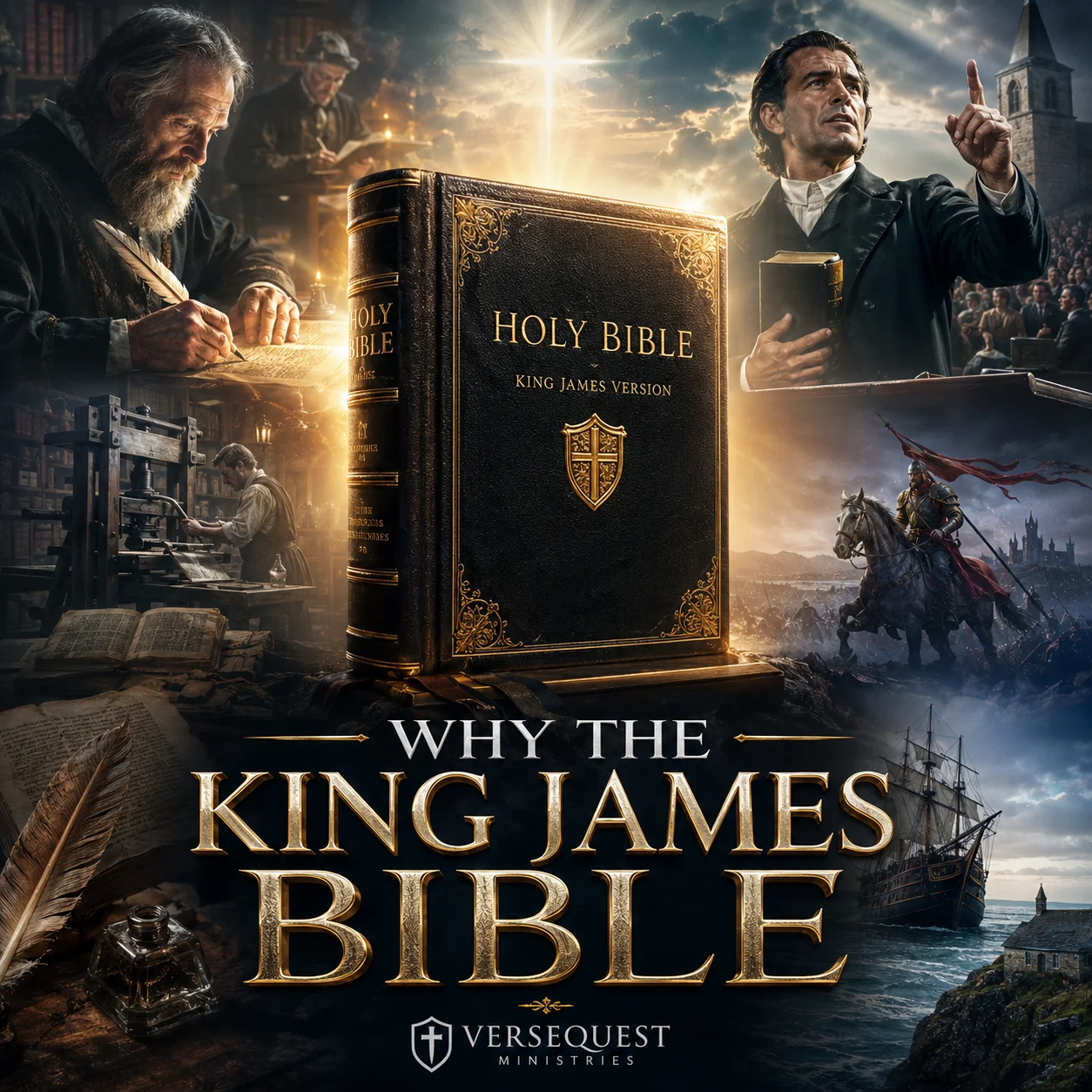
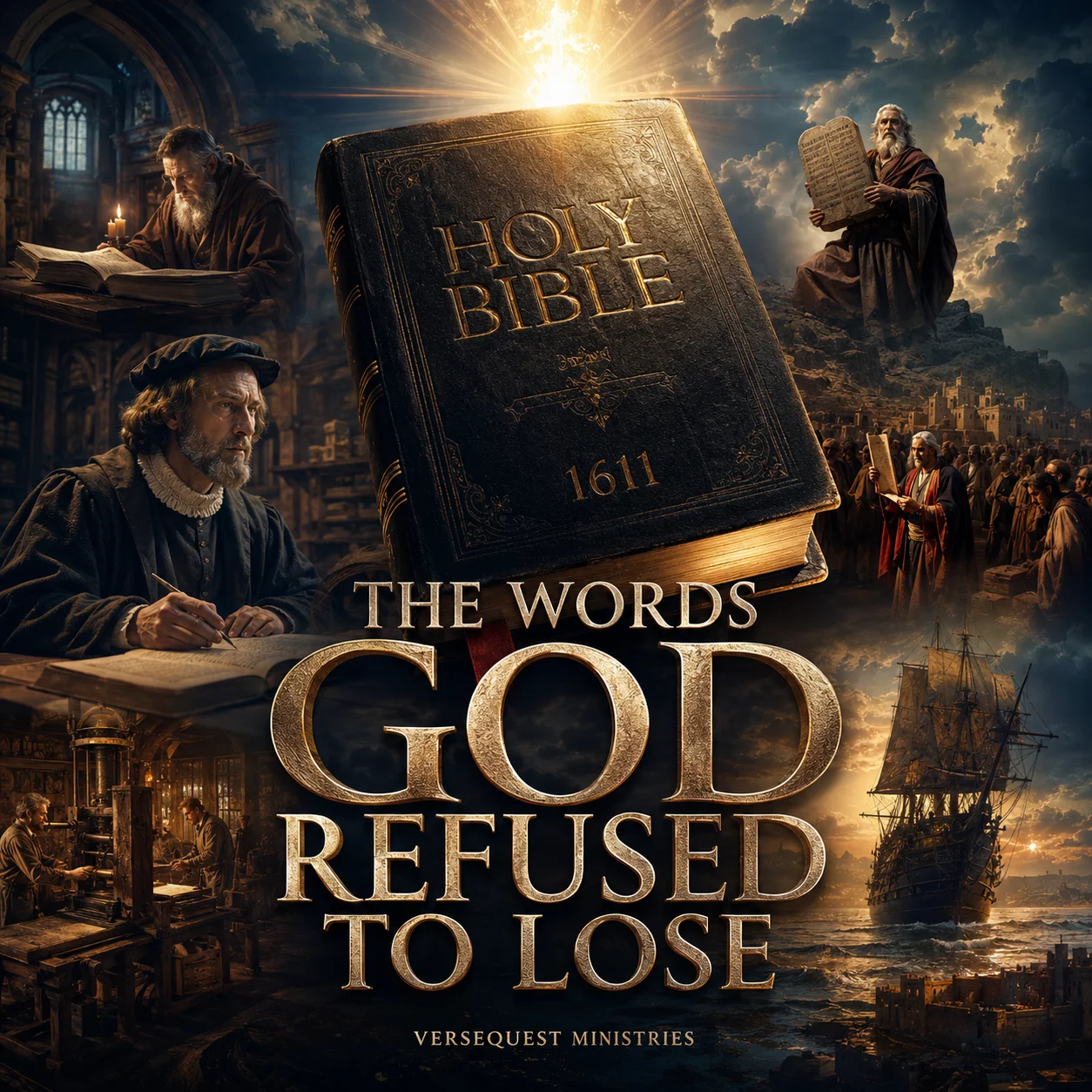
The Words God Refused to Lose — A 40-Part KJV Study of Bible Preservation and Final Authority
he Words God Refused to Lose is a 240-page downloadable PDF book presenting a 40-part KJV study of inspiration, preservation, transmission, textual corruption, translation, manuscript history, and final authority. Beginning with “And God said” in Genesis and ending with Christ’s promise that “my words shall not pass away,” the book builds the doctrine of preservation from Scripture first and then examines the major historical and textual questions that follow.
The study covers the preservation of God’s words through generations, copies and destroyed originals, Psalm 12, Psalm 119, Isaiah 40, Christ’s use of Scripture, Timothy’s “holy scriptures,” the Septuagint debate, Alexandria, Origen, the Apocrypha, manuscript differences, the Majority Text, Westcott and Hort, textual footnotes, revision culture, the English Bible stream, Tyndale, the Authorized Version, and the final-authority question surrounding the King James Bible.
For $12.99, buyers receive the complete 240-page digital book, including the 40 detailed studies, a substantial introduction and conclusion, and a detailed Bible-study chart summarizing the book’s central doctrine. It is designed for serious Bible students, pastors, preachers, teachers, families, Sunday school classes, and anyone wanting a thorough KJV-centered examination of why the words God inspired were not meant to disappear with the original manuscripts.
$12.99
Description
The Words God Refused to Lose is a substantial 240-page digital PDF book examining one of the most foundational questions a Bible believer can ask: Did God preserve the words He inspired, and if He did, where are those words today? Rather than beginning with manuscript catalogues, scholarly theories, or competing translation committees, this study begins where the Bible begins—with God speaking. From “And God said” in Genesis to Christ’s declaration that “my words shall not pass away,” this book traces the Bible’s own testimony concerning the inspiration, preservation, transmission, authority, corruption, translation, and endurance of the words of God.
Across 40 detailed studies, the book develops the doctrine progressively from Genesis through Revelation. It examines God’s spoken words, the written tables at Sinai, the replacement of Moses’ broken tablets, the command to transmit Scripture from parents to children, the prohibition against adding to or diminishing God’s words, the king’s commanded copy of the law, Joshua’s possession of Scripture after Moses died, Josiah’s rediscovery of the Book, and God’s restoration of Jeremiah’s words after Jehoiakim burned the original roll. These passages establish an important foundation before manuscript controversies ever enter the discussion: physical copies can be damaged or destroyed without God losing the words He intends His people to possess.
The study then moves through the great preservation declarations of Scripture, including Psalm 12, Psalm 119, Proverbs 30, Isaiah 40, and Isaiah 55. Particular attention is given to what the Lord Jesus Christ Himself believed and said about Scripture. His repeated “It is written,” His declaration that man lives “by every word that proceedeth out of the mouth of God,” His reference to the jot and tittle, His statement that “the scripture cannot be broken,” and His promise that “Heaven and earth shall pass away, but my words shall not pass away” form a major part of the biblical case.
The New Testament portion examines Timothy’s possession of “the holy scriptures” without possessing the original manuscripts and Peter’s declaration that believers are born again by “the word of God, which liveth and abideth for ever.” The book presses the distinction between inspiration and preservation: inspiration concerns God’s original giving of His words, while preservation concerns those inspired words continuing through history. It challenges the common assumption that divine perfection must necessarily disappear when an original physical manuscript disappears.
From that biblical foundation, the book moves into the historical and textual controversies surrounding Bible transmission. Readers are introduced to the debate over older manuscripts, Alexandria, the traditional Septuagint account, the direction of dependence between New Testament quotations and Greek Old Testament texts, the Apocrypha, Origen and the Hexapla, scribal corruption, the manuscript majority, Westcott and Hort, modern critical editions, and the influence of textual footnotes upon ordinary Bible reading. These subjects are approached through the larger question of final authority: does scholarship serve Scripture, or does Scripture ultimately depend upon scholarship to determine what it is allowed to say?
The English Bible occupies the final portion of the study. The book follows the providential English stream through Tyndale, Coverdale, Matthew’s Bible, the Great Bible, the Geneva Bible, the Bishops’ Bible, and the translation work culminating in the Authorized Version of 1611. The King James Bible is not presented as though preservation suddenly began in seventeenth-century England or as though its translators received new apostolic inspiration. Instead, 1611 is presented as a gathering point in a much older stream of biblical transmission: inspiration filled the spring, preservation kept the river flowing, and translation brought the water into English.
The final studies address the remarkable longevity of the Authorized Version, the claim that “only the originals were perfect,” and the unavoidable question every preservation theory must eventually answer: if the King James Bible is not an accurate, preserved, authoritative form of God’s words, where is the Book? Is final authority Vaticanus, Sinaiticus, the Majority Text, a particular Textus Receptus edition, Nestle-Aland, UBS, a Hebrew edition, a Greek edition, a future critical text, or ultimately the scholar who chooses among them? The issue is pushed beyond slogans toward the practical question of whether a believer can actually possess, read, memorize, teach, preach, and obey identifiable words of God.
The book concludes where the argument ultimately belongs—with Jesus Christ rather than a king, translator, manuscript, critic, or preacher. “Heaven and earth shall pass away, but my words shall not pass away.” The central contention of this book is that preservation is not God keeping His words perfectly in theory while leaving His people permanently uncertain about them. The God who commands men to live by His words intended those words to remain available to men.
This 240-page downloadable PDF is designed for serious Bible students, pastors, preachers, teachers, Sunday school instructors, families, ministry leaders, and believers who want to understand the biblical and historical case for the preservation and final authority of Scripture. It includes the complete 40-part study, a substantial introduction and conclusion, and a detailed Bible-study chart bringing the major preservation arguments together visually. At $12.99, it provides a comprehensive standalone resource for personal study, sermon preparation, doctrinal teaching, family study, and extended examination of the Bible preservation question.
Verbal Inspiration of Scripture — God did not merely inspire religious concepts; He communicated revelation through words. Divine Preservation — The book traces Scripture's repeated declarations that God's words endure, remain, stand, live, and cannot be broken. Words Versus Physical Artifacts — Moses' tablets and Jeremiah's roll demonstrate that destruction of an original physical object does not mean destruction of divine revelation. Generational Transmission — Deuteronomy establishes that God's words were expected to remain available so parents could teach generations not present when revelation was originally given. Authority of Copies — Joshua, Israel's kings, Josiah, Timothy, the Bereans, and others demonstrate Scripture functioning authoritatively beyond original manuscripts. Biblical Warnings Against Alteration — Deuteronomy, Proverbs, Jeremiah, Paul, Peter, and Revelation establish the danger of adding, diminishing, corrupting, or wresting God's words. Preservation and Corruption — The study distinguishes God's preservation from the false claim that every copyist, manuscript, printer, translator, or edition must therefore be error-free. Jesus Christ's Doctrine of Scripture — Particular attention is given to “It is written,” every word, jot and tittle, unbreakable Scripture, enduring words, and final judgment. The Original Autographs Question — The book challenges the assumption that perfection must be restricted exclusively to unavailable first physical manuscripts. The Septuagint Debate — The traditional seventy-translator account, Greek Old Testament evidence, New Testament quotations, and direction of textual dependence are examined. Alexandria and Textual History — The historical and theological assumptions surrounding Alexandrian textual traditions receive sustained attention. The Apocrypha and Canon — The study distinguishes books contained within later codices from books inspired as canonical Scripture. Origen and Textual Management — Origen's Hexapla becomes a case study in the difference between comparing Scripture and placing scholarship over Scripture. The Manuscript Majority — Broad textual continuity is examined as possible evidence of providential transmission rather than automatically dismissed as secondary development. Westcott and Hort — Their significance is considered primarily in terms of the authority structure produced by the critical-text approach. Critical Footnotes — The book examines how marginal textual notes can shape ordinary Christians' practical doctrine of Scripture. Revision Culture — Continually revised Bible editions raise the question of whether final authority can remain permanently provisional. The English Bible Stream — Tyndale through the Authorized Version is presented as historical continuity rather than sudden preservation beginning in 1611. The King James Bible — The Authorized Version is presented within a larger doctrine of preservation and providential transmission. Final Authority — The book repeatedly asks where authority ultimately resides when manuscripts, editions, translators, and scholars disagree.
The central argument of The Words God Refused to Lose is that the doctrine of biblical preservation should begin with Scripture’s testimony about God’s words rather than with uncertainty produced by surviving manuscript evidence. God speaks, writes, commands transmission, prohibits alteration, holds later generations accountable, and repeatedly describes His word as pure, settled, enduring, living, abiding, and unbreakable.
A crucial distinction throughout the study is between words and the physical materials carrying them. Moses’ first tablets and Jeremiah’s first roll demonstrate that the destruction of an original artifact does not necessarily destroy revelation. Preservation therefore concerns continuity of God’s words rather than perpetual survival of the first physical copy.
Another major distinction is between inspiration and preservation. Inspiration concerns God’s original giving of Scripture through chosen men. Preservation concerns the continued identity and availability of those inspired words. Translation does not require new apostolic inspiration if preserved revelation can be faithfully carried into another language.
The existence of textual corruption does not logically disprove preservation. Scripture itself warns about false scribes, corrupted words, additions, subtractions, and wrested Scriptures. Preservation therefore does not mean every textual witness is equally trustworthy; it means human corruption does not ultimately defeat God’s purpose.
Jesus Christ’s own handling of Scripture forms one of the strongest parts of the argument. He repeatedly says “It is written,” appeals to exact verbal details, says Scripture cannot be broken, says His words will not pass away, and declares that His word will judge men in the last day. His practice assumes accessible and authoritative Scripture centuries after Old Testament autographs were produced.
Timothy’s “holy scriptures” are a key test case. Timothy could not have possessed the original physical manuscripts of Moses and the prophets, yet Paul still calls the transmitted Scriptures known from his childhood “holy scriptures.”
The book distinguishes between manuscript age and manuscript accuracy. An older witness may preserve an older and correct reading, but age itself proves chronology rather than inspiration.
This book can serve as an extended personal Bible-study course on inspiration, preservation, textual transmission, translation, and final authority. Because the argument develops progressively through 40 studies, readers can work through one study at a time while examining each primary passage in their King James Bible.
Pastors and preachers can use the material to develop a sermon series on the words of God, the authority of Scripture, biblical preservation, the history of the English Bible, textual corruption, or the believer's confidence in Scripture. Individual chapters can also provide supporting material for sermons dealing with Genesis 3, Psalm 12, Psalm 119, Jeremiah 36, Matthew 4, Matthew 24, John 10, 2 Timothy 3, or 1 Peter 1.
Sunday school teachers and adult Bible-study leaders can use the 40-part structure as a long-form curriculum. The progression from biblical doctrine into textual history allows teachers to establish what Scripture says about itself before entering more technical questions concerning manuscripts and translations.
Families can use the book for advanced family Bible study, particularly the sections dealing with Deuteronomy 6, generational transmission, the authority of Scripture, and teaching children to know what God said. The material is especially suited to older students and adults prepared for substantial doctrinal discussion.
Churches and ministry-training programs can use the resource to examine the distinctions between inspiration, preservation, copying, corruption, transmission, and translation. Those distinctions are particularly useful for helping students avoid both careless textual skepticism and unsupported claims about how preservation operates.
The included Bible-study chart can function as a visual review after completing the book, as a classroom teaching aid, or as a quick-reference summary of the major biblical and historical arguments developed throughout the 40 studies.
The primary companion resource should be the King James Bible, particularly the passages listed in the Related Scriptures section. Readers will benefit from tracing repeated biblical terms such as word, words, scripture, scriptures, written, keep, preserve, pure, settled, endure, abide, corrupt, and wrest.
A Strong's Exhaustive Concordance or another comprehensive King James Bible concordance can help readers trace these expressions throughout Scripture and see how frequently the Bible speaks about the identity, purity, authority, and endurance of God's words.
A reliable King James Bible dictionary can assist with older English terms and help readers distinguish genuine language questions from textual questions.
A Bible cross-reference system is especially useful for connecting Deuteronomy's warnings about adding and diminishing with Proverbs 30 and Revelation 22, Isaiah 40 with 1 Peter 1, and Old Testament Scripture citations with their New Testament use.
For the historical portions, readers may benefit from reputable reference works dealing with the history of the English Bible, William Tyndale, early printed Greek New Testaments, the Reformation, manuscript transmission, textual criticism, the Textus Receptus, the Majority Text, and the development of modern critical editions. These should remain reference tools rather than replacements for Scripture's own testimony concerning preservation.
The detailed The Words God Refused to Lose Bible Study Chart included with this PDF should be used alongside the book as a visual doctrinal summary and teaching reference.
Related products
-
Call For Revival
-

- Sleeping Through the Last Watch – 681-Page KJV Bible Study Series (PDF eBook)
- 681 Pages • 100 Essays • KJV Bible Study • Full-Color Bible Chart What does it really mean to be spiritually awake while waiting for Christ's return? Sleeping Through the…
- $29.99
- Add to cart
-
-
Dispensationalism
-
-50%
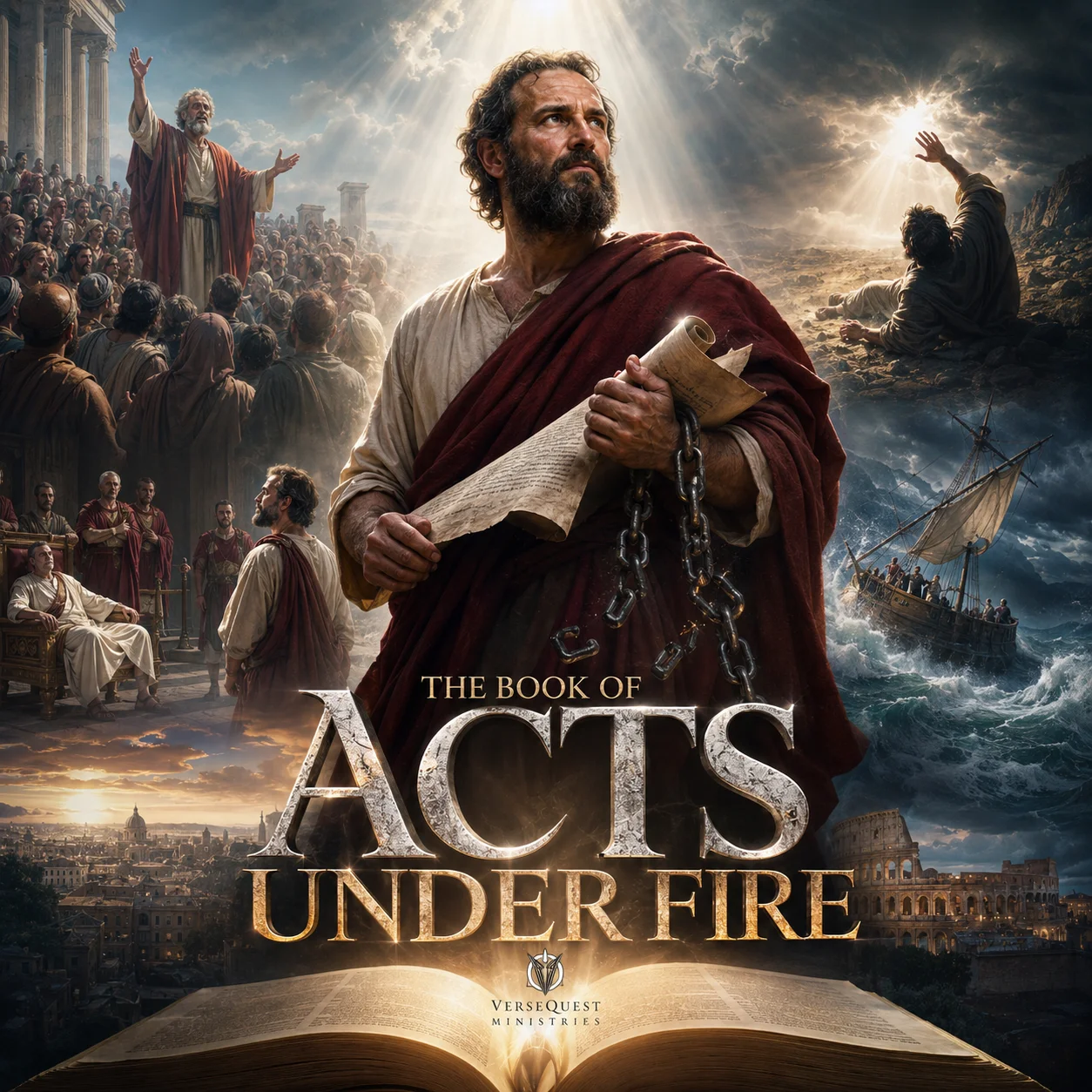
- The Book of Acts Under Fire™ – Defending the Book of Acts (382-Page KJV Apologetics PDF)
- Can the Book of Acts be trusted? The Book of Acts Under Fire™ is a comprehensive 382-page apologetics resource answering many of the most common scholarly, historical, textual, and theological…
- Original price was: $19.99.$9.99Current price is: $9.99.
- Add to cart
-
-50%
-
Doctrine Series
-
Genesis Chapter 2
-
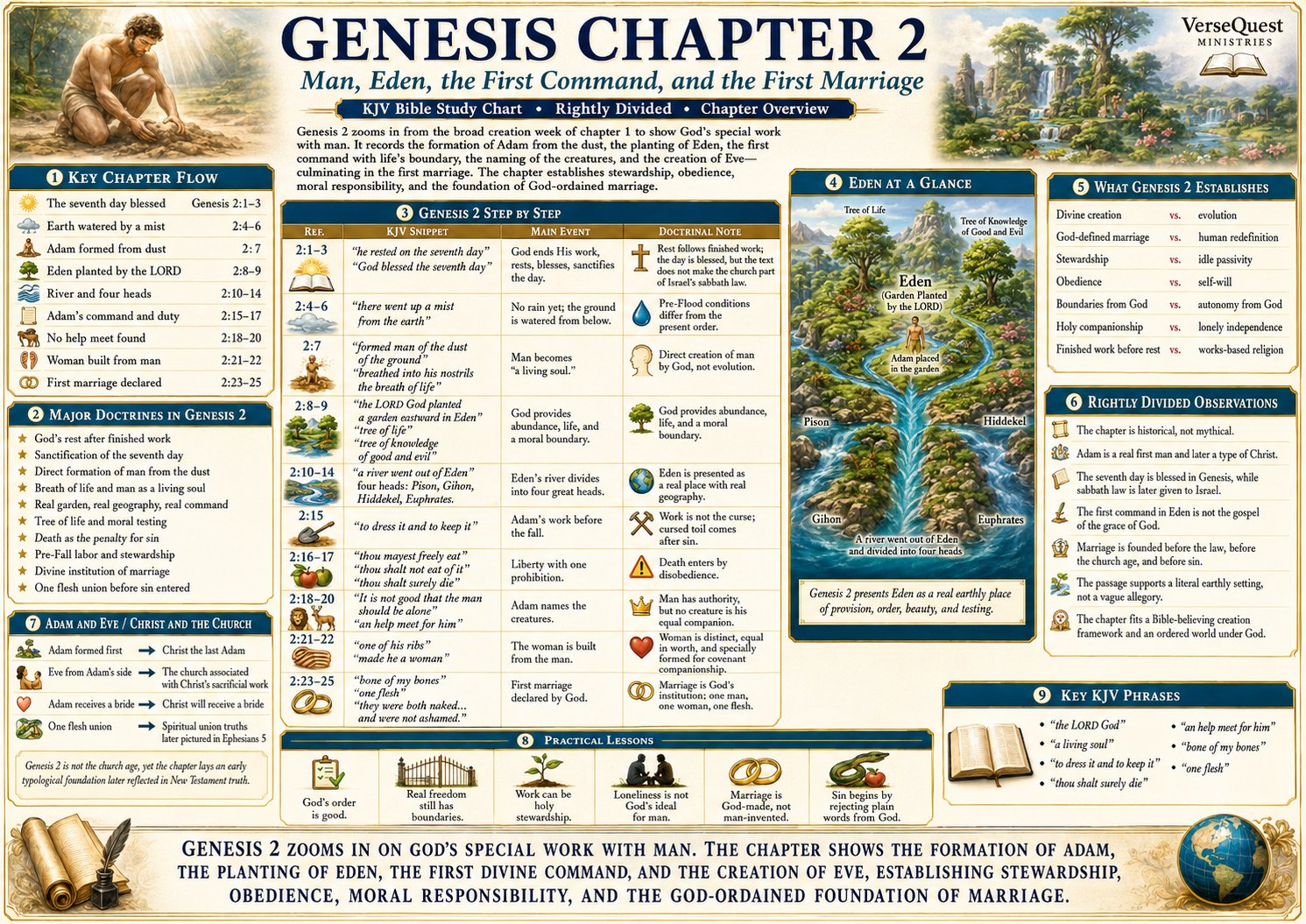
- Genesis Chapter 2 Bible Study Chart – Adam, Eden, the First Command, and the First Marriage (KJV)
- Explore Genesis Chapter 1 with this detailed KJV Bible study chart covering the six days of creation, the firmament, light, fixed kinds, man in God’s image, major doctrines, recurring phrases,…
- $3.99
- Add to cart
-
-
Printable Bible Study Resources
-
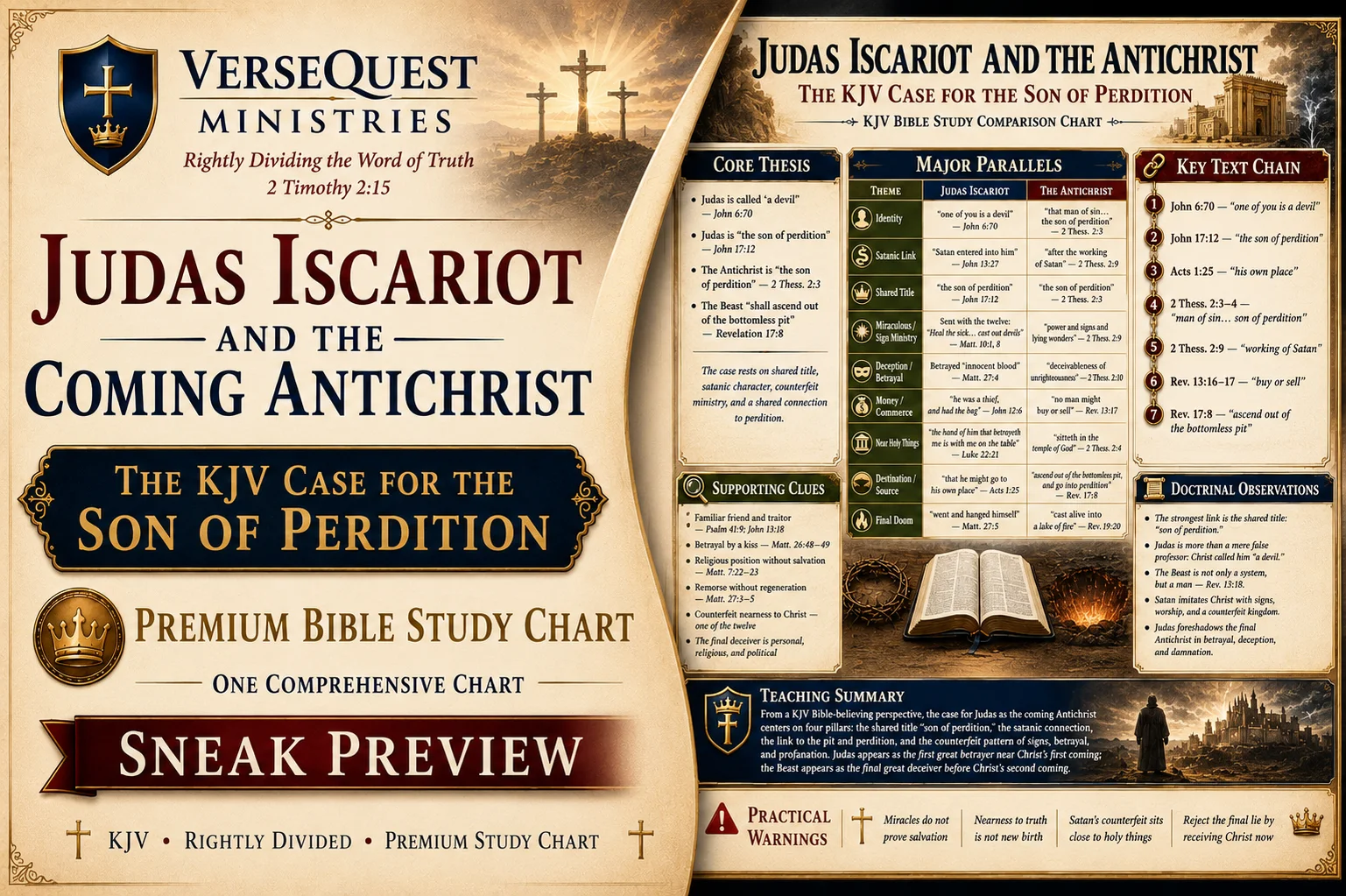
- Judas Iscariot and the Coming Antichrist – KJV Bible Study Chart
- A premium VerseQuest Ministries KJV Bible study chart comparing Judas Iscariot with the coming Antichrist. This one comprehensive chart traces the son of perdition, the Beast from the bottomless pit,…
- $4.99
- Add to cart
-