
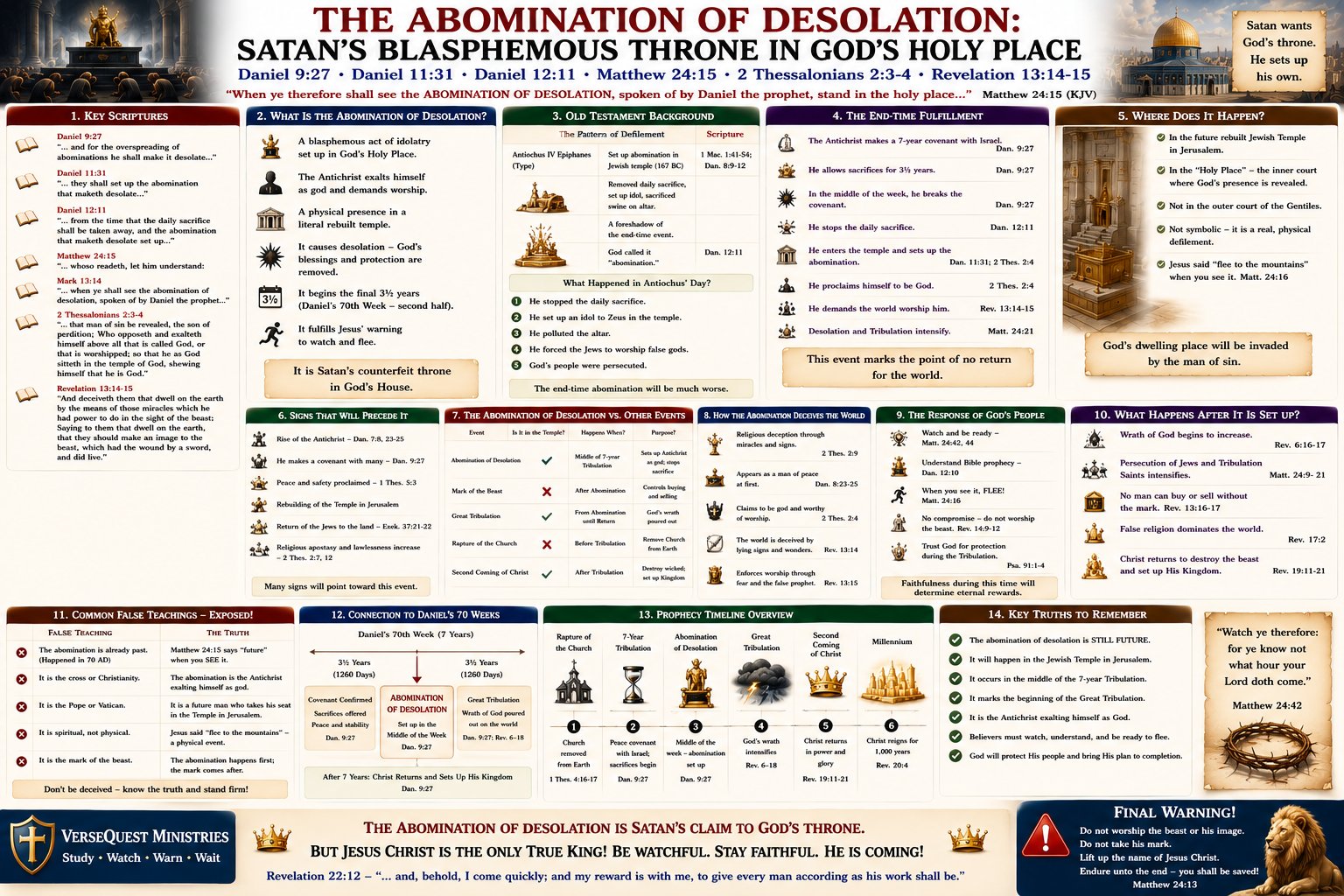
The Abomination of Desolation – Antichrist in the Holy Place, Daniel’s Seventieth Week, and the Beginning of the Great Tribulation (KJV Bible Study Chart)
Understand the abomination of desolation with this detailed KJV chart covering Daniel’s seventieth week, Antichrist’s covenant and betrayal, stopped sacrifices, the future Temple, the man of sin’s blasphemous self-exaltation, the midpoint of the Tribulation, Great Tribulation, beast worship, and Christ’s glorious return.
$4.99
Description
The Abomination of Desolation: Satan’s Blasphemous Throne in God’s Holy Place is a comprehensive, rightly divided KJV Bible study chart examining one of the most important prophetic events of Daniel’s seventieth week. Built around Daniel 9:27, Daniel 11:31, Daniel 12:11, Matthew 24:15, 2 Thessalonians 2:3–4, and Revelation 13:14–15, this chart explains the future desecration of the holy place, Antichrist’s blasphemous self-exaltation, the cessation of sacrifice, the midpoint of the final seven-year period, the outbreak of the Great Tribulation, the persecution of Israel and faithful saints, the beast’s worldwide worship system, and the ultimate destruction of the counterfeit ruler when Jesus Christ returns in glory.
Jesus Christ Himself identifies the event in Matthew 24:15: “When ye therefore shall see the abomination of desolation, spoken of by Daniel the prophet, stand in the holy place.” That statement immediately establishes several foundational truths. The event was still future when Christ spoke, Daniel had previously prophesied concerning it, it involves an identifiable abomination, it stands in a holy place, and its appearance becomes a decisive prophetic signal requiring immediate action from those in Judea.
The abomination of desolation is not merely a general description of apostasy, moral corruption, secular government, or religious compromise. It is a specific end-time desecration occurring within Daniel’s prophetic programme. It involves Antichrist’s self-exaltation, the defilement of the Temple setting, the cessation of biblical sacrifice, and a blasphemous challenge to the authority of God.
Daniel 9:27 establishes the chronological framework. The coming prince confirms a covenant “with many for one week.” Within Daniel’s seventy-weeks prophecy, one week represents seven years. In the midst of that week—after three and one-half years—he causes sacrifice and oblation to cease and brings the prophetic programme into its terrible midpoint crisis.
The abomination therefore becomes one of the clearest prophetic markers dividing Daniel’s final week into two halves. The first half contains the operation of the covenant and continuing sacrifice. The midpoint brings betrayal, sacrificial cessation, Temple desecration, and the unveiling of Antichrist’s true character. The second half becomes the period of unparalleled trouble Christ calls “great tribulation.”
This distinction is essential because Antichrist does not necessarily arrive before the world announcing himself as Satan’s final tyrant. His early rise involves political skill, covenant-making, deceptive peace, prosperity, and increasing international authority. Daniel repeatedly presents the coming ruler as a master of deceit, policy, intrigue, and self-exaltation.
The beast system first sells mankind a counterfeit solution and later reveals its true god. The ruler who appears to guarantee order eventually demands worship.
Daniel 11:31 also speaks of forces that “shall pollute the sanctuary of strength, and shall take away the daily sacrifice, and they shall place the abomination that maketh desolate.” The passage has an important historical background in the desecration associated with Antiochus IV Epiphanes, whose actions against Jewish worship foreshadow the greater future desecration.
Antiochus interfered with Jewish sacrifice, profaned the Temple, promoted pagan worship, persecuted the Jewish people, and became a historical picture of the kind of ruler Daniel’s prophecy ultimately anticipates. Yet the historical type does not exhaust the prophecy because Jesus, speaking long afterward, points His disciples toward a still-future abomination.
That distinction between type and final fulfillment is important. Bible prophecy can contain earlier historical patterns that foreshadow a greater final event without allowing the earlier event to cancel the future prophecy. Antiochus provides historical colour; Jesus Christ provides the authoritative prophetic interpretation.
Matthew 24 places the final abomination within an unmistakably Jewish and prophetic setting. Christ speaks of Judea, the holy place, the Sabbath day, Daniel the prophet, flight into the mountains, and a period of unequalled Tribulation. These are not ordinary instructions for the present Body of Christ.
When those living within that future setting see the abomination standing where it ought not, hesitation becomes dangerous. Jesus commands those in Judea to flee immediately. The person on the housetop is not to return for possessions, and the person in the field is not to turn back for clothing.
This urgency shows that the abomination is not a vague theological development recognized gradually over centuries. It is a specific event sufficiently identifiable that those understanding prophecy can see it and act.
Second Thessalonians 2 supplies another crucial piece of the picture. Paul describes “that man of sin” and “the son of perdition,” who “opposeth and exalteth himself above all that is called God, or that is worshipped.” His rebellion reaches the point where “he as God sitteth in the temple of God, shewing himself that he is God.”
This is the heart of Antichrist’s blasphemy. The final counterfeit ruler is not satisfied with international government, military authority, economic control, or political admiration. He claims the position and worship belonging to God.
Satan’s war has always been about the throne. Isaiah 14 records Lucifer’s desire to exalt his throne, ascend above the heights, and be like the Most High. The serpent offered man godhood in Genesis 3. Revelation later reveals the Dragon granting authority to the beast and receiving worship through the beast’s kingdom.
The abomination of desolation therefore represents the climax of Satan’s ancient ambition: a counterfeit throne, counterfeit king, counterfeit worship, and counterfeit kingdom standing in direct rebellion against the true God.
The chart’s title—Satan’s Blasphemous Throne in God’s Holy Place—captures that spiritual conflict. The Antichrist is the visible ruler, but the Dragon stands behind his authority. The man of sin becomes the human focal point of a satanic attempt to occupy what belongs to God.
The physical location matters. Matthew says the abomination stands “in the holy place.” Second Thessalonians refers to “the temple of God.” Daniel connects the crisis with sacrifice and sanctuary. These references collectively point toward a literal future Temple setting in Jerusalem.
This is another reason replacement theology and purely symbolic interpretation struggle with the passage. Daniel’s prophecy concerns Israel and Jerusalem, Christ speaks of Judea and the holy place, sacrifices operate and are stopped, and Paul speaks of the Temple. The natural reading expects a future Jewish Temple environment.
The chart therefore treats the future Temple as literal rather than symbolic. Antichrist does not merely occupy a figurative throne in mankind’s heart or represent generic institutional apostasy. A real prophetic ruler profanes a real holy place within a real future Tribulation programme centred upon Israel.
The exact relationship between Antichrist personally sitting in the Temple and the image of the beast described in Revelation 13 should be stated carefully. Revelation clearly reveals a speaking image that the false prophet commands mankind to worship. Second Thessalonians clearly reveals the man of sin exalting himself in the Temple. Matthew and Daniel clearly reveal the abomination standing in the holy place. These events belong to the same satanic climax, although Scripture does not explicitly state in one sentence that the Revelation 13 image and Matthew 24’s abomination are identical in every detail.
What Scripture unquestionably establishes is that the midpoint produces a blasphemous Temple desecration centred upon Antichrist’s claim to divine worship.
The chart’s prophetic sequence begins with the rise of Antichrist. Daniel describes the little horn and king of fierce countenance. Revelation presents the beast receiving power, seat, and great authority from the Dragon. The final ruler gains influence within a world already prepared through deception, apostasy, fear, political instability, and rebellion against God.
He then confirms the covenant with many for Daniel’s final week. The covenant helps establish the political framework within which Israel, Jerusalem, sacrifice, and prophetic events move toward their final crisis.
The world may initially interpret the agreement as a triumph of diplomacy. Peace and safety appear to have arrived. Long-standing conflict may seem solved, political leaders celebrate stability, and the coming prince gains extraordinary credibility.
Yet biblical prophecy has already disclosed the betrayal hidden inside the agreement.
Sacrifice continues during the first half of the week. The existence of sacrifice implies a restored Temple system or sanctuary arrangement capable of operating within Jerusalem. Whatever political arrangements are required to establish that worship will therefore exist before the midpoint crisis.
Then comes the middle of the week. Daniel 9:27 marks the turning point. The ruler causes sacrifice and oblation to cease. The peace-making prince reveals himself as the desecrating tyrant.
Daniel 12:11 connects the removal of the daily sacrifice with the setting up of the abomination that maketh desolate. The events are not unrelated. The cessation of sacrifice makes way for the blasphemous counterfeit occupying the place set apart to God.
Second Thessalonians 2 reveals the theological meaning behind the action: the man of sin exalts himself as God.
The world is no longer merely being asked to accept his diplomacy. It is being commanded to accept his deity.
Revelation 13 then reveals the beast worship system in its fullest form. The false prophet performs great signs, deceives earth-dwellers, commands the creation of the beast’s image, causes that image to speak, and requires worship.
Those refusing beast worship face death. Religious allegiance and political allegiance become one.
The mark of the beast becomes part of the same final system. No man may buy or sell without the mark, name, or number connected with the beast.
The chart correctly distinguishes the abomination of desolation from the mark itself. The abomination belongs to the holy-place crisis and midpoint desecration. The mark belongs to the later economic and worship enforcement system. They are connected events but not interchangeable terms.
Likewise, the abomination should not be confused with the Rapture. Within the pre-Tribulation framework of this chart, the Church is caught away before Daniel’s final week begins. The abomination occurs at the midpoint of that future week.
The abomination should not be confused with the Second Coming either. The abomination marks the commencement of the final intensified period of trouble; the Second Coming terminates that period when Christ returns to destroy Antichrist.
This gives the timeline tremendous clarity: Rapture, beginning of Daniel’s seventieth week, first 3½ years, abomination of desolation at the midpoint, Great Tribulation, Second Coming, millennial Kingdom.
The Great Tribulation follows the abomination. Jesus says in Matthew 24:21, “For then shall be great tribulation, such as was not since the beginning of the world to this time, no, nor ever shall be.”
The word then matters. Christ places the unparalleled trouble in direct sequence after the holy-place warning.
The second half of Daniel’s week therefore represents far more than continued ordinary warfare or political difficulty. Antichrist’s persecution intensifies, the beast’s worship system develops, the mark is enforced, Israel becomes a target, Tribulation saints are hunted, and Revelation’s judgments progress toward their climax.
Revelation 12 presents the Dragon intensifying his warfare against the woman associated with Israel and against the remnant keeping God’s commandments. Satan knows his remaining time is short.
Revelation 13 presents the beast making war against the saints and receiving extraordinary authority. The same period that displays satanic political power also reveals divine judgment increasing against the world.
The seals, trumpets, and vials demonstrate that Antichrist never possesses true sovereign control. He may sit in the Temple and demand worship, but Heaven continues opening judgments over his head.
The chart’s “What Happens After It Is Set Up?” panel therefore follows naturally. Divine wrath intensifies. Jewish and Tribulation-saint persecution grows. The mark controls economic participation. False worship dominates the beast’s world system. Yet every step moves closer to Christ’s return.
The counterfeit throne has an expiration date.
The world may marvel after the beast, asking, “Who is like unto the beast? who is able to make war with him?” Revelation 19 supplies the answer.
Jesus Christ is able.
The beast’s kingdom does not end through democratic reform, political resistance, another human empire, improved diplomacy, or gradual religious awakening. Heaven opens and the true King returns.
Jesus Christ appears as Faithful and True, the Word of God, and King of kings and Lord of lords. The armies of heaven follow Him, the nations gather against Him, and the beast’s supposed invincibility collapses instantly.
Second Thessalonians 2:8 declares that the Lord shall consume that Wicked “with the spirit of his mouth, and shall destroy with the brightness of his coming.”
The man who sat in the Temple pretending to be God finally meets God manifested in glory.
Revelation 19 records the beast and false prophet being taken and cast alive into the lake of fire. The false throne disappears, the false worship system collapses, and the false king enters judgment.
Jesus Christ then establishes the Kingdom that Antichrist attempted to counterfeit. The millennial reign reveals the difference between satanic government and divine government.
Antichrist blasphemes God; Christ glorifies the Father. Antichrist demands worship through fear; Christ possesses worship by divine right. Antichrist persecutes the righteous; Christ rewards and reigns with His saints. Antichrist’s kingdom lasts a few years; Christ’s dominion moves toward everlasting glory.
The chart also provides important historical background through Antiochus IV Epiphanes. His desecration of Jewish worship illustrates how a ruler may invade sacred space, stop sacrifice, introduce pagan worship, and persecute those refusing religious compromise.
Daniel 8 is especially important for the biblical side of that historical pattern. Antiochus becomes a prophetic type whose actions foreshadow the greater final desecration.
Historical material from 1 Maccabees may help document those events, but in a KJV study product it should be clearly labelled as historical rather than canonical Scripture. The inspired prophetic authority remains Daniel.
The historical type also teaches an important interpretive principle: the existence of a preliminary fulfillment does not erase the final fulfillment when Christ Himself later places the abomination in the future.
Jesus did not say, “Daniel’s prophecy was completely exhausted by Antiochus.” He told future hearers to watch for the abomination spoken of by Daniel.
The chart therefore correctly rejects the idea that AD 70 fully exhausted the prophecy. Jerusalem’s destruction under Rome was real and prophetically significant, but Matthew 24’s complete programme proceeds into unparalleled Tribulation, cosmic signs, the visible coming of the Son of Man, gathering, and Kingdom consequences not fulfilled exhaustively in AD 70.
Historical events may foreshadow the final programme, but they cannot be allowed to cancel the explicit future return of Jesus Christ.
The abomination is likewise not the cross of Christ or Christianity itself. The cross is God’s redemptive work; the abomination is satanic desecration. Christ humbled Himself at Calvary; Antichrist exalts himself in the Temple. The two stand at opposite ends of the moral universe.
The abomination should not automatically be identified as the Pope or Vatican as though Daniel’s entire final Temple prophecy were merely a symbol for the Roman Catholic system. Rome may contain substantial doctrinal error and apostasy, but Daniel and Matthew place this particular event within Israel’s future Temple programme.
Nor should the abomination be reduced to something entirely spiritual or symbolic. Christ tells those who see it to flee geographically from Judea. A visible act in an identifiable holy place produces immediate physical consequences.
It is also not merely the mark of the beast. The mark follows within the beast’s worship and economic system. The abomination establishes the midpoint desecration that opens the Great Tribulation phase.
The chart’s connection with Daniel’s seventy weeks is foundational. Daniel’s final week consists of seven years. The covenant operates during the opening period, sacrifice continues, and the midpoint brings the abomination.
From that midpoint, three and one-half years remain until the prophetic consummation and return of the true King.
That chronology keeps Israel and the Church distinct. Daniel’s seventy weeks were determined upon Daniel’s people and holy city. The present Body of Christ belongs to mystery truth revealed later through Paul.
From the chart’s pre-Tribulation perspective, the Church’s blessed hope occurs before the final week. The Body of Christ waits for Jesus Christ rather than the abomination of desolation.
This is especially important when applying Matthew 24. The instructions “flee into the mountains” and “let him which is on the housetop not come down” belong to people living within the Tribulation setting Christ describes. They are not the ordinary evacuation instructions for the present Church.
Present believers learn from the prophecy without pretending to occupy the audience to whom its immediate commands belong.
The doctrine teaches that God controls history. Antichrist can desecrate only what God permits and only for the duration God has appointed. Satan never catches Heaven by surprise.
It teaches that false peace does not equal divine peace. Humanity will accept a covenant and ruler promising order while rejecting the Prince of Peace Himself.
It teaches that worship is ultimately the central battlefield. Antichrist’s political empire becomes religious because Satan does not merely want obedience—he wants worship.
It teaches that Temple prophecy confirms God’s continuing programme for Israel. Jerusalem, sacrifice, Judea, Daniel’s holy city, and the Jewish remnant remain prophetically significant.
It teaches that biblical prophecy must be interpreted through Scripture rather than sensationalism. Every Middle Eastern crisis is not automatically the abomination. The actual event possesses clear biblical markers.
It teaches that the Great Tribulation has an identifiable beginning connected with the midpoint desecration. Jesus provides the sign so His future people will understand when immediate flight becomes necessary.
It teaches that Antichrist’s apparent victory is temporary. The man of sin may sit where he does not belong, but Jesus Christ returns to occupy the throne that belongs to Him forever.
The appropriate response for those living within the Tribulation setting is therefore watchfulness, understanding, immediate obedience, rejection of beast worship, and faithfulness to God despite persecution.
They must not bow to Antichrist, accept his claim to deity, worship the image, receive the beast’s mark, or trade eternal truth for temporary survival.
For present Church-age believers, the application is to study prophecy accurately, reject deception, preach the gospel, live faithfully, distinguish Israel from the Church, and look for the blessed hope.
The Church does not need to be terrified by the abomination. It needs to understand it.
The prophetic warning magnifies Jesus Christ because He predicted the event beforehand. Daniel wrote of it centuries earlier, Christ confirmed it, Paul explained Antichrist’s self-exaltation, and Revelation unfolds the final beast system around it.
The same Bible that tells us the abomination will stand also tells us it will fall.
The abomination of desolation is Satan’s attempt to place his counterfeit king where only God deserves honour. But no counterfeit throne survives the coming of Jesus Christ.
The beast will rise. The covenant will be broken. The holy place will be profaned. The world will be deceived. Persecution will rage. Yet the final chapter has already been written.
Jesus Christ returns.
The abomination therefore marks not Satan’s permanent victory but the countdown to his defeat.
This resource is ideal for personal Bible study, Daniel 9 teaching, Matthew 24 studies, Second Thessalonians 2 instruction, Antichrist prophecy, Temple prophecy, Daniel’s seventieth-week studies, Great Tribulation teaching, abomination-of-desolation debates, Israel-and-Church distinctions, pre-Tribulation Rapture studies, mark-of-the-beast instruction, Revelation prophecy, Sunday school, homeschool Bible curriculum, Christian schools, Bible institutes, prophecy conferences, pastoral training, and sermon preparation.
Abomination of desolation, Daniel 9:27, Daniel 11:31, Daniel 12:11, Matthew 24:15, man of sin, son of perdition, Antichrist in the Temple, Temple of God, holy place, Daniel’s seventieth week, midpoint of the Tribulation, covenant with many, sacrifice and oblation cease, Great Tribulation, abomination in the Temple, image of the beast, beast worship, mark of the beast, Israel in prophecy, Jerusalem in prophecy, Second Coming of Christ
The abomination of desolation is a specific future prophetic event connected with Daniel’s seventieth week, Israel, Jerusalem, sacrifice, the holy place, Antichrist’s self-exaltation, and the beginning of the Great Tribulation. It should not be reduced to generic apostasy, moral decline, ordinary persecution, or a merely symbolic description of religious corruption.
Daniel 9:27 establishes the seven-year framework by describing the coming prince confirming a covenant with many for one week. In the midst of that week he causes sacrifice and oblation to cease. Because Daniel’s seventy weeks concern Daniel’s people and holy city, the event belongs to Israel’s prophetic programme rather than the present mystery Body of Christ.
The safest wording is that the coming prince confirms a covenant with many rather than saying Daniel explicitly states that he makes a covenant “with Israel.” The context is unmistakably Israel-centred, but careful teaching should preserve the exact wording of the verse while explaining its setting.
Sacrifice continues until the midpoint, when Antichrist causes it to cease. Scripture does not explicitly say that he personally grants permission for the sacrifices to begin, so the chart should preferably say that sacrifices continue during the first half rather than stating that he “allows” them for three and one-half years.
Matthew 24 confirms that Daniel’s ultimate abomination remained future after the historical desecrations associated with Antiochus IV Epiphanes. Antiochus provides an important type or foreshadowing, but Christ places the final fulfillment within the future Tribulation and instructs those in Judea to flee when they see it.
Historical material concerning Antiochus may be useful in explaining the prophetic pattern, but 1 Maccabees should be labelled as historical background rather than canonical Scripture in a KJV Bible chart. Daniel 8 supplies the inspired biblical foundation for the historical type.
Second Thessalonians 2 identifies the theological centre of the future crisis. The man of sin opposes and exalts himself above everything called God and sits in the Temple of God showing himself that he is God. The abomination therefore involves Antichrist’s attempt to claim divine honour and worship in the place set apart to God.
Revelation 13 presents the beast, false prophet, image of the beast, worldwide deception, compulsory worship, and mark system. These events belong to the same final satanic programme surrounding Antichrist’s blasphemous claims. Scripture does not explicitly state in one verse that the speaking image and Matthew 24’s abomination are identical, so that identification should be presented carefully rather than dogmatically.
The future Temple should be treated as literal within this interpretive framework because Daniel speaks of sacrifice, Matthew identifies a holy place, Paul speaks of the Temple of God, and Jesus gives geographical instructions to people in Judea. “The holy place will be profaned” is more precise than saying God’s visible glory necessarily dwells in that Temple at the moment Antichrist enters it.
The abomination marks the midpoint of Daniel’s final week and introduces the intensified latter three and one-half years. Matthew 24 says that after the holy-place crisis comes Great Tribulation unlike anything before it. Antichrist’s persecution, beast worship, economic control, and divine judgment therefore escalate after the midpoint.
The abomination is distinct from the mark of the beast. The abomination concerns Antichrist’s Temple desecration and self-exaltation, while the mark belongs to the beast’s later worship and commerce system. The events are closely related but should not be treated as identical.
The abomination is also distinct from the Rapture and Second Coming. Within the pre-Tribulation framework presented by the chart, the Rapture occurs before Daniel’s seventieth week, the abomination occurs at its midpoint, and Christ’s visible Second Coming occurs after the Great Tribulation.
Antichrist’s apparent victory remains temporary. Second Thessalonians 2 promises that Jesus Christ will destroy the Wicked with the spirit of His mouth and the brightness of His coming. Revelation 19 records the beast and false prophet being cast alive into the lake of fire.
The ultimate lesson is that Satan seeks God’s throne and worship but cannot keep either. The man of sin may profane the holy place temporarily, but Jesus Christ returns as King of kings and Lord of lords and brings the counterfeit kingdom to its appointed end.
Abomination-of-desolation Bible studies, Daniel 9 teaching, Daniel 11 prophecy, Daniel 12 studies, Matthew 24 instruction, Second Thessalonians 2 teaching, Antichrist studies, future-Temple prophecy, Daniel’s seventieth-week lessons, Great Tribulation teaching, beast-worship studies, mark-of-the-beast instruction, Israel-and-Church distinctions, pre-Tribulation Rapture studies, Second Coming teaching, prophecy timelines, Sunday school lessons, homeschool Bible curriculum, Christian school teaching, Bible institute classes, prophecy conferences, pastoral training, sermon preparation
King James Bible, Strong’s Concordance, Thompson Chain-Reference Bible, Treasury of Scripture Knowledge, Nave’s Topical Bible, Daniel 8–12 study notes, Daniel seventy-weeks charts, Matthew 24 comparison resources, Second Thessalonians 2 commentary materials, Revelation 12–13 studies, Antichrist names and titles charts, future-Temple prophecy resources, Tribulation timelines, mark-of-the-beast studies, beast and False Prophet charts, Israel-versus-Church studies, Rapture-versus-Second-Coming resources, VerseQuest Revelation and prophecy charts
Related products
-
KJV Bible Study Resources
-
-60%
- Practical Christianity for Daily Battles – 329-Page KJV Study PDF
- A premium 329-page KJV study PDF with 40 full essays applying sound, rightly divided Bible doctrine to real daily Christian battles. Topics include temptation, anxiety, marriage, parenting, pornography, grief, church…
- Original price was: $24.99.$9.99Current price is: $9.99.
- Add to cart
-
-60%
-
The Rapture
-
-67%
- Caught Up Before the Wrath – 66-Essay KJV Rapture Study
- Caught Up Before the Wrath is a 430-page premium KJV Bible study defending the pre-tribulation Rapture of the Church from a rightly divided, dispensational perspective. This 66-essay VerseQuest Ministries book…
- Original price was: $29.99.$9.99Current price is: $9.99.
- Add to cart
-
-67%
-
The Rapture
-
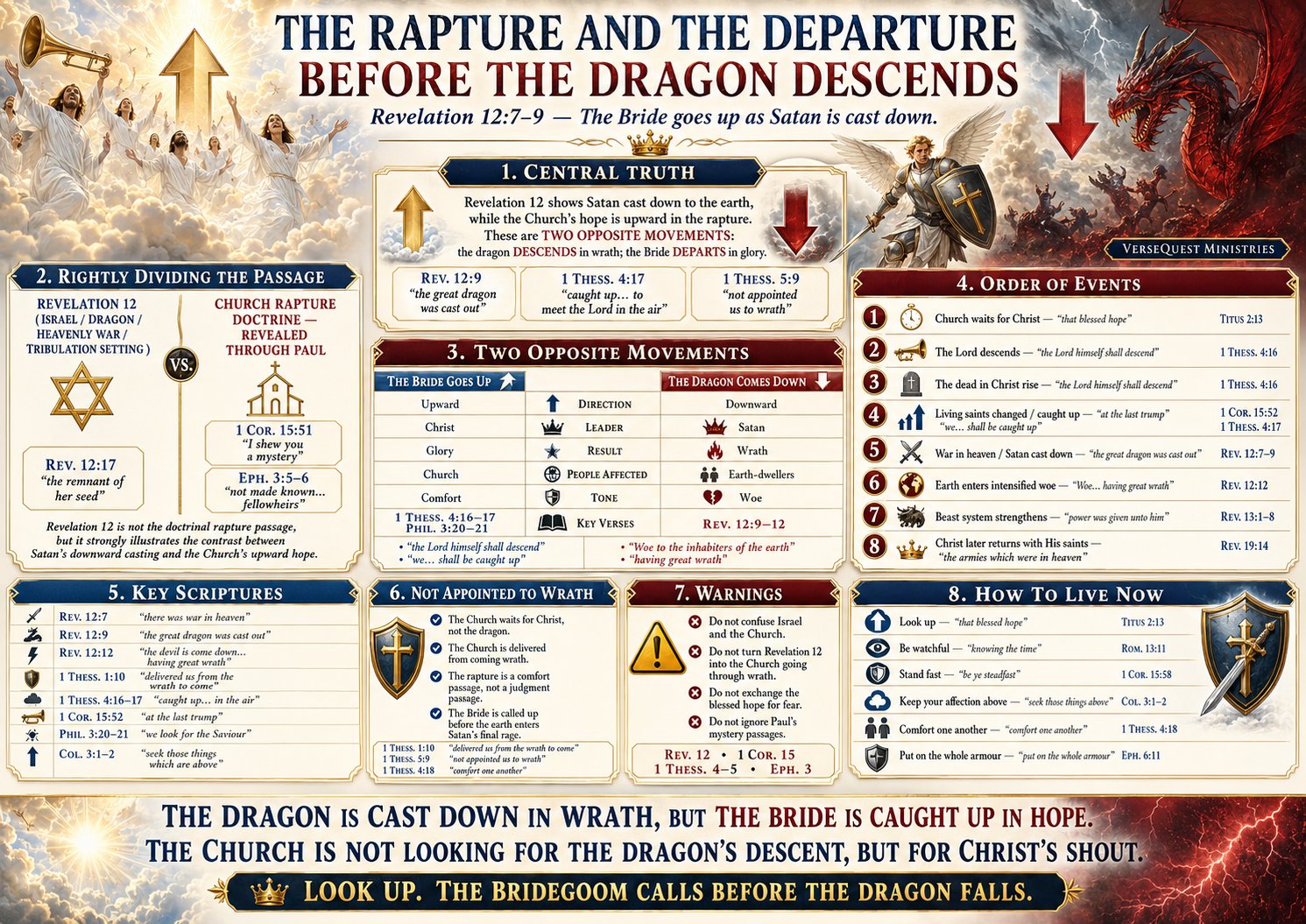
- The Rapture and the Departure Before the Dragon Descends – Printable Bible Study Chart
- Printable KJV Bible study chart on The Rapture and the Departure Before the Dragon Descends, showing the Bride caught up before Satan is cast down in wrath. This premium VerseQuest…
- $4.99
- Add to cart
-
-
VerseQuest Premium Library
-
-67%
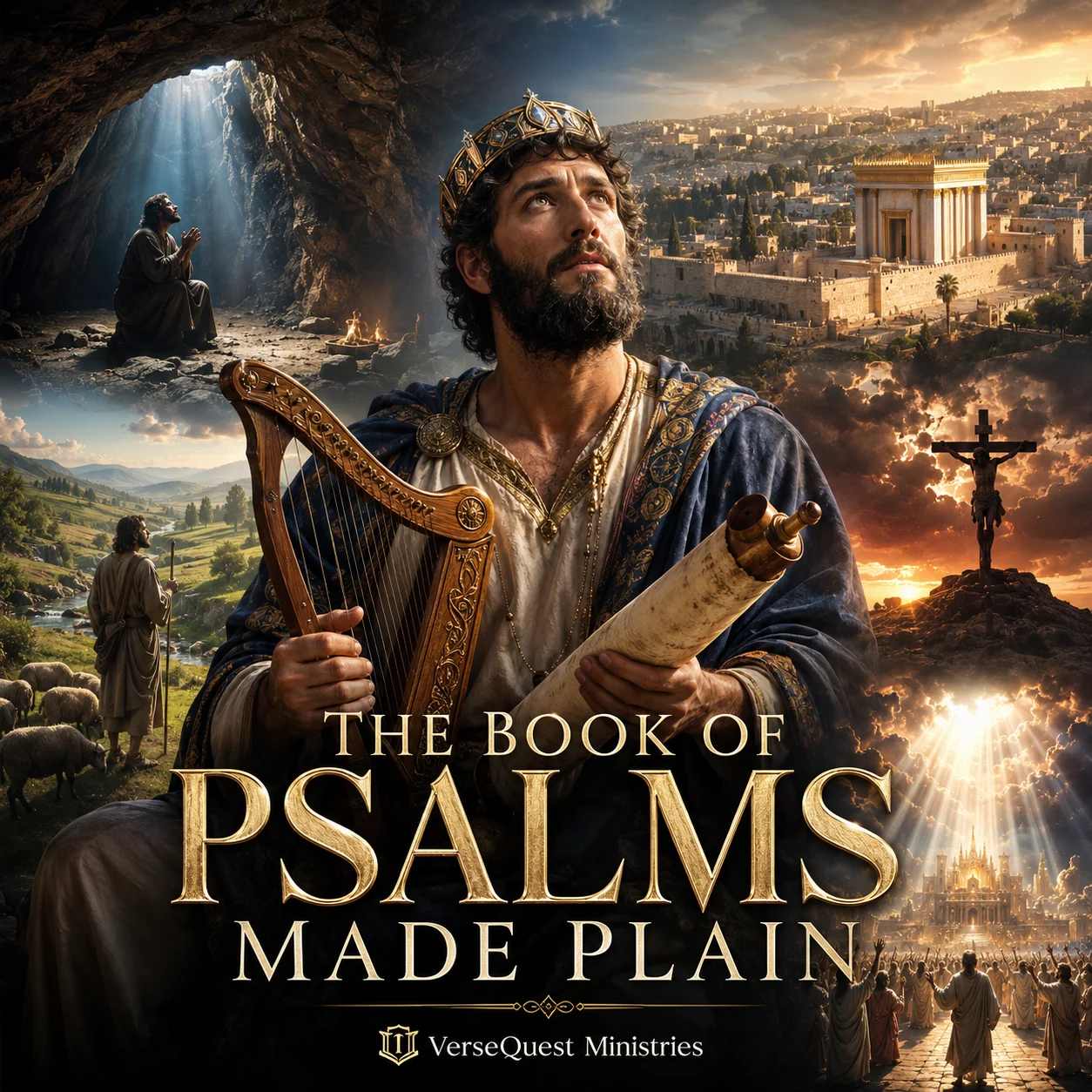
- The Book of Psalms Made Plain – 383-Page KJV Psalm Study
- The Book of Psalms Made Plain is a 383-page premium KJV Bible study featuring 54 detailed essays through the major themes, doctrines, prophecies, prayers, laments, and praises of the Psalms.…
- Original price was: $29.99.$9.99Current price is: $9.99.
- Add to cart
-
-67%
-
Premium Studies
-
-25%
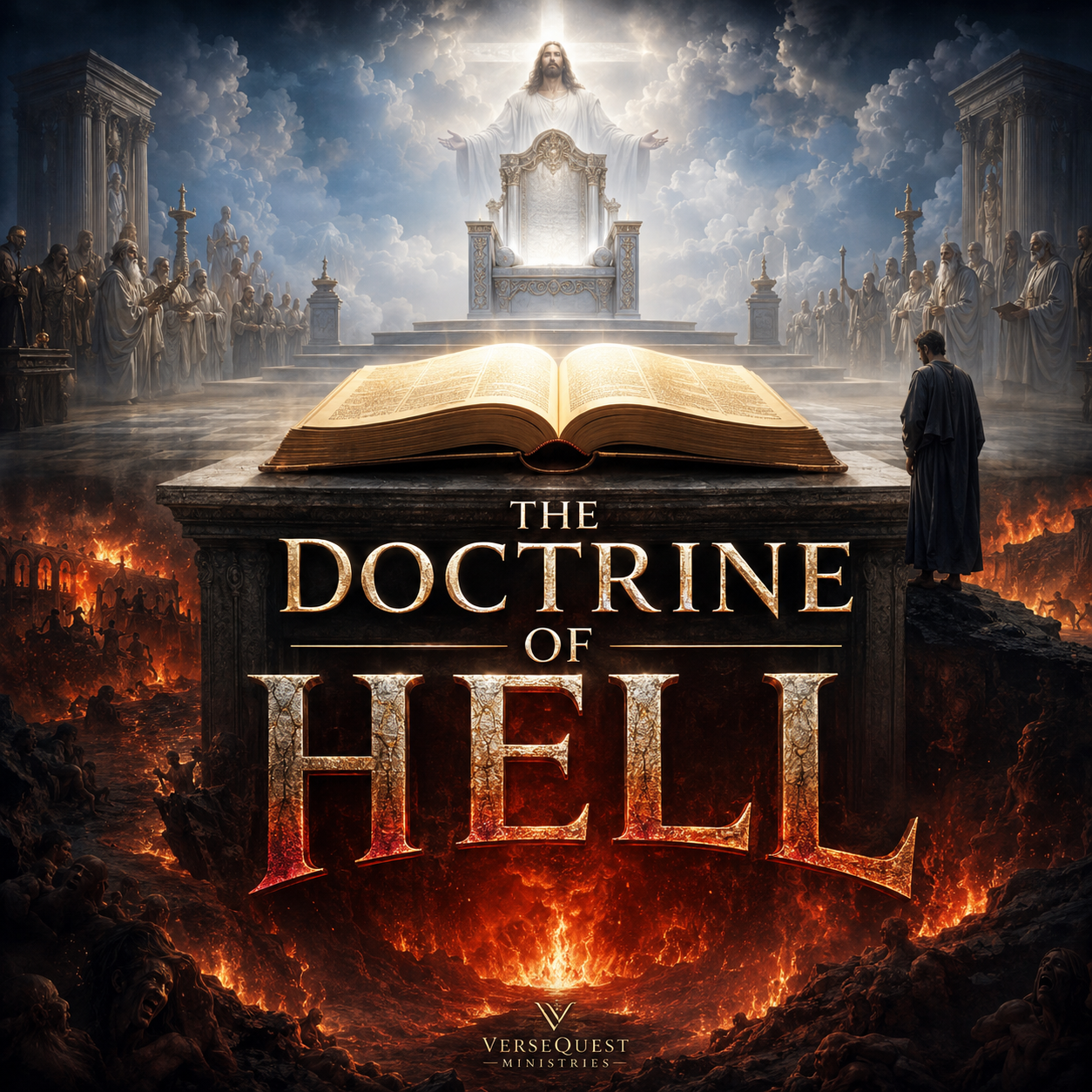
- The Doctrine of Hell — Premium Essay Series PDF
- A 383-page premium VerseQuest PDF study book containing 54 KJV essays on hell, fire, darkness, judgment, the lake of fire, the second death, and Jesus Christ as the only escape.
- Original price was: $39.99.$29.99Current price is: $29.99.
- Add to cart
-
-25%