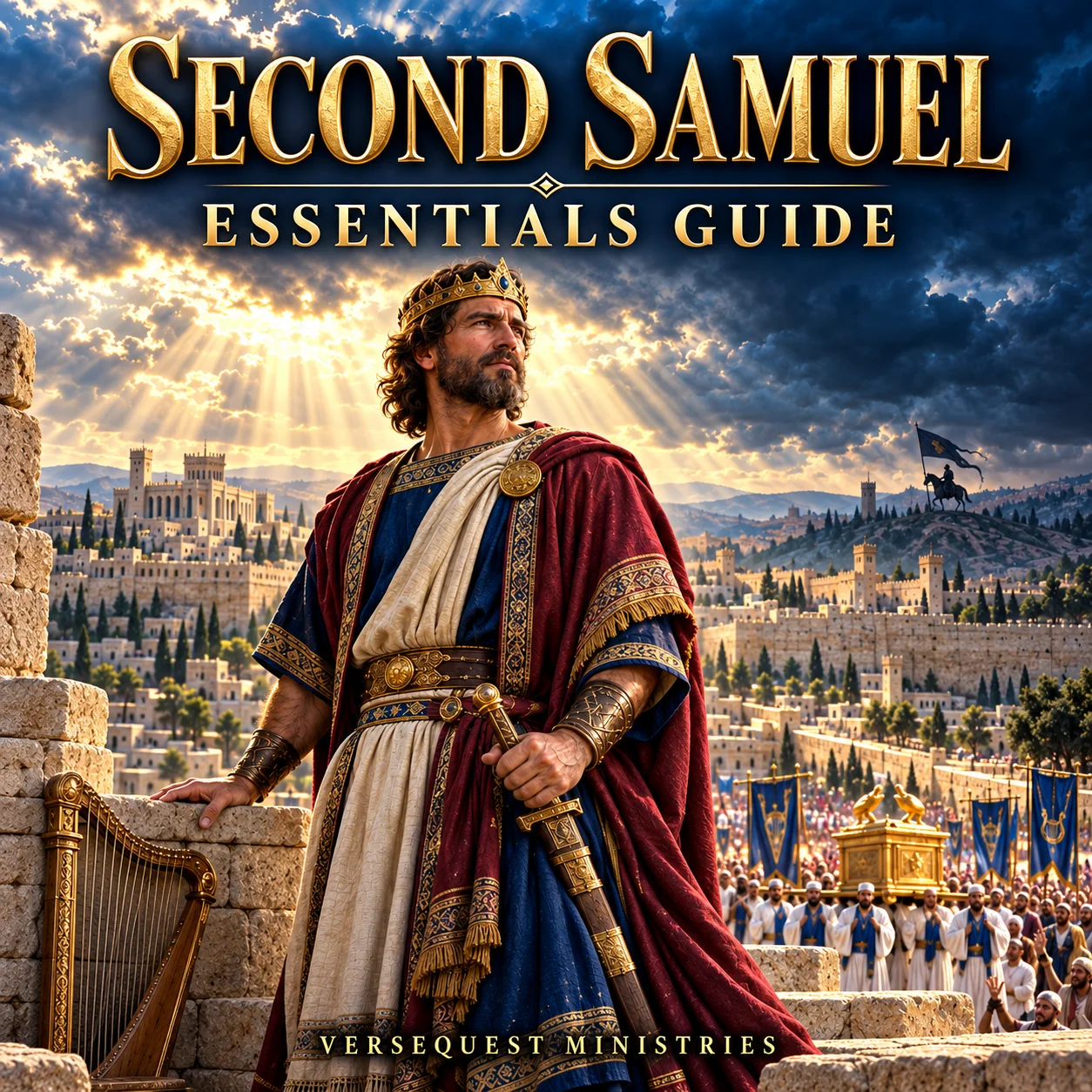
Second Samuel Essentials Guide — KJV Bible Study PDF
The Second Samuel Essentials Guide is a professionally designed 120-page downloadable PDF that provides a clear, substantial, and beginner-friendly study of David’s reign. It covers his rise to the throne, Jerusalem, the ark, the Davidic covenant, Mephibosheth, Bath-sheba and Uriah, Nathan’s rebuke, Absalom’s rebellion, David’s restoration, the mighty men, the census, and Araunah’s altar.
The guide contains 92 Scripture-centered lessons with complete selected KJV passages, explanations, observations, teaching notes, questions, and writing space. Chapter maps, timelines, doctrinal distinctions, difficult-passage guidance, sermon starters, and final review pages make it valuable for personal study, teaching, discipleship, Sunday school, family reading, and sermon preparation.
Digital PDF download. 120 pages. Price: $14.99.
$14.99
Description
The Second Samuel Essentials Guide is a comprehensive 120-page downloadable PDF designed to give Bible students a clear, organized, and substantial understanding of the entire book of Second Samuel. It provides more than a brief summary while remaining more accessible than a large verse-by-verse commentary. Readers are guided through the essential events, people, places, doctrines, covenants, warnings, and spiritual lessons that shape the reign of King David.
Second Samuel opens with David receiving the news of Saul and Jonathan’s deaths and follows his progress from king over Judah in Hebron to ruler over the united nation of Israel. This guide explains the division between the houses of Saul and David, the capture of Jerusalem, the bringing of the ark into the city, David’s victories over surrounding enemies, and the establishment of justice and order throughout the kingdom.
Special attention is given to the Davidic covenant in Second Samuel 7. Readers will examine God’s promises concerning David’s house, seed, kingdom, and throne, along with the covenant’s immediate connection to Solomon and its ultimate fulfillment in the Lord Jesus Christ. The guide preserves the biblical distinctions between Israel, David’s historical throne, the earthly kingdom, and the believer’s present spiritual blessings.
The guide also treats the darker and more difficult portions of David’s reign honestly. David’s adultery with Bath-sheba, the arranged death of Uriah, Nathan’s confrontation, David’s confession, and the continuing consequences within his household are explained carefully. Readers will see the important distinction between divine forgiveness and earthly chastening: David’s sin was put away, but the sword did not depart from his house.
The tragedies involving Amnon, Tamar, Absalom, Ahithophel, Joab, and the divided loyalties of Israel are placed within the larger movement of the book. The guide traces Absalom’s rise through appearance, flattery, political grievance, and stolen affection; David’s departure from Jerusalem; the defeat of Ahithophel’s counsel; Absalom’s death; David’s grief; and the king’s eventual return.
The closing chapters receive the careful attention they deserve. The guide examines the famine connected with Saul’s treatment of the Gibeonites, Rizpah’s vigil, the defeat of the remaining giants, David’s song of deliverance, his last words, the mighty men, the numbering of Israel, the resulting plague, and the purchased altar at Araunah’s threshingfloor. The book ends where judgment meets sacrifice and mercy—the location connected with the future temple.
The 92 Scripture-centered lessons include the complete wording of every selected King James Bible passage. Each lesson supplies an understandable explanation, three important observations, a Bible-study lens, thought-provoking questions, and purposeful writing space. The additional orientation and reference pages include chapter maps, major movements, principal people and places, key terms, historical setting, chronology, doctrinal distinctions, difficult passages, teaching plans, sermon starters, review material, and memorable truths.
This professionally designed PDF uses a consistent navy, gold, cream, and light-blue presentation with strong borders, clearly separated sections, readable Scripture panels, and integrated note areas. It is suitable for personal study, discipleship, family reading, Sunday school, sermon preparation, small-group discussion, classroom instruction, or rapid review before beginning a more detailed commentary.
David’s accession to the throne — David receives the kingdom according to God’s timing rather than seizing it through personal ambition. The decline of Saul’s house — Political resistance cannot permanently overturn the king whom God has chosen. The unification of Israel — The tribes eventually recognize David’s kinship, proven leadership, and divine calling. Jerusalem and Zion — David captures Jerusalem and establishes it as the political and worship center of the kingdom. The holiness of God — Uzzah’s death demonstrates that sincere intentions cannot replace obedience to God’s revealed order. The Davidic covenant — God promises David an enduring house, seed, kingdom, and throne. Messianic kingship — David’s throne and royal line point forward to the perfect reign of the Lord Jesus Christ. Justice and government — David’s early administration joins military strength with judgment and justice. Covenant kindness — David’s treatment of Mephibosheth demonstrates faithfulness shown for Jonathan’s sake. The danger of neglected duty — David’s great moral fall begins when he remains in Jerusalem during the season when kings went to battle. Sin and concealment — David’s adultery leads to deception, manipulation, and murder. Prophetic confrontation — Nathan brings the hidden sin into the light through the Word of the LORD. Forgiveness and chastening — David receives pardon, yet serious temporal consequences continue within his household. The sword within David’s house — Amnon’s sin, Absalom’s vengeance, and subsequent rebellion fulfill Nathan’s warning. Rebellion through flattery — Absalom wins public loyalty through calculated appearance, accessibility, promises, and grievance. Providential preservation — God defeats Ahithophel’s counsel and preserves David through faithful servants. Loyalty under pressure — Ittai, Zadok, Hushai, Barzillai, and the mighty men demonstrate costly faithfulness. The weakness of even a great king — David remains dependent upon God and sometimes upon the courage and correction of others. National responsibility — The Gibeonite famine demonstrates that unresolved bloodguilt remains serious before God. Mercy at the altar — Second Samuel ends with confession, cost, sacrifice, and the staying of deserved judgment.
Second Samuel is the record of David’s reign, but its central subject is larger than the biography of one remarkable man. The book explains how God established the Davidic kingdom, chose Jerusalem as its center, revealed an enduring covenant, governed the conduct of the king, preserved His promise through human failure, and brought deserved judgment to an altar of sacrifice and mercy.
David’s rise teaches patience under divine providence. Although he had already been anointed, he refused to murder Saul or seize the kingdom through rebellion. After Saul’s death, David still inquired of the LORD before moving to Hebron. He ruled Judah for seven and a half years before all Israel received him. God’s promise was certain, but its fulfillment required patience, obedience, and dependence.
The bringing of the ark into Jerusalem warns against substituting human convenience for revealed truth. The first procession was sincere, energetic, and celebratory, but the ark was carried upon a new cart. Uzzah’s death shows that enthusiasm cannot sanctify disobedience. When David corrected the method, the ark entered Jerusalem with sacrifice and rejoicing.
The Davidic covenant is the doctrinal summit of the book. David desired to build God a house, but God promised to build David a house. The language of the covenant must be preserved: God promised David a continuing royal dynasty, a seed, a kingdom, and a throne established for ever. Solomon provided an immediate fulfillment, but the covenant reaches its perfect and final fulfillment in the Lord Jesus Christ, the Son of David.
Mephibosheth provides one of the book’s clearest pictures of covenant kindness. He was connected with Saul’s defeated house, lame in both feet, fearful before the king, and unable to improve his own condition. Nevertheless, David restored his inheritance and gave him a permanent place at the royal table for Jonathan’s sake.
David’s fall is deliberately recorded after his victories, covenant, government, and acts of kindness. Great usefulness does not make a man immune to temptation. David neglected his duty, entertained desire, committed adultery, attempted concealment, and arranged Uriah’s death. The chapter closes with the decisive judgment that the thing David had done displeased the LORD.
Nathan’s confrontation teaches that hidden sin must eventually answer to the Word of God. David confessed, “I have sinned against the LORD,” and Nathan declared that the LORD had put away his sin. Yet pardon did not erase all earthly consequences. The sword remained within David’s house, demonstrating the distinction between forgiveness and divine government.
Absalom’s rebellion did not begin on the battlefield. It began through appearance, display, accessibility, criticism of existing authority, attractive promises, and the gradual theft of public affection. His story remains a powerful warning about ambition disguised as concern for justice.
The closing chapters should not be treated as disconnected appendices. The famine reveals the seriousness of national bloodguilt. The giant accounts show faithful servants completing battles that the aging king could no longer carry alone. David’s song attributes deliverance to the LORD. His last words look toward just government and an everlasting covenant. The mighty men reveal the value of loyal service.
The census brings the reader to the final crisis. David places confidence in measurable strength, his conscience smites him, and judgment follows. At Araunah’s threshingfloor, David refuses to offer to the LORD that which costs him nothing. The purchased place, offered sacrifices, and stayed plague bring the book to its proper conclusion: the rightful king remains dependent upon divine mercy, and judgment is stopped at an altar.
For personal Bible study, the guide can be followed from beginning to end as a structured survey of Second Samuel. Readers can study one lesson at a time, examine the printed KJV passage, record observations, and use the final reference pages to review the book’s major movements.
For sermon preparation, pastors and preachers can use the lesson titles, central truths, observations, teaching lenses, and sermon starters as foundations for textual or topical messages. The guide provides quick access to major passages without attempting to replace prayerful study of the complete biblical context.
For Sunday school and small groups, the 92 lessons may be divided according to the guide’s seven major units. Teachers can combine shorter lessons or devote an entire session to the Davidic covenant, David’s fall, Absalom’s rebellion, David’s song, or the closing altar.
For discipleship, the guide introduces important subjects such as divine guidance, worship, authority, loyalty, temptation, confession, forgiveness, chastening, providence, biblical leadership, and covenant faithfulness.
For family study, individual lessons can be read aloud and discussed without requiring a formal curriculum. The complete Scripture panels, concise explanations, questions, and note spaces make the material approachable for developing Bible readers.
For classroom and ministry training, the chapter maps, chronology, people, places, key terms, doctrinal distinctions, difficult passages, and teaching plans provide an organized framework for understanding and communicating the book.
The primary companion to this guide should be a King James Bible so the reader can study the complete chapters surrounding each selected passage. A Strong’s or Cruden’s concordance can help trace important terms such as anointed, house, seed, kingdom, throne, covenant, kindness, sword, and altar.
A reliable Bible dictionary can provide concise information about Hebron, Jerusalem, Zion, Mahanaim, Rabbah, the Gibeonites, the Philistines, Ammon, Syria, and Araunah’s threshingfloor. A Bible atlas or map of David’s kingdom can help readers follow the movements between Judah, Jerusalem, the regions east of Jordan, and the surrounding nations.
Cross-reference tools are particularly useful when comparing Second Samuel with First Chronicles, the Psalms of David, the prophetic promises concerning David’s throne, and the Gospel records identifying Jesus Christ as the Son of David.
The First Samuel Essentials Guide is the most natural companion resource because it explains Samuel’s ministry, Saul’s rise and fall, David’s anointing, his years of persecution, and the events leading directly into Second Samuel.
For deeper study after completing this Essentials Guide, readers may consult detailed KJV commentaries, chapter-by-chapter studies, historical timelines, covenant studies, and resources addressing the earthly kingdom promised to Israel.
Related products
-
Doctrine Series
-
Jesus Christ
-
-10%
- The Lord Jesus Christ Made Plain – 637-Page KJV Bible Study
- A massive 637-page, 100-part KJV Bible study on the Person and work of the Lord Jesus Christ. This premium VerseQuest resource covers His deity, incarnation, blood, cross, resurrection, present ministry,…
- Original price was: $39.00.$34.99Current price is: $34.99.
- Add to cart
-
-10%
-
Kingdom Hall
-
-71%

- Jehovah’s Witnesses Made Plain – 574-Page KJV Watchtower Study
- A massive 574-page VerseQuest study exposing the Watchtower system from the King James Bible. This detailed 100-essay book covers the false Christ, false gospel, New World Translation, failed prophecy, 144,000,…
- Original price was: $34.99.$9.99Current price is: $9.99.
- Add to cart
-
-71%
-
Jesus Christ Studies
-
-67%
- Jesus Christ Prophet Priest and King – 441-Page PDF Study
- A 441-page premium KJV PDF study on Jesus Christ as Prophet, Priest, and King. This detailed VerseQuest book covers Christ’s prophetic ministry to Israel, His finished sacrifice and present intercession…
- Original price was: $29.99.$9.99Current price is: $9.99.
- Add to cart
-
-67%
-
Names of Christ
-
- The Names and Titles of Jesus Christ Made Plain
- A complete 100-essay KJV Bible study on the names and titles of the Lord Jesus Christ, showing His deity, humanity, blood atonement, resurrection, priesthood, headship over the Church, shepherd care,…
- $29.99
- Add to cart
-