
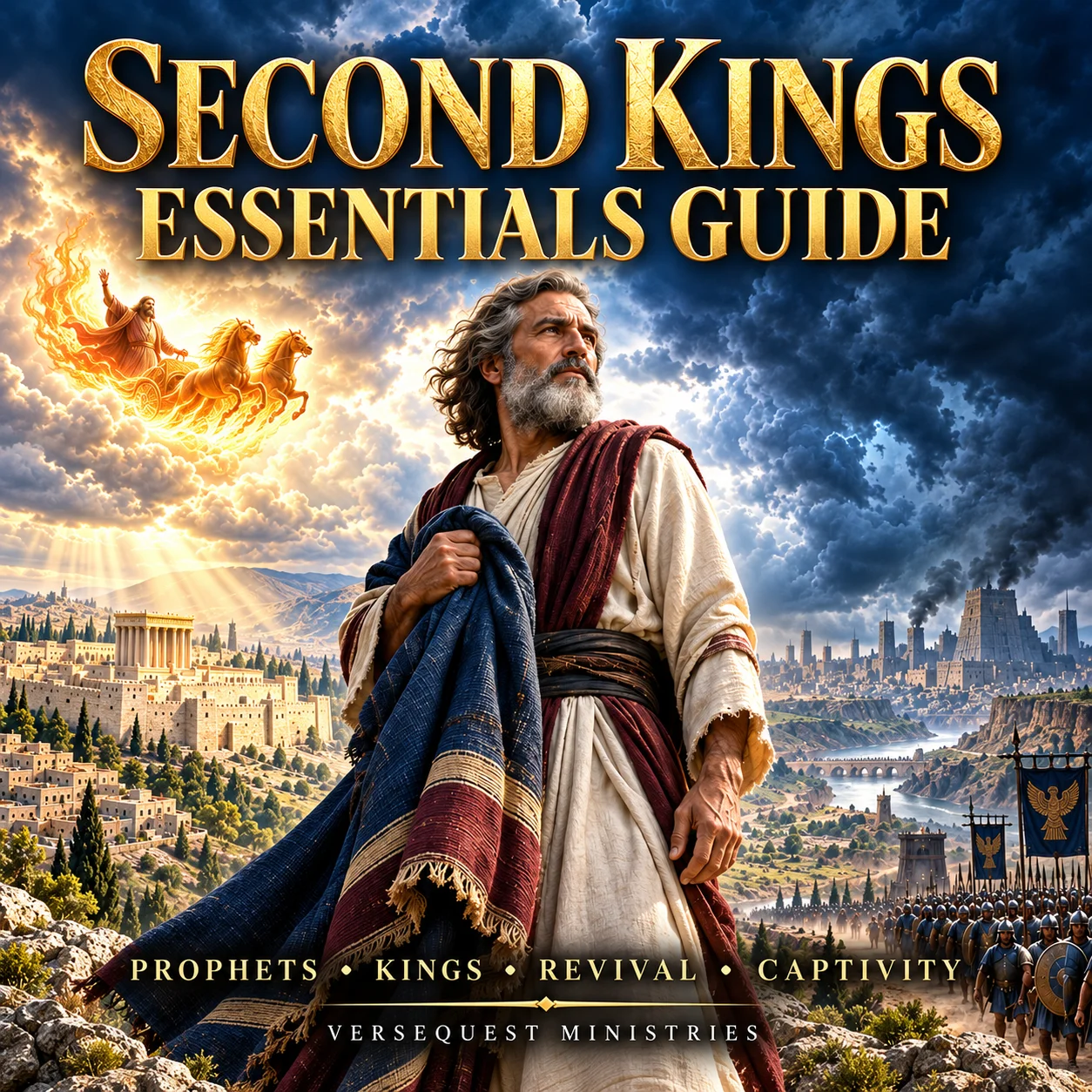
Second Kings Essentials Guide — KJV Bible Study PDF
The Second Kings Essentials Guide is a professionally designed 120-page downloadable PDF that makes the complicated history of Second Kings understandable without reducing it to a shallow summary. Through 92 Scripture-centered lessons, readers follow Elijah’s translation, Elisha’s miracles, the divided kingdoms, Jehu, Athaliah, Joash, Israel’s fall, Hezekiah’s deliverance, Manasseh’s wickedness, Josiah’s revival, and Judah’s Babylonian captivity.
Selected King James Bible passages are written directly into the guide and accompanied by explanations, important observations, study questions, teaching notes, and writing space. Historical orientation, chronological helps, kingdom comparisons, major people and places, doctrinal distinctions, difficult-passage guidance, sermon starters, and review pages make it useful for beginners, experienced Bible readers, teachers, pastors, families, and ministry students.
Digital PDF download. 120 pages. 92 lessons. Price: $14.99.
$14.99
Description
The Second Kings Essentials Guide is a comprehensive 120-page downloadable PDF designed to give readers a clear, organized, and substantial understanding of the entire book of Second Kings. Through 92 Scripture-centered lessons, it presents the essential history, people, miracles, prophetic ministries, royal successions, revivals, judgments, doctrinal truths, and practical warnings found throughout this important Old Testament book.
Second Kings continues the history begun in First Kings. The united kingdom has already divided into the northern kingdom of Israel and the southern kingdom of Judah. From that point forward, the biblical record traces two royal lines, repeated political upheaval, increasing apostasy, courageous prophetic witnesses, temporary reforms, foreign invasions, and the eventual captivity of both kingdoms. The guide organizes this complicated history so readers can follow the major kings, prophets, nations, locations, and turning points without becoming lost among unfamiliar names and rapidly changing events.
The opening chapters follow Elijah’s final ministry, his translation by a whirlwind into heaven, and the beginning of Elisha’s public ministry. Readers examine Elisha’s request for a double portion, the parting of Jordan, the healing of Jericho’s waters, the judgment involving the mocking children, and the confirmation that the spirit of Elijah rested upon Elisha. These events establish the authority of the prophetic office during a time when Israel’s kings continually departed from the Word of the LORD.
Considerable attention is given to Elisha’s remarkable ministry. The guide examines the multiplication of the widow’s oil, the Shunammite woman and her restored son, the healing of the poisoned pottage, the feeding of one hundred men, Naaman’s cleansing from leprosy, Gehazi’s covetousness, the floating axe head, the blinded Syrian army, the siege of Samaria, and the four lepers who discovered the abandoned enemy camp. These accounts reveal the LORD’s power over debt, death, disease, hunger, nature, armies, and impossible circumstances.
The political and spiritual history of both kingdoms is carefully traced. Readers encounter Jehoram, Jehu, Jezebel, Athaliah, Joash, Amaziah, Jeroboam II, Uzziah, Ahaz, Hoshea, Hezekiah, Manasseh, Amon, Josiah, Jehoahaz, Jehoiakim, Jehoiachin, and Zedekiah. The guide explains how each reign contributed either to temporary reform or continued decline, while showing that outward success could never compensate for rebellion against the Word of God.
The fall of the northern kingdom receives thorough treatment. Second Kings explains why Samaria fell to Assyria and why the ten northern tribes were carried away. Their captivity was not merely the result of military weakness or international politics. Israel feared other gods, adopted heathen customs, rejected the LORD’s statutes, ignored His prophets, practiced idolatry, and hardened itself against repeated warnings. The guide also examines the foreign populations placed in Samaria and the confused religious mixture that followed.
The guide then follows Judah through the Assyrian crisis and the reign of Hezekiah. Readers study Hezekiah’s reforms, the destruction of the brasen serpent, Sennacherib’s invasion, Rabshakeh’s blasphemous threats, Hezekiah’s prayer, Isaiah’s answer, and the destruction of 185,000 Assyrian soldiers by the angel of the LORD. Hezekiah’s sickness, miraculous recovery, the sign involving the shadow, and his unwise display of Judah’s treasures to the Babylonian ambassadors are also explained.
The reigns of Manasseh and Josiah demonstrate the far-reaching influence of leadership. Manasseh’s long and wicked reign filled Jerusalem with idolatry, occult practices, corruption, and innocent blood. Josiah later repaired the temple, recovered the book of the law, humbled himself before the LORD, destroyed idols and false worship, and restored the passover. Yet even Josiah’s remarkable reforms could not erase the accumulated guilt of generations that had knowingly rejected God’s warnings.
The closing chapters bring Judah to its final collapse. The guide traces the rise of Babylon, the weakening of Judah’s final kings, the sieges of Jerusalem, the carrying away of the temple treasures, the destruction of the city and temple, the blinding and captivity of Zedekiah, and the removal of the people from the land. The final account of Jehoiachin’s release from prison preserves a small but meaningful sign that God had not forgotten David’s royal line.
Each of the 92 lessons includes a selected King James Bible passage written in full, an understandable explanation, important observations, a focused Bible-study lens, questions for reflection or discussion, and purposeful writing space. The additional reference material includes historical orientation, kingdom comparisons, chapter movements, major people and places, chronological helps, prophetic connections, doctrinal distinctions, difficult passages, teaching plans, sermon starters, review material, and memorable truths.
The professionally designed pages use clean borders, coordinated colors, clearly separated content panels, readable typography, and integrated note areas. This resource is substantial enough to support serious study while remaining more approachable than a large verse-by-verse commentary. It can be used for personal Bible study, Sunday school, discipleship, family reading, small groups, classroom instruction, sermon preparation, ministry training, or rapid review.
The authority of the Word of the LORD — Prophetic declarations repeatedly govern kings, wars, successions, miracles, judgments, and national destinies. Elijah’s translation — Elijah’s departure by a whirlwind demonstrates God’s power over death and completes an extraordinary prophetic ministry. Elisha’s double-portion ministry — Elisha’s miracles display the LORD’s power in both national crises and personal needs. The divided kingdom — Israel and Judah follow separate royal lines while remaining accountable to the same God and His revealed Word. Prophets confronting kings — Political office never places a ruler beyond divine correction. Miracles of provision — Oil, food, water, and other necessities are supplied when ordinary resources cannot meet the need. Power over death and disease — The restoration of the Shunammite’s son and Naaman’s cleansing demonstrate that no human condition exceeds God’s authority. Grace toward Gentiles — Naaman receives cleansing when he humbles himself and obeys the revealed command. Covetousness in ministry — Gehazi warns against using spiritual position for personal profit. Spiritual sight and blindness — Elisha’s servant, the Syrians, Israel’s rulers, and the nation itself illustrate different forms of perception and blindness. The certainty of prophecy — The detailed fulfillment of earlier judgments against Ahab’s house, Jezebel, Jeroboam’s altar, Israel, and Judah confirms the reliability of God’s Word. Incomplete reform — Jehu destroyed Baal worship but retained Jeroboam’s false religious system. The preservation of David’s line — Joash’s rescue from Athaliah preserves the royal lineage through which the Messiah would come. The danger of high places — Repeated references to tolerated high places reveal the weakness of partial obedience. National apostasy and captivity — Israel’s exile is presented as the direct result of long-term rebellion rather than merely political defeat. Religious mixture — The Samaritans feared the LORD while serving their own gods, exposing the contradiction of blended worship. Hezekiah’s faith and prayer — Judah’s king brings an impossible military threat before the LORD and receives supernatural deliverance. The peril of pride after blessing — Hezekiah’s unwise display to Babylon follows his miraculous recovery. The influence of wicked leadership — Manasseh’s reign demonstrates how deeply one ruler can corrupt a nation. Revival through the recovered Book — Josiah’s reform begins when the written law is found, read, believed, and obeyed. The limitations of outward reform — Josiah’s changes were extensive, but many hearts remained unchanged and Judah’s accumulated guilt remained. Judgment after repeated warning — Captivity comes only after generations of prophetic warnings, patience, and rejected opportunities to repent. The fall of Jerusalem — The temple, city, monarchy, and national security cannot protect a people who persistently reject the LORD. Hope within judgment — Jehoiachin’s release shows that God preserved David’s royal line even during Babylonian captivity.
Second Kings is not merely a record of ancient rulers and lost battles. It is the inspired account of what happens when a nation repeatedly rejects the Word of God while assuming that religious institutions, royal traditions, military strength, and national identity will protect it from judgment. The book demonstrates that the LORD rules over kings, armies, disease, famine, international empires, and the course of history.
The transition from Elijah to Elisha establishes continuity in God’s prophetic witness. Elijah is taken up by a whirlwind, but the Word of the LORD does not depart with him. Elisha receives the mantle and immediately crosses Jordan, demonstrating that divine power rests upon the calling and purpose of God rather than upon one indispensable human personality.
Elisha’s miracles address both great crises and ordinary needs. A widow’s debt, a barren woman’s sorrow, a dead child, poisoned food, hungry men, a leprous soldier, a borrowed tool, a frightened servant, and a besieged city all come within the reach of God’s power. The ministry reminds readers that the LORD is neither overwhelmed by national catastrophe nor unconcerned about personal distress.
Naaman’s cleansing joins grace with humble obedience. He possessed rank, reputation, military achievement, wealth, and influence, yet he remained a leper. His anger rose when God’s remedy did not flatter his expectations. Healing came only when he humbled himself and obeyed the simple command. Gehazi then provides the opposite lesson: a man may live near genuine spiritual power while remaining governed by covetousness.
Jehu’s story warns that zeal against one form of wickedness does not equal wholehearted obedience. He destroyed Ahab’s house and removed Baal worship, yet he preserved the calves and political religion established by Jeroboam. A man may execute part of God’s command forcefully while protecting the very compromise that serves his own interests.
Athaliah’s attempt to destroy the royal seed reveals Satan’s opposition to the Davidic line. Joash was preserved in the house of the LORD until the proper time for his public appearance. The event is historically important because God had promised David an enduring house and ultimately preserved the lineage leading to the Lord Jesus Christ.
The fall of Samaria is accompanied by an inspired explanation. Israel was not conquered because Assyria’s gods were stronger or because the LORD had forgotten His people. The nation had rejected His commandments, followed vanity, practiced idolatry, sacrificed children, used divination, and refused the prophets sent to warn them. Captivity was the harvest of sustained rebellion.
The imported populations of Samaria illustrate religious mixture. They learned something of the fear of the LORD while retaining their own gods and inherited practices. Second Kings therefore distinguishes genuine obedience from a religion that adds the LORD to an existing collection of loyalties.
Hezekiah’s confrontation with Assyria demonstrates the power of prayer and the danger of intimidation. Rabshakeh used propaganda, mockery, partial truths, political pressure, and blasphemy to weaken Judah before the battle began. Hezekiah carried the threatening letter into the house of the LORD and spread it before God. The resulting deliverance came through divine intervention, not superior human strength.
Hezekiah’s later failure shows that one victory does not remove the need for continued vigilance. After healing and miraculous confirmation, he proudly displayed his treasures to Babylon. The ambassadors who appeared friendly represented the empire that would eventually carry those treasures and Judah’s descendants away.
Josiah’s revival began with the recovered book of the law. The king heard the words, recognized Judah’s guilt, rent his clothes, humbled himself, sought the LORD, and acted upon what he had learned. Biblical revival is therefore connected with the reading, believing, and obeying of the written Word—not merely with excitement, crowds, music, or public enthusiasm.
Nevertheless, outward reform has limits. Josiah could remove idols, destroy high places, dismiss corrupt priests, and restore the passover, but he could not force genuine repentance into every heart. The guide therefore distinguishes between public reformation and inward conversion.
Second Kings ends with Jerusalem destroyed, the temple burned, the walls broken, the treasures removed, and the population carried into Babylon. Yet the book does not close with the final extinction of David’s house. Jehoiachin is released, treated with favor, and given a continuing place in Babylon. Even in judgment, God preserves the royal line and remains faithful to His covenant purposes.
For personal Bible study, the guide provides a structured journey through Second Kings. Readers can study one lesson at a time, examine the complete selected KJV passage, record observations, answer the study questions, and use the reference pages to review the larger historical movement.
For sermon preparation, pastors and preachers can use the lessons, observations, major themes, prophetic connections, and sermon starters to develop messages about spiritual authority, prayer, revival, leadership, idolatry, compromise, divine judgment, providence, and the certainty of Scripture.
For Sunday school and small groups, the lessons can be organized around Elijah and Elisha, the miracles of Elisha, Jehu and the house of Ahab, the fall of Israel, Hezekiah and Assyria, Josiah’s revival, or Judah’s final captivity. The questions and note areas encourage participation and discussion.
For discipleship, Second Kings supplies powerful instruction concerning obedience, humility, contentment, prayer, courage, spiritual discernment, leadership, compromise, repentance, and faithfulness during national decline.
For family study, selected lessons can be read and discussed without requiring a separate curriculum. The printed Scripture passages and concise explanations help developing Bible readers understand complicated events and unfamiliar historical figures.
For classroom instruction and ministry training, the chronological helps, kingdom distinctions, principal people, key locations, prophetic ministries, doctrinal observations, and review materials provide an organized framework for teaching the book accurately.
For topical teaching, the guide can support studies on biblical revival, apostasy, prophetic authority, false worship, miracles, spiritual leadership, national judgment, Assyria, Babylon, the captivity, and the preservation of the Davidic line.
The most important companion to this guide is a King James Bible so readers can examine the complete chapters and surrounding context of every selected passage. A Strong’s or Cruden’s concordance can help trace important terms such as prophet, king, high place, covenant, captivity, Assyria, Babylon, word of the LORD, and man of God.
The First Kings Essentials Guide is the most natural companion resource because it introduces the divided kingdom, Solomon’s decline, Jeroboam’s counterfeit worship, Ahab and Jezebel, Elijah’s early ministry, and the spiritual conditions that continue into Second Kings.
The First Samuel Essentials Guide and Second Samuel Essentials Guide can help readers follow the development of Israel’s monarchy from Samuel and Saul through David’s reign and the establishment of the Davidic covenant.
A reliable Bible dictionary can provide background information about Samaria, Jerusalem, Jordan, Carmel, Jezreel, Moab, Edom, Syria, Assyria, Babylon, Nineveh, and the principal kings and prophets. A Bible atlas is helpful for following military campaigns, prophetic journeys, invasions, and the deportations of Israel and Judah.
Cross-reference tools can help readers compare Second Kings with Second Chronicles, Isaiah, Jeremiah, and the New Testament references to Elijah, Elisha, Naaman, and the faithful remnant. Chronological charts of the kings of Israel and Judah are especially helpful because the two royal lines frequently overlap.
Related products
-
Jesus Christ
-
-10%
- The Lord Jesus Christ Made Plain – 637-Page KJV Bible Study
- A massive 637-page, 100-part KJV Bible study on the Person and work of the Lord Jesus Christ. This premium VerseQuest resource covers His deity, incarnation, blood, cross, resurrection, present ministry,…
- Original price was: $39.00.$34.99Current price is: $34.99.
- Add to cart
-
-10%
-
The Rapture
-
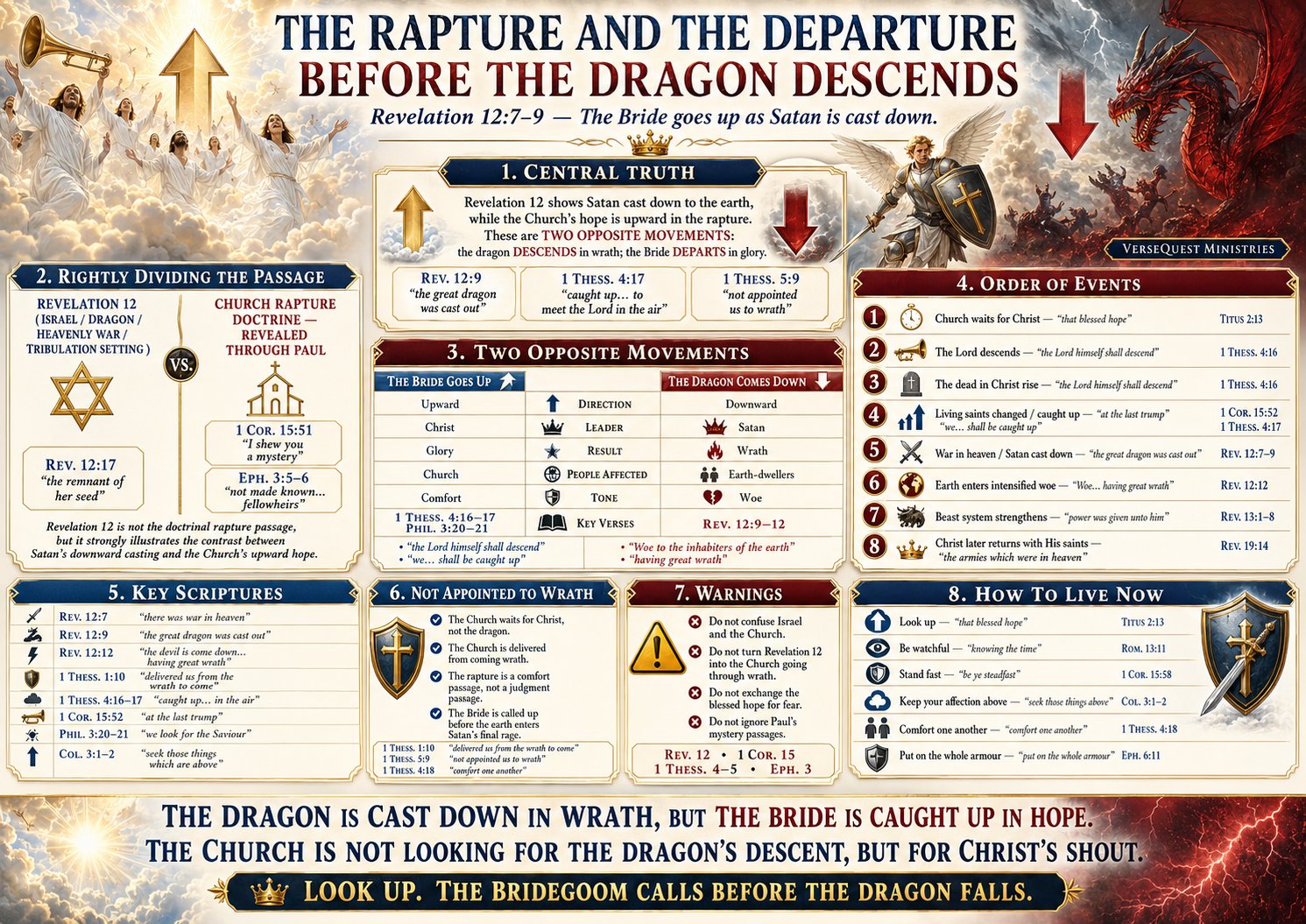
- The Rapture and the Departure Before the Dragon Descends – Printable Bible Study Chart
- Printable KJV Bible study chart on The Rapture and the Departure Before the Dragon Descends, showing the Bride caught up before Satan is cast down in wrath. This premium VerseQuest…
- $4.99
- Add to cart
-
-
Names of Christ
-
- The Names and Titles of Jesus Christ Made Plain
- A complete 100-essay KJV Bible study on the names and titles of the Lord Jesus Christ, showing His deity, humanity, blood atonement, resurrection, priesthood, headship over the Church, shepherd care,…
- $29.99
- Add to cart
-
-
VerseQuest Premium Library
-
-67%
- The Book of Psalms Made Plain – 383-Page KJV Psalm Study
- The Book of Psalms Made Plain is a 383-page premium KJV Bible study featuring 54 detailed essays through the major themes, doctrines, prophecies, prayers, laments, and praises of the Psalms.…
- Original price was: $29.99.$9.99Current price is: $9.99.
- Add to cart
-
-67%
-
Bible Overview Series
-
- The New Jerusalem Made Plain — 621-Page PDF Study
- The New Jerusalem Made Plain is a massive 621-page KJV/rightly divided PDF study on the literal holy city revealed in Revelation 21–22. This 100-essay book makes the New Jerusalem plain…
- $34.99
- Add to cart
-