
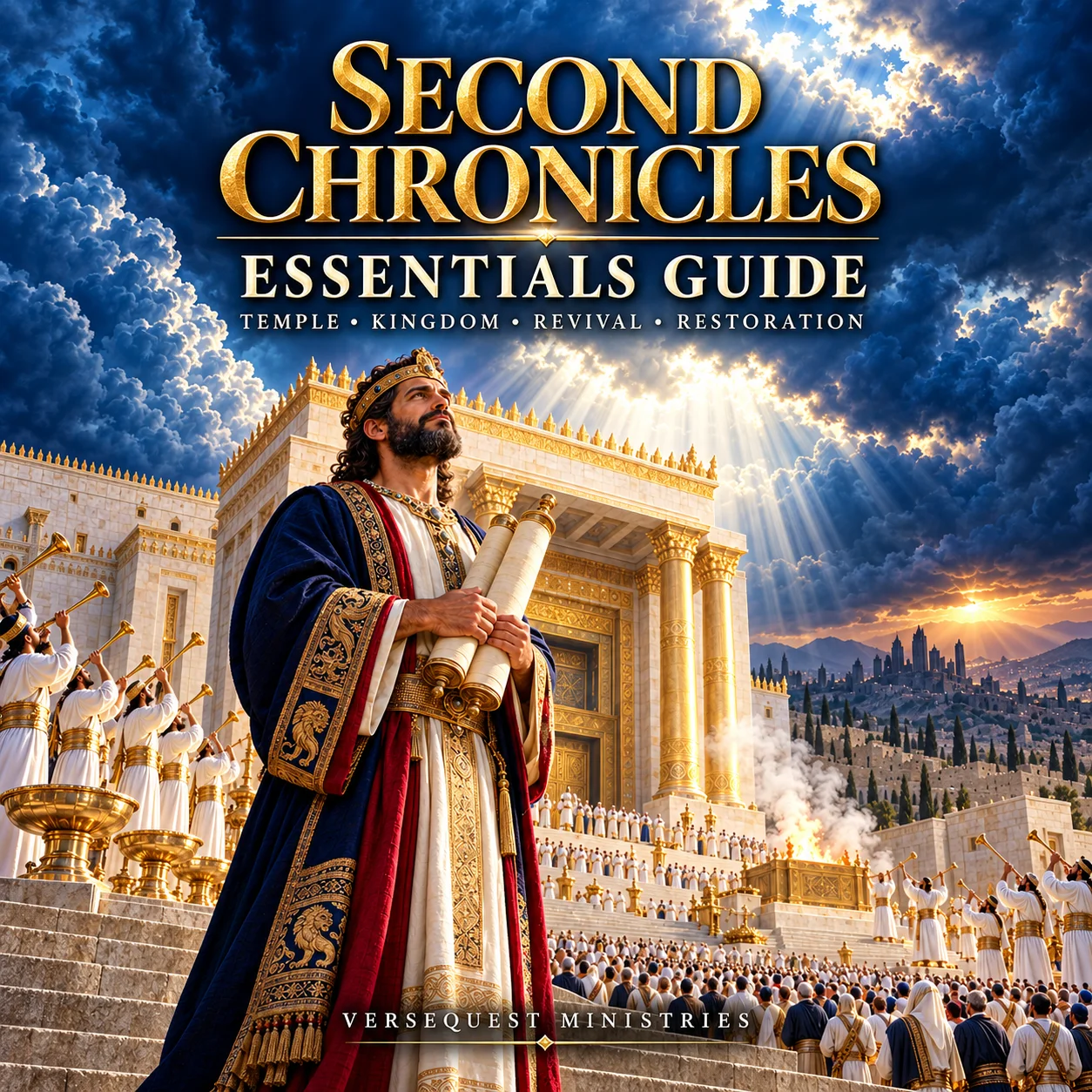
Second Chronicles Essentials Guide — KJV Bible Study PDF
The Second Chronicles Essentials Guide is a professionally designed 120-page downloadable PDF that makes the history and message of Second Chronicles understandable without reducing it to a shallow summary. Through 88 Scripture-centered lessons, readers follow Solomon’s wisdom, the temple and its dedication, the divided kingdom, Judah’s kings, prophetic warnings, major revivals, Assyrian threats, Babylonian captivity, and Cyrus’s decree.
Selected King James Bible passages are printed directly in the guide and accompanied by clear explanations, important observations, Bible-study lenses, review questions, memorable truths, and writing space. Orientation pages, timelines, comparisons, doctrinal guardrails, teaching plans, sermon starters, master-reference studies, and Scripture indexes make the guide valuable for beginners, experienced Bible readers, pastors, teachers, families, and ministry students.
Digital PDF download. 120 pages. 88 lessons. Price: $14.99.
$14.99
Description
The Second Chronicles Essentials Guide is a professionally designed 120-page downloadable PDF created to give readers a clear, substantial, and organized understanding of the entire book of Second Chronicles. Through 88 Scripture-centered lessons, the guide presents the essential history, kings, prophets, prayers, revivals, warnings, judgments, covenants, and doctrinal truths found throughout all 36 chapters.
Second Chronicles begins with Solomon established upon the throne of Israel. Readers follow his request for wisdom, the preparation and construction of the temple, the transportation of the ark, the organization of worship, the dedication of the house, and the visible manifestation of the glory of the LORD. Solomon’s prayer in chapter 6 and God’s answer in chapter 7 receive careful attention because they establish the covenant setting for much of the history that follows.
The guide explains Second Chronicles 7:14 within its proper biblical context. The promise concerns Israel, the temple, national chastening, prayer, repentance, forgiveness, and the healing of the land. Readers will learn how to preserve that original covenant setting while still recognizing the important spiritual lessons concerning humility, prayer, seeking God, and turning from wickedness.
After Solomon’s reign, the guide follows the division of the kingdom under Rehoboam. His rejection of mature counsel, harsh response to the people, and contribution to the national rupture provide serious lessons about leadership, pride, service, and the consequences of foolish advice. The migration of faithful priests, Levites, and worshippers to Jerusalem also demonstrates the cost of separating from a corrupted religious system.
The reigns of Abijah, Asa, and Jehoshaphat reveal the book’s recurring emphasis upon seeking the LORD. Abijah appeals to the Davidic covenant and ordered temple worship. Asa experiences remarkable deliverance when he relies upon God, but his later dependence upon Syria and rejection of prophetic correction show that former faithfulness does not guarantee a faithful finish. Jehoshaphat strengthens Judah through the teaching of Scripture and the appointment of righteous judges, yet his alliances with Ahab and Ahaziah bring rebuke and loss.
Special attention is given to Jehoshaphat’s prayer in Second Chronicles 20. Surrounded by enemies and unable to meet the threat in his own strength, the king confesses, “neither know we what to do: but our eyes are upon thee.” The guide traces the national fast, the prophetic answer, the promise that the battle belonged to God, the singers sent before the army, and the extraordinary deliverance that followed.
The preservation of David’s royal line is another major subject. Jehoram’s murders, Athaliah’s attempt to destroy the royal seed, the hiding of the young Joash, Jehoiada’s courageous leadership, and the public restoration of the rightful king are placed within the larger purpose of the Davidic covenant. Human wickedness repeatedly threatens the royal house, but it cannot overturn what God has promised.
The guide honestly examines kings who began well but declined through compromise or pride. Joash depended upon Jehoiada’s convictions without developing sufficient conviction of his own. Amaziah obeyed with an imperfect heart and later became presumptuous. Uzziah was marvelously helped until he became strong, after which pride led him to invade the priestly office. Hezekiah experienced revival and supernatural deliverance but later required humbling after his heart was lifted up.
The reign of Ahaz demonstrates the destructive reach of wicked leadership. He promoted idolatry, shut the temple doors, sought foreign help, and hardened himself during distress. His reign prepares the reader to appreciate the great revival under Hezekiah, who reopened the temple, sanctified the priests and Levites, restored sacrifice and praise, invited Israel to the Passover, supported continuing ministry, and sought the LORD with all his heart.
The final portion of the guide examines Manasseh, Amon, Josiah, Judah’s last kings, the Babylonian captivity, and Cyrus’s decree. Manasseh’s great wickedness and later repentance demonstrate both the depth of human rebellion and the reach of divine mercy. Josiah’s revival begins when the book of the law is recovered, read, believed, and obeyed. His tender response to Scripture stands in sharp contrast with the final generation that mocked God’s messengers until there was no remedy.
The destruction of Jerusalem and the temple is presented as the fulfillment of repeated biblical warnings rather than an accidental political defeat. Nevertheless, the book does not end with Babylon, fire, or captivity. It closes with Cyrus acknowledging his charge to rebuild the house at Jerusalem and inviting God’s people to return. Judgment does not cancel God’s covenant purpose.
Every lesson contains the complete selected King James Bible passage, a clear explanation of the text, three important observations, a Bible-study lens, review questions, a memorable central truth, and purposeful writing space. The guide also contains orientation pages, chapter movements, timelines, comparisons, teaching aids, Scripture and subject indexes, and 16 master-reference pages addressing the temple, Davidic covenant, Second Chronicles 7:14, Judah’s kings, prophets, revivals, prayers, alliances, pride, difficult passages, Christ in Second Chronicles, and sermon preparation.
This digital resource is suitable for beginners who are encountering Second Chronicles for the first time and experienced readers who need a reliable review or teaching reference. It can be used for personal Bible study, discipleship, family reading, Sunday school, small groups, classroom instruction, ministry training, sermon preparation, and topical teaching.
Solomon’s request for wisdom — The new king seeks wisdom and knowledge to govern the people entrusted to him. The construction of the temple — Materials, craftsmen, architecture, vessels, courts, and sacred furnishings are prepared for the house of God. Mount Moriah and Ornan’s threshingfloor — The temple stands where sacrifice previously stayed judgment. The ark and covenant testimony — The ark is placed at the center of the completed temple beneath the cherubims. The glory of the LORD — Divine glory fills the house and temporarily prevents the priests from ministering. Solomon’s dedicatory prayer — The prayer joins temple worship with justice, defeat, drought, repentance, forgiveness, captivity, and restoration. Second Chronicles 7:14 — The passage is explained within its covenant setting concerning Israel, national chastening, prayer, repentance, and the land. The Davidic covenant — God preserves David’s royal line through division, assassination, usurpation, apostasy, and captivity. The divided kingdom — Rehoboam’s pride and foolish counsel contribute to the rupture between Judah and the northern tribes. Seeking and forsaking the LORD — The book repeatedly interprets national events according to whether king and people seek or forsake God. Reliance upon God — Abijah, Asa, Jehoshaphat, and Hezekiah experience deliverance when they rely upon the LORD. Dangerous alliances — Partnerships with Syria, Ahab, Ahaziah, and Assyria repeatedly bring rebuke, loss, or greater distress. The authority of the written Word — Scripture is taught under Jehoshaphat, recovered under Josiah, and fulfilled through captivity and restoration. Prophets confronting kings — God’s messengers explain events, expose compromise, promise deliverance, and announce judgment. The preservation of Joash — The survival of the hidden royal child protects the Davidic line from Athaliah’s attempted destruction. Borrowed conviction — Joash’s decline after Jehoiada’s death warns against depending entirely upon another person’s faithfulness. Pride after prosperity — Rehoboam, Amaziah, Uzziah, and Hezekiah demonstrate dangers that arise after strength, victory, or blessing. The boundaries of sacred service — Uzziah’s leprosy demonstrates that royal authority did not grant permission to assume the priestly office. Hezekiah’s revival — Temple cleansing, sacrifice, music, Passover, teaching, giving, and wholehearted seeking restore national worship. Manasseh’s repentance — One of Judah’s most wicked kings humbles himself greatly and demonstrates repentance through visible reform. Josiah’s tender heart — Revival begins when the recovered book is read, believed, and obeyed. The limitations of outward reform — National changes cannot substitute for inward repentance in every individual heart. The no-remedy judgment — Persistent mockery of God’s messengers eventually brings irreversible governmental judgment. The Babylonian captivity — Jerusalem’s fall fulfills covenant warnings and enforces the land’s neglected sabbatical years. Hope after judgment — Cyrus’s decree demonstrates that captivity did not cancel God’s covenant purposes. Christ as the greater Son of David — The failures of Judah’s kings increase the expectation of the perfect, righteous, everlasting King.
Second Chronicles is an inspired interpretation of Judah’s history from Solomon’s throne to Cyrus’s decree. Its central argument is that the nation’s relationship to the LORD, His Word, His temple, His covenant, and His messengers explains its strength, weakness, revival, defeat, captivity, and continuing hope. Political events matter, but the book consistently reveals the spiritual reasons beneath those events.
The opening nine chapters establish the glory and responsibility of Solomon’s reign. Solomon receives wisdom, builds the temple, organizes worship, brings in the ark, prays before the nation, and witnesses the glory of the LORD fill the house. The temple is not merely an impressive national monument. It is connected with God’s name, sacrifice, priestly service, covenant testimony, prayer, and Israel’s responsibility before the LORD.
Solomon’s prayer anticipates nearly every major national crisis that follows: personal disputes, military defeat, drought, famine, pestilence, foreign witness, war, sin, captivity, repentance, forgiveness, and restoration. God’s answer in chapter 7 must therefore be interpreted within that setting. Second Chronicles 7:14 concerns the covenant people, their land, national chastening, prayer, repentance, and healing. Christian application should never erase Israel or replace the original promise.
Rehoboam’s failure demonstrates how quickly pride can divide what wisdom might have preserved. He rejected the counsel of experienced men because their advice required him to serve the people and speak kindly. He preferred the counsel that magnified his authority. The result was not stronger government but national rupture.
Asa’s reign demonstrates the difference between beginning in faith and finishing in self-reliance. When confronted by an overwhelming Ethiopian host, Asa called upon the LORD and confessed that divine help was not limited by numbers. Later, when threatened by Baasha, Asa used sacred treasure to purchase Syrian assistance. The king who once relied upon God rejected the prophet who exposed his compromise.
Jehoshaphat’s reign contains both admirable reform and serious inconsistency. He sent teachers throughout Judah with the book of the law and charged judges to act in the fear of the LORD. Yet he repeatedly entered alliances with wicked rulers. His life warns that biblical knowledge and public usefulness do not make compromise harmless.
Second Chronicles 20 presents one of Scripture’s clearest examples of national prayer and supernatural deliverance. Jehoshaphat did not pretend to possess sufficient strength or wisdom. He confessed, “neither know we what to do: but our eyes are upon thee.” God’s answer did not glorify Judah’s military ability. The singers went before the army, the LORD turned the enemies against one another, and the people gathered the spoil after God had fought the battle.
The account of Athaliah and Joash demonstrates the preservation of the Davidic covenant. Athaliah attempted to destroy the royal seed, but one child was hidden in the house of God. Joash’s survival was not an insignificant palace incident. The promised royal line through which the Messiah would come was being preserved through providence, courage, and faithful action.
Joash also illustrates the danger of borrowed conviction. While Jehoiada lived, Joash repaired the temple and supported ordered worship. After Jehoiada’s death, the king listened to corrupt princes, forsook the house, and authorized the death of Zechariah. A person may behave properly beneath another individual’s influence without developing convictions strong enough to survive alone.
Uzziah’s reign warns about pride after success. The king was marvelously helped until he became strong. His strength became the occasion for self-exaltation, and he entered the temple to perform work assigned to the priests. His leprosy demonstrates that success in one calling does not authorize a person to ignore boundaries God has established in another.
Hezekiah’s revival joins temple cleansing, sanctified servants, sacrifice, music, praise, Passover, teaching, generosity, and national joy. The revival was not based upon excitement alone. The house was cleansed, the priests and Levites were prepared, proper worship was restored, and the people were taught to support continuing ministry. Hezekiah’s later pride also demonstrates that even great deliverance does not remove the need for continued humility.
Manasseh provides one of the book’s strongest demonstrations of repentance. His wickedness was extensive, deliberate, and corrupting. Yet in affliction he humbled himself greatly, prayed, and was restored. His later actions—removing idols, repairing the altar, and commanding Judah to serve the LORD—show that genuine repentance produces a changed direction.
Josiah’s revival begins with the recovered book. When the law was read, the king did not debate it, revise it, or explain away its judgment. His heart was tender, he humbled himself, and he acted upon what he heard. Biblical revival begins with the written Word believed and obeyed.
The final generation stands in deliberate contrast with Josiah. The people mocked God’s messengers, despised His words, and misused His prophets until the wrath of the LORD arose “till there was no remedy.” Jerusalem, the temple, the monarchy, and national identity could not protect a people who continually rejected the God who gave those privileges.
Nevertheless, the final word is not Babylon. Cyrus issues a decree concerning the rebuilding of the house at Jerusalem and calls God’s people to go up. Second Chronicles therefore closes with covenant continuity and restored opportunity. Judgment is real, but God’s purpose remains certain.
For personal Bible study, the guide can be read from beginning to end as a structured survey of Second Chronicles. Readers can study one lesson at a time, examine the complete selected KJV passage, record observations, and use the master-reference pages to review the temple, kings, prophets, revivals, and major doctrinal distinctions.
For sermon preparation, pastors and preachers can use the lesson titles, central truths, textual observations, Bible-study lenses, reference charts, and sermon starters as foundations for messages. Major preaching subjects include Solomon’s prayer, Second Chronicles 7:14, Asa’s reliance, Jehoshaphat’s prayer, Joash’s decline, Uzziah’s pride, Hezekiah’s revival, Manasseh’s repentance, Josiah’s tender heart, and the no-remedy judgment.
For Sunday school and small groups, the 88 lessons are arranged within eight major units. Teachers may follow those units or organize shorter studies around the temple, the divided kingdom, Judah’s kings, prophetic correction, spiritual revival, prayer, national judgment, and restoration.
For discipleship, the guide provides instruction concerning wisdom, worship, leadership, humility, prayer, spiritual discernment, response to correction, separation from idolatry, wholehearted service, repentance, stewardship, and finishing faithfully.
For family study, selected lessons can be read aloud and discussed without requiring a formal curriculum. The printed KJV passages, explanations, observations, questions, and note spaces make the material approachable for developing Bible readers.
For classroom instruction and ministry training, the historical orientation, timeline, comparison with Kings, kings chart, chapter movements, doctrinal guardrails, difficult-passage guidance, indexes, and teaching plans provide an organized framework for communicating the book accurately.
For topical teaching, the guide can support studies on Solomon’s temple, the Davidic covenant, biblical revival, national repentance, the kings of Judah, prophetic authority, pride, ungodly alliances, Assyria, Babylon, captivity, and restoration.
The primary companion to this guide should be a King James Bible so readers can examine the complete chapters surrounding every selected passage. A Strong’s or Cruden’s concordance can help trace important words such as temple, house, throne, covenant, seek, forsake, humble, prayer, prophet, Passover, revival, and captivity.
The First Chronicles Essentials Guide is the most natural companion resource because it explains Israel’s genealogies, David’s kingdom, the transportation of the ark, the Davidic covenant, the purchase of the temple site, the organization of priests and Levites, David’s temple preparations, and Solomon’s enthronement.
The First Kings Essentials Guide and Second Kings Essentials Guide provide the parallel historical record of Solomon, the divided kingdom, the kings of Israel and Judah, prophetic ministries, Assyria, Babylon, and the captivities. Reading Kings and Chronicles together helps the student recognize the distinct inspired purpose and emphasis of each account.
A reliable Bible dictionary can provide helpful information about Jerusalem, Mount Moriah, Gibeon, Samaria, Ramoth-gilead, Assyria, Babylon, Persia, the temple, the priesthood, Levites, Passover, and the principal kings and prophets. A Bible atlas can help readers follow invasions, alliances, battles, deportations, and the return from captivity.
A chronological chart of the kings of Judah and Israel is especially useful because several reigns overlap with events recorded in Kings and the Prophets. Cross-reference tools can also help readers compare Second Chronicles with Samuel, Kings, Ezra, Psalms, Isaiah, Jeremiah, and the Gospel passages concerning David’s throne and the greater Son of David.
For deeper study, readers may consult detailed KJV commentaries, temple diagrams, studies of the Davidic covenant, historical timelines, and doctrinal resources addressing Israel, the earthly kingdom, the future reign of Christ, and the proper distinction between Israel and the Church.
Related products
-
Heaven
-
- The Doctrine of Heaven Made Plain — 599-Page KJV Bible Study PDF
- A massive 599-page KJV, rightly divided study on heaven, covering the present heaven, resurrection body, Rapture, Millennium, New Jerusalem, eternal state, hard questions, funeral lies, and cult errors.
- $34.99
- Add to cart
-
-
Revelation
-
-71%
- Moses and Elijah: The Two Witnesses Made Plain
- Moses and Elijah: The Two Witnesses Made Plain is a 636-page premium VerseQuest PDF study proving from Scripture that the Two Witnesses of Revelation 11 are Moses and Elijah. This…
- Original price was: $34.99.$9.99Current price is: $9.99.
- Add to cart
-
-71%
-
Jesus Christ
-
-10%
- The Lord Jesus Christ Made Plain – 637-Page KJV Bible Study
- A massive 637-page, 100-part KJV Bible study on the Person and work of the Lord Jesus Christ. This premium VerseQuest resource covers His deity, incarnation, blood, cross, resurrection, present ministry,…
- Original price was: $39.00.$34.99Current price is: $34.99.
- Add to cart
-
-10%
-
KJV Bible Study Resources
-
-60%
- Practical Christianity for Daily Battles – 329-Page KJV Study PDF
- A premium 329-page KJV study PDF with 40 full essays applying sound, rightly divided Bible doctrine to real daily Christian battles. Topics include temptation, anxiety, marriage, parenting, pornography, grief, church…
- Original price was: $24.99.$9.99Current price is: $9.99.
- Add to cart
-
-60%
-
Kingdom Hall
-
-71%

- Jehovah’s Witnesses Made Plain – 574-Page KJV Watchtower Study
- A massive 574-page VerseQuest study exposing the Watchtower system from the King James Bible. This detailed 100-essay book covers the false Christ, false gospel, New World Translation, failed prophecy, 144,000,…
- Original price was: $34.99.$9.99Current price is: $9.99.
- Add to cart
-
-71%