
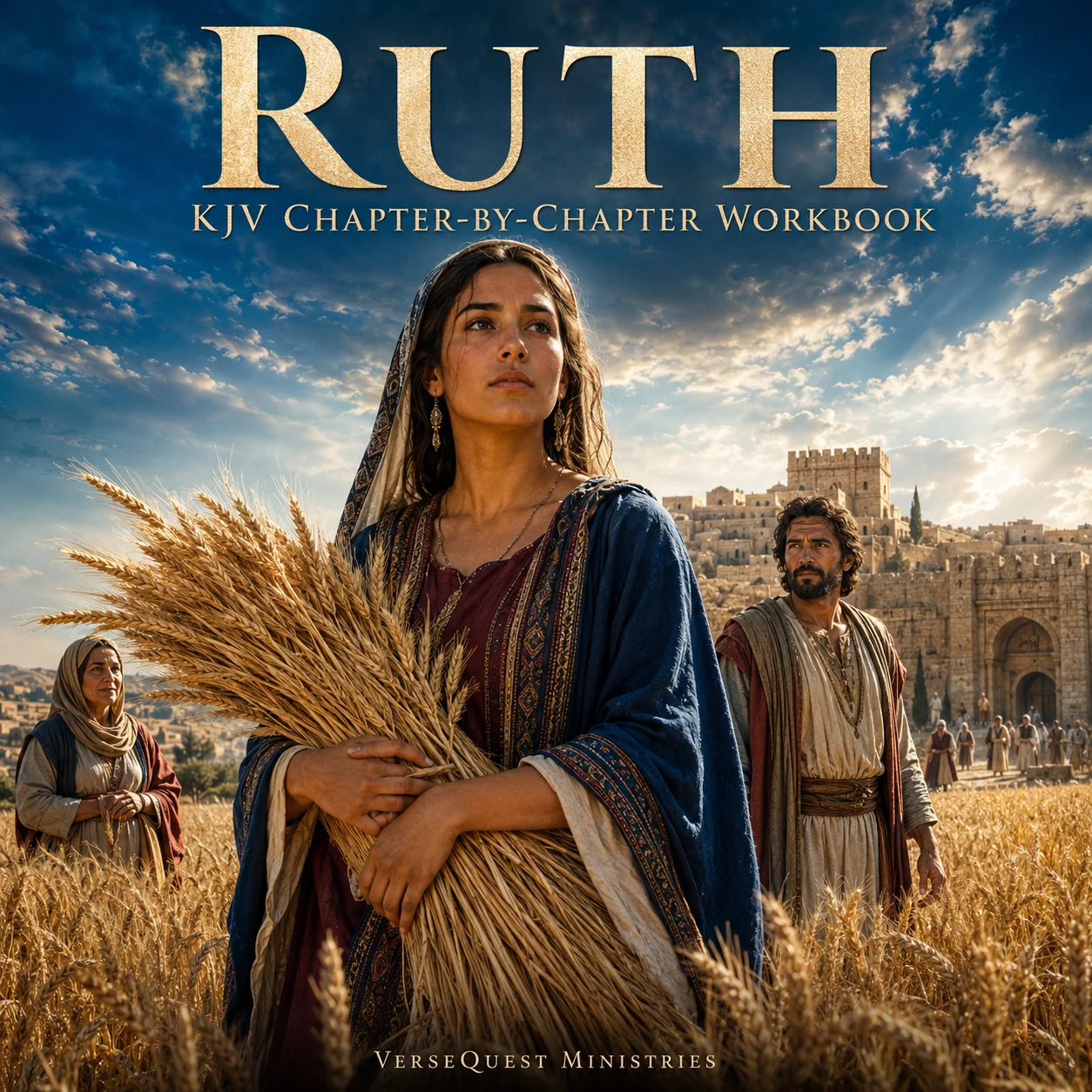
Ruth KJV Chapter-by-Chapter Workbook
The Ruth KJV Chapter-by-Chapter Workbook is a complete 160-page downloadable Bible curriculum covering all four chapters of Ruth from a Bible-believing, King James Bible-centered, rightly divided perspective.
Every chapter includes ten student-study pages followed by a Teacher and Leader Guide and suggested answers. Students will examine Naomi’s departure and return, Ruth’s confession, gleaning in the field of Boaz, refuge under the LORD’s wings, the threshingfloor appeal, the near-kinsman responsibility, redemption at the city gate, Obed’s birth, and the genealogy leading to David and Jesus Christ.
The workbook also includes flexible course schedules, reviews, a four-part final assessment, answer keys, sixteen advanced verse-study sections, thirty-two reference studies, a KJV glossary, subject and Scripture indexes, master charts, a teaching project, evaluation rubric, bookmarks, and a certificate of completion.
It may be printed for handwritten study or used digitally with compatible PDF software. Ideal for personal study, homeschool, Sunday school, Christian schools, church classes, small groups, Bible institutes, and ministry training.
Price: $14.99
$14.99
Description
The Ruth KJV Chapter-by-Chapter Workbook is a complete 160-page downloadable Bible curriculum designed to guide students carefully through all four chapters of Ruth. Although Ruth is one of the shorter books of the Old Testament, its inspired record reaches from the dark days of the judges to the royal genealogy of David and ultimately to the earthly lineage of Jesus Christ.
The workbook begins with Naomi’s family leaving Bethlehemjudah during a famine and follows the consequences of their sojourn in Moab. After the deaths of Elimelech, Mahlon, and Chilion, Naomi prepares to return home. Orpah returns to her people, but Ruth cleaves to Naomi and makes her remarkable confession of loyalty: “thy people shall be my people, and thy God my God.” The two widows arrive in Bethlehem at the beginning of barley harvest, where the LORD has already prepared the next stage of their restoration.
Students will follow Ruth into the field of Boaz and examine Israel’s laws concerning gleaning, the stranger, the widow, and the poor. The workbook studies Ruth’s diligence, humility, courage, and trust under the wings of the LORD, along with Boaz’s generosity, protection, godly speech, moral strength, and willingness to go beyond the minimum requirements of the law. The apparently ordinary circumstance by which Ruth comes to the field of Boaz becomes one of Scripture’s clearest demonstrations of divine providence working without spectacle.
Special attention is given to the threshingfloor scene in Ruth 3. The workbook approaches the passage carefully and refuses the sensational and immoral interpretations sometimes imposed upon it. Ruth makes a lawful appeal to a near kinsman, while Boaz praises her as a virtuous woman, protects her reputation, acknowledges the right of the nearer kinsman, and promises to complete the matter lawfully. The chapter teaches courage, purity, restraint, integrity, patient waiting, and confidence in the character of the redeemer.
Ruth 4 is examined in connection with Israel’s laws and customs concerning family property, inheritance, the widow, preservation of the dead man’s name, the city gate, public witnesses, and the removal of the shoe. The workbook carefully compares Ruth 4 with Leviticus 25 and Deuteronomy 25 without pretending that every legal procedure is identical. Boaz accepts the entire responsibility connected with redemption, marries Ruth after the public transaction is completed, and becomes the father of Obed.
The book closes with Naomi’s restoration and the inspired genealogy from Pharez to David. What began with famine, departure, death, widowhood, and emptiness concludes with harvest, return, redemption, marriage, birth, nourishment, and the preservation of Israel’s royal line. Matthew 1 carries that genealogy forward by naming Boaz, Ruth, Obed, Jesse, and David in the lineage leading to Jesus Christ.
Every chapter receives a consistent twelve-page treatment. The first ten pages guide the student through the chapter’s structure, principal movements, key passage, KJV vocabulary, doctrinal distinctions, cross-reference chains, written exercises, special studies, controlled typology, difficult questions, error correction, review, personal response, and teach-back preparation. The final two pages provide a coordinated Teacher and Leader Guide followed by suggested answers and a model chapter summary.
The additional curriculum includes course instructions, learning tracks, course outcomes, interpretive principles, structural overviews, chapter summaries, flexible schedules, eight-lesson and sixteen-lesson teaching plans, chronology and geography studies, chapter reviews, comprehensive reviews, a four-part final assessment, answer keys, sixteen advanced verse-study sections, thirty-two doctrinal and historical reference studies, a KJV glossary, subject and Scripture indexes, master charts, a final teaching project, evaluation rubric, further-study recommendations, final challenge, and certificate of completion.
This searchable downloadable PDF may be printed for handwritten study or used on a computer or tablet. With compatible PDF software, students may highlight text, add comments, draw markings, and type answers into added text boxes. Organized PDF bookmarks make the major sections and chapter studies easy to locate.
The Ruth KJV Chapter-by-Chapter Workbook is suitable for personal Bible study, homeschool families, Sunday school classes, Christian schools, church Bible-study groups, discipleship programs, Bible institutes, prison and recovery ministries, pastors, preachers, and teachers. It is a working Bible curriculum intended to help students open their King James Bible, examine the words, compare Scripture with Scripture, understand important distinctions, and develop the ability to explain and teach Ruth faithfully.
Life during the days of the judges — Ruth reveals household faithfulness and divine providence during an era of national spiritual disorder. Famine and departure from Bethlehem — The opening crisis drives Elimelech’s family from Bethlehemjudah into Moab. The consequences of prolonged sojourning — What begins as a temporary sojourn becomes a period of death, widowhood, and threatened family extinction. Naomi’s grief and bitterness — Naomi speaks honestly from profound loss and interprets her return through the language of emptiness. Ruth’s sevenfold commitment — Ruth cleaves to Naomi and joins her journey, dwelling, people, God, death, burial, and final separation. Faith demonstrated through action — Ruth’s confession is followed by departure from Moab, diligent labour, humility, purity, and perseverance. The return to Bethlehem — Naomi and Ruth return to the place of covenant history and divine provision. Barley harvest and renewed hope — The harvest begins before Naomi and Ruth understand how the LORD will use it. Gleaning under Israel’s law — Ruth benefits from the LORD’s commanded provision for the poor, widow, and stranger. Dignity through honest labour — Ruth requests permission, works throughout the day, gathers the grain, and brings the fruit home. Providence without spectacle — The LORD guides events through an apparently ordinary field, timely arrival, reputation, law, and human decisions. Boaz as a mighty man of wealth — Boaz’s strength is demonstrated through godly speech, protection, generosity, self-control, integrity, and responsibility. Refuge under the LORD’s wings — Ruth’s trust in Israel’s God becomes one of the controlling spiritual images of the book. Grace beyond minimum obligation — Boaz obeys the gleaning law and deliberately provides more than the law’s minimum requirement. Kindness to the living and the dead — Ruth, Naomi, and Boaz act with loyal kindness that remembers both present need and the threatened name of the dead. The search for rest — Naomi’s concern for Ruth’s settled well-being links the first and third chapters. Purity at the threshingfloor — Ruth and Boaz act with virtue, restraint, lawful order, protected reputation, and moral seriousness. Ruth as a virtuous woman — Her reputation is established through consistent conduct before she becomes a wife or mother. The nearer kinsman’s prior right — Boaz refuses to ignore the lawful claim of a relative nearer than himself. Waiting for the redeemer’s completed work — After making her appeal, Ruth must sit still while Boaz finishes the matter. Public righteousness at the city gate — Redemption is completed openly before the nearer kinsman, elders, inhabitants, and witnesses. Land, widow, name, and inheritance — Ruth 4 brings several family and property responsibilities together in one public transaction. The shoe of testimony — The removed shoe confirms the transfer of the right of redemption according to the custom explained by the narrator. Boaz as a controlled type of Christ — Boaz is related, qualified, able, willing, and prepared to accept the cost, while Christ is the perfect and eternal Redeemer. Redemption through an accepted price — Boaz willingly assumes the entire responsibility attached to the household and inheritance. Naomi’s restoration — The woman who returned empty receives family, nourishment, renewed hope, and a child in her household. Obed as restorer and nourisher — Obed represents renewed life for Naomi and becomes a vital link in Israel’s royal genealogy. The genealogy to David — The closing names reveal that this quiet family history advances the line of Israel’s coming king. Ruth in Christ’s earthly genealogy — Matthew explicitly carries Boaz, Ruth, Obed, Jesse, and David into the genealogy of Jesus Christ. Israel and the Body of Christ distinguished — Israel’s land, harvest laws, family responsibilities, and inheritance customs must not be turned into Church ordinances.
- Central argument: Ruth demonstrates how the LORD quietly preserves an emptied Bethlehem household through Ruth’s faithfulness and Boaz’s lawful redemption, bringing Obed into the line leading to David.
- Historical setting: The events occur during the days when the judges ruled, although Scripture does not identify the exact judge or calendar year.
- Opening and conclusion: The book opens with famine, departure, death, and widowhood but closes with harvest, redemption, marriage, birth, and royal genealogy.
- The controlling movement: Emptiness leads to return, return to provision, provision to an appeal for rest, and the appeal to completed redemption.
- The central geography: Moab represents the place of sojourn and bereavement, while Bethlehem becomes the place of return, harvest, redemption, and restored family history.
- Naomi’s perspective: Naomi believes she has returned empty, yet Ruth stands beside her and barley harvest has already begun.
- Ruth’s decision: Ruth’s confession joins personal loyalty with a decisive departure from her former people and gods.
- Faith and conduct: Ruth’s later diligence, humility, courage, and purity agree with the trust expressed in her confession.
- Providence: Ruth’s arrival in Boaz’s field appears incidental from the human viewpoint, but the narrative shows circumstances converging under divine direction.
- Gleaning: Israel’s law joins the landowner’s responsibility to leave grain with the poor person’s responsibility to gather it.
- Boaz’s generosity: Boaz protects Ruth, supplies water and food, permits broader access, prevents reproach, and commands deliberate handfuls of grain to be left for her.
- The LORD’s wings: Ruth seeks refuge under the God of Israel, and Boaz becomes one of the human instruments through whom that care is provided.
- Near-kinsman hope: Naomi’s recognition of Boaz as a near kinsman introduces the legal and family question that governs the remainder of the story.
- The meaning of rest: Naomi seeks a settled household future for Ruth, while the narrative shows that such rest requires the redeemer to complete his work.
- Ruth 3: Ruth’s actions must be interpreted through her explicit request in verse 9 and Boaz’s testimony to her virtue in verse 11.
- The threshingfloor: The chapter does not record fornication, intercourse, or a secret marriage.
- Boaz’s integrity: Boaz is willing to redeem, but he will not violate the nearer kinsman’s prior right.
- Six measures: The precise unit of measurement is not supplied, so confident numerical calculations should be avoided.
- “Sit still”: Ruth has acted faithfully and must now wait while Boaz finishes what only he can complete.
- The gate: Boaz resolves the matter publicly rather than using secrecy, pressure, or private advantage.
- The nearer kinsman: He initially desires the parcel but declines when the full responsibility involving Ruth and the inheritance is revealed.
- The shoe custom: Ruth 4 explains the removal of the shoe as confirmation of redeeming and changing in former time.
- Comparison with Deuteronomy 25: The passages are related, but Ruth records no spitting and should not be treated as identical in every procedural detail.
- Boaz and Christ: Boaz is a qualified and willing human redeemer; Christ is the sinless incarnate Redeemer who purchases eternal redemption through His blood.
- Typological restraint: Scripture does not explicitly identify Ruth as the Church or the unnamed nearer kinsman as the law.
- Naomi’s nurse relationship: Naomi’s role may describe caring for and rearing Obed; the text does not require the conclusion that she served as his wet nurse.
- The women of Bethlehem: Their words interpret Naomi’s restoration and recognize Ruth’s extraordinary love.
- Obed: The child restores hope to Naomi’s household and becomes father of Jesse and grandfather of David.
- The genealogy: Ruth’s closing genealogy explains why this family history belongs within the larger movement of Scripture.
- Messianic connection: Matthew 1 explicitly places Ruth in the genealogy leading from Abraham and David to Jesus Christ.
- Important distinction: Ruth’s historical customs illuminate redemption but do not become ordinances governing the Body of Christ.
- Question for further study: How do the laws of gleaning preserve both generosity and the dignity of labour?
- Question for further study: What does the book reveal about providence working through ordinary circumstances rather than spectacular signs?
- Question for further study: How does Boaz’s treatment of Ruth display strength governed by holiness and responsibility?
- Question for further study: Which comparisons between Boaz and Christ are supported by clear New Testament redemption passages?
- Memorable teaching point: Ruth went into the field seeking permission to gather leftovers and came out connected to the royal line of Israel.
- Memorable teaching point: When Naomi could see only emptiness, the LORD had already prepared a harvest, a field, a kinsman, a redeemer, and a child.
- Memorable teaching point: Ruth could make the appeal, but only the redeemer could finish the matter.
- Memorable teaching point: The book begins with no bread in Bethlehem and ends with the family line that leads to the Bread of life.
For personal Bible study, the workbook provides a disciplined method for reading Ruth repeatedly and observing details that can easily be missed in a familiar story. Students can trace recurring words, family relationships, geographical movement, legal responsibilities, narrative reversals, and the gradual unfolding of divine providence.
For homeschool families and Christian schools, the workbook can serve as a complete Bible course on Ruth. The four-chapter structure makes the material flexible enough for a four-week intensive study, an eight-week standard course, or a sixteen-lesson classroom schedule. Reviews, assessments, answer keys, vocabulary, writing assignments, indexes, and the certificate provide practical curriculum components.
For Sunday school and church Bible classes, teachers may assign the chapter reading and selected student pages before class. The Teacher and Leader Guides provide lesson aims, learning outcomes, preparation passages, suggested teaching flow, interpretive cautions, assessment standards, and adaptation guidance.
For small groups and discipleship, Ruth supplies focused lessons on grief, loyalty, faith, work, generosity, purity, reputation, patience, responsibility, marriage, family care, and trusting the LORD’s providence. Participants can compare written observations and work through the difficult interpretive questions together.
For pastors, preachers, and Bible teachers, the advanced verse notes, doctrinal studies, chapter movements, KJV vocabulary, cross-reference chains, and master charts provide an organized foundation for sermons, Bible lessons, character studies, women’s studies, marriage lessons, and teaching on redemption.
For Bible institutes and ministry training, students may be required to complete every chapter page, advanced note, reference study, review, assessment, and final teaching presentation. The material trains students to distinguish historical fact, doctrine, inference, typology, canonical connection, and practical application.
For prison, recovery, counseling, and care ministries, carefully selected sections may support studies concerning loss, returning, faithful decisions, honest labour, dignity, protection, moral integrity, restored hope, family responsibility, and the LORD’s ability to work through circumstances that initially appear empty.
A King James Bible with readable reference formatting
An exhaustive concordance keyed to the King James Bible
A reliable KJV Bible dictionary for older words, agricultural practices, family relationships, and legal customs
A cross-reference Bible or treasury of Scripture cross-references
A map showing Moab, the Dead Sea, the Jordan valley, Judah, and Bethlehem
A timeline connecting Judges, Ruth, Samuel, Saul, David, and the beginning of Israel’s monarchy
A study of gleaning using Leviticus 19, Leviticus 23, Deuteronomy 24, and Ruth 2
A study of land redemption using Leviticus 25 and Ruth 4
A comparative study of Deuteronomy 25 and Ruth 4
A word study tracing “kinsman,” “redeem,” “redemption,” “inheritance,” “rest,” “kindness,” and “wings”
A study of biblical women connected with Christ’s genealogy in Matthew 1
A study of Bethlehem from Genesis through Ruth, Samuel, Micah, and Matthew
A study of Boaz and Christ using Ruth, Mark 10, Galatians, Ephesians, Titus, Hebrews, and 1 Peter
Judges KJV Chapter-by-Chapter Workbook for the historical period in which Ruth takes place
Through the Bible with VerseQuest for a broader survey of all sixty-six books of the King James Bible
Related products
-
KJV Studies
-
-67%
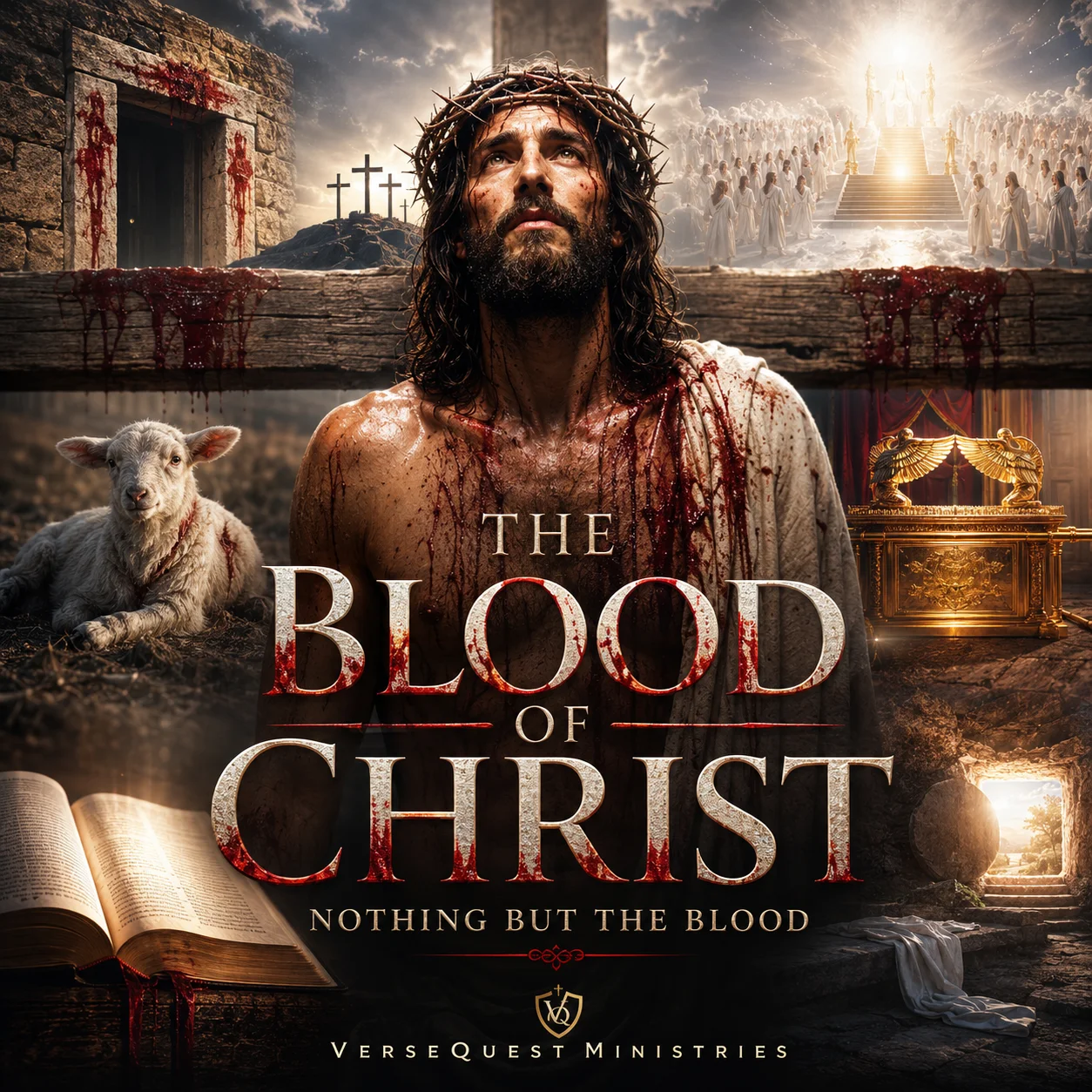
- The Blood of Christ – 66-Study KJV Bible Doctrine PDF
- A 441-page premium VerseQuest PDF featuring 66 detailed KJV Bible studies on the blood of Jesus Christ. This powerful doctrinal resource covers redemption, justification, propitiation, cleansing, access to God, eternal…
- Original price was: $29.99.$9.99Current price is: $9.99.
- Add to cart
-
-67%
-
Premium VerseQuest Books
-
-75%
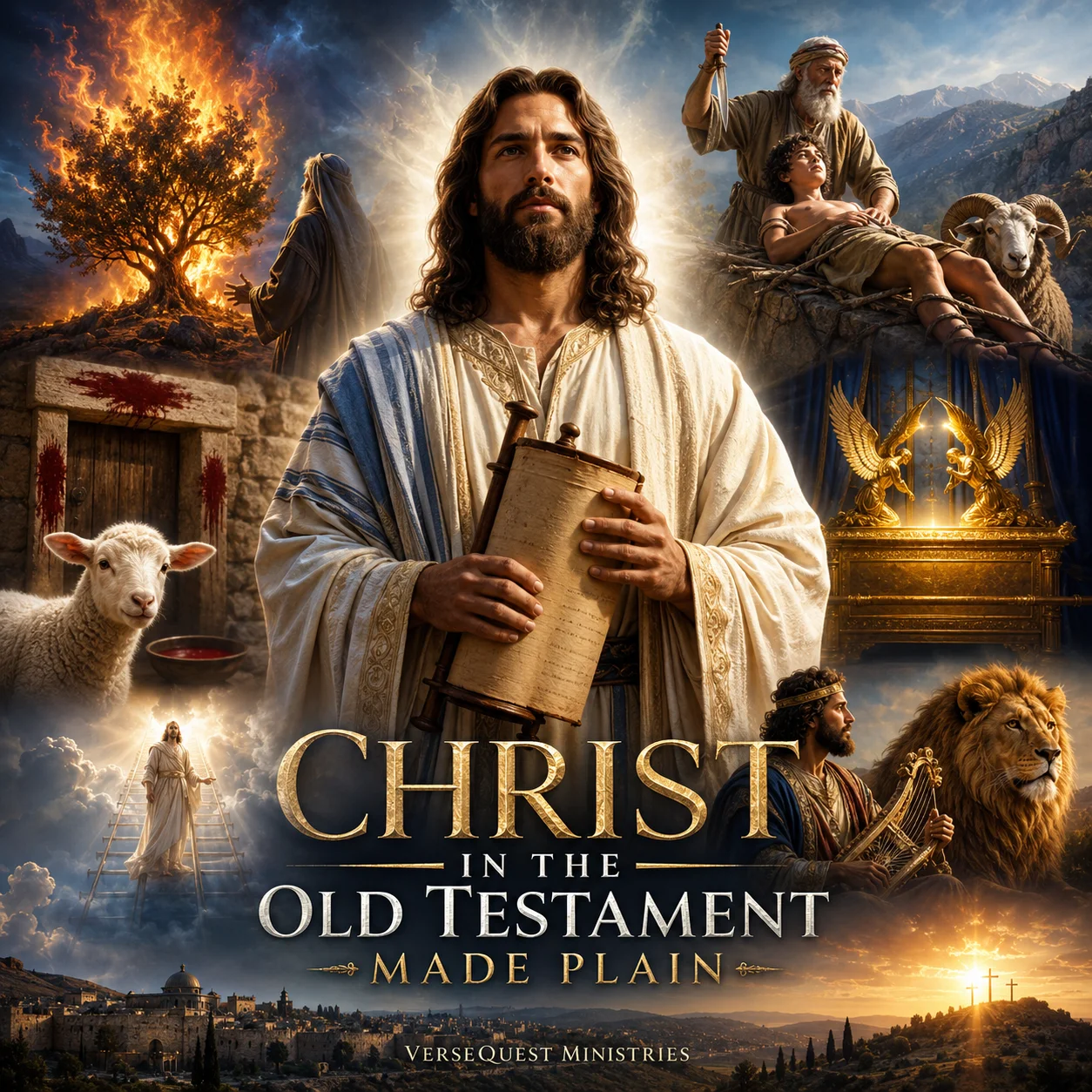
- Christ in the Old Testament Made Plain — 100-Essay KJV Study PDF
- A massive 670-page premium KJV Bible study PDF featuring 100 detailed essays showing Jesus Christ throughout the Old Testament in promise, type, sacrifice, Christophany, prophecy, suffering, resurrection, priesthood, and future…
- Original price was: $39.99.$9.99Current price is: $9.99.
- Add to cart
-
-75%
-
Doctrine Series
-
-14%
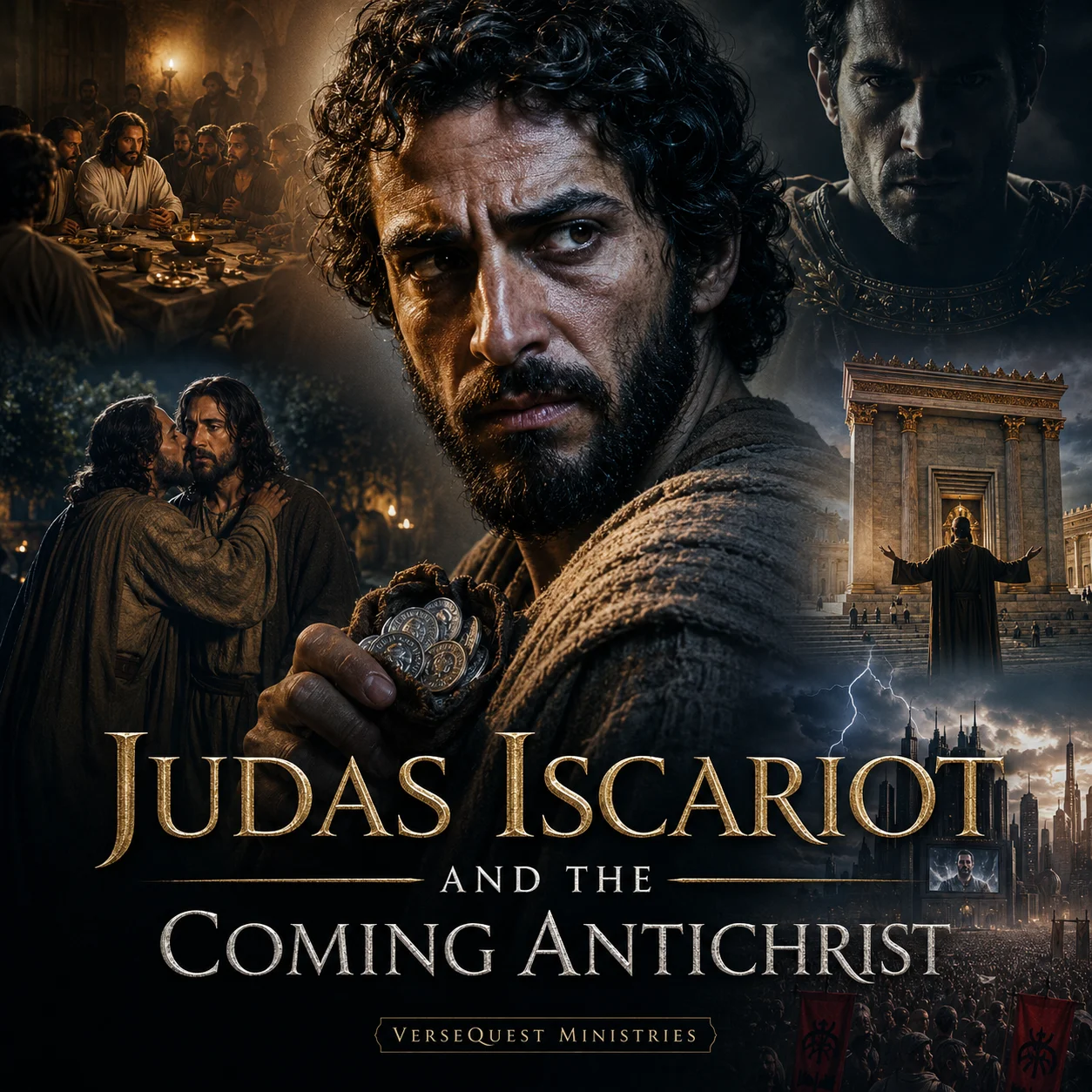
- Judas Iscariot and the Coming Antichrist – Premium KJV Prophecy Study
- A massive 459-page premium KJV prophecy study tracing the biblical connection between Judas Iscariot, the son of perdition, and the coming Antichrist. This detailed VerseQuest Ministries PDF examines Judas’ betrayal,…
- Original price was: $34.99.$29.99Current price is: $29.99.
- Add to cart
-
-14%
-
Angels
-
-67%
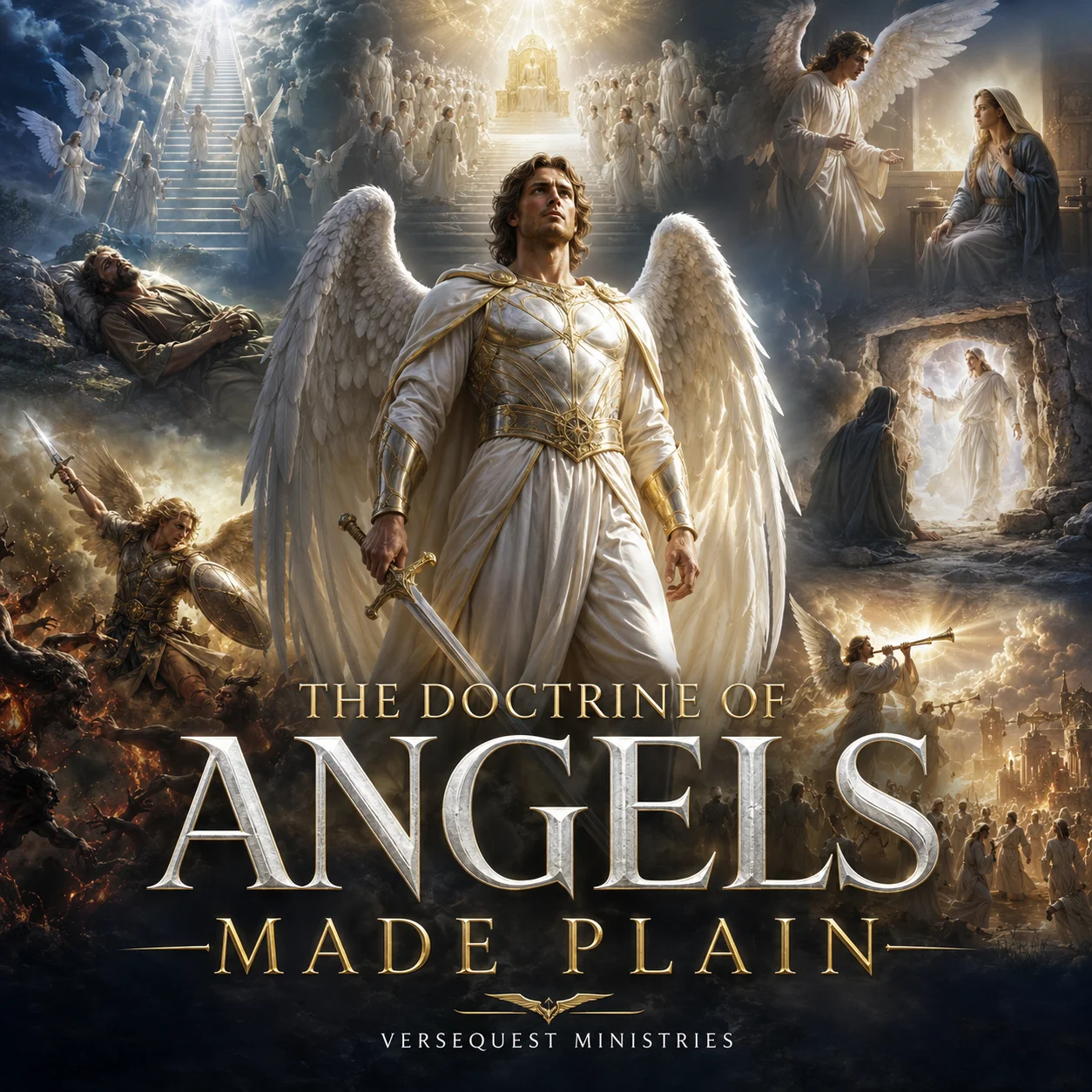
- The Doctrine of Angels Made Plain – 620-Page KJV Bible Study PDF
- The Doctrine of Angels Made Plain is a 620-page KJV Bible study that traces angels from Genesis to Revelation. This premium VerseQuest PDF explains holy angels, Christ’s supremacy over angels,…
- Original price was: $29.99.$9.99Current price is: $9.99.
- Add to cart
-
-67%
-
Kingdom Hall
-
-71%

- Jehovah’s Witnesses Made Plain – 574-Page KJV Watchtower Study
- A massive 574-page VerseQuest study exposing the Watchtower system from the King James Bible. This detailed 100-essay book covers the false Christ, false gospel, New World Translation, failed prophecy, 144,000,…
- Original price was: $34.99.$9.99Current price is: $9.99.
- Add to cart
-
-71%