
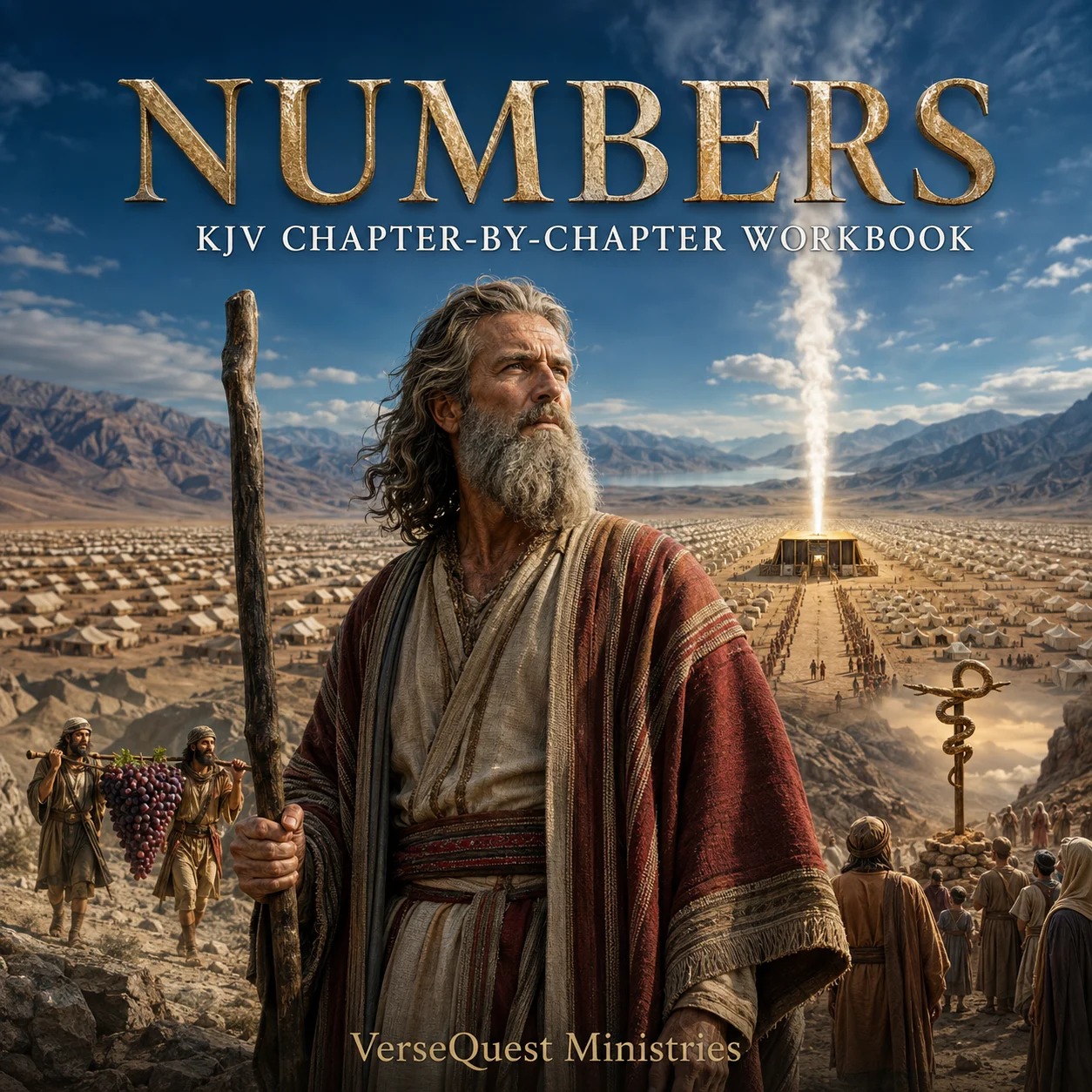
Numbers KJV Chapter-by-Chapter Workbook
The Numbers KJV Chapter-by-Chapter Workbook is a complete 500-page downloadable Bible curriculum covering all 36 chapters of Numbers from a King James Bible-believing, rightly divided perspective.
Every chapter includes ten student-study pages followed by a Teacher and Leader Guide and suggested answers. Students will examine the two censuses, Israel’s camp, the Levites, the wilderness journey, the twelve spies, Kadeshbarnea, Korah’s rebellion, Aaron’s rod, the red heifer, the brass serpent, Balaam, Baalpeor, Joshua’s appointment, Israel’s offerings and vows, the forty-two journey stations, the cities of refuge, and the preparation of a new generation to inherit the land.
The workbook also includes multiple course schedules, a 72-lesson teaching plan, cumulative reviews, a final assessment, answer guides, a KJV glossary, statistical and doctrinal reference studies, maps and structural charts, indexes, teaching projects, bookmarks, and a certificate of completion. It can be printed for handwritten work or studied and annotated digitally using compatible PDF software.
Ideal for personal study, homeschool, Sunday school, church classes, Bible-study groups, discipleship, sermon preparation, and ministry training.
$45.00
Description
The Numbers KJV Chapter-by-Chapter Workbook is a complete 500-page downloadable Bible curriculum designed to lead students carefully through all 36 chapters of Numbers. Through guided observation, exposition, written exercises, doctrinal study, cross-references, numerical comparisons, chapter reviews, teaching assignments, and personal application, the workbook helps readers understand a book that is often remembered for its censuses but contains some of the most important warnings and prophetic pictures in Scripture.
Numbers begins with the generation that came out of Egypt being counted and organized for the journey toward Canaan. It concludes with a new generation standing on the borders of the promised land, prepared to receive its inheritance. Between those two censuses lies the tragic record of murmuring, rebellion, unbelief, chastening, judgment, intercession, preservation, and renewed preparation. The nation was redeemed from Egypt, ordered around the tabernacle, and led by the visible presence of the LORD, yet an entire generation forfeited entrance into Canaan because it would not believe God’s word.
Every chapter receives a consistent twelve-page treatment. The first ten pages lead the student through the chapter’s key passage, principal movements, guided exposition, doctrinal distinctions, KJV vocabulary, cross-reference study, written exercises, special studies, biblical typology, difficult questions, error correction, review, memorization, and teach-back preparation. The final two pages provide a coordinated Teacher and Leader Guide followed by suggested answers and a model chapter summary.
The workbook gives special attention to the two military censuses, the arrangement of Israel’s camp, the central position of the tabernacle, the responsibilities of the Levites, ceremonial purity, restitution, the Nazarite vow, the Aaronic blessing, the princes’ offerings, Israel’s second Passover, the guiding cloud, the silver trumpets, the departure from Sinai, the seventy elders, Miriam’s rebellion, the twelve spies, Israel’s refusal at Kadesh, Korah’s rebellion, Aaron’s budding rod, the red heifer, the waters of Meribah, the death of Aaron, the brass serpent, the victories over Sihon and Og, Balaam’s prophecies, the sin at Baalpeor, the zeal of Phinehas, the daughters of Zelophehad, Joshua’s appointment, the calendar of offerings, Israel’s vows, the war against Midian, the eastern tribes, the wilderness journeys, the boundaries of Canaan, the Levitical cities, the cities of refuge, and the preservation of tribal inheritance.
The numerical material is presented as part of the inspired record rather than as meaningless detail. Students compare the first military census of 603,550 men with the second census of 601,730, an overall decrease of 1,820. They examine the changing strength of the tribes, including Simeon’s decrease of 37,100 and Manasseh’s increase of 20,500. Additional studies consider the 22,000 Levite males, the 22,273 firstborn males, the redemption of the additional 273 firstborn, the 8,580 Levites assigned to tabernacle service, the twelve spies, the forty days of searching the land, the forty years of wilderness wandering, the 250 censers associated with Korah’s rebellion, the forty-two named journey stations, the forty-eight Levitical cities, and the six cities of refuge.
The workbook approaches Numbers from a Bible-believing, rightly divided perspective. Israel remains literal Israel, the land remains the inheritance promised to Israel, and the Mosaic covenant, Aaronic priesthood, tribal arrangements, sacrificial system, and national judgments are not transferred to the Body of Christ. At the same time, the workbook carefully examines the inspired applications made by later Scripture. First Corinthians 10 treats Israel’s wilderness experiences as examples and warnings, Hebrews uses Israel’s unbelief to warn against an unbelieving heart, and John 3 identifies the lifted brass serpent as a divinely given picture of the crucified Son of man.
Historical meaning is established before typological or practical application is considered. Moses is examined as Israel’s mediator, leader, intercessor, and faithful servant while remaining distinct from and inferior to Jesus Christ. Aaron’s rod, the red heifer, the rock, the manna, the cities of refuge, Balaam’s prophecies, and the brass serpent are studied in the light of clear supporting passages rather than speculative symbolism.
The additional course material turns the workbook into a flexible curriculum for individual students, families, churches, and ministry classrooms. It includes instructions for using the workbook, course outcomes, interpretive safeguards, structural overviews, summaries of all 36 chapters, 36-week and 18-week schedules, a 72-lesson teaching plan, core and enrichment tracks, cumulative reviews, a final assessment, answer guides, a KJV glossary, chronology and geography studies, statistical comparisons, doctrinal reference studies, teaching calendars, project options, subject and Scripture indexes, and a certificate of completion.
This searchable and organized PDF may be printed for handwritten study or used on a computer or tablet. Readers using compatible PDF software may highlight material, insert comments, draw markings, and add electronic notes. Navigation bookmarks make it practical to move between the chapter studies, teacher guides, reviews, reference sections, and answer material.
The Numbers KJV Chapter-by-Chapter Workbook is suitable for serious personal Bible study, homeschool courses, Sunday school classes, church Bible studies, small groups, discipleship programs, Bible institutes, and ministry training. It also provides pastors, preachers, and teachers with an organized framework for preparing sermons, lessons, doctrinal studies, historical surveys, and teaching series.
This is not merely a commentary to be read and placed on a shelf. It is a working Bible curriculum designed to help students open the King James Bible, examine the inspired words, follow Israel’s movements, compare the two generations, understand the cost of unbelief, recognize the faithfulness of God, and develop the ability to explain and teach the book of Numbers faithfully.
The numbering of Israel — The censuses identify men available for war and mark the transition from the Exodus generation to its successors. Divine order in the camp — Every tribe receives an appointed position, standard, leader, and place in the march. The tabernacle at the center — Israel’s camp is arranged around the dwelling place of the LORD, making His presence the organizing center of national life. Distinct responsibilities in service — Priests, Levites, tribal princes, soldiers, families, and individuals receive different duties under the law. The preservation of holy boundaries — The Kohathites, Gershonites, and Merarites must handle their assigned burdens according to God’s instructions. Purity within the camp — Uncleanness, wrongdoing, restitution, and suspected unfaithfulness are addressed because the LORD dwells among Israel. Separation and the Nazarite vow — Voluntary separation demonstrates consecration within Israel’s covenant structure. The Aaronic blessing — The priestly blessing places the name of the LORD upon Israel and emphasizes divine keeping, grace, and peace. Willing dedication — The princes’ offerings show ordered generosity directed toward the service of the sanctuary. Passover remembrance — Israel must remember the redemption that brought the nation out of Egypt. Divine guidance — The cloud and the trumpets govern when Israel rests, assembles, alarms, and journeys. Murmuring and discontent — Repeated complaints expose ingratitude, unbelief, and resistance to God’s provision. The danger of lust — Israel’s craving for Egypt’s food demonstrates how the appetite can become an instrument of rebellion. Shared leadership and accountability — The seventy elders assist Moses, but leadership remains subject to God’s appointment and word. The meekness and intercession of Moses — Moses repeatedly bears opposition and pleads for a guilty nation. The crisis at Kadeshbarnea — Israel’s refusal to enter Canaan becomes the decisive act that condemns the generation to wander. Faith versus sight — Joshua and Caleb judge the land by God’s promise, while the other spies judge the promise by visible obstacles. Unbelief and presumption distinguished — Refusing to go when God commands and advancing after God has forbidden are both forms of disobedience. The forty-year judgment — The forty days of searching the land correspond to the years in which the unbelieving generation is consumed. Rebellion against appointed authority — Korah’s gainsaying challenges the order God established for Israel’s priesthood and leadership. Aaron’s rod that budded — Life appearing from a dead rod publicly confirms God’s chosen priesthood. Priestly responsibility and provision — Numbers defines the burdens, dangers, tithes, and support associated with sanctuary service. Defilement through death — The red heifer ordinance emphasizes death’s contaminating presence and the need for purification. Accountability in leadership — Moses’ failure at Meribah shows that long service and high office do not remove personal responsibility. The lifted brass serpent — The dying Israelite lives by looking to the remedy God provides, a picture directly applied to Christ in John 3. Victory east of Jordan — The defeats of Sihon and Og demonstrate that the LORD can give victory over powerful opposition. God’s control over Balaam’s words — Balak cannot purchase a curse capable of overturning God’s covenant purpose. The way and doctrine of Balaam — Later Scripture exposes Balaam’s covetousness and his use of corruption when direct cursing fails. Compromise at Baalpeor — Idolatry and fornication accomplish internally what hostile powers could not accomplish through an external curse. The zeal of Phinehas — Phinehas acts in defense of God’s holiness and turns away wrath from Israel. The passing of one generation — The second census confirms that the unbelieving generation has fallen according to the word of the LORD. The preparation of a new generation — Inheritance laws, Joshua’s appointment, offerings, vows, and military responsibilities prepare Israel for life in the land. Women and tribal inheritance — The daughters of Zelophehad demonstrate that individual justice and tribal preservation both matter under Israel’s law. The succession from Moses to Joshua — God prepares an appointed shepherd to lead the congregation after Moses. Worship ordered by time — The offering calendar regulates Israel’s daily, weekly, monthly, and annual national worship. The seriousness of vows — Spoken commitments before the LORD are treated as binding responsibilities. Corporate responsibility in warfare — The eastern tribes may receive land east of Jordan, but they must first help their brethren possess Canaan. Remembering the journey — The forty-two named stations preserve a record of God’s leading and Israel’s historical path. Literal land and boundaries — Canaan is presented as a defined geographical inheritance promised to the tribes of Israel. Justice and refuge — The cities of refuge distinguish murder from manslaughter while protecting both justice and due process. The preservation of inheritance — The closing chapter safeguards tribal possession as Israel prepares to enter the land. Israel and the Body of Christ distinguished — Israel’s national covenants, priesthood, sacrifices, censuses, land, and tribal inheritance must not be reassigned to the Church.
- Central argument: Numbers demonstrates how the LORD orders His redeemed nation, judges the unbelief of the Exodus generation, preserves His covenant purpose through the wilderness, and prepares a new generation to inherit the promised land.
- Opening and conclusion: The book begins with Israel numbered for warfare at Sinai and ends with Israel receiving final instructions for inheritance in the plains of Moab.
- The controlling movement: God ordered the nation; unbelief condemned the generation; chastening consumed the rebels; grace preserved the covenant; and the LORD prepared a new generation to inherit the land.
- The two generations: The first census numbers the generation that came out of Egypt, while the second census numbers the generation preparing to enter Canaan.
- The two census totals: The first military total is 603,550 and the second is 601,730, producing an overall decrease of 1,820.
- Tribal change: Five tribes decrease and seven increase between the censuses. Simeon experiences the largest decrease, while Manasseh experiences the largest increase.
- More than a census book: The numbers establish accountability, responsibility, military readiness, service, judgment, preservation, and inheritance.
- The tabernacle at the center: Israel does not organize itself around military power or tribal preference. The dwelling place of the LORD stands at the center.
- Redemption and testing: Deliverance from Egypt does not remove the need for faith, obedience, patience, and dependence upon God.
- The wilderness reveals the heart: Hunger, thirst, delay, leadership pressure, visible enemies, and uncertain circumstances expose what Israel believes.
- The decisive failure: Israel is kept out of Canaan because of unbelief at Kadeshbarnea, not because the Canaanites are too powerful for God.
- Faith’s minority report: Joshua and Caleb stand against the majority because they believe the word and presence of the LORD.
- Presumption is not faith: Israel’s attempt to invade after God announces judgment is disobedience disguised as determination.
- Moses as intercessor: Moses repeatedly appeals to God’s character, reputation, promises, and mercy when Israel deserves destruction.
- Moses as a servant: Moses is faithful and meek, but his sin at Meribah confirms that he is not the sinless and final mediator.
- Korah’s rebellion: Korah presents resistance to God’s appointed order as a demand for equality, but the LORD identifies it as rebellion against Himself.
- Aaron’s rod: The rod that buds, blossoms, and bears almonds confirms the priesthood through a sign of life emerging from death.
- The red heifer: The ordinance addresses ceremonial defilement associated with death and is later referenced in Hebrews when explaining the superior cleansing of Christ.
- The rock at Meribah: God provides water despite Israel’s contention, but Moses is held accountable for failing to sanctify the LORD before the congregation.
- The brass serpent: The serpent is God’s appointed remedy for dying Israelites and is directly connected with Christ’s crucifixion in John 3.
- Balaam’s limitation: Balaam cannot curse the nation God has determined to bless.
- Balaam’s corruption: When direct cursing fails, corruption through idolatry and fornication becomes the enemy’s weapon.
- Phinehas and holiness: Phinehas’ zeal demonstrates the seriousness of covenant corruption within the camp.
- Joshua’s appointment: Leadership succession is public, orderly, and dependent upon God’s choice rather than personal ambition.
- Zelophehad’s daughters: Their case demonstrates that Israel’s inheritance laws include both personal justice and the preservation of tribal boundaries.
- The eastern tribes: Receiving an inheritance does not excuse Reuben, Gad, and half Manasseh from helping their brethren.
- The journey list: Numbers 33 proves that the wilderness years were a real historical journey with identifiable stages, departures, and encampments.
- The land: Canaan is a literal, bounded inheritance assigned to literal tribes. It should not be dissolved into a general promise to the Body of Christ.
- The cities of refuge: Refuge does not abolish justice. The law distinguishes intentional murder from accidental killing and requires adequate witnesses.
- Right-division distinction: Israel’s wilderness experiences instruct and warn present believers, but Israel’s covenants, priesthood, land, sacrifices, and tribal inheritance remain Israel’s.
- Question for further study: Why did Simeon decline so dramatically between the two censuses, and how might Numbers 25 contribute to the comparison?
- Question for further study: How do Psalms 78, 95, 105, and 106 interpret Israel’s wilderness history?
- Question for further study: What distinctions should be maintained between Israel’s entrance into Canaan, the believer’s salvation, and the believer’s present walk?
- Question for further study: How does the New Testament develop the way, error, and doctrine of Balaam?
- Question for further study: What does Numbers teach about leadership pressure, delegation, accountability, intercession, and succession?
- Memorable teaching point: Numbers begins with a generation counted for war and ends with another generation counted for inheritance; between the two censuses lies the cost of unbelief.
- Memorable teaching point: The giants did not keep Israel out of Canaan. Unbelief did.
- Memorable teaching point: Israel changed, leaders died, rebels fell, and generations passed, but the covenant purpose of the LORD continued.
For personal Bible study, the workbook provides a disciplined path through all 36 chapters. Students can read the assigned chapter in their King James Bible, record initial observations, trace repeated words, complete the written exercises, compare cross-references, and prepare their own chapter summaries before consulting the suggested answers.
For homeschool families, the workbook can function as a complete Bible curriculum. Parents may use the 36-week schedule for a full academic year, the 18-week schedule for a semester, or the 72-lesson plan for shorter teaching sessions. Vocabulary studies, memory assignments, numerical exercises, maps, cumulative reviews, the final assessment, and the certificate of completion provide measurable academic components.
For Sunday school and church Bible classes, teachers can assign the chapter reading and selected student pages before class. The Teacher and Leader Guide provides lesson objectives, teaching direction, interpretive cautions, discussion prompts, assessment standards, and extension assignments that can be adapted for youth or adult instruction.
For small groups and discipleship, the repeated chapter structure encourages participation rather than passive listening. Group members can compare observations, discuss difficult questions, trace the consequences of unbelief, examine God’s responses to rebellion, and practice explaining the chapter to one another.
For pastors, preachers, and Bible teachers, the chapter movements, census comparisons, doctrinal distinctions, KJV vocabulary, typological studies, and cross-reference chains provide an organized foundation for sermons, teaching series, historical surveys, and topical lessons. The material supports preparation while keeping the King James Bible itself at the center.
For Bible institutes and ministry training, the workbook can serve as a focused Pentateuch or Old Testament course. Students may be required to complete enrichment assignments, reproduce chapter structures, explain the two censuses, defend right-division distinctions, trace Israel’s route, prepare teaching outlines, and complete the final assessment.
For family Bible study, parents may select the chapter overview, key passage, special study, memory assignment, and review questions. Younger students can complete the core material while older students pursue the doctrinal, numerical, typological, and teaching assignments.
A King James Bible with readable reference formatting
An exhaustive concordance keyed to the King James Bible
A reliable KJV Bible dictionary for names, offices, objects, sacrifices, measurements, and older words
A cross-reference Bible or treasury of Scripture cross-references
A map of the Sinai Peninsula, Transjordan, Moab, Edom, and Canaan
A diagram of Israel’s tribal arrangement around the tabernacle
A comparison chart of the censuses in Numbers 1 and Numbers 26
A chart of the Gershonite, Kohathite, and Merarite families and their responsibilities
A map or chart of the forty-two wilderness stations recorded in Numbers 33
A calendar of the offerings commanded in Numbers 28–29
A map of the forty-eight Levitical cities and six cities of refuge
Psalms 78, 95, 105, and 106 as inspired reviews of Israel’s wilderness history
John 3, 1 Corinthians 10, Hebrews 3–4, 2 Peter 2, Jude, and Revelation 2 for inspired New Testament applications
Genesis KJV Chapter-by-Chapter Workbook for the covenant promises and patriarchal history behind Israel’s inheritance
Exodus KJV Chapter-by-Chapter Workbook for Israel’s redemption, Sinai covenant, and construction of the tabernacle
Leviticus KJV Chapter-by-Chapter Workbook for the sacrifices, priesthood, purity laws, feasts, and sanctuary service continued in Numbers
Through the Bible with VerseQuest for a broader survey of all 66 books of the King James Bible
Related products
-
Revelation
-
-71%
- Moses and Elijah: The Two Witnesses Made Plain
- Moses and Elijah: The Two Witnesses Made Plain is a 636-page premium VerseQuest PDF study proving from Scripture that the Two Witnesses of Revelation 11 are Moses and Elijah. This…
- Original price was: $34.99.$9.99Current price is: $9.99.
- Add to cart
-
-71%
-
Christology Studies
-
- The Deity of Christ Defended — 66 KJV Studies Proving Jesus Christ Is God Manifest in the Flesh
- he Deity of Christ Defended is a 444-page premium KJV Bible study defending the full deity of the Lord Jesus Christ. This 66-study book proves from Scripture that Jesus is…
- $29.99
- Add to cart
-
-
Chart Collections
-
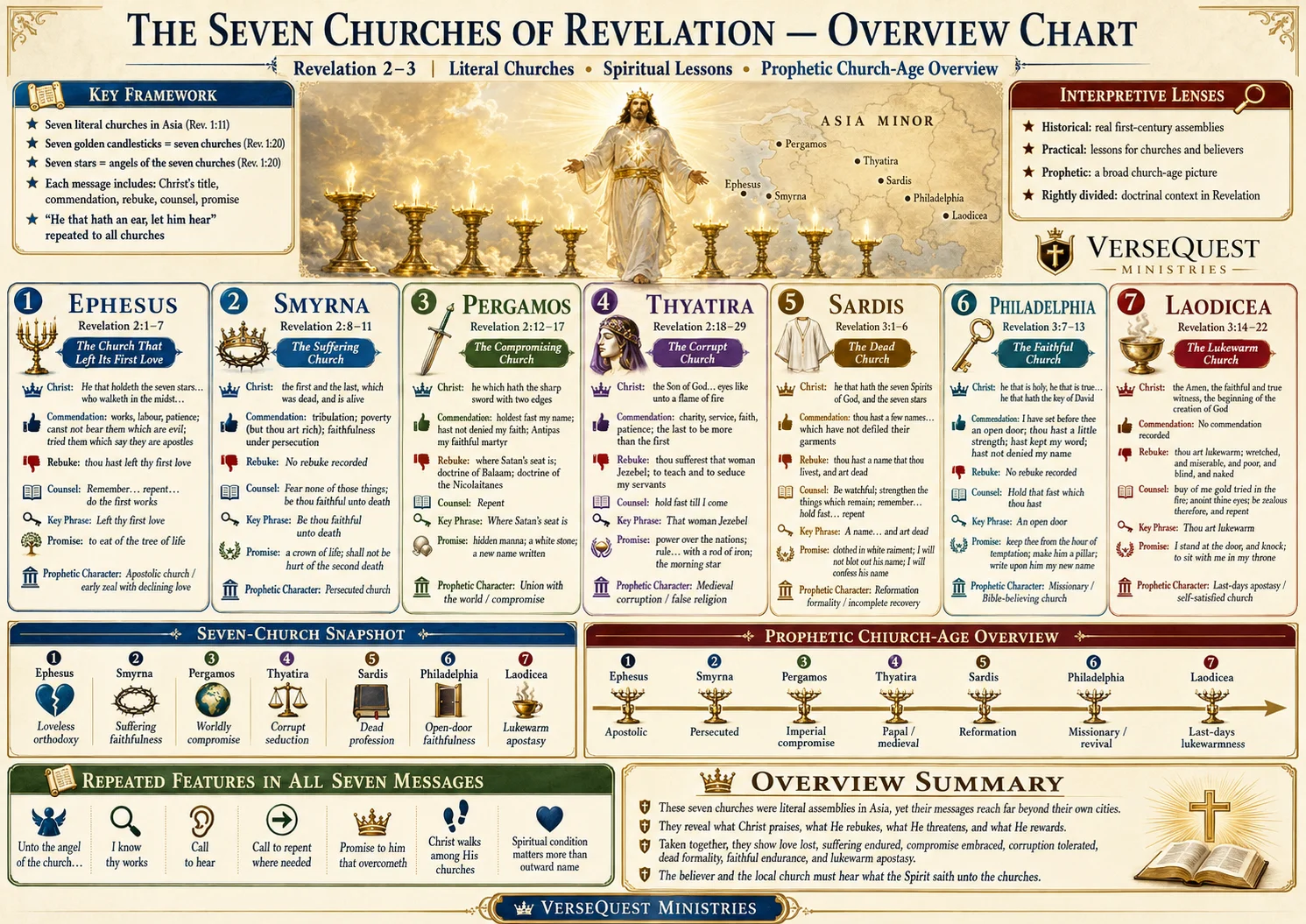
- The Seven Churches of Revelation Chart Collection – Christ Walking Among the Candlesticks
- A premium VerseQuest Ministries™ PDF chart collection covering the Seven Churches of Revelation in Revelation 2–3. Includes one overview chart plus individual KJV Bible study charts for Ephesus, Smyrna, Pergamos,…
- $12.99
- Add to cart
-
-
Kingdom Hall
-
-71%

- Jehovah’s Witnesses Made Plain – 574-Page KJV Watchtower Study
- A massive 574-page VerseQuest study exposing the Watchtower system from the King James Bible. This detailed 100-essay book covers the false Christ, false gospel, New World Translation, failed prophecy, 144,000,…
- Original price was: $34.99.$9.99Current price is: $9.99.
- Add to cart
-
-71%
-
Doctrine Series
-
- The Lost Tribes Myth Exposed (213-Page Premium Study)
- A 213-page premium KJV study exposing the Lost Tribes myth, tribal identity errors, prophecy abuse, race theories, and false Israel claims through 35 detailed essays.
- $24.99
- Add to cart
-