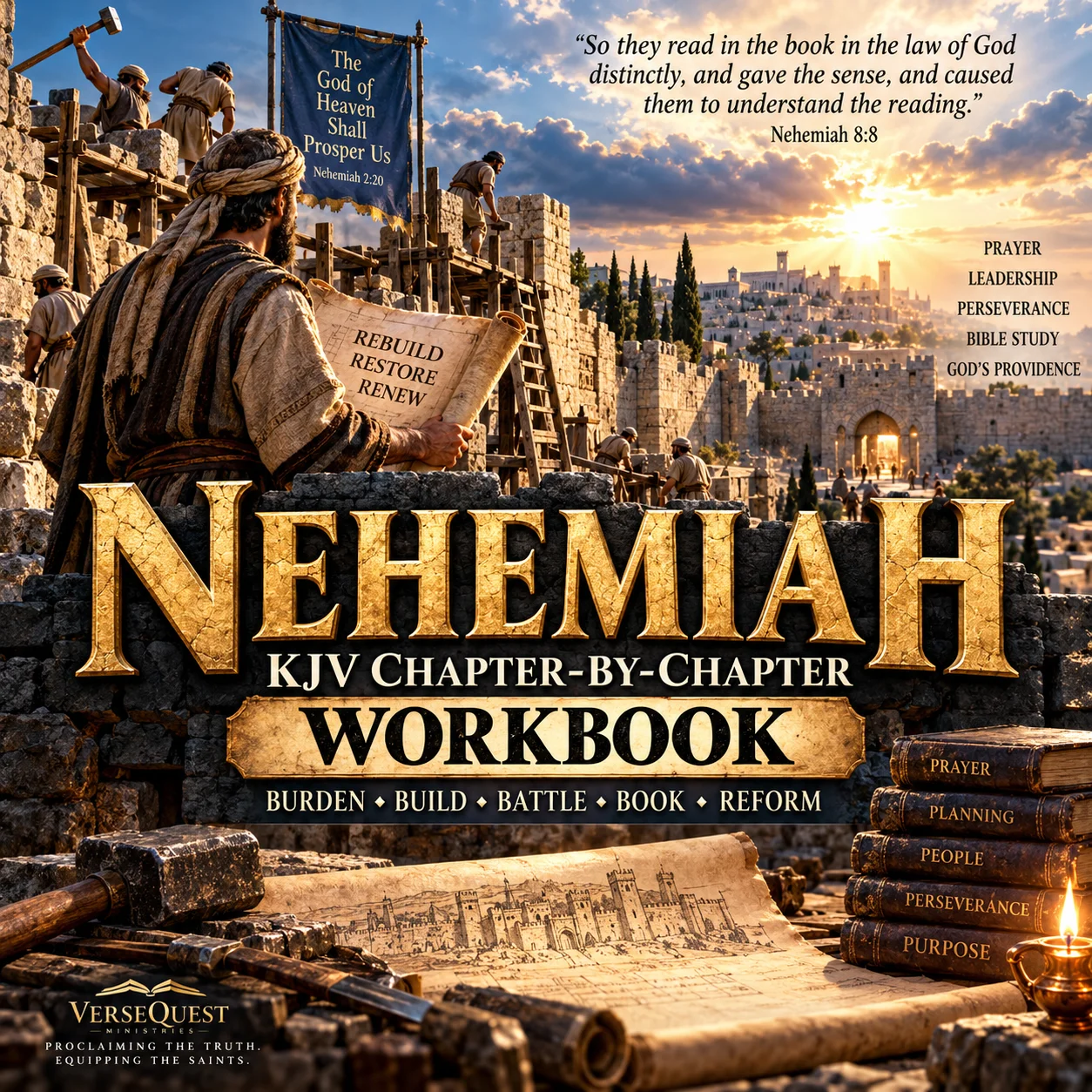
Nehemiah KJV Chapter-by-Chapter Workbook
The Nehemiah KJV Chapter-by-Chapter Workbook is a 380-page downloadable PDF Bible-study curriculum designed to guide you through all 13 chapters and 406 verses of Nehemiah with your King James Bible open beside you.
Study Nehemiah’s burden and prayers, Artaxerxes, Jerusalem’s broken walls and gates, the builders of chapter 3, Sanballat and Tobiah, sword-and-trowel watchfulness, internal corruption, false accusations, the fifty-two-day wall, Ezra’s public reading of Scripture, the great confession of chapter 9, covenant renewal, dedication, and Nehemiah’s final reforms.
Built around Burden — Build — Battle — Book — Reform, this interactive workbook includes guided verse study, chapter analysis, cross-reference work, KJV words in context, doctrinal and right-division studies, difficult passages, advanced studies, charts, review material, teaching helps, and dedicated areas for your own observations and notes.
Ideal for personal Bible study, homeschool curriculum, Sunday school, family study, church classes, discipleship, Bible institutes, and ministry training.
Digital PDF — 380 pages — $29.99
$29.99
Description
The Nehemiah KJV Chapter-by-Chapter Workbook is a comprehensive 380-page downloadable PDF Bible-study workbook designed to take the student carefully through all 13 chapters and 406 verses of Nehemiah. This is not simply a commentary to read and put back on the shelf. It is an interactive study resource built to keep the King James Bible open in front of the student while he reads, observes, compares Scripture with Scripture, answers questions, traces themes, records conclusions, and makes the book of Nehemiah his own.
Nehemiah begins with broken walls, burned gates, and a burdened servant hundreds of miles from Jerusalem. When Nehemiah hears the condition of the city, he does not begin with a construction plan. He sits down, weeps, mourns, fasts, and prays. From that burden grows one of the Bible’s great accounts of prayer, leadership, opposition, rebuilding, spiritual renewal, Bible teaching, covenant responsibility, and reform.
The workbook follows the full progression of the book: Nehemiah’s prayer in Shushan; his service as the king’s cupbearer; his request before Artaxerxes; the journey to Jerusalem; the nighttime inspection of the broken walls; the call to rise and build; the division of labor in chapter 3; the ridicule, conspiracy, threats, and intimidation of Sanballat, Tobiah, Geshem, and others; the armed builders working with one hand while prepared to defend the work with the other; the internal crisis of debt and usury; repeated attempts to draw Nehemiah away from the work; the open-letter accusation; false prophecy; and the extraordinary completion of the wall in fifty-two days.
But Nehemiah does not end when the construction is finished. The physical wall is only part of the story. Chapters 7–10 move from rebuilding walls to rebuilding a people. Genealogical records are examined. Ezra brings forth the book of the law. The people stand attentively while the Scriptures are read distinctly, the sense is given, and the people are caused to understand the reading. Conviction follows. The Feast of Tabernacles is observed. Chapter 9 contains one of the great historical prayers of the Old Testament, reviewing Israel’s history from creation and Abraham through Egypt, Sinai, the wilderness, the land, rebellion, judgment, mercy, and restoration.
The later chapters examine covenant commitments, the repopulation of Jerusalem, priestly and Levitical service, the dedication of the wall, the two great thanksgiving companies, worship, tithes, stewardship, and finally Nehemiah’s return to Jerusalem and his forceful correction of abuses that had already begun to reappear. The conclusion teaches a sobering lesson: yesterday’s reform does not guarantee tomorrow’s faithfulness.
The workbook is organized around the major movement Burden — Build — Battle — Book — Reform. That progression helps the student understand the entire book without reducing Nehemiah to a collection of leadership slogans. The emphasis remains on the biblical text, its historical setting, its doctrinal significance, and the lessons that legitimately arise from it.
Each chapter is treated as a complete interactive study unit. The student works through chapter dashboards, principal movements, guided verse study, movement-by-movement exposition, people and decisions, KJV words in context, doctrinal observations, right-division studies, Scripture-with-Scripture cross-reference exercises, difficult passages, special studies, written reviews, teach-back exercises, and guided areas for personal observations and notes.
The workbook also contains extensive material beyond the chapter studies, including advanced studies, master charts and analysis pages, cumulative reviews, final examination material, glossary and reference sections, Scripture and subject indexes, special Nehemiah studies, teaching tools, and book-wide synthesis exercises. These additions are designed to help the student move beyond individual chapters and understand how the whole book fits together.
Special attention is given to passages commonly misused or removed from their biblical setting. Nehemiah concerns Israel, Jerusalem, the restored remnant, the Mosaic law, the priesthood, the Temple system, covenant obligations, the Sabbath, tithes, and national restoration. The workbook allows those passages to speak in their proper context while still drawing sound spiritual and practical applications for believers today.
One of the great study principles of Nehemiah appears in Nehemiah 8:8: the Scriptures were read distinctly, the sense was given, and the people were caused to understand the reading. That is the educational heartbeat of this workbook. The goal is not merely to finish 13 chapters. The goal is to understand what you have read and become better equipped to study the Bible for yourself.
The Nehemiah KJV Chapter-by-Chapter Workbook is suitable for personal Bible study, homeschool Bible curriculum, Sunday school, family study, church Bible classes, small groups, discipleship, sermon preparation, Bible institute instruction, and ministry training.
The complete resource is supplied as a 380-page downloadable PDF and is available for $29.99.
The Burden for Jerusalem — Nehemiah's work begins with grief over the actual condition of Jerusalem rather than personal ambition. Prayer Before Action — Nehemiah repeatedly prays before, during, and after critical decisions. The Good Hand of God — Nehemiah recognizes divine providence behind the king's favor and the progress of the work. Rebuilding Jerusalem's Walls — The physical restoration of Jerusalem dominates the opening half of the book. Every Man at His Place — Chapter 3 emphasizes organized labor, personal responsibility, families, occupations, and assigned sections of the wall. The Gates of Jerusalem — The gates provide geographical structure to the rebuilding narrative and invite careful biblical cross-reference study. Opposition to God's Work — Ridicule, anger, conspiracy, physical threats, exhaustion, political pressure, false reports, intimidation, compromise, and false prophecy all appear. Sword and Trowel — The builders work while remaining prepared against attack, illustrating labor joined with vigilance. The Danger Within — Nehemiah 5 shows that internal greed and exploitation can damage a work even when outside opposition fails. Biblical Leadership — Nehemiah demonstrates prayer, courage, planning, accountability, confrontation, sacrifice, perseverance, and discernment. “I Am Doing a Great Work” — Nehemiah refuses distractions designed to pull him away from his God-given responsibility. Fear of Man — Several attacks are specifically designed to make Nehemiah afraid and weaken his hands. False Prophecy and Spiritual Manipulation — Shemaiah's counsel demonstrates that religious language must be tested against truth. The Fifty-Two-Day Wall — The rapid completion of the wall becomes a testimony that the work was wrought of God. Genealogy and Historical Identity — Nehemiah 7 shows that the restoration concerns identifiable Israelites and families returning from captivity. Reading the Word Distinctly — Nehemiah 8 provides one of Scripture's clearest models for public Bible reading and explanation. Understanding the Reading — Biblical teaching should do more than recite words; it should give the sense and cause hearers to understand. Conviction and Joy — The Word produces grief over sin but also leads God's people into proper rejoicing. National Confession — Nehemiah 9 reviews Israel's history through the lens of God's righteousness and Israel's repeated rebellion. God's Mercy Despite Israel's Failure — The historical prayer repeatedly contrasts Israel's disobedience with God's patience, mercy, and covenant faithfulness. Covenant Renewal — Chapter 10 records specific obligations undertaken by the restored remnant. Israel and the Church Distinguished — Sabbath regulations, tithes, Temple service, priesthood, Jerusalem, and Mosaic covenant obligations must remain in their proper setting. Repopulation of Jerusalem — Rebuilding walls is incomplete unless the restored city is occupied by people prepared to live and serve there. Dedication and Thanksgiving — Chapter 12 shows the completed work being dedicated with praise, music, sacrifice, and joy. Reform and Relapse — Chapter 13 demonstrates how quickly corruption can return when vigilance disappears. Remember Me, O My God — Nehemiah repeatedly appeals to God concerning his service, opposition, and faithfulness. Burden — Build — Battle — Book — Reform — These five movements provide a clear overview of the entire book.
Nehemiah is not merely a book about building a wall. The wall is essential, but the story progresses from broken walls to rebuilt walls, from rebuilt walls to an opened Book, and from the opened Book to conviction, covenant renewal, dedication, and reform.
A useful summary of the book is:
Burden — Build — Battle — Book — Reform.
Nehemiah’s first response to Jerusalem’s condition is prayer. Before he speaks to Artaxerxes, before he travels to Jerusalem, and before he organizes workers, he spends time before the God of heaven.
Nehemiah 1 should be compared carefully with Ezra 9 and Daniel 9. All three prayers identify with Israel’s national transgression and appeal to God’s revealed words and covenant dealings.
Nehemiah 2 demonstrates that prayer does not exclude planning. Nehemiah asks for authorization, letters of passage, timber, and a defined period of absence. Faith and careful preparation are not enemies.
The nighttime survey demonstrates the wisdom of understanding the actual condition before publicly announcing the entire plan.
Nehemiah 3 repeatedly records individuals repairing specific portions. The work is large, but responsibility is distributed. One of the chapter’s most important recurring ideas is that people work “next unto” one another.
The gates of chapter 3 should first be interpreted historically and geographically. Symbolic or devotional applications should never replace what the passage actually records.
Opposition escalates throughout chapters 4–6. It begins with ridicule, proceeds to anger and conspiracy, then includes physical threats, discouragement, compromise invitations, open accusations, intimidation, false prophecy, and political relationships.
Nehemiah 4 demonstrates that prayer and watchfulness belong together. The people pray unto God and also set a watch.
The sword-and-trowel image summarizes an important feature of the chapter: the people are prepared to defend themselves while continuing to work.
Nehemiah 5 reveals that external enemies are not the only threat. Exploitation and greed among brethren can weaken a community from within.
Nehemiah’s conduct as governor should be examined carefully. He possesses authority but refuses to use that authority merely to enrich himself at the expense of the people.
Nehemiah 6 contains one of the book’s most memorable statements: “I am doing a great work, so that I cannot come down.” The immediate context concerns repeated efforts to remove Nehemiah from his work and draw him into a dangerous meeting.
The open letter in chapter 6 shows how accusations can be constructed around rumor, political suspicion, and fear rather than truth.
Shemaiah’s false counsel demonstrates the importance of testing supposedly spiritual advice. Nehemiah determines that God had not sent him.
The wall is finished in fifty-two days, and even the surrounding enemies perceive that the work was wrought of God.
Nehemiah 7 demonstrates that names and genealogies matter. The restoration involves identifiable families and an identifiable nation rather than an abstract spiritual community.
Nehemiah 8 should become a pattern for serious Bible teaching: read the Book distinctly, give the sense, and cause the hearers to understand the reading.
Understanding produces a response. The people initially mourn, but they are then taught how to respond correctly to what they have learned.
Nehemiah 9 provides a remarkable summary of Old Testament history. The prayer moves through creation, Abraham, Egypt, the Red Sea, Sinai, wilderness provision, the promised land, rebellion, judgment, deliverance, repeated failure, and God’s continuing mercy.
The repeated pattern in chapter 9 is worth charting:
God blesses — Israel rebels — judgment follows — Israel cries — God delivers — Israel rebels again.
Chapter 10 must be handled with careful right division. The commitments concerning Sabbath observance, Temple support, firstfruits, tithes, priesthood, and Mosaic law concern restored Israel under the covenant.
Nehemiah 12 demonstrates that biblical restoration includes thanksgiving and praise. The dedication of the wall is not treated as merely an engineering accomplishment.
Chapter 13 is essential to understanding the entire book. Nehemiah leaves Jerusalem, abuses return, and he must correct them again. Reform requires continuing vigilance.
The conclusion is deliberately sobering. A generation may experience restoration and still drift quickly when the Word of God is neglected.
The workbook is especially suited to personal Bible study because it requires active participation. Instead of simply reading explanations, the student works directly through the biblical text, records a chapter thesis, identifies movements, follows cross-references, investigates words, answers questions, evaluates difficult passages, and writes his own observations.
For homeschool Bible curriculum, the 380-page workbook provides a substantial course through one complete Old Testament book. Parents can assign chapter studies, verse investigations, writing exercises, charts, reviews, advanced studies, and final assessment material while students build a permanent record of what they have learned.
For Sunday school and church Bible classes, the book contains enough material to turn individual chapters into multiple teaching sessions. Teachers can develop lessons around Nehemiah's prayer, the nighttime survey, the gates, the wall builders, Sanballat and Tobiah, sword-and-trowel watchfulness, internal injustice, false accusations, the fifty-two-day wall, Ezra's reading of Scripture, the confession of chapter 9, covenant renewal, dedication, and reform.
Pastors and preachers can use the workbook for sermon and lesson preparation by working through historical setting, chapter structure, repeated expressions, cross-references, doctrinal distinctions, major characters, and practical applications.
Small groups can use Nehemiah to study prayer, perseverance, opposition, discernment, personal responsibility, Scripture, reform, accountability, and the danger of spiritual relapse.
For Bible institutes and ministry training, the workbook provides practice in interpretation before application, Scripture compared with Scripture, historical context, doctrinal classification, right division, Bible chronology, and distinguishing genuine biblical leadership from modern motivational slogans imposed upon the text.
The chapter 8 material is particularly useful for training Bible teachers, because the passage itself establishes the pattern of reading the Book distinctly, giving the sense, and causing people to understand the reading.
A King James Bible should remain the primary resource throughout the workbook and the final authority for every doctrinal conclusion.
A Strong's Exhaustive Concordance or another concordance keyed to the King James Bible can help trace significant words and expressions such as wall, gate, work, build, fear, remember, law, covenant, and Jerusalem.
A dependable Bible dictionary can help students identify Persian rulers, Jewish offices, ancient occupations, gates, cities, priestly terms, measurements, and historical customs.
A map of ancient Jerusalem is especially helpful when studying chapters 2–4 and tracing the gates and repaired portions of the wall.
A Persian-period chronology can help place Nehemiah alongside Ezra, Artaxerxes, Zerubbabel, Haggai, Zechariah, and the broader restoration period.
The books of 2 Chronicles and Ezra should be studied alongside Nehemiah because they provide the historical background for captivity, return, Temple restoration, and the renewed Jewish community.
The 2 Chronicles KJV Chapter-by-Chapter Workbook provides important background leading from Judah's monarchy to captivity and Cyrus's decree.
The Ezra KJV Chapter-by-Chapter Workbook is the most natural companion to Nehemiah because Ezra covers the earlier return, restoration of the Temple, and the ministry of Ezra the scribe before the events associated with Jerusalem's wall and later reforms.
The books of Haggai, Zechariah, Daniel, Isaiah, and Jeremiah provide valuable prophetic and historical background for the restoration era.
Bible atlases, historical timelines, cross-reference tools, and charts of Jerusalem's gates can substantially strengthen the student's understanding of Nehemiah's geographical and chronological setting.
Related products
-
Doctrine Series
-
-14%
- Judas Iscariot and the Coming Antichrist – Premium KJV Prophecy Study
- A massive 459-page premium KJV prophecy study tracing the biblical connection between Judas Iscariot, the son of perdition, and the coming Antichrist. This detailed VerseQuest Ministries PDF examines Judas’ betrayal,…
- Original price was: $34.99.$29.99Current price is: $29.99.
- Add to cart
-
-14%
-
Doctrine Series
-
Premium Studies
-
-25%
- The Doctrine of Hell — Premium Essay Series PDF
- A 383-page premium VerseQuest PDF study book containing 54 KJV essays on hell, fire, darkness, judgment, the lake of fire, the second death, and Jesus Christ as the only escape.
- Original price was: $39.99.$29.99Current price is: $29.99.
- Add to cart
-
-25%
-
Premium VerseQuest Books
-
-75%
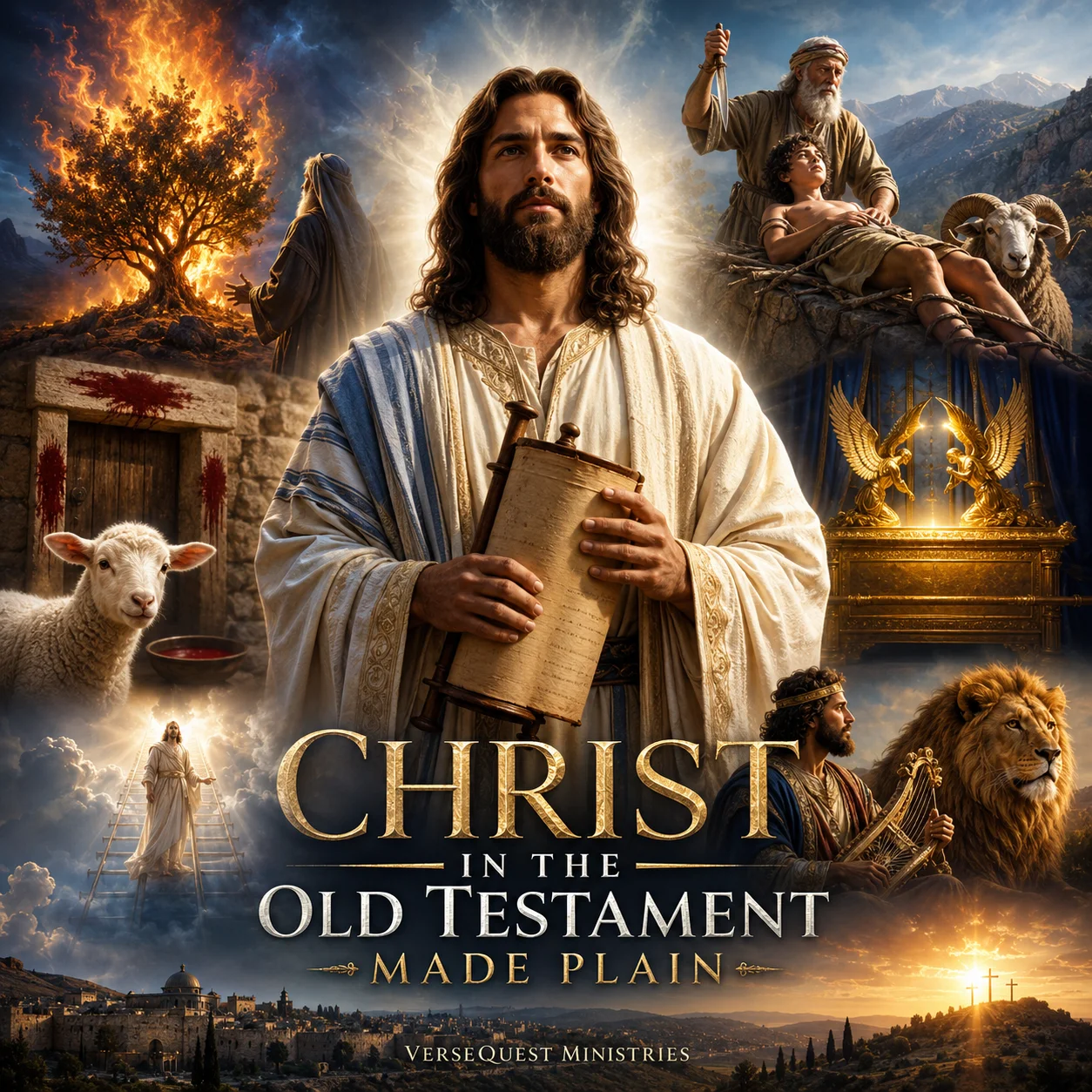
- Christ in the Old Testament Made Plain — 100-Essay KJV Study PDF
- A massive 670-page premium KJV Bible study PDF featuring 100 detailed essays showing Jesus Christ throughout the Old Testament in promise, type, sacrifice, Christophany, prophecy, suffering, resurrection, priesthood, and future…
- Original price was: $39.99.$9.99Current price is: $9.99.
- Add to cart
-
-75%
-
Christology Studies
-
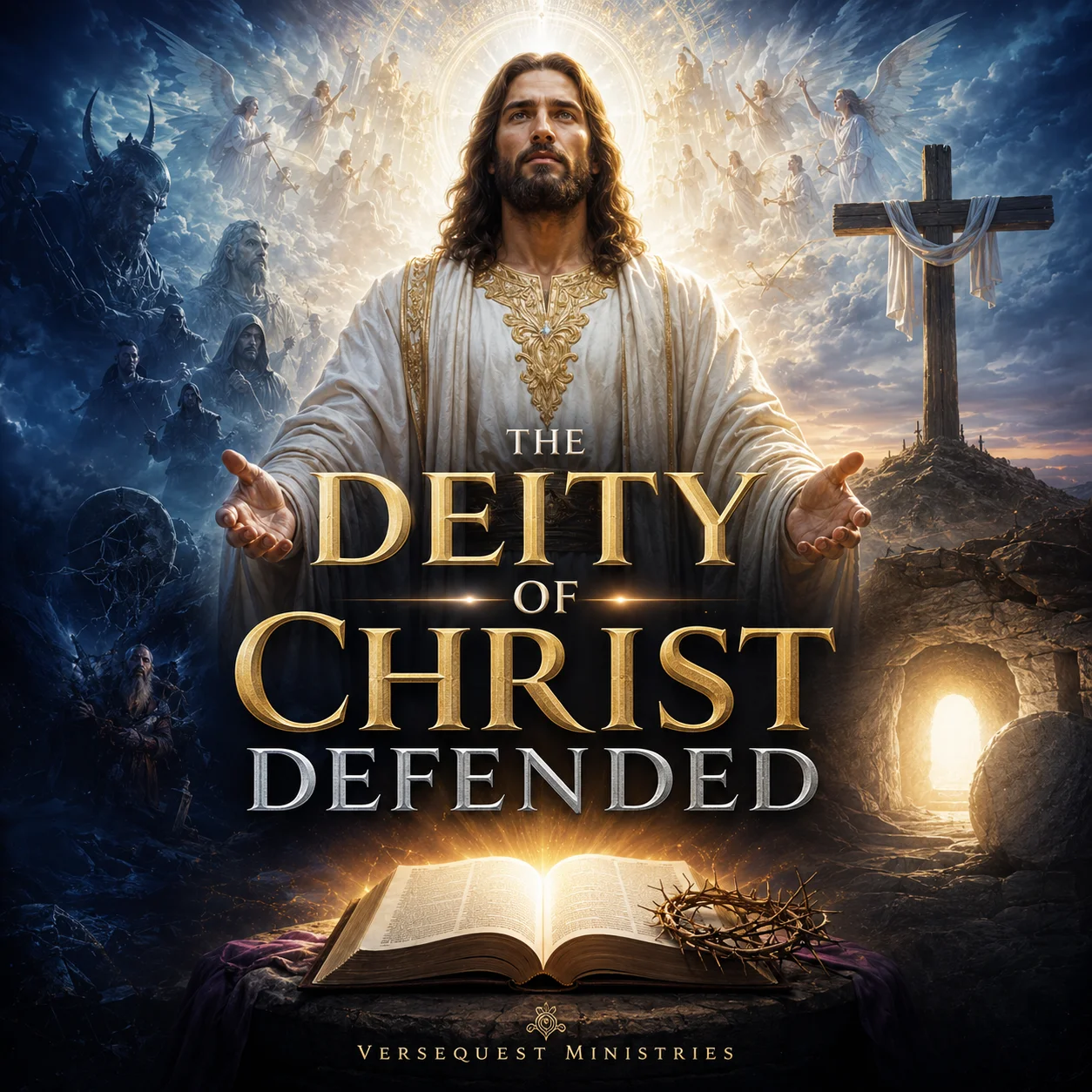
- The Deity of Christ Defended — 66 KJV Studies Proving Jesus Christ Is God Manifest in the Flesh
- he Deity of Christ Defended is a 444-page premium KJV Bible study defending the full deity of the Lord Jesus Christ. This 66-study book proves from Scripture that Jesus is…
- $29.99
- Add to cart
-