
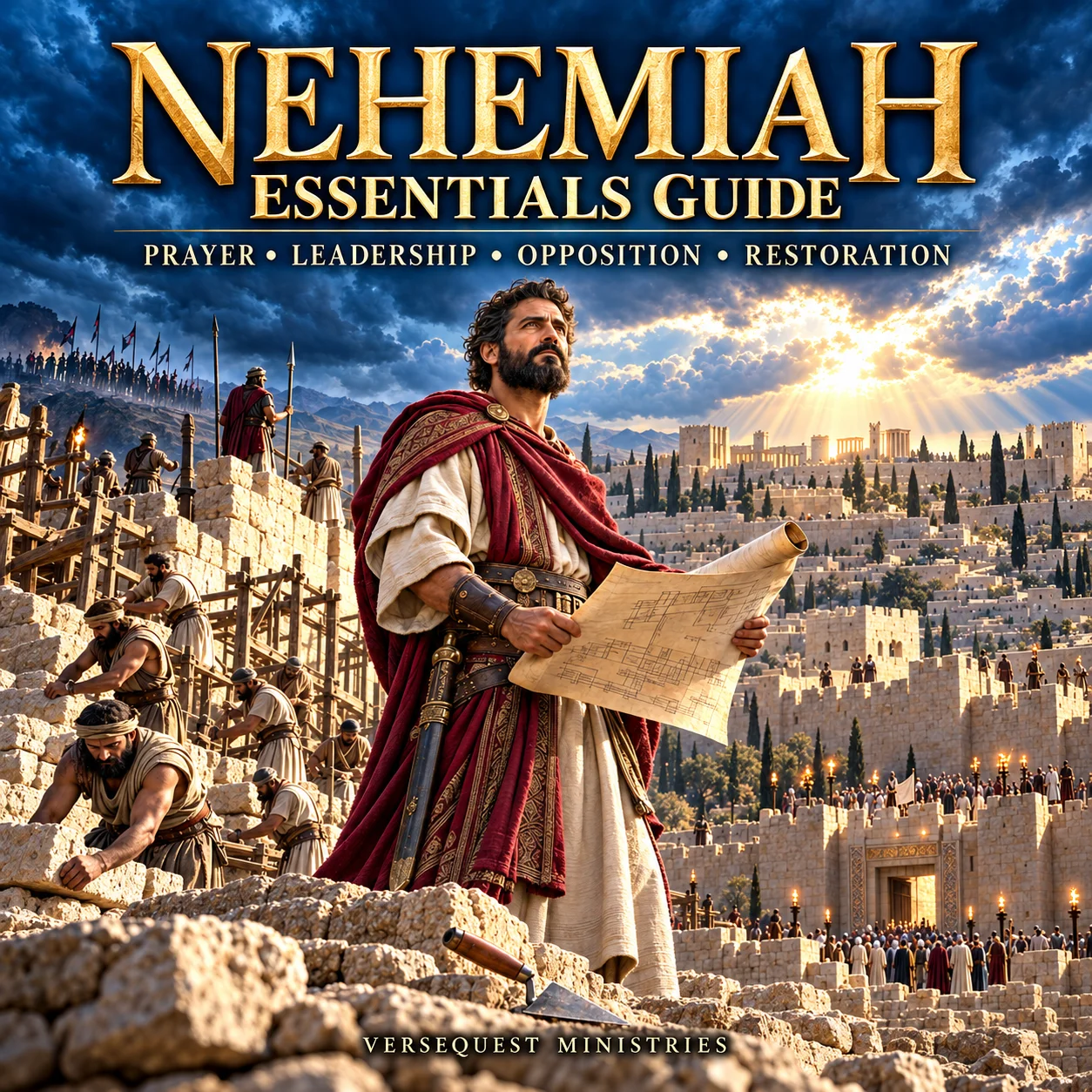
Nehemiah Essentials Guide — KJV Bible Study PDF
The Nehemiah Essentials Guide is a detailed 111-page downloadable KJV Bible study PDF that explains Nehemiah’s burden, prayer, Persian commission, nighttime inspection, organized rebuilding, opposition, leadership, completed wall, public reading of the law, national confession, covenant renewal, dedication, and final reforms.
Its 73 Scripture-centered studies include selected King James Bible passages written in full, explanations, important observations, cross-references, study questions, and purposeful writing space. Chapter maps, a historical timeline, Jerusalem gate studies, people profiles, doctrinal distinctions, difficult-passage guidance, teaching plans, sermon starters, reviews, and an index make it valuable for beginners, experienced Bible readers, pastors, teachers, families, and ministry students.
Digital PDF download. 111 pages. 73 studies. Price: $14.99.
$14.99
Description
The Nehemiah Essentials Guide is a comprehensive 111-page downloadable PDF designed to give readers a clear, organized, and substantial understanding of the entire book of Nehemiah. Through 73 Scripture-centered studies, it presents the essential history, prayers, people, places, leadership decisions, opposition, reforms, doctrinal distinctions, and practical lessons found throughout Nehemiah’s thirteen chapters.
Nehemiah begins far from Jerusalem, inside the Persian palace at Shushan. Although he served as the king’s cupbearer, his heart remained burdened for the city of his fathers. When he learned that Jerusalem’s wall was broken down and its gates burned with fire, Nehemiah did not react with empty outrage or immediate human activity. He sat down, wept, mourned, fasted, confessed sin, remembered God’s covenant, and prayed for favor before the king.
The guide follows Nehemiah from private burden to public responsibility. Readers examine his prayerful approach to Artaxerxes, his carefully prepared request, the royal authorization he received, his nighttime inspection of Jerusalem, and his call for the people to rise and build. Nehemiah demonstrates that dependence upon God does not eliminate planning, preparation, organization, courage, or decisive leadership.
Special attention is given to the rebuilding of Jerusalem’s wall and gates. The guide explains the organization of the labor, the families and groups assigned to different sections, the importance of shared responsibility, and the significance of repairing what had remained broken. Chapter maps, gate studies, people profiles, and geographical information help readers follow the work without becoming lost among unfamiliar names and locations.
The opposition led by Sanballat, Tobiah, Geshem, and their allies is examined carefully. Their tactics included ridicule, anger, conspiracy, intimidation, false reports, deceptive invitations, political accusations, infiltration, secret alliances, and hired prophets. Nehemiah’s responses provide enduring instruction in discernment, courage, prayer, watchfulness, concentration, and refusal to abandon an assigned work merely because enemies become loud.
Nehemiah’s leadership was not limited to resisting external enemies. When wealthy Jews exploited their poorer brethren through debt, interest, property loss, and bondage, Nehemiah confronted the internal injustice directly. He called the nobles and rulers to account, appealed to the fear of God, required restoration, and supported his words through his own unselfish example. The guide therefore presents leadership as moral responsibility rather than position, visibility, or personal advantage.
Readers also study the relationship between Ezra and Nehemiah. Nehemiah’s work upon the wall brought physical security and civil order, while Ezra’s public reading of the law brought the people face-to-face with the authority of the written Word. The gathering at the water gate, the reading and explanation of Scripture, the people’s understanding, the restored feast of tabernacles, national confession, and covenant renewal demonstrate that rebuilt walls could never replace restored obedience.
The guide treats the prayers of Nehemiah as a major feature of the book. His prayers include confession, remembrance, requests for favor, immediate cries for help, appeals for justice, petitions for strength, and repeated requests that God remember faithful service. These prayers reveal a servant who joined spiritual dependence with practical action. He could pray before speaking to the king, pray while facing opposition, and pray while continuing the work.
The later chapters receive the careful attention they deserve. Readers examine the repopulation of Jerusalem, the organization of priests and Levites, the joyful dedication of the completed wall, the two great companies of thanksgiving, the purification of worship, and Nehemiah’s final reforms. The guide explains his response to Tobiah’s chamber in the temple courts, neglected Levites, Sabbath violations, and covenant compromise.
The guide preserves the literal historical setting of Judah, Jerusalem, the wall, the temple, the priesthood, the Mosaic law, and Persian rule. It maintains the biblical distinction between Israel and the Church while drawing responsible applications concerning prayer, leadership, perseverance, separation, stewardship, justice, worship, vigilance, and obedience to the written Word of God.
The 73 core studies cover selected passages from every chapter of Nehemiah. Each study includes its selected King James Bible passage written in full, a central truth, clear explanation, important observations, a focused Bible-study lens, cross-references, questions, and purposeful writing space.
The orientation and reference sections include a book-at-a-glance survey, structure and outline, historical setting, timeline, Jerusalem’s wall and gates, chapter maps, principal people, places and political powers, key terms, major themes, the prayers of Nehemiah, comparisons between Ezra and Nehemiah, and essential doctrinal distinctions.
The concluding Reference Treasury contains unit reviews, an analysis of the book’s opposition, a study of Jerusalem’s gates, leadership and prayer tools, the sword-and-trowel principle, justice and stewardship studies, material on the Word, worship, and covenant renewal, difficult-passage guidance, teaching plans, sermon starters, review tools, an index, and a personal study record.
This guide is substantial enough for serious study while remaining more approachable than a large verse-by-verse commentary. It can be read digitally or printed for personal Bible study, family study, discipleship, Sunday school, small groups, classroom instruction, sermon preparation, ministry training, leadership study, or rapid review of the entire book.
A burden produced by truth — Nehemiah’s mission begins when he receives an honest report concerning Jerusalem’s broken walls and burned gates. Prayer before public action — Nehemiah’s first response is mourning, fasting, confession, and prayer rather than self-appointed activity. Confession with covenant understanding — Nehemiah acknowledges both Israel’s sin and the promises God had given concerning chastening and restoration. Providence within Persian government — God uses Nehemiah’s position, Artaxerxes’s authority, official letters, timber, and political protection to advance the work. Prayer joined with preparation — Nehemiah depends upon God while forming a careful request and making practical plans. Private inspection before public announcement — Nehemiah examines Jerusalem’s condition personally before presenting his rebuilding program. Organized service — Priests, rulers, craftsmen, merchants, families, and communities receive identifiable responsibilities along the wall. Shared responsibility — Jerusalem’s restoration requires many faithful workers rather than one visible leader performing every task. Working near one’s own house — Many builders repair the portion closest to their homes, joining personal responsibility with the larger work. Leadership by example — Nehemiah accepts sacrifice, rejects personal exploitation, remains present during danger, and works alongside the people. The changing tactics of opposition — Enemies move from ridicule and anger to conspiracy, distraction, accusation, intimidation, infiltration, and compromise. Prayer and watchfulness — The builders pray unto God while setting a watch against the enemy. The sword-and-trowel principle — God’s servants remain prepared to defend the work while continuing to build. Refusal to be distracted — Nehemiah rejects repeated invitations intended to remove him from his assignment. Strength for weakened hands — Nehemiah answers fear and intimidation by asking God to strengthen his hands. Internal injustice — The work of restoration is threatened when members of the community exploit one another economically. Moral courage in leadership — Nehemiah confronts nobles and rulers when their conduct violates the fear of God. The authority of the written Word — Renewal deepens when Ezra opens, reads, and explains the book of the law. Understanding before response — The people are helped to understand the meaning of Scripture rather than merely hearing its words. Conviction joined with joy — The reading of the law produces grief over sin, but the people are also directed toward worship, strength, and obedient rejoicing. Historical confession — Nehemiah 9 reviews Israel’s history by contrasting God’s faithfulness with human rebellion. Covenant renewal — The people commit themselves publicly to responsibilities defined by the law of God. Worship and thanksgiving — The wall is dedicated with purification, singing, musical instruments, sacrifices, and great rejoicing. The need for continuing reform — Completed walls and public commitments do not eliminate the danger of later compromise. Israel and the Church distinguished — Jerusalem, the temple, priesthood, Sabbath regulations, and national covenant remain within Israel’s historical setting. Restoration without final completion — Nehemiah records genuine restoration, but it does not exhaust every prophetic promise concerning Israel and Jerusalem.
Nehemiah’s central argument is that genuine restoration requires more than repairing damaged structures. Jerusalem needed walls and gates, but the people also needed prayer, courage, justice, Scripture, confession, worship, separation, and continuing reform. The book moves from a broken wall to an organized work and then from an organized city to a people confronted by the written Word.
Nehemiah’s burden was informed rather than imaginary. He asked concerning the Jews who had escaped and concerning Jerusalem. When he received the report, he allowed the truth to affect him. His grief did not become hopelessness, and his concern did not become immediate self-promotion. He carried the matter to God before carrying it to the king.
His prayer in Nehemiah 1 contains adoration, confession, covenant remembrance, and specific petition. Nehemiah did not blame Babylon, Persia, previous generations, or unfavorable circumstances while excusing Israel. He confessed, “both I and my father’s house have sinned.” Biblical leadership begins with personal accountability before it issues instructions to others.
Nehemiah’s appearance before Artaxerxes demonstrates the relationship between prayer and preparation. He prayed to the God of heaven, but he also knew what he wanted, how long the work might require, which letters were needed, and what materials should be requested. Faith was not carelessness with religious language attached to it.
The nighttime inspection reveals disciplined leadership. Nehemiah did not announce a plan built upon rumor. He personally examined the damage and understood the condition before calling others to action. He then connected the visible reproach with God’s good hand and the king’s authorization.
Nehemiah 3 demonstrates that great work is usually completed through distributed responsibility. Different people repaired different portions, yet every faithful section contributed to one wall. Some repaired near their own houses, some accepted more than one assignment, and some possessed greater enthusiasm than their rulers. The chapter honors work that may appear repetitive but remains necessary.
Opposition intensified as the work advanced. Sanballat and Tobiah began with mockery, but ridicule became anger, conspiracy, threats, distraction, political accusation, hired intimidation, and internal alliances. The variety of attacks teaches that opposition does not always approach with a drawn sword. It may arrive as a joke, invitation, rumor, religious warning, private letter, or proposed partnership.
The builders’ response joined prayer with watchfulness. They did not claim that prayer made guards unnecessary, nor did they act as though security made prayer unnecessary. Some labored while others remained ready to defend them. Those carrying burdens worked with one hand and held a weapon with the other. The image of the sword and the trowel remains one of Nehemiah’s most memorable pictures of vigilant service.
Nehemiah refused to come down from the wall for a manufactured conference. His statement, “I am doing a great work, so that I cannot come down,” expresses disciplined concentration. Not every invitation deserves acceptance, and not every accusation deserves a prolonged defense. Some distractions are defeated by continuing the assigned work.
The crisis in Nehemiah 5 proves that internal corruption can threaten restoration as seriously as external hostility. The wall could not represent strength while the wealthy oppressed their own brethren. Nehemiah became angry, but he also consulted with himself, rebuked the nobles, called an assembly, demanded restoration, and supported the correction through his personal example.
Completion of the wall in fifty-two days was not merely an organizational success. Even the enemies perceived that the work was wrought of God. Nevertheless, completion did not end the need for gates, guards, reliable leadership, genealogical records, repopulation, instruction, worship, or reform. One finished assignment opened the way for further responsibilities.
The public reading in Nehemiah 8 places Scripture at the center of restored national life. Ezra opened the book in the sight of the people, the Levites helped them understand, and the congregation responded with worship, conviction, and obedience. Revival was connected with an opened Book that was read distinctly and understood—not with excitement detached from revealed truth.
The feast of tabernacles demonstrates that recovery of neglected truth should produce action. The people discovered what was written and obeyed it. Their joy did not rest upon inventing a new religious experience but upon returning to what God had already commanded.
Nehemiah 9 reviews Israel’s history through the character of God. The LORD is presented as Creator, covenant keeper, deliverer, guide, provider, teacher, judge, and merciful preserver. Israel repeatedly acts proudly and rebelliously, yet God remains righteous in everything brought upon the nation. True confession agrees with God’s judgment rather than revising history to protect human pride.
The covenant commitments in Nehemiah 10 belong to Israel’s national and Mosaic setting. They address separation, Sabbath observance, temple support, offerings, priestly duties, and the house of God. Christians may learn principles of obedience, worship, stewardship, and separation without pretending that the Church has inherited Israel’s civil covenant or national institutions.
The dedication of the wall brings the book’s labor into worship. The people purified themselves, organized singers and musicians, formed two companies of thanksgiving, offered sacrifices, and rejoiced so greatly that Jerusalem’s joy was heard afar off. The wall was not dedicated to human achievement but to the God whose hand had enabled the work.
Nehemiah 13 prevents the reader from adopting an unrealistic view of reform. After public Scripture, confession, covenant commitments, and dedication, compromise returned. Tobiah obtained a chamber, the Levites were neglected, the Sabbath was profaned, and covenant boundaries were violated. Nehemiah returned and acted decisively. Reform must be guarded because yesterday’s commitment does not automatically govern tomorrow’s conduct.
The book leaves several valuable subjects for further study: the identity and role of each gate, the historical relationship among Ezra, Nehemiah, and the Persian kings, the repeated prayers that God would remember, the nature of Sanballat and Tobiah’s political influence, the distinction between national Israel and the Church, and the relationship between Nehemiah’s restoration and Jerusalem’s future prophetic promises.
The entire book can be remembered in one sentence: God used a praying, prepared, courageous, and accountable servant to rebuild Jerusalem’s wall, resist determined opposition, restore civil order, exalt the written Word, and confront compromise that threatened the restored community.
For personal Bible study, readers can work through the 73 studies in biblical order. Each study provides the selected KJV passage, explanation, observations, cross-references, questions, and writing space needed for a structured study of Nehemiah’s complete historical movement.
For sermon preparation, pastors and preachers can use the lesson themes, prayer studies, opposition analysis, leadership observations, difficult-passage guidance, memorable truths, and sermon starters as foundations for textual or topical messages.
For Sunday school and small groups, the guide can be organized around Nehemiah’s burden, his Persian commission, the rebuilding program, opposition, internal injustice, the completion of the wall, Ezra’s reading of the law, covenant renewal, dedication, and final reforms. Questions and integrated note areas support class participation and discussion.
For discipleship, Nehemiah provides focused instruction concerning prayer, courage, planning, accountability, teamwork, stewardship, justice, spiritual discernment, perseverance, biblical separation, worship, and submission to Scripture.
For family study, selected lessons can be read aloud and discussed without requiring a separate curriculum. The printed KJV passages and clear explanations help developing Bible readers understand the people, locations, conflicts, and lessons of the book.
For leadership and ministry training, the guide supplies practical studies of Nehemiah’s preparation, delegation, communication, crisis management, confrontation of wrongdoing, refusal of personal advantage, and determination to finish the work entrusted to him.
For classroom instruction, the historical setting, timeline, wall-and-gates study, chapter maps, principal people, Persian background, doctrinal distinctions, unit reviews, and index provide an organized framework for teaching all thirteen chapters.
For topical teaching, the guide can support studies on fasting, intercessory prayer, rebuilding, spiritual opposition, false accusations, discernment, internal corruption, the public reading of Scripture, confession, revival, covenant responsibility, and faithful reform.
The primary companion to this guide should be a King James Bible so readers can study the complete chapters surrounding every selected passage. Although the guide prints its selected passages in full, repeated reading of all thirteen chapters will strengthen the reader’s understanding of the entire narrative.
The Ezra Essentials Guide is the most natural companion resource because it explains the earlier return from Babylon, the restoration of the altar and temple, the opposition to the work, Ezra’s ministry as a ready scribe, and the events leading into Nehemiah.
The Second Chronicles Essentials Guide provides valuable background concerning Judah’s decline, Jerusalem’s destruction, the Babylonian captivity, and Cyrus’s proclamation permitting the rebuilding of the house of the LORD.
A Strong’s or Cruden’s concordance can help readers trace words and expressions such as wall, gate, build, repair, prayer, remember, reproach, fear, law, covenant, and Jerusalem.
A reliable Bible dictionary can provide additional information about Shushan, Jerusalem, Persia, Artaxerxes, Nehemiah, Ezra, Sanballat, Tobiah, Geshem, and the principal gates of Jerusalem. A Bible atlas or historical map can help readers understand Nehemiah’s journey and the geography surrounding Jerusalem.
Cross-reference tools are especially helpful when comparing Nehemiah with Second Chronicles, Ezra, Esther, the Psalms, Daniel, Haggai, and Zechariah. A timeline of the Persian period can help distinguish the earlier return under Zerubbabel, Ezra’s later ministry, and Nehemiah’s commission concerning Jerusalem’s wall.
For deeper study, readers may consult detailed KJV commentaries, historical studies of the Persian period, resources on Jerusalem’s gates and topography, and careful examinations of Israel’s post-exilic history.
Related products
-
Jesus Christ
-
-10%

- The Lord Jesus Christ Made Plain – 637-Page KJV Bible Study
- A massive 637-page, 100-part KJV Bible study on the Person and work of the Lord Jesus Christ. This premium VerseQuest resource covers His deity, incarnation, blood, cross, resurrection, present ministry,…
- Original price was: $39.00.$34.99Current price is: $34.99.
- Add to cart
-
-10%
-
Names of Christ
-
- The Names and Titles of Jesus Christ Made Plain
- A complete 100-essay KJV Bible study on the names and titles of the Lord Jesus Christ, showing His deity, humanity, blood atonement, resurrection, priesthood, headship over the Church, shepherd care,…
- $29.99
- Add to cart
-
-
Chart Collections
-
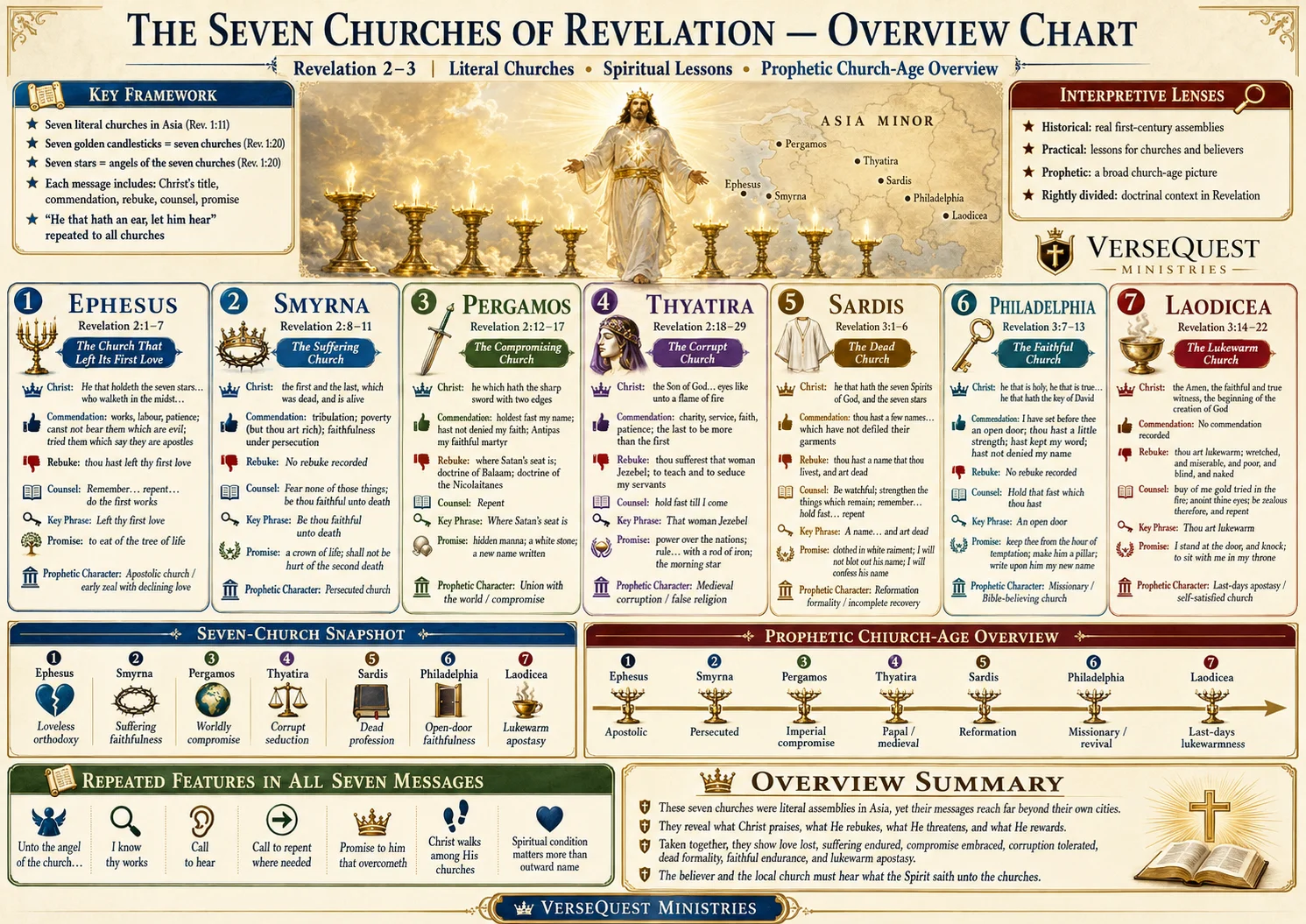
- The Seven Churches of Revelation Chart Collection – Christ Walking Among the Candlesticks
- A premium VerseQuest Ministries™ PDF chart collection covering the Seven Churches of Revelation in Revelation 2–3. Includes one overview chart plus individual KJV Bible study charts for Ephesus, Smyrna, Pergamos,…
- $12.99
- Add to cart
-
-
Bible Overview Series
-
- The New Jerusalem Made Plain — 621-Page PDF Study
- The New Jerusalem Made Plain is a massive 621-page KJV/rightly divided PDF study on the literal holy city revealed in Revelation 21–22. This 100-essay book makes the New Jerusalem plain…
- $34.99
- Add to cart
-
-
Premium Studies
-
-25%
- The Doctrine of Hell — Premium Essay Series PDF
- A 383-page premium VerseQuest PDF study book containing 54 KJV essays on hell, fire, darkness, judgment, the lake of fire, the second death, and Jesus Christ as the only escape.
- Original price was: $39.99.$29.99Current price is: $29.99.
- Add to cart
-
-25%