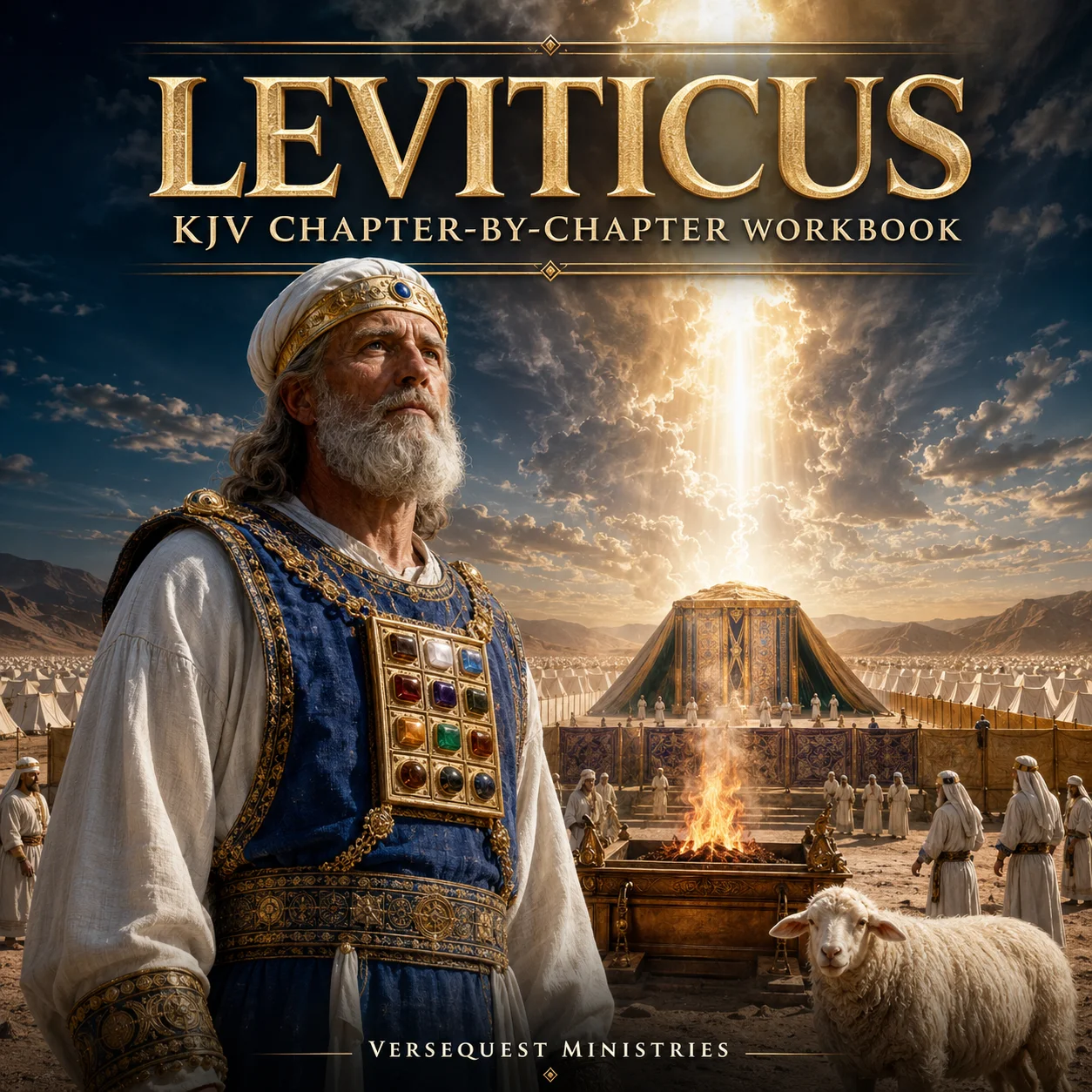
Leviticus KJV Chapter-by-Chapter Workbook
The Leviticus KJV Chapter-by-Chapter Workbook is a complete 386-page downloadable Bible curriculum covering all 27 chapters of Leviticus from a King James Bible-believing, rightly divided perspective.
Every chapter includes ten student-study pages followed by a Teacher and Leader Guide and suggested answers. Students will examine the five principal offerings, the Aaronic priesthood, strange fire, clean and unclean distinctions, leprosy, ceremonial cleansing, the Day of Atonement, the blood upon the altar, holiness, the feasts of the LORD, Jubilee, covenant blessing and chastening, and vows and redemptions.
The workbook also includes multiple course schedules, cumulative reviews, a final assessment, answer guide, KJV glossary, doctrinal reference studies, offering comparisons, subject and Scripture indexes, final-project options, navigation bookmarks, and a certificate of completion.
It may be printed for handwritten work or studied and annotated digitally using a compatible PDF reader. Ideal for personal study, homeschool, Sunday school, church classes, Bible-study groups, discipleship, and ministry training.
Price: $39.99
$39.99
Description
The Leviticus KJV Chapter-by-Chapter Workbook is a complete 386-page downloadable Bible curriculum designed to guide students carefully through all 27 chapters of Leviticus. It transforms one of the Bible’s most detailed and frequently misunderstood books into an organized course of study built around direct interaction with the King James Bible.
Leviticus begins where Exodus ends. The glory of the LORD has filled the completed tabernacle, and the LORD now calls Moses from within that dwelling place. The central question is no longer how Israel can escape Egypt, but how a redeemed yet sinful nation can approach a holy God, maintain fellowship with Him, worship according to His appointed order, distinguish between clean and unclean, and live as His separated covenant people.
The workbook examines the burnt offering, meat offering, peace offering, sin offering, trespass offering, priestly laws of sacrifice, consecration of Aaron and his sons, beginning of the priestly ministry, judgment of Nadab and Abihu, clean and unclean creatures, purification after childbirth, examination and cleansing of leprosy, bodily issues, the Day of Atonement, the sanctity of blood, forbidden relationships, holiness in daily life, priestly qualifications, acceptable offerings, the feasts of the LORD, sanctuary service, equal justice, sabbath years, Jubilee, covenant blessing and chastening, vows, valuations, redemptions, and devoted things.
Every chapter receives a consistent twelve-page treatment. The first ten pages guide the student through the chapter’s theme, key passage, six principal movements, guided exposition, doctrinal distinctions, KJV vocabulary, cross-reference chains, written exercises, special studies, biblical typology, difficult questions, error correction, review, personal response, and teach-back preparation. The final two pages provide a coordinated Teacher and Leader Guide followed by suggested answers and a model chapter summary.
The workbook approaches Leviticus from a Bible-believing, rightly divided perspective. The offerings are first understood as literal sacrifices appointed for Israel. Aaron and his sons remain Israel’s historical and covenantal priesthood. The dietary laws, ceremonial cleansings, feast calendar, civil penalties, land sabbaths, and Jubilee are preserved within their proper Mosaic setting. Israel is not transformed into the Body of Christ, and present-day believers are not placed under Israel’s covenant ordinances.
At the same time, the workbook carefully traces the inspired connections between Leviticus and the finished work of Jesus Christ. The sacrifices, priesthood, blood, altar, veil, sanctuary, Day of Atonement, and approach to God are compared with their explanations in the New Testament, especially Hebrews. Historical facts are established before typology is considered, and clear scriptural connections are distinguished from imaginative speculation.
The opening course material includes instructions for using the workbook, learning outcomes, doctrinal and interpretive safeguards, a seven-part structural outline of Leviticus, chapter summaries, a twenty-seven-week study schedule, a fourteen-week intensive schedule, a fifty-four-lesson teaching plan, core and enrichment tracks, assessment standards, teacher guidance, an offering comparison, and a course-progress record.
The concluding resource section includes five cumulative reviews, a two-part final course assessment, a five-part answer guide, a five-part KJV glossary, a master offering comparison, doctrinal studies of the Aaronic priesthood, clean and unclean distinctions, the Day of Atonement, the feasts of the LORD, the holiness code, vows and valuations, covenant blessing and chastening, Leviticus and Hebrews, the sacrifices and Christ, and Israel and the Body of Christ. It also contains a right-division mail test, difficult questions for further study, common errors corrected, teaching records, final-project options, subject and doctrine indexes, a Scripture index, further-study recommendations, a final challenge, and a certificate of completion.
This downloadable PDF contains searchable text and organized navigation bookmarks. It may be printed for handwritten study or used on a computer or tablet. Readers using compatible PDF software may highlight passages, insert comments, draw markings, and add text boxes through their PDF reader’s annotation tools.
The Leviticus KJV Chapter-by-Chapter Workbook is suitable for serious individual Bible students, homeschool families, Sunday school classes, church Bible-study groups, discipleship programs, Bible institutes, prison and recovery ministries, pastors, preachers, and teachers. It may be completed one chapter each week, taught through an intensive semester, divided into fifty-four teaching sessions, or adapted into selected topical modules.
This is more than a commentary to be read and placed on a shelf. It is a working Bible curriculum that trains students to open Leviticus, observe its exact words, follow its inspired structure, compare Scripture with Scripture, preserve important doctrinal distinctions, recognize legitimate connections to Christ, and develop the ability to explain and teach the book faithfully.
Approaching a holy God — Leviticus reveals that sinful man does not invent the terms of approach, sacrifice, worship, or fellowship. The filled tabernacle — The book begins after the glory of the LORD fills the sanctuary constructed in Exodus. The burnt offering — The whole offering is presented upon the altar as an offering made by fire and a sweet savour unto the LORD. The meat offering — Fine flour, oil, frankincense, unleavened preparation, and salt accompany Israel’s bloodless gift. The peace offering — Sacrifice, blood, fat, priestly portions, and the worshipper’s meal are joined in covenant fellowship. The sin offering — Sacrificial requirements differ according to the position and responsibility of the offender. The trespass offering — Guilt may require confession, sacrifice, restitution, and the addition of the fifth part. The laws of the offerings — Priests and worshippers must handle the altar, fire, blood, fat, holy food, and sacrificial portions exactly as commanded. The Aaronic priesthood — Aaron and his sons are washed, clothed, anointed, blood-marked, consecrated, and appointed for Israel’s sanctuary service. Divine glory and accepted service — The glory appears and fire comes out before the LORD when the priesthood begins its ministry according to the commandment. Strange fire — Nadab and Abihu demonstrate that sincerity, position, and religious activity cannot replace obedience to God’s revealed order. Priestly discernment — Priests must distinguish between holy and unholy, clean and unclean, and teach Israel the statutes of the LORD. Clean and unclean creatures — Israel’s dietary distinctions belong to the nation’s covenant separation and daily life. Ceremonial uncleanness — Childbirth, bodily issues, contact, disease, garments, and houses are regulated in relation to cleansing and sanctuary access. Leprosy examination and cleansing — Priests examine evidence carefully and declare a condition according to God’s stated tests. The Day of Atonement — The high priest enters within the veil once each year with sacrificial blood for himself, the people, and the sanctuary. The two goats — One goat is slain and the other bears confessed sins into an uninhabited land. The life of the flesh in the blood — Blood is reserved by God for the altar and given for atonement under the covenant. Holiness in daily life — Worship, family, labour, justice, speech, sexuality, charity, and treatment of neighbours fall under the LORD’s authority. The holiness of God’s name — Priests, worshippers, offerings, sanctuary service, and public conduct must not profane the name of the LORD. Priestly qualifications — Those who handle holy things are governed by stricter requirements concerning service and conduct. Acceptable sacrifices — Israel must not bring defective offerings while claiming to honour the LORD. The feasts of the LORD — Israel’s sacred calendar is ordered around sabbaths, harvests, memorials, atonement, and rejoicing. Continual light and shewbread — The sanctuary service requires continuing order before the LORD. Blasphemy and equal justice — Leviticus joins reverence for God’s name with one manner of law for the Israelite and the stranger. Sabbath years and Jubilee — The land, property, liberty, service, debt, and inheritance remain under the LORD’s ownership. Covenant blessing and chastening — Israel’s obedience brings national blessing, while persistent rebellion brings escalating judgment. Covenant remembrance — Even after severe chastening, God declares that He will remember His covenant and the land. Vows and valuations — Voluntary dedication remains accountable to the LORD’s stated requirements and priestly valuation. Literal Israel and the Body of Christ — The workbook preserves Israel’s national covenant while drawing legitimate instruction for present believers. Law and grace distinguished — The law reveals holiness and exposes sin but cannot provide justification or change the flesh. Christ and the sacrifices — New Testament passages identify Christ as the sinless offering, precious Lamb, sweetsmelling savour, and once-for-all sacrifice. Christ and the priesthood — Aaron’s temporary and limited priesthood is surpassed by the everlasting and perfect priesthood of Jesus Christ. Controlled biblical typology — Explicit scriptural connections are separated from possible correspondence and unsupported imagination. Teaching from the text — Every chapter trains the student to observe, explain, defend, correct error, and prepare a faithful lesson.
- Central argument: Leviticus explains how the holy LORD orders sacrifice, priesthood, cleansing, worship, daily conduct, sacred time, and covenant responsibility for redeemed Israel.
- Opening connection: Exodus ends with the LORD’s glory filling the tabernacle; Leviticus begins with the LORD speaking from that tabernacle.
- Controlling question: How may a sinful people approach, worship, and live before a holy God who dwells among them?
- Book movement: Sacrifice leads to priesthood, priesthood guards cleanness, cleansing protects the sanctuary, atonement reaches the nation, holiness governs life, and covenant responsibility reaches the land.
- Seven major divisions: The offerings; priesthood; clean and unclean; atonement and blood; holiness; sacred times and land; covenant consequences and dedicated things.
- Five offerings distinguished: The burnt, meat, peace, sin, and trespass offerings differ in material, procedure, blood use, burning, priestly portion, worshipper’s portion, purpose, and stated result.
- God appoints the approach: The worshipper does not choose any animal, method, altar, fire, or priestly procedure he prefers.
- Sacrifice and obedience: An offering brought outside God’s appointed order does not honour Him merely because the worshipper is sincere.
- The continual fire: Leviticus 6 requires the altar fire to remain burning and never go out.
- Restitution matters: Certain trespasses require restoration and the addition of the fifth part as well as sacrifice.
- Priesthood is commanded: Aaron does not appoint himself, design his garments, establish his own ordination, or determine his duties.
- Glory follows appointed service: Leviticus 9 reaches its climax when the glory appears and divine fire consumes the offering.
- Strange fire warns against invention: Nadab and Abihu offer what the LORD “commanded them not” and are judged before the sanctuary.
- Priests must teach: Aaron’s sons are responsible to distinguish holy from unholy and clean from unclean and to teach Israel.
- Unclean is not always sinful: Some conditions of ceremonial uncleanness arise from ordinary bodily events rather than deliberate moral rebellion.
- Patient examination: Leviticus 13 requires repeated observation, waiting periods, and priestly judgment rather than careless assumptions.
- Cleansing follows healing: In Leviticus 14, the priest does not heal the leper; he examines a healed person and administers the appointed cleansing.
- The Day of Atonement is annual: The high priest enters within the veil once each year and not whenever he chooses.
- Aaron needs sacrifice: Israel’s high priest must first offer for himself because he is also a sinner.
- The sanctuary is cleansed: Leviticus 16 shows that atonement concerns the people, priesthood, altar, holy place, and tabernacle.
- The two goats perform different roles: One is slain and its blood presented; the other carries confessed sins away.
- Blood is reserved by God: Leviticus 17:11 teaches that God gave the blood upon the altar to make atonement for souls.
- Holiness governs ordinary life: Leviticus refuses to confine holiness to ceremonies performed at the tabernacle.
- Neighbour-love comes from Leviticus: The command to love one’s neighbour as oneself appears in Leviticus 19:18.
- The land can be defiled: Leviticus 18 connects national abomination with the land vomiting out its inhabitants.
- Priestly privilege brings responsibility: Those who handle holy things are placed under stricter requirements.
- The feasts belong to the LORD: Leviticus 23 calls them “the feasts of the LORD,” not merely Jewish cultural celebrations.
- Jubilee protects divine ownership: Israel may possess and use the land, but the LORD declares that the land is His.
- Leviticus 26 addresses literal Israel: Its rain, harvest, military victory, disease, famine, dispersion, land desolation, repentance, and restoration are national covenant realities.
- Chastening increases in stages: Persistent refusal produces repeated and escalating covenant judgments.
- The covenant is not forgotten: God’s judgment does not erase His promises to Abraham, Isaac, Jacob, and their seed.
- Voluntary vows remain accountable: A person cannot dedicate something to the LORD and then disregard the valuation and redemption requirements.
- The law exposes human need: Perfect commandments can define holiness, guilt, sacrifice, and cleansing, but they cannot perfect the conscience or change sinful flesh.
- Animal sacrifices were limited: Hebrews explains that repeated animal offerings could not provide the final removal of sin accomplished by Christ.
- Christ is the better High Priest: He is sinless, everlasting, unchangeable, and able to save to the uttermost.
- Christ offered Himself once: His finished sacrifice must not be reduced to one more offering in an endless ceremonial cycle.
- Israel remains Israel: Aaronic priesthood, dietary distinctions, feast days, civil penalties, land sabbaths, and Jubilee must not be reassigned to the Body of Christ.
- Instruction remains valuable: Leviticus reveals God’s holiness, man’s guilt, the seriousness of worship, the necessity of sacrifice, and the glory of Christ’s completed work.
- Question for further study: What did animal sacrifice accomplish under the Mosaic covenant, and what could it never accomplish?
- Question for further study: How does Hebrews interpret the high priest, sanctuary, veil, blood, and Day of Atonement?
- Question for further study: Which Levitical types are explicitly identified in later Scripture, and which comparisons require restraint?
- Question for further study: How do the feasts relate to Israel’s history and prophetic future?
- Question for further study: How does Leviticus distinguish moral guilt from ceremonial uncleanness?
- Memorable teaching point: Exodus brings Israel to the dwelling place; Leviticus teaches Israel how to approach the God who dwells there.
- Memorable teaching point: The altar declares that sin is costly, the priesthood declares that approach is ordered, and the veil declares that access is restricted.
- Memorable teaching point: Leviticus is not a collection of dead ceremonies; it is the inspired foundation beneath the Bible’s teaching about sacrifice, priesthood, blood, holiness, and atonement.
For personal Bible study, the workbook supplies an organized path through every chapter of Leviticus. Students can read the KJV text, follow the six movements, define important words, complete written exercises, trace cross-references, examine doctrinal distinctions, and prepare original chapter summaries before consulting the suggested answers.
For homeschool families, the workbook can function as a complete Bible course. Parents may use the twenty-seven-week schedule, the fourteen-week intensive schedule, or the fifty-four-lesson teaching plan. The repeated structure, vocabulary work, written responses, cumulative reviews, final assessment, project options, progress records, and certificate of completion provide the components needed for a substantial course of study.
For Sunday school and church Bible classes, teachers can assign the chapter reading and selected student pages before class. The coordinated Teacher and Leader Guide provides lesson outcomes, teaching flow, cautions, discussion prompts, assessment standards, and additional assignments.
For small groups and discipleship, participants can compare their observations, work through difficult passages, trace biblical connections, examine common errors, and complete the teach-back sections together. The core and enrichment tracks allow students with different experience levels to participate in the same course.
For pastors, preachers, and Bible teachers, the chapter movements, KJV vocabulary, doctrinal distinctions, special studies, cross-reference chains, and typological examinations provide organized material for sermon preparation, chapter studies, doctrinal lessons, and teaching series.
For Bible institutes and ministry training, students may be required to complete the enrichment track, reproduce the seven major divisions, compare the five offerings, explain the Aaronic priesthood, defend right-division distinctions, complete the final assessment, and prepare a sermon, lesson, chart, or teaching project.
For prison, recovery, counseling, and care ministries, selected chapters may support careful lessons concerning guilt, confession, restitution, accountability, holiness, separation, forgiveness, worship, responsibility, restoration, and fellowship. Teachers should preserve the historical and doctrinal setting while making appropriate practical applications.
A King James Bible with readable reference formatting
An exhaustive concordance keyed to the King James Bible
A reliable KJV Bible dictionary for sacrificial, priestly, ceremonial, legal, and covenant terminology
A cross-reference Bible or treasury of Scripture cross-references
A chart comparing the burnt, meat, peace, sin, and trespass offerings
A tabernacle floor plan based upon Exodus 25-30 and 35-40
A diagram of the tabernacle court, brazen altar, laver, holy place, veil, ark, and mercy seat
A study of Aaron’s garments and consecration using Exodus 28-29 and Leviticus 8
A Day of Atonement flowchart based upon Leviticus 16
A feast calendar based upon Leviticus 23
A chart comparing clean, unclean, cleansing, guilt, forgiveness, and holiness
A study of sabbath years, Jubilee, redemption, inheritance, and the land in Leviticus 25
A comparison of Leviticus and Hebrews concerning sacrifice, priesthood, blood, sanctuary, conscience, and access to God
Genesis KJV Chapter-by-Chapter Workbook for the beginnings of sacrifice, covenant, promise, and substitution
Exodus KJV Chapter-by-Chapter Workbook for Israel’s redemption, Sinai covenant, priesthood, and tabernacle
Through the Bible with VerseQuest for a broader survey of all 66 books of the King James Bible
Journey Through the Bible Series: Leviticus as companion reading for extended exposition
Leviticus Chapter-by-Chapter Series as additional chapter-focused study material
Related products
-
VerseQuest Premium Library
-
-67%
- The Book of Psalms Made Plain – 383-Page KJV Psalm Study
- The Book of Psalms Made Plain is a 383-page premium KJV Bible study featuring 54 detailed essays through the major themes, doctrines, prophecies, prayers, laments, and praises of the Psalms.…
- Original price was: $29.99.$9.99Current price is: $9.99.
- Add to cart
-
-67%
-
Names of Christ
-
- The Names and Titles of Jesus Christ Made Plain
- A complete 100-essay KJV Bible study on the names and titles of the Lord Jesus Christ, showing His deity, humanity, blood atonement, resurrection, priesthood, headship over the Church, shepherd care,…
- $29.99
- Add to cart
-
-
Jesus Christ Studies
-
-67%
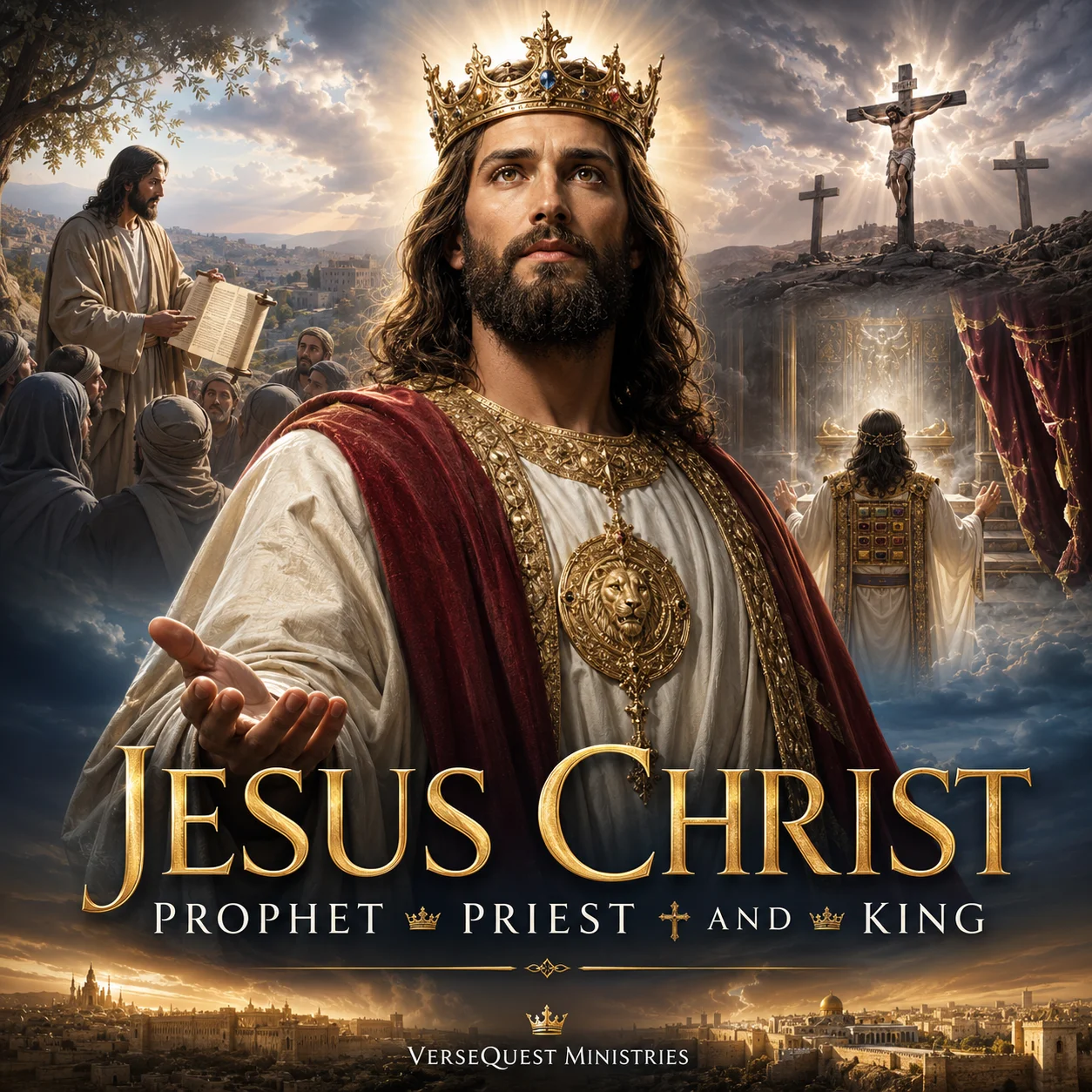
- Jesus Christ Prophet Priest and King – 441-Page PDF Study
- A 441-page premium KJV PDF study on Jesus Christ as Prophet, Priest, and King. This detailed VerseQuest book covers Christ’s prophetic ministry to Israel, His finished sacrifice and present intercession…
- Original price was: $29.99.$9.99Current price is: $9.99.
- Add to cart
-
-67%
-
KJV Bible Study Resources
-
-60%
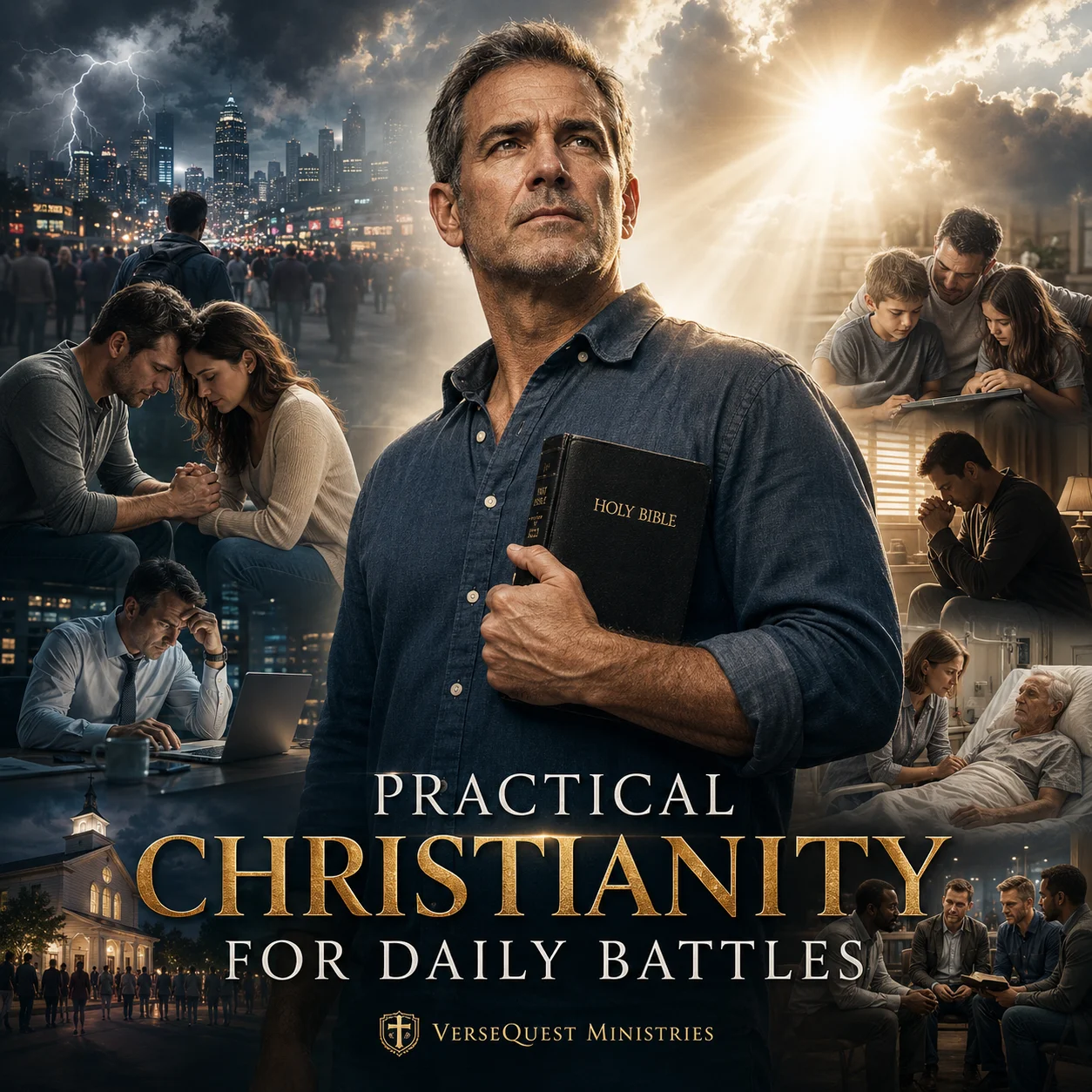
- Practical Christianity for Daily Battles – 329-Page KJV Study PDF
- A premium 329-page KJV study PDF with 40 full essays applying sound, rightly divided Bible doctrine to real daily Christian battles. Topics include temptation, anxiety, marriage, parenting, pornography, grief, church…
- Original price was: $24.99.$9.99Current price is: $9.99.
- Add to cart
-
-60%
-
Bible Overview Series
-
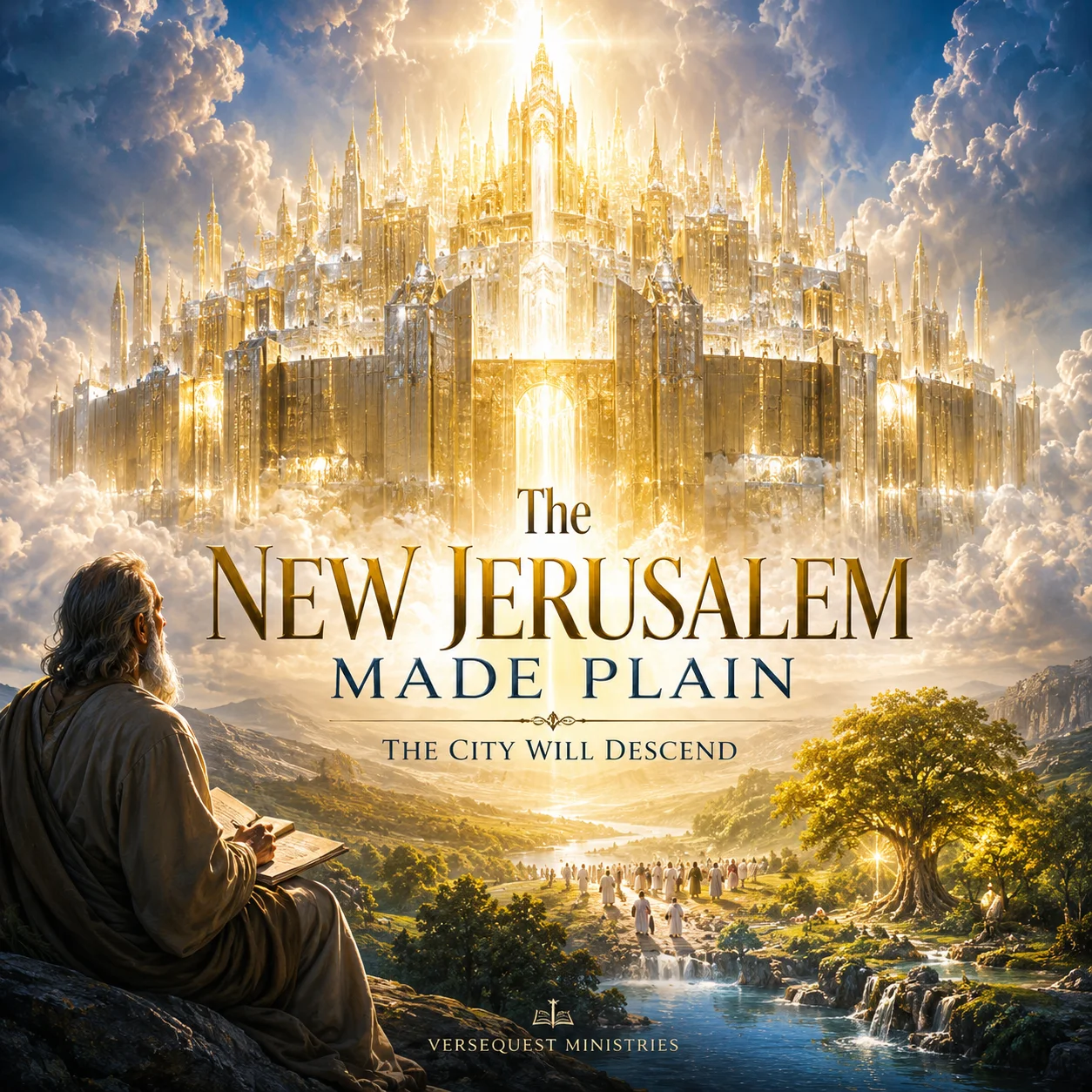
- The New Jerusalem Made Plain — 621-Page PDF Study
- The New Jerusalem Made Plain is a massive 621-page KJV/rightly divided PDF study on the literal holy city revealed in Revelation 21–22. This 100-essay book makes the New Jerusalem plain…
- $34.99
- Add to cart
-