
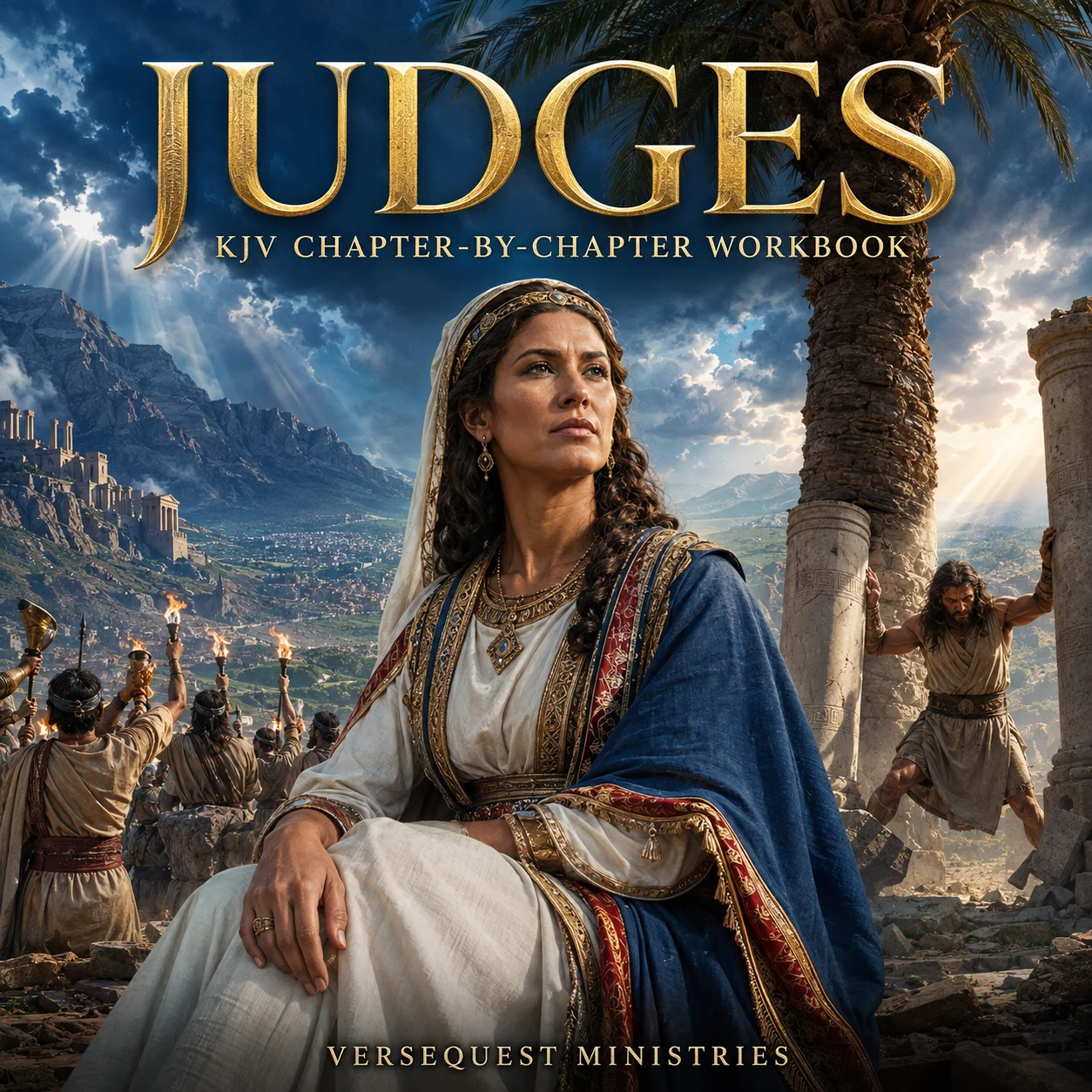
Judges KJV Chapter-by-Chapter Workbook
The Judges KJV Chapter-by-Chapter Workbook is a complete 320-page downloadable Bible curriculum covering all 21 chapters of Judges from a Bible-believing, KJV-centered, rightly divided perspective.
Every chapter includes ten student-study pages followed by a Teacher and Leader Guide and suggested answers. Students will study Israel’s incomplete conquest, the recurring cycle of apostasy and deliverance, Deborah and Barak, Gideon, Abimelech, Jephthah, Samson, Micah’s false worship, Dan’s idolatry, the corruption at Gibeah, the Benjaminite war, and the final declaration that every man did what was right in his own eyes.
The workbook also includes flexible course schedules, a forty-two-lesson teaching plan, cumulative reviews, a four-part final assessment, answer keys, ten doctrinal studies, a KJV glossary, subject and Scripture indexes, a final teaching project, and a certificate of completion.
It may be printed for handwritten work or studied digitally with compatible PDF software. Ideal for personal study, homeschool, Sunday school, church Bible classes, discipleship, Bible institutes, and ministry training.
Price: $24.99
$24.99
Description
The Judges KJV Chapter-by-Chapter Workbook is a complete 320-page downloadable Bible curriculum designed to lead students carefully through all 21 chapters of Judges. This extensive workbook combines serious biblical exposition with observation exercises, chapter mapping, KJV vocabulary, doctrinal distinctions, cross-reference studies, written assignments, difficult questions, error correction, reviews, teacher guidance, suggested answers, and teach-back preparation.
Judges begins with Israel’s unfinished conquest following the death of Joshua and closes with the fearful declaration, “In those days there was no king in Israel: every man did that which was right in his own eyes.” Between those boundaries, the book records Israel’s repeated descent into apostasy, idolatry, oppression, desperation, deliverance, compromise, civil disorder, and moral ruin. The judges could defeat Israel’s enemies, but they could not permanently change the nation’s heart.
Every chapter receives a consistent twelve-page treatment. The first ten pages guide the student through the chapter’s principal movements, key passages, people, places, events, KJV vocabulary, doctrinal observations, cross-reference chains, special studies, controlled typology, difficult questions, common interpretive errors, personal application, review, and teaching preparation. The final two pages provide a coordinated Teacher and Leader Guide followed by suggested answers and a model chapter summary.
Students will examine the incomplete conquest of Canaan, the rebuke at Bochim, the recurring cycle of rebellion and deliverance, Othniel, Ehud, Shamgar, Deborah, Barak, Jael, Gideon, Abimelech, Jephthah, Samson, Micah’s private shrine, the migration of Dan, the corruption at Gibeah, the civil war against Benjamin, and the final collapse of righteous order in Israel. The material follows the book’s progression from tolerated compromise to national corruption rather than treating Judges as a disconnected collection of heroic stories.
The workbook addresses the book’s difficult passages honestly and carefully. It examines warfare, deception, vengeance, abuse, rash vows, tribal rivalry, idolatry, religious corruption, civil slaughter, and moral disorder without pretending that every recorded action received God’s approval. The course consistently distinguishes between inspired description and divine endorsement. It also separates God’s providential overruling from His moral approval of human conduct.
Judges is approached from a Bible-believing, literal-historical, dispensational, and rightly divided perspective. Literal Israel remains Israel, the Mosaic covenant retains its historical setting, and Israel’s land inheritance, national warfare, civil judgments, Nazarite appointments, and covenant discipline are not transferred to the Body of Christ. The workbook draws legitimate spiritual instruction for present believers while preserving the people, promises, covenants, and doctrinal distinctions established by Scripture.
Special doctrinal attention is given to the cycle of apostasy and deliverance, the angel of the LORD, the Spirit of the LORD coming upon selected judges, Samson’s Nazarite separation, the women appearing throughout Judges, vows and rash speech, Israel’s need for righteous kingship, idolatry and religious mixture, the interpretation of violence and judgment, and the distinction between Israel and the Body of Christ.
The workbook includes several flexible course schedules. Students may follow a standard twenty-one-week schedule, complete an accelerated ten-week course, divide each chapter into multiple study sessions, or follow the complete forty-two-lesson teaching plan. Core and enrichment tracks allow families and teachers to adjust the workload for younger students, self-directed learners, church classes, advanced homeschool students, or ministry-training settings.
Four cumulative reviews cover Judges 1–5, 6–10, 11–15, and 16–21. Each review is followed by a teacher key. A four-part final assessment and corresponding answer key test the student’s knowledge of the book’s people, places, events, structure, doctrines, and interpretive distinctions. The course concludes with a final teaching assignment requiring the student to prepare and deliver a 20–30-minute KJV lesson from one chapter of Judges.
Additional reference material includes an overview of the book’s structure, chapter summaries, chronology and historical-setting notes, geographical studies, an examination of the recurring cycle, a survey of the judges and deliverers, ten doctrinal reference studies, a four-part KJV glossary, a detailed subject and doctrine index, a Scripture index, further-study recommendations, a final challenge, and a certificate of completion.
This downloadable PDF may be printed for handwritten study or used on a computer or tablet. Students using compatible PDF software may highlight text, insert comments, draw markings, and add text boxes electronically. The searchable text and organized navigation bookmarks make it convenient for both classroom preparation and independent digital study.
The Judges KJV Chapter-by-Chapter Workbook is suitable for personal Bible study, homeschool instruction, Sunday school, church Bible classes, discipleship, small groups, Bible institutes, prison and recovery ministries, and ministry training. It is designed to help students read every chapter, compare Scripture with Scripture, recognize the consequences of tolerated compromise, preserve important doctrinal distinctions, and explain the book of Judges faithfully from the King James Bible.
Incomplete obedience — Israel wins genuine victories but repeatedly stops short of removing the influences God commanded the nation to destroy. Tolerated compromise — The inhabitants Israel permits to remain eventually become sources of temptation, corruption, and oppression. The rebuke at Bochim — Israel’s tears do not produce a lasting national return to obedience. The failure of spiritual memory — A generation arises that does not know the LORD’s works as the preceding generation had known them. The cycle of Judges — Rebellion leads to retribution, ruin, crying, rescue, rest, and eventual relapse. Covenant discipline — Israel’s oppression occurs within the terms of the Mosaic covenant rather than as meaningless political misfortune. Divine mercy — The LORD repeatedly raises deliverers for a nation that continually returns to corruption. The limitations of human deliverers — The judges can defeat enemies but cannot cure the heart of the nation. The Spirit upon selected servants — The Spirit of the LORD empowers particular judges for appointed national service. Unexpected instruments — God uses Othniel, a left-handed Ehud, Shamgar’s ox goad, Deborah, Jael, Gideon’s reduced army, Jephthah, and Samson. Willinghearted service — Judges 5 honors those who willingly offered themselves for the LORD’s work. Tribal hesitation and division — Some tribes respond faithfully while others remain among the sheepfolds, protect wickedness, or fight their brethren. The defeat of human boasting — Gideon’s army is reduced so Israel cannot claim that its own hand produced deliverance. Strength emerging from weakness — God calls Gideon while he is hiding and works through a deliberately inadequate force. Idolatry beginning at home — Gideon must confront his father’s altar of Baal before leading Israel against Midian. Providence without moral approval — God may overrule human choices without approving every motive, method, or relationship. The snare of success — Gideon’s victory is followed by an ephod that becomes a religious snare. Counterfeit kingship — Abimelech seizes power through murder and demonstrates the destructive rule of the bramble king. The danger of rash speech — Jephthah’s vow illustrates the fearful consequences of words spoken without restraint. Historical truth in spiritual conflict — Jephthah answers Ammon’s false territorial claim with a careful review of Israel’s history. Brethren becoming the battlefield — Ephraim’s pride and accusation lead to bloodshed within Israel. Samson’s Nazarite appointment — Samson is separated from the womb for a divinely appointed work against the Philistines. Great strength and personal weakness — Samson’s supernatural victories stand beside repeated failures in judgment, separation, and self-control. The danger of presuming upon past power — Samson rises as before without realizing that the LORD has departed from him. Chastening and final usefulness — Samson’s humiliation does not prevent God from using his final prayer against the Philistines. Homemade religion — Micah combines religious language, images, a private shrine, and an unauthorized priesthood. Religious professionalism — The Levite’s search for position and advantage exposes ministry separated from divine authority. Private error becoming public religion — Micah’s household idolatry is adopted and established by the tribe of Dan. Moral anarchy — Israel increasingly resembles the corrupt nations it was commanded to judge. Description is not approval — The inspired record truthfully reports sinful actions without endorsing them. Loyalty that protects wickedness — Benjamin’s refusal to surrender the guilty men turns tribal loyalty into complicity. Solving sin with additional sin — Israel’s attempts to repair the Benjaminite crisis produce further injustice. The absence of righteous rule — The repeated statement that there was no king explains the disorder of the closing chapters. Every man’s own standard — Doing what is right in one’s own eyes becomes the book’s final description of social and spiritual rebellion. The need for the perfect Judge and King — The failures of Israel and its deliverers point beyond human leadership toward the righteous rule of Jesus Christ. Israel and the Body of Christ distinguished — Israel’s covenant history provides instruction without transferring its land, law, or sword to the Church.
- Central argument: Judges records the progressive spiritual, religious, moral, and civil deterioration of Israel when the nation forsakes the LORD and substitutes human judgment for divine authority.
- Opening movement: The book begins with remaining conquest and partial victories rather than complete national obedience.
- Closing movement: The book ends without a delivering judge, with Israel divided and every man doing what is right in his own eyes.
- Controlling pattern: Rest is followed by rebellion, covenant judgment, oppression, crying, deliverance, and relapse.
- Descending spiral: The cycles are not identical circles. The condition of the nation and the character of its leadership grow progressively worse.
- Primary covenant setting: Judges concerns literal Israel living in its earthly inheritance under the Mosaic covenant.
- Important distinction: The Church may learn from Judges, but Israel’s territorial warfare and civil penalties are not the commission of the Body of Christ.
- The unfinished conquest: Tolerated inhabitants become instruments of temptation and oppression.
- Bochim: Tears and sacrifice do not replace complete repentance and obedience.
- Spiritual memory: A generation may inherit the Bible and testimony of its fathers while failing to know the LORD’s works personally.
- Othniel: The first judge provides the clearest presentation of the basic cycle and Spirit-empowered deliverance.
- Ehud: God uses an unexpected and underestimated instrument to overthrow Moabite domination.
- Shamgar: One verse demonstrates that limited equipment does not limit the LORD.
- Deborah and Barak: God’s word governs the campaign, while Judges 5 interprets the victory through inspired song.
- Jael: Sisera’s defeat demonstrates the humiliation of a proud military power through an unexpected instrument.
- Judges 5: Willing service is praised, while hesitation and refusal are remembered.
- Gideon’s call: God addresses Gideon according to the work He intends to accomplish rather than Gideon’s present fear.
- The altar of Baal: Public deliverance begins with the destruction of tolerated idolatry at home.
- The reduced army: God deliberately removes human strength so that Israel cannot boast in its own power.
- Gideon’s finish: A correct rejection of hereditary kingship is followed by an ephod that becomes a snare.
- Abimelech: Self-appointed rule founded upon murder produces the judgment pictured in Jotham’s bramble parable.
- Jephthah’s history: His answer to Ammon demonstrates the importance of knowing biblical history when confronting false claims.
- Jephthah’s vow: The exact facts should be stated carefully without pretending that debated details are more certain than Scripture makes them.
- Shibboleth: A single word exposes identity during a tragic conflict between brethren.
- Samson’s birth: His appointment begins with divine promise, parental instruction, and Nazarite separation.
- Samson’s strength: His power comes from the LORD rather than from natural muscle or magical hair.
- Samson’s weakness: Extraordinary gifting does not excuse compromise, presumption, or lack of self-government.
- Samson’s final prayer: The fallen judge is used once more, but his final victory arrives through suffering and death.
- Micah’s shrine: Religious vocabulary does not sanctify idolatry, unauthorized worship, or a man-made priesthood.
- Dan’s migration: Private doctrinal corruption can grow into an institutional religious system.
- Judges 19: The passage should be taught soberly as an exposure of wickedness rather than sensationalized.
- Benjamin’s refusal: Loyalty becomes complicity when it protects guilty men from righteous judgment.
- Israel’s civil war: Numerical strength and a stated cause do not eliminate the need to seek the LORD humbly.
- Judges 21: Human solutions formed outside divine authority often multiply the original disorder.
- The no-king refrain: The book does not merely demand political organization; it exposes rejection of the LORD’s righteous government.
- Description and approval: Inspiration guarantees the truth of the record, not the righteousness of every person recorded.
- Providence and approval: God may accomplish His purposes through flawed people without endorsing their flaws.
- Christ-centered conclusion: Every temporary and compromised deliverer increases the reader’s appreciation for the sinless, final, and righteous Judge.
- Memorable teaching point: The judges could break an enemy’s yoke, but they could not change Israel’s heart.
- Memorable teaching point: What one generation tolerates, the next may serve.
- Memorable teaching point: Private compromise rarely remains private.
- Memorable teaching point: When every man becomes his own authority, sin eventually becomes society’s law.
- Question for further study: How do the covenant warnings of Deuteronomy explain the oppressions recorded in Judges?
- Question for further study: How does the book’s repeated cycle change and deteriorate from Othniel to Samson?
- Question for further study: What distinctions must be maintained between the Spirit coming upon a judge and the believer being sealed into the Body of Christ?
- Question for further study: How do Judges, Ruth, 1 Samuel, and 2 Samuel develop the biblical theme of righteous kingship?
- Question for further study: Which actions in Judges are directly commanded, which are providentially overruled, and which are simply reported?
For personal Bible study, the workbook provides a disciplined path through every chapter of Judges. Students can read the KJV text, map the chapter’s structure, define important words, trace cross-references, answer difficult questions, and write their own summary before consulting the suggested answers.
For homeschool families, the workbook supplies a complete Bible curriculum with standard and accelerated schedules, core and enrichment tracks, vocabulary work, written exercises, reviews, a final assessment, a teaching project, and a certificate of completion. Parents may adjust the written workload while preserving the biblical and doctrinal content.
For Sunday school and church Bible classes, teachers can assign the KJV chapter and selected workbook pages before class. The Teacher and Leader Guides provide lesson direction, central truths, doctrinal cautions, discussion material, and suggested answers.
For small groups and discipleship, the chapter units can guide discussions about compromise, spiritual memory, idolatry, leadership, rash speech, personal weakness, moral courage, religious corruption, and submission to biblical authority.
For pastors, preachers, and Bible teachers, the chapter outlines, cross-reference chains, doctrinal distinctions, error corrections, and memorable teaching points can assist in developing sermons, teaching series, Bible-class lessons, and topical studies.
For Bible institutes and ministry training, students may complete the enrichment track, defend interpretive conclusions from Scripture, trace the book’s structure, complete all assessments, and deliver the required final teaching presentation.
For prison and recovery ministries, selected chapters may support teaching about bondage, repeated destructive cycles, compromise, consequences, crying to God, deliverance, relapse, responsibility, and the need for righteous authority. Teachers should preserve the historical and doctrinal setting while drawing careful practical applications.
A King James Bible with readable reference formatting
An exhaustive concordance keyed to the King James Bible
A reliable KJV Bible dictionary for older words, offices, weapons, customs, and locations
A treasury of Scripture cross-references
A Bible atlas showing Canaan, the tribal territories, surrounding nations, and principal battle sites
A blank map for tracing the Kishon campaign, Gideon’s pursuit, Jephthah’s conflict, Samson’s Philistine border, Dan’s migration, and the Benjaminite war
A timeline extending from Joshua through Judges, Ruth, and the opening chapters of 1 Samuel
A comparative study of Deuteronomy’s covenant warnings and their fulfillment in Judges
A study of the angel of the LORD from Genesis through Judges
A study of the Spirit of the LORD in Judges and the believer’s position in the Body of Christ
A study of Nazarite separation using Numbers 6 and Judges 13–16
A study of kingship using Deuteronomy 17, Judges 8–9, Judges 17–21, 1 Samuel 8, and 2 Samuel 7
Psalms 78 and 106 as inspired reviews of Israel’s forgetfulness, idolatry, judgment, and deliverance
Hebrews 11 for the inspired New Testament assessment of Gideon, Barak, Samson, and Jephthah
Through the Bible with VerseQuest for a broader survey of Judges within the complete sixty-six-book structure
Related products
-
Doctrine Series
-
-14%
- Judas Iscariot and the Coming Antichrist – Premium KJV Prophecy Study
- A massive 459-page premium KJV prophecy study tracing the biblical connection between Judas Iscariot, the son of perdition, and the coming Antichrist. This detailed VerseQuest Ministries PDF examines Judas’ betrayal,…
- Original price was: $34.99.$29.99Current price is: $29.99.
- Add to cart
-
-14%
-
Doctrine Series
-
- The Lost Tribes Myth Exposed (213-Page Premium Study)
- A 213-page premium KJV study exposing the Lost Tribes myth, tribal identity errors, prophecy abuse, race theories, and false Israel claims through 35 detailed essays.
- $24.99
- Add to cart
-
-
Chart Collections
-
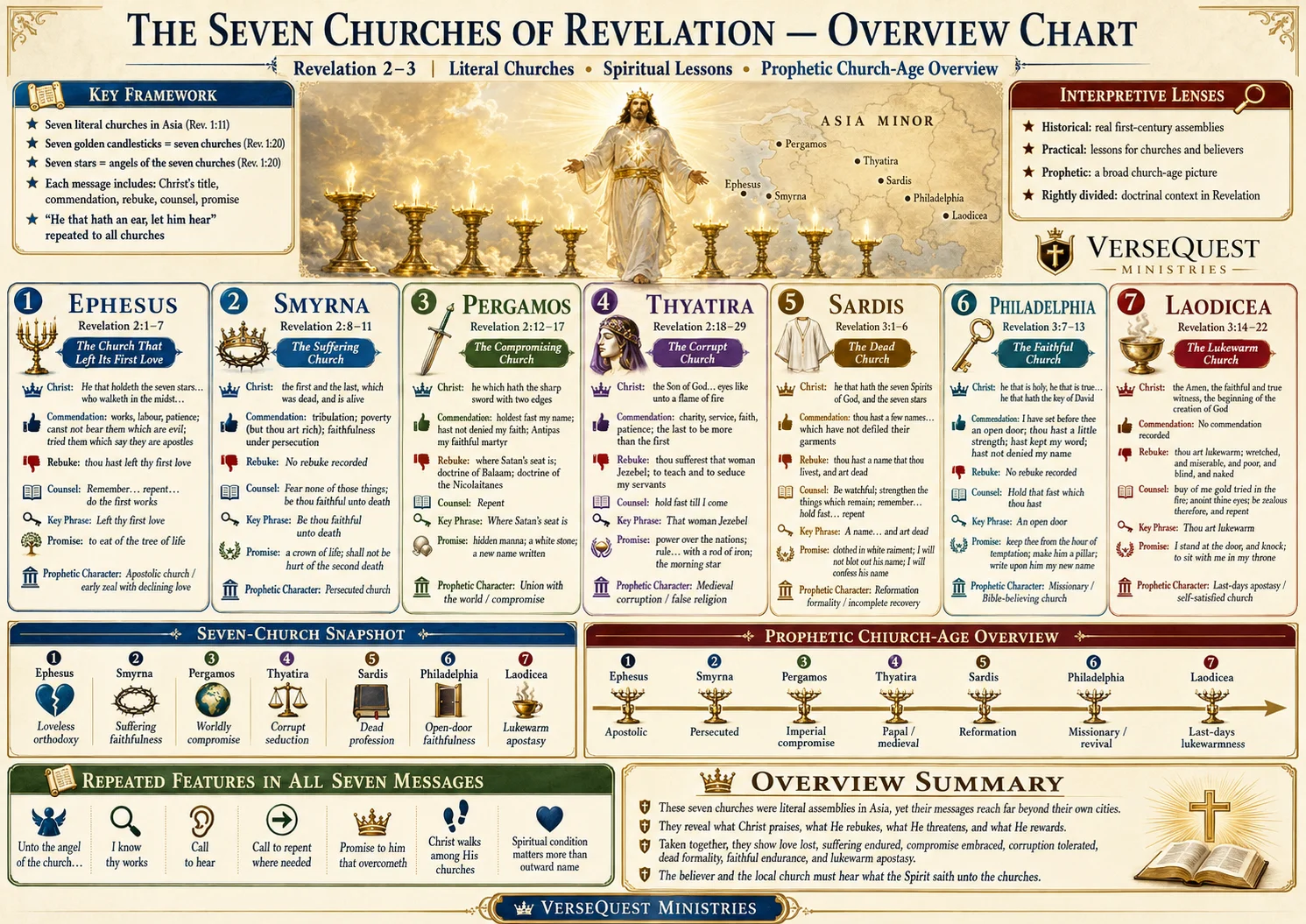
- The Seven Churches of Revelation Chart Collection – Christ Walking Among the Candlesticks
- A premium VerseQuest Ministries™ PDF chart collection covering the Seven Churches of Revelation in Revelation 2–3. Includes one overview chart plus individual KJV Bible study charts for Ephesus, Smyrna, Pergamos,…
- $12.99
- Add to cart
-
-
Christology Studies
-
- The Deity of Christ Defended — 66 KJV Studies Proving Jesus Christ Is God Manifest in the Flesh
- he Deity of Christ Defended is a 444-page premium KJV Bible study defending the full deity of the Lord Jesus Christ. This 66-study book proves from Scripture that Jesus is…
- $29.99
- Add to cart
-
-
Bible Overview Series
-
- The New Jerusalem Made Plain — 621-Page PDF Study
- The New Jerusalem Made Plain is a massive 621-page KJV/rightly divided PDF study on the literal holy city revealed in Revelation 21–22. This 100-essay book makes the New Jerusalem plain…
- $34.99
- Add to cart
-