
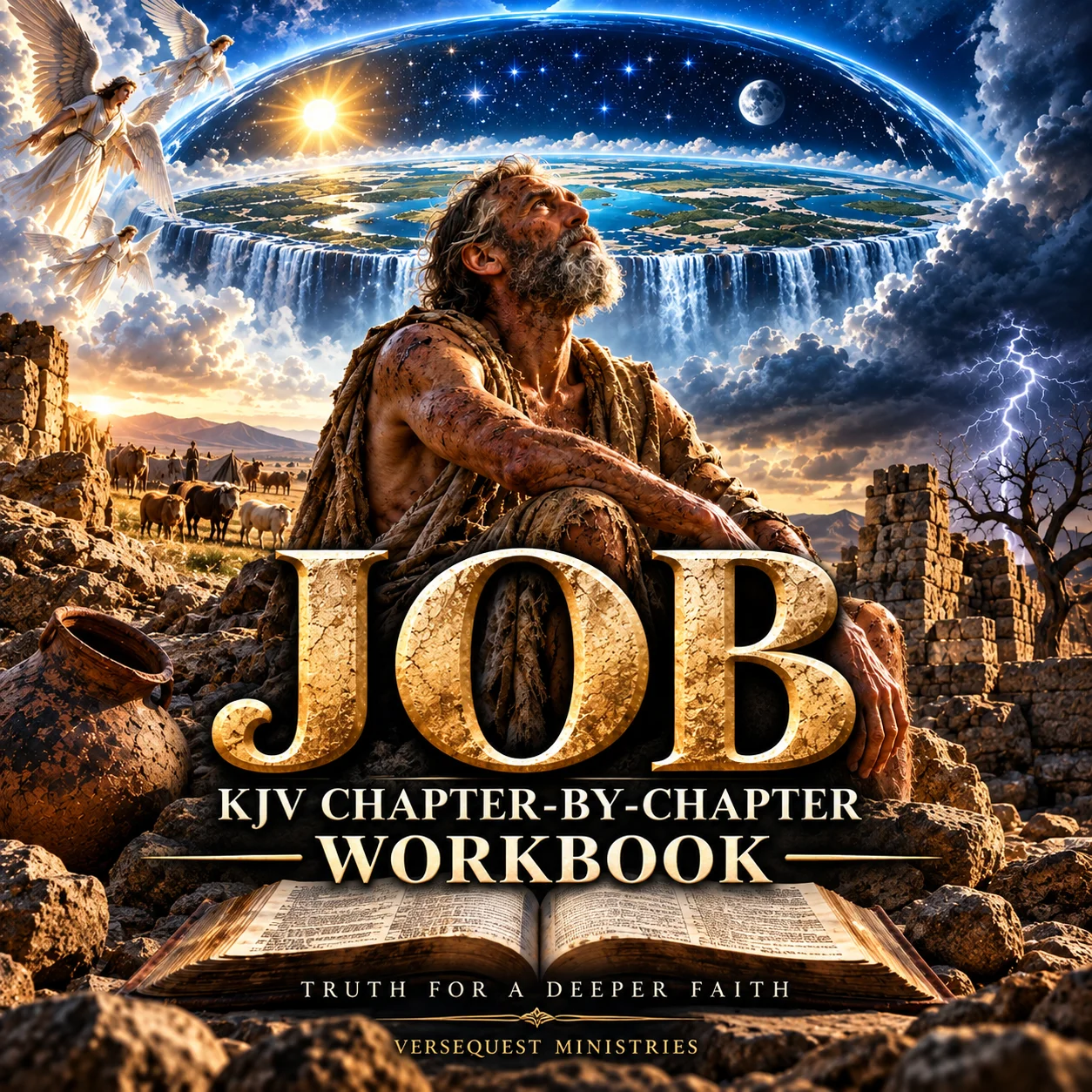
Job KJV Chapter-by-Chapter Workbook
Job KJV Chapter-by-Chapter Workbook is an extensive downloadable Bible-study curriculum designed to take the student through all 42 chapters of Job while digging far beyond the familiar story of suffering and restoration. This workbook examines Job’s trials, Satan’s accusations, the arguments of Job’s friends, Elihu’s speeches, Job’s longing for a daysman and living Redeemer, God’s answer from the whirlwind, creation, biblical cosmology, prophecy, Behemoth, Leviathan, resurrection, judgment, and Job’s final restoration.
Built around the King James Bible and designed for serious interaction with the text, the workbook helps students read, mark, compare Scripture with Scripture, answer study questions, record observations, and develop material that can be used for teaching. It is suitable for individual Bible study, homeschool Bible curriculum, family study, Sunday school, church classes, Bible institutes, pastors, teachers, and serious students who want to discover just how much is packed into the Book of Job.
Digital Download — $39.99
$39.99
Description
The Book of Job is far more than a record of one righteous man suffering through unimaginable loss. Beneath its familiar story lies an extraordinary body of biblical truth concerning God, Satan, the heavenly realm, creation, the earth, the stars, angels, suffering, righteousness, death, resurrection, prophecy, the coming Redeemer, Behemoth, Leviathan, and the ultimate sovereignty of Almighty God. The Job KJV Chapter-by-Chapter Workbook is designed to take the Bible student through all 42 chapters carefully, systematically, and directly from the King James Bible.
This downloadable PDF workbook approaches Job as a book to be studied rather than merely read. It follows the progression of the biblical account from Job’s prosperity and Satan’s appearance before the LORD through the devastating trials of chapters 1–2, the long dispute between Job and his friends, the intervention of Elihu, the LORD’s tremendous questions from the whirlwind, the revelations surrounding Behemoth and Leviathan, and Job’s repentance and restoration in chapter 42.
Special attention is given to the doctrinal questions that make Job one of the richest books in the Old Testament. Why do righteous people suffer? What limitations does God place upon Satan? What does Job reveal about the unseen spiritual conflict surrounding events on earth? Why are Job’s friends sometimes correct in what they say while being wrong in how they apply it? What does Job teach about self-righteousness? What did Job know about a living Redeemer, resurrection, judgment, and seeing God? These questions are followed through the text rather than isolated from their biblical setting.
The workbook also digs deeply into Job’s remarkable creation passages. The student is directed to examine the foundations of the earth, its pillars, the waters, the heavens, the morning stars and sons of God, the chambers and treasures described in the book, God’s control over the sea, weather, snow, hail, light, darkness, and the extraordinary creation material concentrated in Job 38–41. These passages are studied within the workbook’s KJV-centered biblical cosmology framework, including the firmament, the created heavenly order, stars and angels, and connections to the world before Adam where applicable.
Prophecy receives substantial attention as well. Job contains passages that reach beyond Job’s immediate historical circumstances and connect with subjects appearing elsewhere throughout Scripture. The workbook helps students compare Scripture with Scripture when studying tribulation patterns, the wicked man, the adversary, judgment, restoration, resurrection, the Second Advent, Israel, and the ultimate triumph of God’s purposes. These connections are examined without losing sight of Job’s historical narrative.
Job’s declaration, “For I know that my redeemer liveth” in Job 19:25 stands among the great statements of faith in Scripture. The workbook develops the significance of the Redeemer, Job’s expectation of bodily resurrection, his confidence that he would see God, and the larger biblical revelation that ultimately points the reader toward Jesus Christ.
The final chapters receive the attention they deserve. When the LORD answers Job out of the whirlwind, God does not give Job a simple philosophical explanation for suffering. Instead, He confronts him with question after question concerning creation and divine government. Job 38–41 therefore becomes a tremendous study of the difference between the knowledge of the Creator and the limitations of the creature. Behemoth and Leviathan are examined carefully from the actual language of the King James Bible rather than being dismissed as incidental details.
This workbook is built for active study. Readers can read the assigned KJV passages, follow chapter analysis and doctrinal observations, compare related Scriptures, work through study questions, record conclusions, and develop their own notes as they progress. That makes it useful not only as a personal Bible-study resource but also for homeschool Bible curriculum, Sunday school instruction, church Bible studies, discipleship, Bible institutes, teaching preparation, and serious independent study.
The goal is straightforward: when the student finishes Job, he should understand far more than the basic story of a suffering man. He should understand the argument of the book, the mistakes of Job’s counselors, the purpose of Elihu’s intervention, Job’s struggle with self-righteousness, Satan’s limitations, God’s sovereignty, the great creation passages, the prophetic connections, the promise of the Redeemer, and the tremendous conclusion in which Job finally encounters the God about whom everyone else had been talking.
The Sovereignty of God — Job repeatedly demonstrates that God remains sovereign even when human beings cannot understand what He is doing. The Reality and Limitations of Satan — Job 1–2 reveals a personal adversary who acts maliciously but cannot move beyond the boundaries God permits. Why the Righteous Suffer — The book destroys the simplistic assumption that every instance of suffering proves personal wickedness. The Danger of Misapplied Truth — Job's counselors often state principles containing truth but apply them incorrectly to Job's circumstances. Self-Righteousness — As the debate develops, Job's defense of himself becomes an increasingly important issue that God ultimately addresses. The Daysman and Mediator — Job's longing for someone who could stand between God and man anticipates one of Scripture's great redemptive themes. The Living Redeemer — Job 19 provides one of the Old Testament's clearest declarations of confidence in a living Redeemer. Death and Resurrection — Job repeatedly wrestles with death while expressing remarkable expectations concerning life beyond the grave and seeing God. Creation and Biblical Cosmology — Job contains extensive material concerning the earth, its foundations, the heavens, waters, stars, weather, sea, light, darkness, and God's created order. The Firmament and Heavenly Realm — Creation passages are compared with the broader KJV testimony concerning the structure and ordering of the heavens. Morning Stars and Sons of God — Job 38 connects the laying of earth's foundations with heavenly beings already present to witness God's creative work. The Adversary and the Heavenly Conflict — The opening chapters allow the reader to see a spiritual conflict of which Job himself initially knows nothing. The Pre-Adamic World — Relevant creation and prophetic passages are compared within the workbook's broader rightly divided understanding of events preceding Adam. Biblical Prophecy — Job contains language and patterns that can be compared with later passages concerning tribulation, judgment, Israel, the adversary, restoration, and the Second Advent. Elihu's Intervention — Chapters 32–37 provide a crucial transition between the failed arguments of the three friends and God's direct answer. God's Questions to Job — Chapters 38–41 demonstrate the immeasurable gulf between divine knowledge and human understanding. Behemoth — Job 40 presents an extraordinary creature whose description must be allowed to stand on the wording of Scripture. Leviathan — Job 41 becomes a major biblical study when compared with other passages identifying and describing Leviathan. Repentance and Restoration — Job's encounter with God changes the controversy from speculation about God to personal confrontation with Him. The Fear of the Lord — Job 28 establishes the biblical foundation that genuine wisdom begins with man's proper relationship to God.
Central Study:
The Book of Job is far more than a record of one righteous man’s suffering. It opens a window into the unseen conflict involving God, Satan, human righteousness, suffering, creation, judgment, prophecy, redemption, and the limits of human wisdom. The reader knows from the opening chapters what Job and his friends do not know: there is a spiritual conflict taking place behind the visible circumstances of Job’s life. That fact becomes essential for understanding the arguments that follow.
Job’s Character:
Job begins as a man described by God as “perfect and upright, and one that feared God, and eschewed evil” (Job 1:1). His suffering therefore cannot simply be explained by the formula repeatedly advanced by his friends—that extraordinary suffering must prove extraordinary personal wickedness. The opening chapters establish the facts before the debates begin.
The Unseen Conflict:
Job 1–2 reveals Satan as a real personal adversary who accuses Job before God. Satan attacks Job’s possessions, family, health, and circumstances, but he operates only within boundaries established by God. This provides one of Scripture’s clearest early pictures of spiritual conflict and the limitations placed upon Satan’s activity.
The Problem of Suffering:
The central human question throughout Job is not merely, “Why do people suffer?” It becomes much more personal: Why can a righteous man suffer when he has no knowledge of the heavenly reason behind his suffering? Job repeatedly searches for an explanation while his friends repeatedly attempt to force his experience into their theological system.
Job’s Three Friends:
Eliphaz, Bildad, and Zophar frequently say things that sound religious and may contain elements of truth, yet their application to Job is often wrong. Their speeches demonstrate that a statement can sound spiritual while still misrepresenting a particular situation. Their failure is ultimately exposed when the LORD addresses them in Job 42.
Human Wisdom Versus Divine Knowledge:
Job contains lengthy arguments from intelligent, experienced, religious men, but the debates cannot solve Job’s problem. The book steadily demonstrates the limitations of human observation. Men can observe circumstances without knowing what God knows about those circumstances.
The Need for a Mediator:
Job’s longing for someone who could stand between God and man is one of the book’s great theological themes. Job 9:33 speaks of a “daysman” who might lay his hand upon both. Job’s longing points the Bible student toward the larger scriptural revelation concerning the need for a mediator between God and man.
The Living Redeemer:
Job 19:25–27 contains one of the great declarations in the book: “For I know that my redeemer liveth.” Job connects his Redeemer with future bodily existence and seeing God. These verses make resurrection, redemption, and future hope central subjects for careful cross-reference study.
Elihu’s Intervention:
Elihu enters after the debate between Job and the three older men has exhausted itself. His speeches in Job 32–37 introduce additional arguments concerning God’s greatness, chastening, instruction, righteousness, creation, weather, and God’s dealings with man. His appearance also prepares the narrative for the LORD’s direct answer.
God Speaks:
Beginning in Job 38, the entire discussion changes. God does not simply give Job a philosophical explanation for suffering. Instead, He confronts Job with question after question concerning creation, the earth, the sea, light and darkness, snow, hail, stars, weather, animals, and realities beyond man’s control. The questions expose the enormous difference between man’s knowledge and God’s.
Creation and Biblical Cosmology:
Job contains an extraordinary concentration of creation language. The foundations of the earth, the morning stars, the sons of God, the sea and its bounds, the treasures of snow and hail, the ordinances of heaven, the chambers of the south, the pillars of heaven, the waters, and other descriptions make Job an important book for comparing the Bible’s statements concerning the structure and operation of creation. These passages should be studied alongside Genesis, Psalms, Isaiah, and other related KJV passages rather than isolated from the rest of Scripture.
The Morning Stars and Sons of God:
Job 38:7 records that “the morning stars sang together, and all the sons of God shouted for joy.” This passage becomes especially important when tracing the Bible’s language concerning stars, heavenly beings, angels, the original creation, and events preceding Adam’s history.
The Ancient World:
Job contains language and historical features that invite careful comparison with Genesis and the ancient world. Its setting, longevity, sacrificial practices, absence of Mosaic institutions from Job’s personal life, and numerous references to creation make its historical placement an important subject for advanced study.
Prophetic Patterns:
Numerous passages in Job can be profitably compared with later prophetic Scripture. Themes involving persecution, the wicked, judgment, darkness, destruction, restoration, resurrection, the Redeemer, supernatural conflict, and God’s final intervention provide material for broader prophetic study. These connections should always be tested by comparing Scripture with Scripture.
Behemoth:
Job 40 gives an extended divine description of Behemoth. Rather than treating the passage as an insignificant interruption, the workbook encourages the student to examine every detail of the KJV description, its immediate context, and its relationship to the larger confrontation between God and Job.
Leviathan:
Job 41 presents one of Scripture’s most extraordinary creatures. Leviathan should be studied directly from the biblical description and then compared with other KJV passages using the same name or related imagery, particularly Psalm 74:14, Psalm 104:26, Isaiah 27:1, and prophetic passages concerning the dragon and serpent.
Job’s Final Response:
After hearing directly from the LORD, Job no longer argues his case as before. Job 42:5–6 records the decisive change: “I have heard of thee by the hearing of the ear: but now mine eye seeth thee.” Greater revelation produces humility rather than self-exaltation.
God Corrects the Friends:
The conclusion establishes that religious confidence is no substitute for speaking correctly about God. The LORD specifically rebukes Job’s friends and requires them to deal with their error. This makes the ending essential to interpreting the speeches that came before it.
Restoration:
Job’s story does not end at the ash heap. Job 42 records restoration, renewed fellowship, blessing, family, possessions, longevity, and a completed life. The ending must be read in connection with the entire book rather than reducing Job to a story about suffering.
Major Study Questions Worth Pursuing:
Why did God permit Satan to test Job? What did Satan know about Job, and what did he misunderstand? Why were Job’s friends unable to explain his suffering? What did Job understand about resurrection and the Redeemer? What is the significance of the daysman? Why does God answer Job with questions about creation? What are the morning stars and sons of God? What do Behemoth and Leviathan contribute to the argument? What does Job reveal about the unseen world? How should prophetic passages in Job be compared with later revelation? Why does the book end with restoration rather than merely an explanation?
The great lesson of Job is that man’s inability to see what God is doing does not mean that God has ceased to rule. Job could see the ash heap; God could see the entire conflict.
For personal Bible study, the workbook provides a structured way to move through all 42 chapters without getting lost in the lengthy speeches and counterarguments. The reader can identify who is speaking, what argument is being advanced, whether that argument agrees with the larger biblical revelation, and how each section contributes to the complete book.
For homeschool and Christian education, Job provides material for Bible, doctrine, creation, apologetics, character, suffering, prophecy, and biblical worldview studies. The workbook's chapter progression and study interaction make it suitable for a substantial Old Testament course rather than simply assigned reading.
For Sunday school and church Bible studies, individual chapters or major sections can form complete lessons. Teachers can develop studies around Job's trials, Satan, false assumptions about suffering, Job's friends, Elihu, the Redeemer, creation, Behemoth, Leviathan, God's questions, repentance, and restoration.
For pastors and preachers, the workbook can serve as a teaching and sermon-development resource. Job contains abundant material for messages concerning suffering, faith, spiritual warfare, self-righteousness, friendship, wisdom, creation, death, resurrection, prophecy, God's sovereignty, and the Redeemer.
For Bible institutes and ministry training, Job provides an opportunity to teach students how to compare Scripture with Scripture, distinguish historical context from doctrinal and prophetic applications, follow an extended biblical argument, and test theological claims against the actual words of the King James Bible.
The primary companion resource should always be a King James Bible, allowing every observation, question, doctrine, and cross-reference to be checked directly against Scripture.
A Strong's Exhaustive Concordance can help students trace important words and recurring expressions throughout Job and the rest of Scripture.
A Bible dictionary can assist with ancient locations, peoples, customs, animals, measurements, and historical terminology encountered throughout Job.
A good KJV cross-reference Bible or Treasury of Scripture Knowledge is particularly valuable because Job's vocabulary reaches into Genesis, Psalms, Isaiah, Ezekiel, Daniel, the Gospels, Pauline epistles, and Revelation.
Bible maps and ancient Near Eastern geography resources can help students locate Uz, Edom, Teman, and other geographical connections relevant to the historical setting.
A biblical timeline can help students compare Job's ancient setting with the patriarchal period and the broader chronology of Scripture.
For deeper topical study, readers should especially compare Genesis 1–6, Psalms 19 and 104, Isaiah 14 and 27, Ezekiel 28, Daniel 7, Matthew 24, 1 Corinthians 15, 2 Thessalonians 2, and Revelation 12–20.
Related products
-
Jesus Christ Studies
-
-67%
- Jesus Christ Prophet Priest and King – 441-Page PDF Study
- A 441-page premium KJV PDF study on Jesus Christ as Prophet, Priest, and King. This detailed VerseQuest book covers Christ’s prophetic ministry to Israel, His finished sacrifice and present intercession…
- Original price was: $29.99.$9.99Current price is: $9.99.
- Add to cart
-
-67%
-
Doctrine Series
-
-14%
- Judas Iscariot and the Coming Antichrist – Premium KJV Prophecy Study
- A massive 459-page premium KJV prophecy study tracing the biblical connection between Judas Iscariot, the son of perdition, and the coming Antichrist. This detailed VerseQuest Ministries PDF examines Judas’ betrayal,…
- Original price was: $34.99.$29.99Current price is: $29.99.
- Add to cart
-
-14%
-
VerseQuest Premium Library
-
-67%

- The Book of Psalms Made Plain – 383-Page KJV Psalm Study
- The Book of Psalms Made Plain is a 383-page premium KJV Bible study featuring 54 detailed essays through the major themes, doctrines, prophecies, prayers, laments, and praises of the Psalms.…
- Original price was: $29.99.$9.99Current price is: $9.99.
- Add to cart
-
-67%
-
Revelation
-
-71%
- Moses and Elijah: The Two Witnesses Made Plain
- Moses and Elijah: The Two Witnesses Made Plain is a 636-page premium VerseQuest PDF study proving from Scripture that the Two Witnesses of Revelation 11 are Moses and Elijah. This…
- Original price was: $34.99.$9.99Current price is: $9.99.
- Add to cart
-
-71%
-
The Rapture
-
-67%
- Caught Up Before the Wrath – 66-Essay KJV Rapture Study
- Caught Up Before the Wrath is a 430-page premium KJV Bible study defending the pre-tribulation Rapture of the Church from a rightly divided, dispensational perspective. This 66-essay VerseQuest Ministries book…
- Original price was: $29.99.$9.99Current price is: $9.99.
- Add to cart
-
-67%