
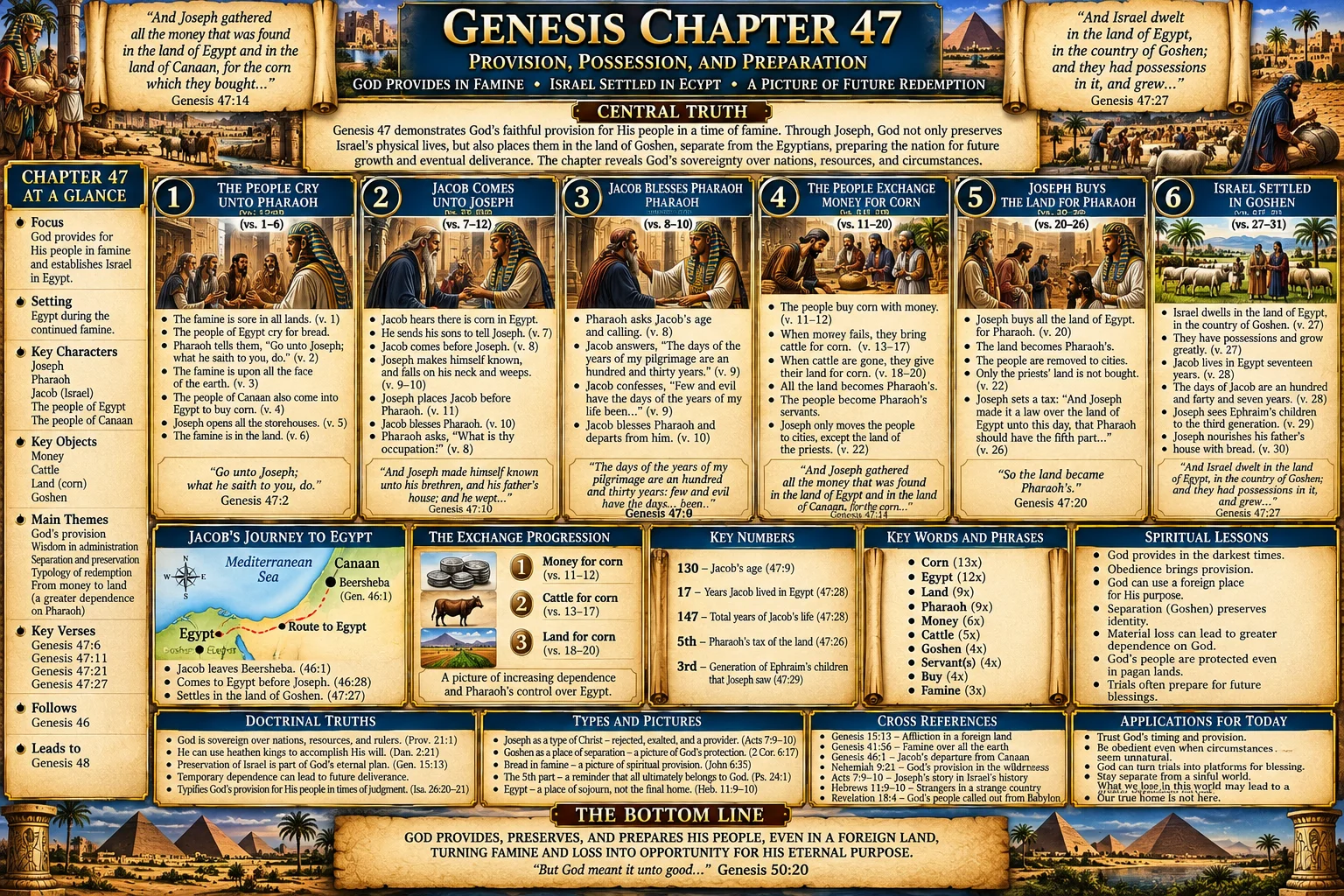
Genesis 47 – Provision, Possession, and Preparation: Jacob Before Pharaoh, Israel in Goshen, Joseph’s Famine Administration, and the Burial Oath (KJV Bible Study Chart)
Explore Genesis 47 with this detailed KJV Bible study chart tracing Joseph’s family as they are formally established in Egypt during the great famine. Follow Joseph as he presents five of his brethren to Pharaoh, Jacob blesses Pharaoh and describes his 130 years as a pilgrimage, and Israel is settled and nourished in the land of Goshen. The chart also examines Joseph’s famine administration as Egypt exchanges money, cattle, and eventually land for food, leading to the established fifth part for Pharaoh. Finally, see Israel multiply exceedingly while Jacob reaches 147 years old and makes Joseph swear that he will be buried with his fathers rather than in Egypt. Ideal for Bible study, sermon preparation, homeschool, Sunday school, stewardship studies, and teaching on providence and covenant hope.
$4.99
Description
Genesis 47: Provision, Possession, and Preparation is a detailed KJV Bible study chart tracing Joseph’s family as they are formally established in Egypt, Jacob’s remarkable appearance before Pharaoh, Joseph’s administration during the severe famine, Israel’s growth in Goshen, and Jacob’s solemn request concerning his burial in the promised land. The chapter demonstrates God’s providential preservation of the covenant family while also recording enormous economic changes throughout Egypt during the famine.
Joseph first tells Pharaoh that his father and brethren have arrived from Canaan with their livestock and possessions. He presents five of his brothers, and Pharaoh asks their occupation. They identify themselves as shepherds and request permission to sojourn in Goshen because the famine is severe in Canaan. Pharaoh grants them access to “the best of the land” and even authorizes capable men among them to oversee his own cattle.
Joseph then brings Jacob before Pharaoh. The aged patriarch blesses the king of Egypt, and when Pharaoh asks his age, Jacob answers that the years of his pilgrimage are one hundred thirty years, describing them as “few and evil” compared with the years of his fathers. Jacob blesses Pharaoh again before departing.
Joseph settles his father and brethren in a possession within Egypt and nourishes the household with bread. Yet outside Goshen the famine becomes increasingly severe. Joseph gathers all the money found in Egypt and Canaan in exchange for corn. When the money fails, the Egyptians bring their livestock. When the livestock is exhausted, they offer their land and themselves in exchange for seed and food.
Joseph purchases the land for Pharaoh, with the priests’ land excepted because they receive an assigned portion from Pharaoh. He then establishes a continuing arrangement in which one-fifth of the produce belongs to Pharaoh while the people retain four-fifths for seed and household use. The people acknowledge that Joseph has preserved their lives.
Against this background of famine and dependence, Israel prospers in Goshen. Genesis says they “had possessions therein, and grew, and multiplied exceedingly.” The family that entered Egypt small is already beginning the multiplication foretold to Abraham.
Jacob lives seventeen years in Egypt, reaching the age of 147. As death approaches, he calls Joseph and requires a solemn promise that he will not be buried in Egypt but carried back to the burial place of his fathers.
Genesis 47 therefore combines provision with pilgrimage. Egypt sustains Israel temporarily, but it is not Israel’s covenant inheritance. God uses Joseph to preserve the family in famine while Jacob’s burial request keeps the promised land firmly before the next generation.
Genesis 47, Joseph, Jacob, Israel, Pharaoh, Goshen, land of Rameses, five brethren before Pharaoh, shepherds in Egypt, Jacob blesses Pharaoh, Jacob age 130, years of pilgrimage, famine in Egypt, money for corn, cattle for corn, land for food, Pharaoh owns the land, priests’ land exempt, fifth part, Joseph’s administration, Israel multiplies, Jacob age 147, burial oath, promised land, divine providence
Genesis 47 begins with Joseph formally presenting his family’s arrival to Pharaoh. He takes five of his brethren and introduces them to the king. Pharaoh asks their occupation, and they identify themselves as shepherds. Because the famine is severe in Canaan, they request permission to dwell in Goshen. Pharaoh grants them the best of the land and instructs Joseph that capable men among them may be placed over his own cattle.
Joseph then brings Jacob before Pharaoh. Jacob blesses Pharaoh, an unusual scene in which an aged pilgrim stands before one of the world’s most powerful rulers and pronounces blessing upon him. Pharaoh asks Jacob’s age, and Jacob answers that he is 130 years old. He describes his life as the “days of the years of my pilgrimage,” acknowledging that even his long earthly life is temporary.
Genesis 47:11–12 records Joseph placing his family in a possession in Egypt and nourishing them with bread. These verses belong to the settlement narrative and should not be confused with earlier chapters concerning the brothers’ first journeys for grain.
The famine then dominates verses 13–26. First, Joseph gathers the money of Egypt and Canaan in exchange for corn. When the money is exhausted, the Egyptians exchange cattle for food. In the following year, they offer their land and themselves so they may survive. The progression is therefore money, livestock, then land and labor.
Joseph purchases Egypt’s land for Pharaoh. The priests are excepted because Pharaoh already supplies them with an allotted portion. Joseph then gives the people seed and establishes a continuing law that one-fifth of the produce belongs to Pharaoh while four-fifths remain for seed and household use. The people respond that Joseph has saved their lives.
Genesis does not require us to treat every feature of Egyptian economic policy as a Church-age model. The chapter records Joseph’s historical administration during an extraordinary national famine. Applications concerning stewardship and preparation are appropriate, but the historical setting should remain intact.
Against Egypt’s severe famine stands the striking statement of Genesis 47:27: “Israel dwelt in the land of Egypt, in the country of Goshen; and they had possessions therein, and grew, and multiplied exceedingly.” God is already fulfilling His promise to multiply Jacob’s family.
Jacob lives seventeen years in Egypt and reaches 147 years of age. When death approaches, he makes Joseph swear not to bury him in Egypt. He wants to lie with his fathers in the covenant burial place.
This request is an act of faith. Egypt has provided food, safety, and prosperity, but Jacob still views Canaan as the land connected with God’s promises. Genesis 47 therefore ends with a pilgrim enjoying God’s present provision while looking beyond Egypt toward the promised inheritance.
Genesis 47 is useful for teaching faithful stewardship during crisis, wise administration of resources, God’s ability to preserve His people in foreign surroundings, and the difference between temporary provision and permanent inheritance. Jacob’s appearance before Pharaoh demonstrates that spiritual dignity does not depend upon political rank, while his final burial request shows faith looking beyond present comfort toward God’s covenant promises. The chapter is valuable for personal Bible study, Sunday school, homeschool instruction, Bible institutes, sermon preparation, leadership and stewardship studies, Israel studies, providence teaching, and lessons on pilgrimage, provision, responsibility, preparation, and trusting God through seasons of famine.
King James Bible, Strong’s Concordance, Thompson Chain-Reference Bible, Treasury of Scripture Knowledge, Nave’s Topical Bible, Genesis 45–50 study notes, Joseph life timeline, Jacob genealogy charts, maps of Goshen and Egypt, Genesis 15 covenant studies, famine chronology charts, Exodus 1–12 studies, Psalm 105 Joseph studies, Acts 7 patriarchal studies, Hebrews 11 studies, Abrahamic covenant charts, biblical stewardship studies, VerseQuest Genesis charts
Related products
-
Names of Christ
-
- The Names and Titles of Jesus Christ Made Plain
- A complete 100-essay KJV Bible study on the names and titles of the Lord Jesus Christ, showing His deity, humanity, blood atonement, resurrection, priesthood, headship over the Church, shepherd care,…
- $29.99
- Add to cart
-
-
Bible Overview Series
-
- The New Jerusalem Made Plain — 621-Page PDF Study
- The New Jerusalem Made Plain is a massive 621-page KJV/rightly divided PDF study on the literal holy city revealed in Revelation 21–22. This 100-essay book makes the New Jerusalem plain…
- $34.99
- Add to cart
-
-
KJV Studies
-
-67%
- The Blood of Christ – 66-Study KJV Bible Doctrine PDF
- A 441-page premium VerseQuest PDF featuring 66 detailed KJV Bible studies on the blood of Jesus Christ. This powerful doctrinal resource covers redemption, justification, propitiation, cleansing, access to God, eternal…
- Original price was: $29.99.$9.99Current price is: $9.99.
- Add to cart
-
-67%
-
VerseQuest Premium Library
-
-67%
- The Book of Psalms Made Plain – 383-Page KJV Psalm Study
- The Book of Psalms Made Plain is a 383-page premium KJV Bible study featuring 54 detailed essays through the major themes, doctrines, prophecies, prayers, laments, and praises of the Psalms.…
- Original price was: $29.99.$9.99Current price is: $9.99.
- Add to cart
-
-67%
-
Premium Studies
-
-25%
- The Doctrine of Hell — Premium Essay Series PDF
- A 383-page premium VerseQuest PDF study book containing 54 KJV essays on hell, fire, darkness, judgment, the lake of fire, the second death, and Jesus Christ as the only escape.
- Original price was: $39.99.$29.99Current price is: $29.99.
- Add to cart
-
-25%