
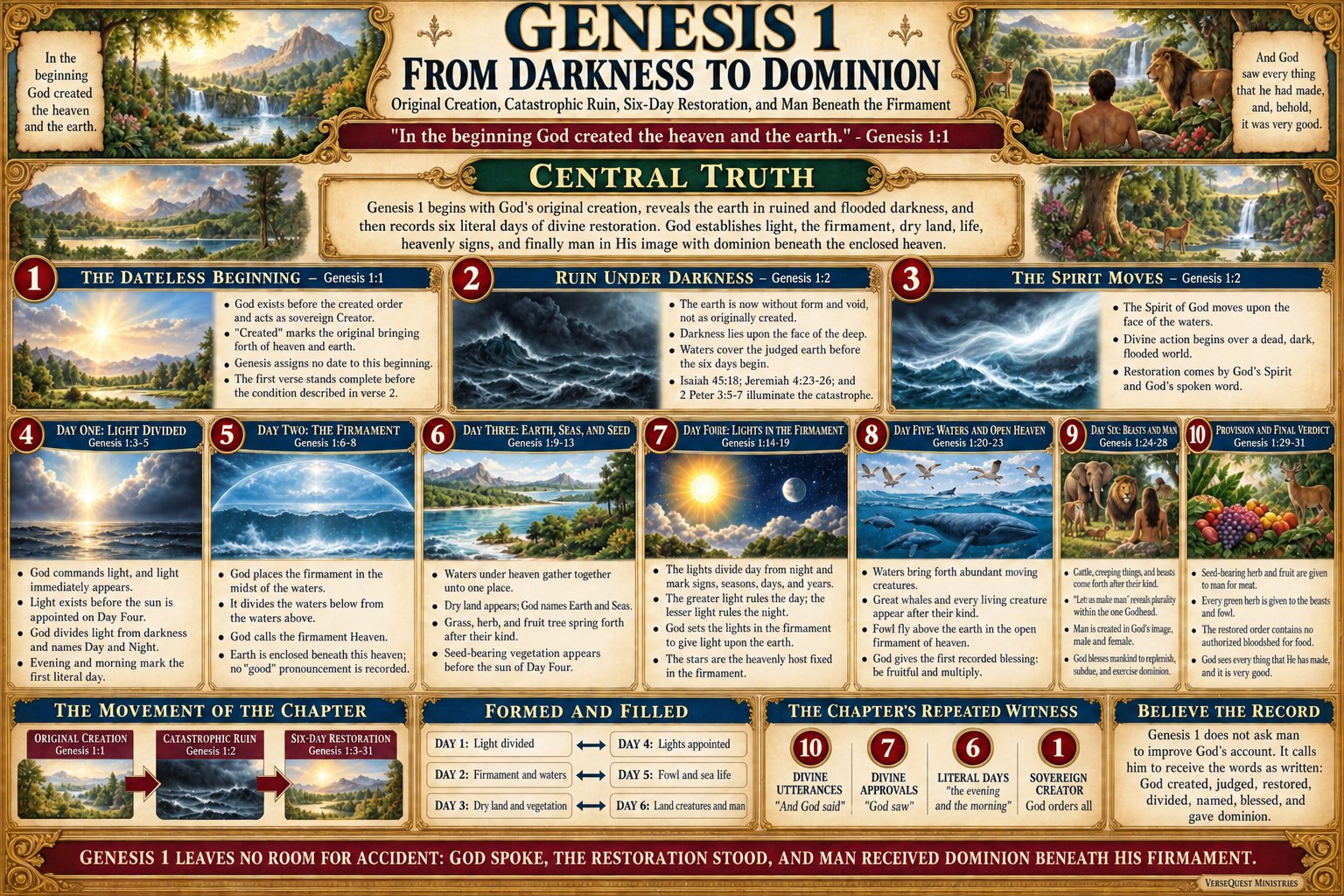
Genesis 1 – From Darkness to Dominion: Original Creation, Catastrophic Ruin, Six-Day Restoration, and Man Beneath the Firmament (KJV Bible Study Chart)
Explore Genesis 1 with this detailed KJV chart covering God’s original creation, the ruin-and-restoration interpretation of Genesis 1:2, six literal restoration days, the firmament and waters above, creation after its kind, mankind in God’s image, and dominion over the restored earth.
$4.99
Description
Genesis 1: From Darkness to Dominion is a comprehensive KJV Bible study chart presenting Genesis 1 through a literal, rightly divided ruin-and-restoration framework. It traces the chapter from God’s dateless original creation in Genesis 1:1, through the dark and flooded condition described in Genesis 1:2, into six literal days in which God restores order, establishes the firmament, gathers the waters, brings forth vegetation, appoints the heavenly lights, fills the waters and open heaven with living creatures, creates land animals, forms mankind in His image, and gives man dominion beneath the heaven.
Built primarily around Genesis 1:1–31, the chart emphasizes that the first chapter of Scripture begins with God rather than matter, chance, evolution, chaos, or human speculation. “In the beginning God created the heaven and the earth.” Scripture gives no genealogy for God, no explanation for His existence, and no power standing behind Him. He is already present, sovereign, speaking, creating, dividing, naming, blessing, judging, and assigning purpose.
The opening verse is treated as a complete statement of original creation. God creates “the heaven and the earth” in the beginning, while Genesis 1:2 describes the earth in a dramatically different condition: “without form, and void,” with darkness upon the face of the deep and waters covering the scene. Within the ruin-and-restoration interpretation presented by this chart, verse 2 is not viewed as the normal condition in which God originally created the earth but as the aftermath of a catastrophe occurring between verses 1 and 2.
This interpretive framework is commonly known as the gap doctrine, gap theory, or ruin-restoration view, though the chart presents it as a Bible-based doctrinal conclusion rather than as an attempt to accommodate evolutionary ages. The gap is not inserted to rescue Darwin, geological uniformitarianism, or secular chronology. Its purpose is to recognize the distinctions the chart sees between God’s original creative act in Genesis 1:1, the judged condition of Genesis 1:2, and the six literal days beginning when God commands light to appear.
The chart connects Genesis 1:2 with passages such as Isaiah 45:18, where the Lord declares that He created the earth “not in vain,” using terminology related to the condition translated “without form” in Genesis. Within this interpretive framework, the contrast suggests that the earth was not originally created in the devastated condition described in verse 2.
Jeremiah 4:23–26 supplies another important comparison because Jeremiah describes a judged land using the expression “without form, and void,” accompanied by darkness, absence of man, fleeing birds, fruitful places becoming wilderness, and cities broken down at the presence and fierce anger of the LORD. The chart understands Jeremiah’s language as evidence that the phrase can describe divine judgment rather than merely unfinished construction.
Second Peter 3:5–7 is likewise brought into the discussion because Peter speaks of the heavens and earth of old, a world that then was, judgment by water, and the present heavens and earth reserved unto fire. Within the chart’s interpretation, Peter’s wording supports the existence of divine judgment involving water before the final judgment by fire.
The chart therefore presents a three-stage movement through Genesis 1: original creation, catastrophic ruin, and six-day restoration. Genesis 1:1 gives the original creative act. Genesis 1:2 reveals the earth in darkness, waters, and desolation. Genesis 1:3–31 records God restoring and ordering the terrestrial world for mankind.
This distinction matters because it preserves six literal days without requiring the entire universe to have been originally created during those six days. The days beginning in Genesis 1:3 are treated as ordinary literal days identified repeatedly by “the evening and the morning.” God is not portrayed as slowly evolving creation through indefinite ages. He speaks and the commanded condition appears.
The chart’s first great movement is the dateless beginning. Genesis does not assign a calendar date to Genesis 1:1. Scripture simply says “In the beginning.” The verse stands before Adam, human chronology, the patriarchs, Israel, and the ordinary history measured through biblical genealogies.
God acts as sovereign Creator. The existence of heaven and earth originates in His will, not in an eternal universe, spontaneous matter, or cosmic accident. Creation begins with divine intelligence, divine authority, and divine purpose.
The Hebrew and English wording “created” marks the bringing forth of the created order by God. The chart does not treat the first verse as a summary title for everything following. It treats Genesis 1:1 as a completed declaration followed by a different condition in verse 2.
Genesis 1:2 then presents the earth “without form, and void.” Darkness covers the deep, waters dominate the scene, and no dry land, plant life, animals, or man are visible. The chart calls this ruin under darkness.
Darkness is not treated merely as an innocent stage before God happened to switch on illumination. Within the chart’s doctrinal framework, darkness accompanies the judged condition of the earth before restoration begins.
The deep and the waters are similarly important. Genesis 1:2 does not present an idyllic garden waiting for landscaping. The entire surface lies beneath waters before God begins dividing and gathering them.
The chart therefore understands the condition as a flooded and ruined earth awaiting divine restoration. The emphasis is not upon a self-healing planet but upon a creation unable to restore itself until God acts.
Genesis 1:2 then introduces the Spirit of God moving upon the face of the waters. Restoration begins with divine activity. The earth does not evolve itself out of chaos. God’s Spirit moves before God’s spoken command brings light.
The movement of the Spirit provides an important biblical pattern: where God produces ordered life and divine purpose, the Spirit acts according to the Word of God. Scripture begins with the Spirit moving over a darkened world and proceeds immediately to God speaking.
The chart therefore connects restoration with both God’s Spirit and God’s spoken Word. The darkness cannot resist His command. The waters cannot ignore His divisions. Creation does not vote on whether to obey its Maker.
Day One begins when God says, “Let there be light: and there was light.” The command and fulfillment are immediate. Scripture does not require the sun to exist before light because God Himself is the source of the first illumination described in the restoration sequence.
This becomes one of the chart’s important observations: light appears before the sun is appointed on Day Four. Modern readers often assume light must originate from the astronomical body they presently associate with daylight. Genesis reverses that assumption by giving light before the appointment of the greater luminary.
God sees the light, divides it from darkness, and names the light Day and the darkness Night. Naming demonstrates authority. The One who created the order defines its divisions.
The repeated phrase “the evening and the morning were the first day” establishes the literal-day pattern followed through the chapter. The chart therefore rejects attempts to turn the six days into millions or billions of years.
Day One restores the fundamental distinction between light and darkness. The world that begins verse 2 under darkness now possesses ordered day and night beneath God’s command.
Day Two introduces the firmament. God says, “Let there be a firmament in the midst of the waters, and let it divide the waters from the waters.” The firmament is therefore a real created division placed within the waters.
God separates the waters beneath the firmament from waters above it. The structure of the world described by Genesis is therefore not merely dry land surrounded by outer space. Waters exist below and waters exist above, with the firmament standing as the dividing structure.
God calls the firmament Heaven. The chart takes this wording literally rather than replacing the inspired noun with concepts imported from modern cosmological models.
Within the chart’s enclosed-world interpretation, the earth exists beneath this heaven, and the later lights are placed “in the firmament of the heaven.” The firmament therefore becomes a major structural feature of biblical cosmology rather than a poetic metaphor.
An unusual feature of Day Two is that the chapter does not record “God saw that it was good” at the conclusion of the day. The chart notes this absence without forcing an explanation beyond what Scripture supplies. The repeated approval resumes later in the chapter.
Day Two establishes ordered separation in the waters. The formerly flooded scene now possesses a heaven and divided waters according to divine boundaries.
Day Three begins with the waters beneath heaven being gathered together into one place so that dry land appears. God names the dry land Earth and the gathered waters Seas.
Again, God names what He orders. Earth and Seas are not autonomous forces; they exist where God places them and under the boundaries He establishes.
The appearance of dry land prepares the earth for terrestrial life. God then commands vegetation to spring forth: grass, herbs yielding seed, and fruit trees producing fruit after their kind.
The repeated phrase “after his kind” becomes important to the chapter’s doctrine of life. Creation reproduces according to divinely established kinds rather than one kind gradually transforming into another through unguided evolutionary processes.
Seed-bearing vegetation appears before the sun’s appointment on Day Four. Like the appearance of light before the sun, this challenges assumptions that the Genesis order must conform itself to modern naturalistic expectations.
God is not dependent upon the mechanisms He later appoints. He can sustain and establish life by His Word before assigning ordinary created instruments to their ongoing functions.
Day Three receives divine approval. The dry land, seas, grass, herbs, seed, and fruit trees all stand exactly as God commanded.
Day Four introduces the lights in the firmament. God appoints them to divide day from night and to serve for “signs, and for seasons, and for days, and years.”
The greater light rules the day, while the lesser light rules the night. The chart emphasizes function and appointment rather than worship of the heavenly bodies.
Throughout pagan history, mankind repeatedly worshipped the sun, moon, and stars. Genesis places them firmly beneath God’s authority. They are not gods; they are created servants functioning where God placed them.
The chapter says God sets the lights “in the firmament of the heaven to give light upon the earth.” The chart takes this spatial description seriously and understands the lights as belonging within the firmament rather than at unimaginable distances beyond an undefined universe.
The greater light becomes associated with the day and the lesser with the night. Their appointed functions establish signs, seasons, days, and years, producing an ordered calendar governed by God.
The chart also understands the stars within a broader biblical theology of the heavenly host, drawing connections between stars and angelic beings elsewhere in Scripture. That identification is an interpretive conclusion extending beyond Genesis 1:14–19 itself, but it forms part of the chart’s larger biblical cosmology.
Day Four therefore fills the structure established on Day One. Day One brought light and divided day from night; Day Four appoints the heavenly luminaries governing those ordered periods.
This creates part of the chapter’s formed-and-filled pattern. Days One through Three establish major environments and divisions, while Days Four through Six populate and govern those environments.
Day One establishes light and darkness; Day Four appoints the heavenly lights. Day Two establishes firmament and divided waters; Day Five fills the waters and open firmament with living creatures. Day Three establishes dry land and vegetation; Day Six fills the land with beasts and mankind.
This correspondence demonstrates deliberate literary and theological order without turning the days into symbols. The structural pattern strengthens rather than weakens the plain six-day sequence.
Day Five fills the waters and the open firmament with living creatures. God commands the waters to bring forth abundantly the moving creatures that have life.
The chapter specifically mentions great whales and every living creature moving in the waters after their kinds. Marine life is not produced through gradual transformation from simpler organisms but by divine command.
Flying creatures are also created to fly “above the earth in the open firmament of heaven.” The phrase again reinforces the chapter’s cosmological structure: earth lies beneath the heaven, and flying creatures move within its open expanse.
God blesses these creatures, telling them to “Be fruitful, and multiply.” This is the first recorded explicit blessing in the chapter.
Life receives both existence and reproductive capacity from God. Multiplication is not a meaningless biological accident but part of the Creator’s blessing and command.
Day Five fills the environments prepared on Day Two, demonstrating once more the formed-and-filled architecture of the chapter.
Day Six brings land animals and mankind. God commands the earth to bring forth living creatures after their kind: cattle, creeping things, and beasts of the earth.
Again, the phrase “after his kind” dominates. Each creature occupies a divinely ordered category, reproducing according to the boundaries established by the Creator.
Mankind, however, receives a unique place. God does not merely say, “Let the earth bring forth man.” The language changes: “Let us make man in our image, after our likeness.”
The plural language is treated within orthodox Christian theology as consistent with the plurality present within the Godhead, while the singular image demonstrates one divine nature. Man is not another beast elevated through biological development but a distinct creation carrying the image of God.
Genesis 1:27 declares, “So God created man in his own image, in the image of God created he him; male and female created he them.” Human identity therefore begins with God’s act rather than man’s self-definition.
The chart emphasizes male and female as the created order. Biblical anthropology begins with two sexes deliberately created by God, each equally human and both bearing His image while remaining distinct.
Mankind receives dominion over fish, fowl, cattle, the earth, and creeping things. Dominion is delegated authority. Man rules because God, the ultimate Sovereign, assigns him stewardship.
This dominion explains the chart’s movement from darkness to dominion. The chapter begins with the earth beneath darkness and waters and ends with an ordered world in which man stands beneath God’s heaven as His image-bearing earthly ruler.
God blesses man and commands mankind to “Be fruitful, and multiply, and replenish the earth, and subdue it.” Human civilization begins beneath divine blessing, responsibility, multiplication, and stewardship.
Man’s authority is therefore never absolute. Dominion is exercised beneath God. Humanity does not own creation independently of its Maker.
The chapter’s provision for food is also important. God gives seed-bearing herbs and fruit to man, while every green herb is given to the beasts and fowl. Within the restored pre-Fall order of Genesis 1, authorized food does not include animal bloodshed.
The permission to eat flesh appears later, after the Flood, in Genesis 9. The chart therefore treats Genesis 1’s food provision as part of the peaceful order God declares very good.
Genesis 1 closes with God inspecting everything He has made: “And God saw every thing that he had made, and, behold, it was very good.”
This verdict is significant within the ruin-restoration framework. Genesis 1:2 presented darkness, waters, emptiness, and ruin; Genesis 1:31 presents an ordered earth filled with light, land, vegetation, living creatures, and image-bearing mankind under divine blessing.
The chapter therefore moves from judgment conditions to restored goodness.
The chart highlights the chapter’s ten divine utterances, repeatedly introduced through the words “And God said.” Creation and restoration advance through speech. God’s Word is not a commentary added after events; His Word causes events.
The chapter also records repeated divine approvals through the expression “God saw” that what He had made was good. The final inspection expands the verdict to “very good.”
The six literal days are marked by evening and morning. Their repetition is not incidental. The text establishes a recognizable sequence of first day, second day, third day, fourth day, fifth day, and sixth day.
Behind all of these details stands one sovereign Creator. Genesis is unapologetically monotheistic. God speaks, God divides, God names, God sets, God creates, God blesses, God commands, and God evaluates.
No rival creator appears. No cosmic struggle determines the outcome. No chaotic deity must be defeated before creation can proceed. The entire chapter exists beneath one divine will.
The chart’s movement of the chapter summarizes the restoration doctrine visually: Genesis 1:1 gives original creation; Genesis 1:2 presents catastrophic ruin; Genesis 1:3–31 records six days of restoration.
This structure also guards against evolutionary compromise. The ruin-restoration doctrine need not involve biological evolution, ape-to-man development, death before Adam as part of God’s creative method, or millions of years inserted into the six restoration days.
The six days remain literal, ordered, supernatural, and governed by God’s spoken commands.
The doctrine also preserves the distinction between the original creation and Adam’s terrestrial world. Scripture can acknowledge events before Adam without making Adam the descendant of previous human races or placing human death, sin, and redemption inside an evolutionary chain.
Mankind arrives only when God deliberately creates him in His image. Adam’s race begins with divine creation, not biological ancestry.
The chart’s title From Darkness to Dominion therefore captures the chapter’s remarkable progression. Darkness gives way to light. Flooded waters are divided. Dry land emerges. Barren earth becomes fruitful. Empty environments become filled with living creatures. Finally, man receives dominion beneath God.
The movement is entirely downward from God’s command rather than upward from matter’s self-development.
Genesis 1 also establishes principles that echo throughout the rest of Scripture: light and darkness, heaven and earth, waters above and below, seed and fruit, kinds, divine naming, blessing, dominion, male and female, and God’s final evaluation.
The light-and-darkness distinction later becomes spiritually significant throughout Scripture. John contrasts light with darkness, Paul speaks of believers as children of light, and Revelation ends with God Himself supplying eternal light.
Seed likewise develops into a major biblical theme, especially in Genesis 3:15 and the promise concerning the seed of the woman. The physical principle introduced in Genesis becomes the vocabulary through which redemption is later revealed.
The distinction between heaven and earth becomes essential throughout the Bible. God governs from above while earthly kingdoms rise and fall beneath Him.
Dominion becomes a major Kingdom theme. Adam receives delegated dominion, loses ground through sin, earthly kingdoms struggle for control, and the final dominion ultimately belongs to Jesus Christ, the last Adam and rightful King.
Genesis 1 should therefore never be treated as an irrelevant ancient prologue. Its doctrines become foundational to creation, sin, mankind, marriage, stewardship, Kingdom, redemption, and biblical cosmology.
The chart also rejects accident as an explanation for existence. The earth does not accidentally emerge from darkness. Light does not accidentally appear. Waters do not accidentally divide. Life does not accidentally organize itself into reproductive kinds.
The repeated subject is God.
Modern naturalism begins with matter and tries to explain intelligence. Genesis begins with Intelligence and explains matter.
Naturalism begins with death and attempts to produce life. Genesis presents the living God commanding life to appear.
Naturalism begins with chaos and requires immense periods for order to emerge. Genesis presents God speaking order into existence immediately.
Naturalism struggles to explain meaning and purpose because matter possesses no intention. Genesis explains purpose because everything exists under a Creator who assigns function.
The firmament is especially important within the chart’s biblical cosmology. Genesis describes it as a division between waters and calls it Heaven.
The chart therefore refuses to treat the firmament as an embarrassing relic of ancient ignorance that must be translated away before modern readers can accept the Bible. The wording is received as intentional revelation.
The waters above remain part of that created structure. Later Scripture speaks repeatedly of waters above the heavens, windows of heaven, fountains of the deep, and heavenly boundaries. The chart interprets those passages consistently with Genesis rather than beginning with modern cosmology and forcing Genesis to conform.
The earth is consequently presented as the central terrestrial realm beneath the firmament where God places mankind. Man’s calling concerns the earth, its creatures, cultivation, multiplication, and dominion.
The chapter’s theology is therefore intensely terrestrial while remaining governed by Heaven.
The final panel—Believe the Record—expresses the practical purpose of the chart. Genesis 1 does not ask mankind to improve God’s creation account. It calls the reader to receive the record as written.
The student may compare passages, study words, trace doctrines, examine chronology, and seek understanding, but he does not possess authority to rewrite the opening chapter of Scripture whenever contemporary theories change.
Scientific theories, cosmological models, geological schemes, and philosophical fashions have changed repeatedly. Genesis remains.
The believer’s confidence rests not in being able to answer every question modern man can invent but in trusting the God who was present when no scientist, philosopher, theologian, or skeptic existed.
Job was confronted with precisely this reality when God asked, “Where wast thou when I laid the foundations of the earth?” Human beings study creation from inside it. God speaks as its Author.
Genesis 1 therefore begins the Bible by placing man in his proper position. Man is important because he is created in God’s image, but he is not ultimate. He is a creature.
He receives dominion, but he does not receive deity.
He names animals later, but God names Day, Night, Heaven, Earth, and Seas first.
He receives the world, but he did not make it.
He sees the light, but he did not command it.
He lives beneath the firmament, but he did not stretch it out.
Every line of Genesis 1 brings the creature back beneath the Creator.
The chart’s strong concluding truth is therefore appropriate: Genesis 1 leaves no room for accident. God spoke, the restoration stood, and man received dominion beneath His firmament.
This resource is ideal for personal Bible study, Genesis teaching, creation studies, gap-doctrine instruction, ruin-and-restoration studies, biblical cosmology, firmament studies, six-day-creation teaching, creation-versus-evolution discussions, Christian homeschool curriculum, Sunday school, Bible institutes, Christian schools, apologetics, pastoral teaching, sermon preparation, and students seeking a detailed visual overview of the first chapter of the King James Bible.
Genesis 1, creation account, original creation, Genesis gap doctrine, ruin and restoration, Genesis 1:1, Genesis 1:2, without form and void, darkness upon the deep, six literal days, Spirit of God moved, let there be light, firmament of heaven, waters above the firmament, dry land and seas, creation kinds, lights in the firmament, heavenly host, great whales, man in God’s image, male and female, dominion over the earth, biblical cosmology, creation versus evolution
Genesis 1 opens with the absolute declaration that God created the heaven and the earth. Within the ruin-and-restoration interpretation presented by this chart, Genesis 1:1 describes the original creation as a completed act, while Genesis 1:2 presents the earth in a subsequently ruined condition described as without form and void, under darkness and covered by the deep. The chart uses Isaiah 45:18, Jeremiah 4:23–26, and Second Peter 3:5–7 as cross-references supporting the interpretation that the condition of verse 2 reflects catastrophe or judgment rather than the original condition in which God created the earth.
The six days beginning in Genesis 1:3 are understood as six literal restoration days rather than symbolic ages. The repeated language of evening and morning establishes an ordinary sequence of days. This approach distinguishes the possible interval between Genesis 1:1 and 1:2 from the six-day restoration itself; it does not require evolutionary ages within the six days.
The Spirit of God moves upon the face of the waters before the first restorative command is given. God then commands light to appear on Day One, divides light from darkness, and names Day and Night. Light exists before the sun is appointed on Day Four, emphasizing that God is not dependent upon the luminary for the existence of light.
Day Two establishes the firmament in the midst of the waters and divides the waters beneath it from the waters above it. God calls the firmament Heaven. The chart interprets this description literally within an enclosed biblical cosmology and regards the firmament as a real structural division rather than a poetic synonym for modern outer space.
Day Three gathers the lower waters into one place, reveals dry land, names Earth and Seas, and brings forth grass, herbs, seed, and fruit trees after their kinds. Vegetation appears before the Day Four luminaries, showing again that God’s creative command is primary while later created mechanisms serve the functions He assigns.
Day Four places the greater light, lesser light, and stars in the firmament for signs, seasons, days, years, and illumination upon the earth. Genesis explicitly places the lights in the firmament. The chart’s identification of the stars with the wider biblical heavenly host is an interpretive conclusion drawn from other passages and should be distinguished from the direct wording of Genesis 1:14–19 itself.
Day Five fills the waters with abundant living creatures and great whales and fills the open firmament with flying creatures. God blesses them and commands them to be fruitful and multiply. The repeated creation after their kind is understood as establishing created boundaries rather than an evolutionary progression from one biological kind into another.
Day Six brings cattle, creeping things, beasts, and finally mankind. Man is uniquely created in God’s image and likeness rather than merely appearing as another animal kind. Genesis identifies humanity as male and female and grants mankind delegated dominion over the creatures and the earth beneath God’s authority.
Genesis 1 gives seed-bearing plants and fruit to man for food and green herbs to the animals. The chart understands this as a pre-Fall and pre-Flood order in which God had not yet authorized mankind to eat animal flesh. The later permission concerning meat appears in Genesis 9.
The chapter displays a formed-and-filled pattern: Day One establishes light and darkness and Day Four appoints the lights; Day Two establishes firmament and waters and Day Five fills those environments with flying and aquatic creatures; Day Three establishes dry land and vegetation and Day Six fills the land with animals and man. This structural correspondence operates within the six literal days rather than replacing their chronological reality.
Genesis 1 repeatedly presents God as the active subject. God creates, speaks, divides, names, sets, makes, blesses, commands, and evaluates. The chapter therefore leaves no place for an accidental or self-generating universe. Creation possesses order and purpose because it proceeds from a sovereign Creator.
The chapter begins with an earth under darkness in verse 2 and ends with a restored world declared “very good” in verse 31. The chart summarizes this movement as original creation, catastrophic ruin, and six-day restoration, culminating in mankind receiving dominion beneath God’s firmament.
Genesis 1 Bible studies, creation doctrine, gap-theory studies, ruin-and-restoration teaching, six-day-restoration instruction, firmament studies, biblical cosmology lessons, creation-versus-evolution teaching, image-of-God studies, male-and-female creation teaching, dominion theology, creation-kind studies, Genesis homeschool curriculum, Christian apologetics, Sunday school lessons, Christian school teaching, Bible institute classes, pastoral training, creation seminars, sermon preparation
King James Bible, Strong’s Concordance, Thompson Chain-Reference Bible, Treasury of Scripture Knowledge, Nave’s Topical Bible, Genesis 1–3 study notes, creation Scripture chains, gap-doctrine comparison studies, Isaiah 45 commentary materials, Jeremiah 4 studies, Second Peter 3 outlines, biblical firmament studies, creation-kind worksheets, Genesis creation timelines, image-of-God studies, Adam and creation resources, biblical cosmology charts, VerseQuest Genesis and creation-study charts
Related products
-
Jesus Christ / Christology
-
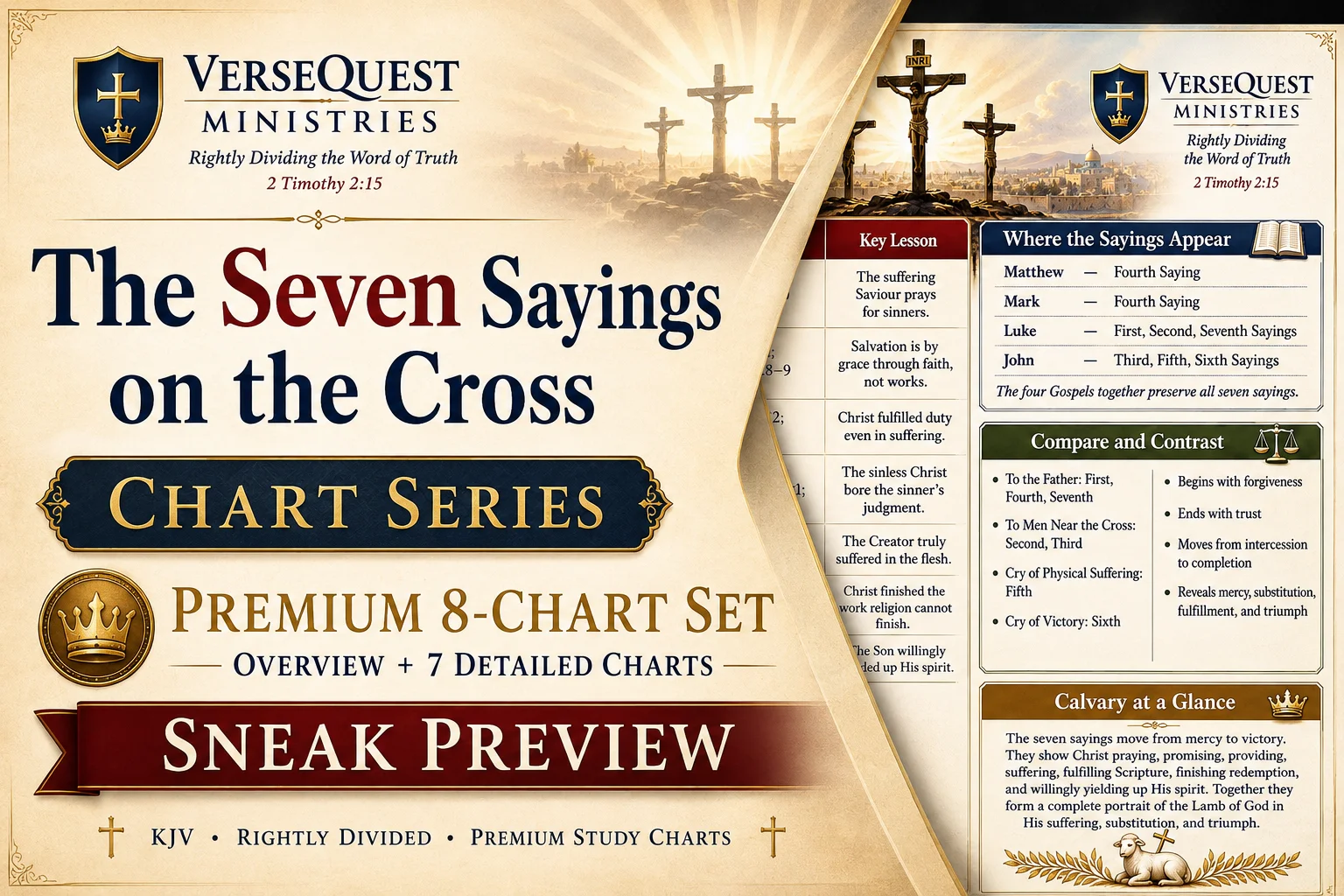
- The Seven Sayings on the Cross – Premium 8-Chart KJV Study Set
- A premium VerseQuest Ministries digital PDF study set on The Seven Sayings on the Cross, featuring an overview chart plus seven detailed KJV Bible study charts. This resource examines Calvary,…
- $12.99
- Add to cart
-
-
Jesus Christ
-
-10%
- The Lord Jesus Christ Made Plain – 637-Page KJV Bible Study
- A massive 637-page, 100-part KJV Bible study on the Person and work of the Lord Jesus Christ. This premium VerseQuest resource covers His deity, incarnation, blood, cross, resurrection, present ministry,…
- Original price was: $39.00.$34.99Current price is: $34.99.
- Add to cart
-
-10%
-
Jesus Christ
-
-67%
- The Millennium Made Plain – 416-Page KJV Study on Christ’s Future Reign
- A premium 416-page KJV, rightly divided Bible study on the literal future Millennial reign of Jesus Christ. The Millennium Made Plain explains Revelation 19–20, Israel’s restoration, Satan’s binding, the Kingdom…
- Original price was: $29.99.$9.99Current price is: $9.99.
- Add to cart
-
-67%
-
Christology Studies
-
- The Deity of Christ Defended — 66 KJV Studies Proving Jesus Christ Is God Manifest in the Flesh
- he Deity of Christ Defended is a 444-page premium KJV Bible study defending the full deity of the Lord Jesus Christ. This 66-study book proves from Scripture that Jesus is…
- $29.99
- Add to cart
-
-
Chart Collections
-
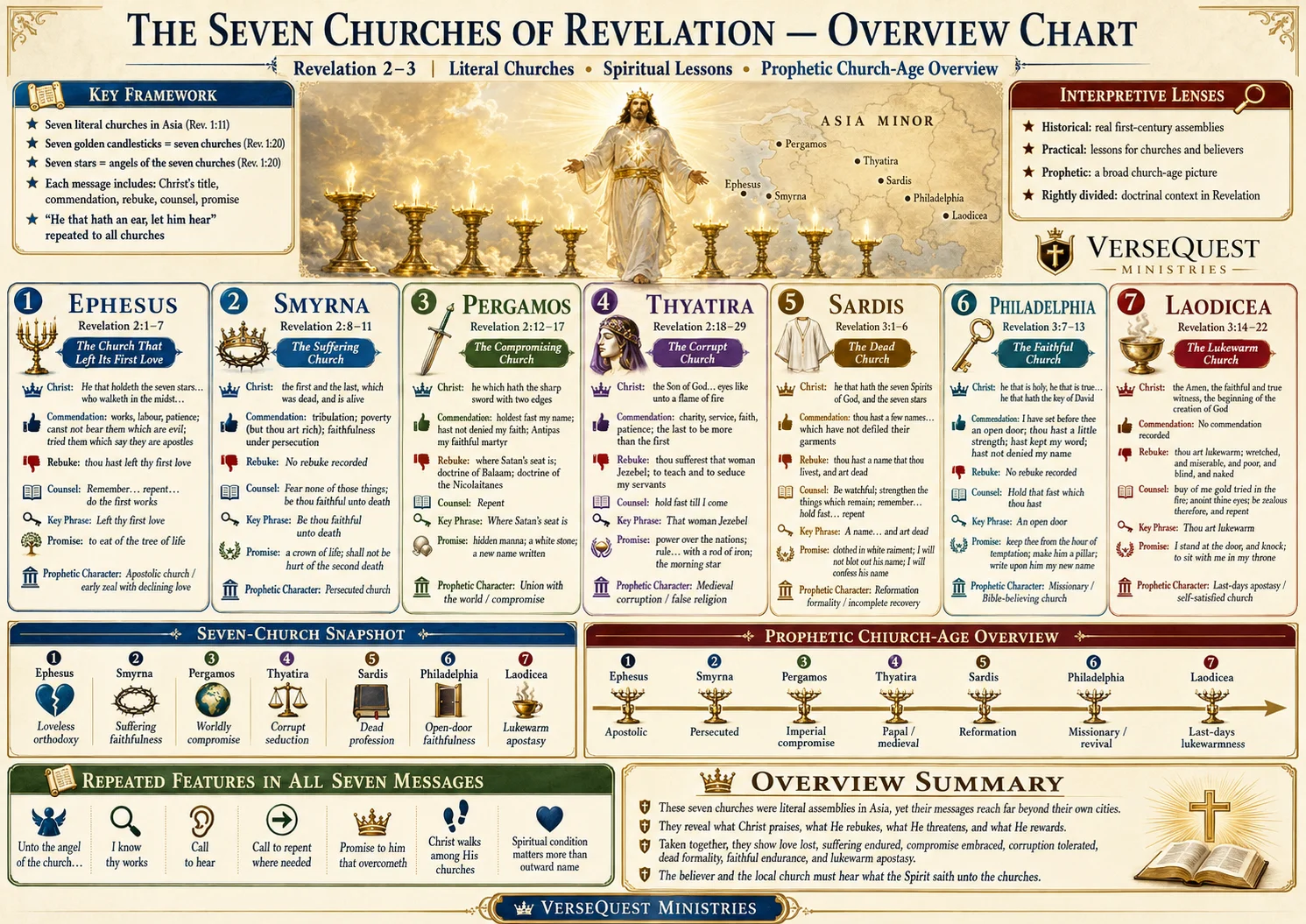
- The Seven Churches of Revelation Chart Collection – Christ Walking Among the Candlesticks
- A premium VerseQuest Ministries™ PDF chart collection covering the Seven Churches of Revelation in Revelation 2–3. Includes one overview chart plus individual KJV Bible study charts for Ephesus, Smyrna, Pergamos,…
- $12.99
- Add to cart
-