
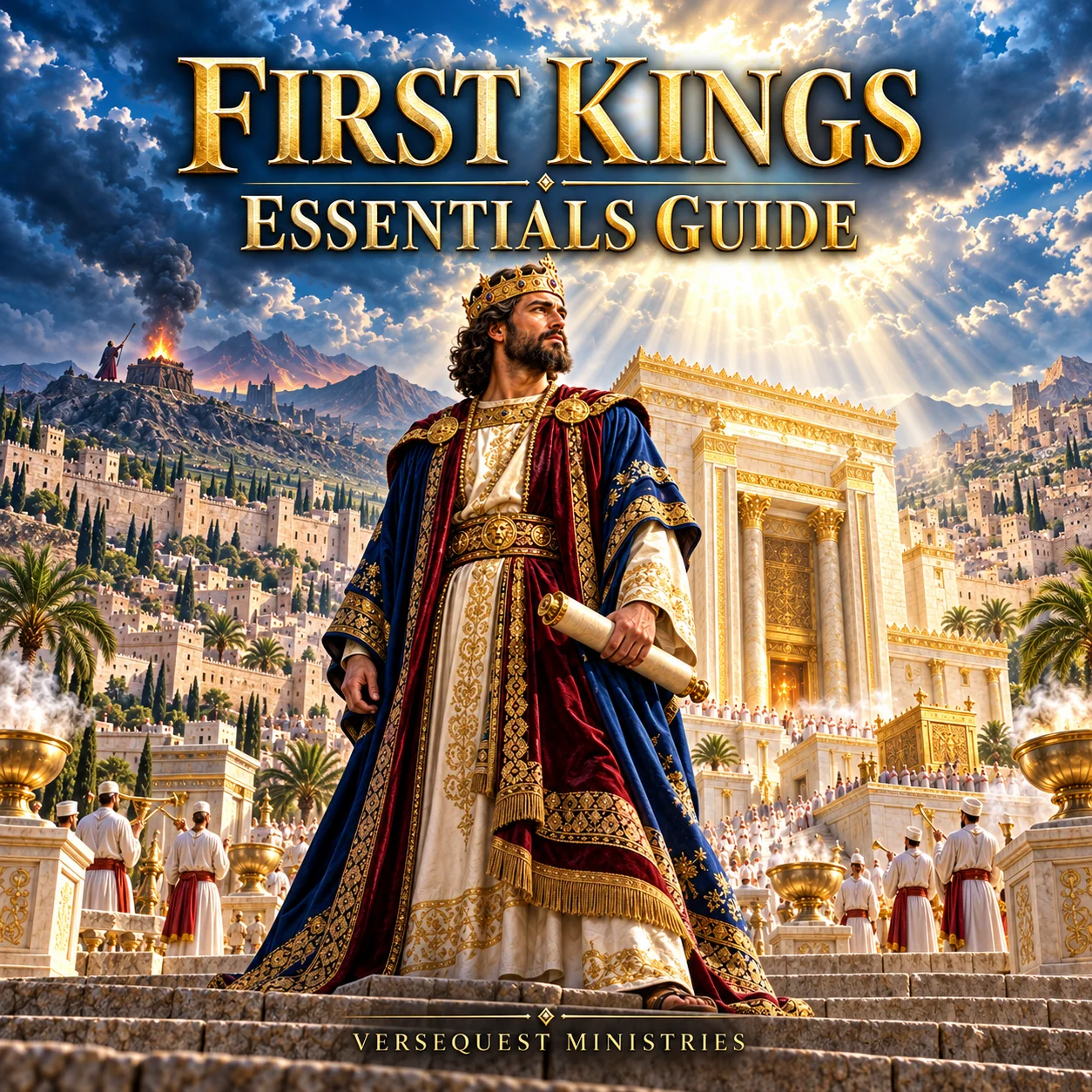
First Kings Essentials Guide — KJV Bible Study PDF
The First Kings Essentials Guide is a professionally designed 120-page downloadable PDF providing a clear, substantial, and beginner-friendly study of the entire book of First Kings. It covers Solomon’s accession, his request for wisdom, the temple, the queen of Sheba, Solomon’s compromise, the divided kingdom, Jeroboam’s counterfeit religion, Elijah’s ministry, Mount Carmel, Naboth’s vineyard, Micaiah, and Ahab’s fall.
The guide contains 92 Scripture-centered lessons covering all 22 chapters, with complete selected KJV passages, explanations, observations, Bible-study lenses, questions, and writing space. Chapter maps, chronology, kings and prophets, doctrinal distinctions, difficult-passage guidance, sermon starters, and final review pages make it valuable for personal study, teaching, discipleship, Sunday school, family reading, and sermon preparation.
Digital PDF download. 120 pages. Price: $14.99.
$14.99
Description
The First Kings Essentials Guide is a comprehensive 120-page downloadable PDF created to give Bible students a clear, organized, and substantial understanding of the entire book of First Kings. It is more detailed than a brief Bible survey while remaining easier to approach than a large verse-by-verse commentary. Readers are guided through the essential events, people, places, doctrines, covenants, warnings, and prophetic confrontations that define this important period in Israel’s history.
First Kings begins during the final days of David’s reign. The guide explains Adonijah’s attempt to take the kingdom, Bath-sheba and Nathan’s intervention, Solomon’s lawful establishment upon David’s throne, and David’s final instructions to his son. These opening chapters show that a throne may be claimed by human ambition, but the purposes of God cannot be secured by self-promotion, political maneuvering, or outward display.
Solomon’s early reign receives careful attention. Readers will examine his request for an understanding heart, his famous judgment involving two women, the organization and prosperity of his kingdom, and the wisdom that caused surrounding nations to seek him. The guide also distinguishes possessing wisdom from continuing to obey the wisdom God has given. Solomon’s life demonstrates that extraordinary knowledge cannot protect a heart that gradually turns away from the LORD.
A major portion of the guide is devoted to the construction and dedication of the temple. Readers will study the preparation of materials, the skilled labor, the temple’s structure and furnishings, the ark entering the most holy place, the glory of the LORD filling the house, Solomon’s dedication prayer, and God’s response. The temple is presented within its proper historical and covenant setting as the appointed center of Israel’s national worship—not as a replacement for the local church or as a structure capable of containing the infinite God.
The guide traces Solomon’s growing wealth, international influence, royal splendor, and reception of the queen of Sheba. It then examines the compromises that brought decline: multiplied horses, riches, wives, political alliances, idolatry, high places, and a divided heart. Solomon’s outward glory could not compensate for inward departure. The reader will see how tolerated compromise in one generation can become open rebellion and national division in the next.
The division of the kingdom under Rehoboam and Jeroboam is explained in detail. The guide follows Rehoboam’s rejection of wise counsel, the revolt of the northern tribes, and Jeroboam’s establishment of a counterfeit religious system involving golden calves, unauthorized worship centers, man-made priests, and an invented feast. First Kings shows that false religion is often engineered to preserve political power and spare people the inconvenience of obeying the truth.
The prophetic ministry of Elijah forms another central portion of the guide. Readers will follow Elijah from his sudden appearance before Ahab through the drought, the brook Cherith, the widow of Zarephath, the raising of her son, the confrontation on Mount Carmel, the fire of the LORD, the end of the drought, Elijah’s flight from Jezebel, and his meeting with God at Horeb. These chapters reveal the living God’s authority over nature, nations, kings, false prophets, life, death, provision, and judgment.
The closing chapters examine Ahab’s wars, Ben-hadad’s defeat, Naboth’s vineyard, Jezebel’s conspiracy, Elijah’s sentence upon Ahab’s house, Ahab’s temporary humiliation, the alliance between Ahab and Jehoshaphat, the confrontation involving Micaiah, and Ahab’s death at Ramoth-gilead. The book ends with the sobering truth that disguises, alliances, popular approval, and hundreds of agreeable prophets cannot overturn one true word spoken by the LORD.
The guide contains 92 Scripture-centered lessons covering all 22 chapters of First Kings. Every selected King James Bible passage is printed directly in the lesson. Each study includes an understandable explanation, three important observations, a Bible-study lens, thought-provoking questions, and purposeful writing space. The additional orientation and reference pages include the book’s historical setting, seven major movements, chapter maps, chronology, principal people and places, key terms, kings and prophets, doctrinal distinctions, difficult passages, sermon starters, review material, and memorable truths.
This professionally designed PDF uses a consistent navy, gold, cream, and light-blue presentation with strong borders, clearly separated sections, readable Scripture panels, and integrated note areas. It is suitable for personal Bible study, discipleship, family reading, Sunday school, sermon preparation, small-group discussion, classroom instruction, ministry training, or rapid review before beginning a more detailed study.
The lawful succession of Solomon — Solomon receives David’s throne by divine appointment rather than through Adonijah’s self-exaltation. The danger of self-promotion — Adonijah’s attempt to make himself king demonstrates that appearance, ambition, and political support cannot create divine authority. Wisdom from God — Solomon’s request for an understanding heart establishes wisdom as a gift meant for righteous judgment and faithful service. Wisdom practiced in judgment — The case of the two women makes Solomon’s God-given discernment visible to Israel. Peace, order, and national prosperity — Solomon’s early administration displays the strength and blessing of an orderly kingdom. Preparation for the temple — Materials, labor, craftsmen, and organization show that sacred work requires thoughtful preparation. The house of the LORD — The temple becomes the appointed center of Israel’s national worship under the Mosaic covenant. The holiness and glory of God — The cloud filling the temple demonstrates God’s presence while Solomon confesses that heaven itself cannot contain Him. Prayer and covenant responsibility — Solomon’s dedication prayer recognizes sin, chastening, repentance, forgiveness, and Israel’s relationship to the land. Privilege and accountability — Solomon’s wisdom, wealth, temple, and position increased his responsibility to remain faithful. The queen of Sheba — Her journey illustrates the international testimony of Solomon’s wisdom and kingdom glory. The seduction of gradual compromise — Solomon’s departure develops through accumulated wealth, political alliances, strange wives, high places, and divided affection. A heart turned from the LORD — First Kings identifies the heart—not merely outward administration—as the decisive issue in spiritual faithfulness. The division of the kingdom — Solomon’s apostasy and Rehoboam’s foolishness produce lasting consequences for Israel and Judah. The rejection of wise counsel — Rehoboam chooses the advice that flatters his strength and loses most of the kingdom. Counterfeit religion — Jeroboam manufactures gods, worship centers, priests, and a feast to protect political control. The certainty of prophetic judgment — The Word of the LORD stands against kings, altars, dynasties, armies, and popular opinion. The living God against Baal — Elijah’s ministry reveals the LORD’s authority over drought, food, fire, rain, life, and death. Provision during judgment — The brook Cherith and the widow’s barrel show God sustaining His servant during national famine. Repairing the broken altar — Mount Carmel joins restored worship, answered prayer, divine fire, and public confession. Discouragement after victory — Elijah’s flight demonstrates that a faithful servant may require rest, correction, renewed perspective, and a fresh commission. The preserved remnant — The seven thousand who had not bowed to Baal show that God’s work is greater than one discouraged prophet can see. Ahab and Jezebel’s corruption — Their reign joins idolatry, manipulation, false accusation, murder, theft, and contempt for the Word of God. Naboth’s inheritance — Naboth’s refusal to surrender his fathers’ inheritance demonstrates fidelity to God’s order under pressure from royal power. True and false prophets — Micaiah stands alone with the truth while hundreds speak what the king desires to hear. The failure of disguise — Ahab may hide his identity from men, but he cannot escape the judgment God has spoken. Israel and the Church distinguished — The guide preserves the historical, national, covenant, and kingdom setting of First Kings while drawing legitimate spiritual instruction for believers.
First Kings records more than the reigns of ancient rulers. It demonstrates how a kingdom may rise through wisdom, worship, order, and divine blessing, yet decline through compromise, idolatry, foolish counsel, and rejection of the Word of God. The book begins with Solomon lawfully receiving David’s throne and ends with Ahab dying exactly as the rejected prophet had foretold.
Adonijah’s failure establishes one of the book’s first lessons: a man may prepare chariots, runners, supporters, and a public celebration, yet still lack God’s authorization. He attempted to turn desire into destiny through self-exaltation. Solomon waited until David’s command and Nathan’s intervention brought the rightful succession into public view.
Solomon’s request for an understanding heart reveals the proper purpose of wisdom. He did not initially ask for wealth, long life, or victory over his enemies. He asked for discernment so he could judge God’s people. Wisdom begins as a gift to be received humbly, but it must continue as truth to be obeyed faithfully.
The temple occupies the physical and theological center of Solomon’s reign. Its construction required preparation, order, skilled labor, valuable materials, and obedience to the pattern given. Yet Solomon correctly declared that heaven and the heaven of heavens could not contain the LORD. The temple was God’s appointed meeting place with Israel, not a structure that confined His being.
Solomon’s dedication prayer repeatedly anticipates human failure. It addresses sin, defeat, drought, famine, captivity, repentance, confession, and divine forgiveness. The prayer recognizes that national privilege never removes moral accountability. Israel’s blessing in the land remained connected with covenant faithfulness.
The queen of Sheba saw Solomon’s wisdom, servants, order, prosperity, worship, and ascent to the house of the LORD. She confessed that the report she had heard did not equal the reality she witnessed. Nevertheless, the New Testament identifies Jesus Christ as greater than Solomon. Solomon’s kingdom supplied a historical display of glory, but Christ alone possesses perfect wisdom and an everlasting kingdom.
Solomon’s decline is one of Scripture’s strongest warnings concerning gradual compromise. The man who built the temple later built high places for false gods. His wisdom remained famous, but his heart was no longer wholly devoted to the LORD. Knowledge stored in the mind cannot replace obedience maintained in the heart.
Rehoboam’s failure demonstrates the danger of confusing harshness with strength. He rejected the counsel of experienced men, accepted the advice of companions who appealed to pride, and answered the people roughly. His attempt to appear stronger than Solomon exposed how weak his judgment actually was.
Jeroboam established counterfeit worship because he feared losing political control. His religion possessed visible gods, convenient locations, appointed priests, an altar, sacrifices, and a religious calendar. Nearly every part of it imitated something familiar while rejecting what God had commanded. False religion often succeeds by offering recognizable forms without submission to revealed truth.
Elijah enters the record without royal introduction or institutional approval. He stands before Ahab with the Word of the living God. The drought directly challenges Baal’s supposed authority over fertility and rain. At Cherith and Zarephath, the LORD demonstrates that He can sustain His servant even while judging the surrounding nation.
Mount Carmel forces Israel to confront divided loyalty. Elijah does not ask the people to add the LORD to Baal worship. He demands a choice. The repaired altar, saturated sacrifice, brief prayer, consuming fire, and public confession reveal that the answer comes from God rather than from theatrical religion.
Elijah’s flight after Carmel shows that public victory does not make a servant immune to exhaustion or discouragement. God gives him rest, food, correction, revelation, renewed work, and the assurance of a preserved remnant. Elijah was not the only faithful man remaining, and God’s purpose did not depend upon Elijah’s emotions.
Naboth’s vineyard reveals the corruption of power when rulers reject God’s law. Naboth refused to surrender the inheritance of his fathers. Jezebel answered his faithfulness with conspiracy, false witnesses, religious hypocrisy, and murder. Ahab accepted the stolen vineyard, but Elijah met him there with the Word of judgment.
Micaiah’s final confrontation with Ahab provides a fitting conclusion to the book. Four hundred prophets promised success, but one imprisoned prophet spoke the truth. Ahab disguised himself for battle, yet a seemingly random arrow fulfilled the divine sentence. The majority was wrong, the flattering message failed, the disguise proved useless, and the Word of the LORD stood.
For personal Bible study, the guide may be followed from beginning to end as a structured survey of First Kings. Readers can study one lesson at a time, examine the printed KJV passage, record observations, and use the reference pages to review the book’s principal movements.
For sermon preparation, pastors and preachers can use the lesson titles, central truths, observations, Bible-study lenses, and sermon starters as foundations for textual, biographical, doctrinal, or topical messages. Major preaching subjects include wisdom, worship, compromise, divided loyalty, counterfeit religion, prophetic courage, discouragement, idolatry, leadership, and the certainty of God’s Word.
For Sunday school and small groups, the 92 lessons may be organized around the guide’s seven major units. Teachers can combine shorter studies or devote complete sessions to Solomon’s wisdom, the temple, the kingdom’s division, Jeroboam’s religious system, Elijah at Carmel, Elijah at Horeb, Naboth’s vineyard, or Micaiah’s stand.
For discipleship, the guide introduces foundational lessons concerning prayer, divine guidance, spiritual discernment, faithful worship, obedience, compromise, courage, leadership, correction, perseverance, and submission to Scripture.
For family study, individual lessons can be read aloud and discussed without requiring a separate curriculum. The printed Scripture panels, concise explanations, questions, and writing spaces make the material approachable for developing Bible readers.
For classroom instruction and ministry training, the historical setting, chronology, people, places, kings, prophets, chapter maps, doctrinal distinctions, difficult passages, and review tools provide an organized framework for understanding and teaching the book.
For topical teaching, the guide can support studies on biblical wisdom, the temple, the divided kingdom, false worship, the ministry of a prophet, the danger of political religion, the remnant, righteous judgment, and the consequences of rejecting God’s Word.
The primary companion to this guide should be a King James Bible so readers can examine the complete chapters surrounding each selected passage. A Strong’s or Cruden’s concordance can help trace important terms such as king, wisdom, heart, house, temple, altar, prophet, word, high places, Baal, and covenant.
A reliable Bible dictionary can provide concise information about Jerusalem, Gibeon, Lebanon, Tyre, Ophir, Shechem, Bethel, Dan, Samaria, Cherith, Zarephath, Carmel, Horeb, Jezreel, and Ramoth-gilead. A Bible atlas can help readers follow the geography of the united kingdom, the division between Israel and Judah, Elijah’s travels, and the conflicts involving Syria.
Cross-reference tools are especially useful when comparing First Kings with First and Second Chronicles, the writings associated with Solomon, later prophetic references to Israel’s apostasy, and New Testament passages concerning Solomon, Elijah, and the preserved remnant.
The Second Samuel Essentials Guide is an important companion because it explains David’s reign, Jerusalem, the Davidic covenant, David’s later troubles, and the events leading toward Solomon’s accession. The First Samuel Essentials Guide provides the earlier background involving Samuel, Saul, David’s anointing, and the establishment of Israel’s monarchy.
For deeper study after completing this Essentials Guide, readers may consult detailed KJV commentaries, Bible dictionaries, historical timelines, studies of Israel’s kings and prophets, temple diagrams, and resources examining the Davidic covenant and the future earthly kingdom of the Lord Jesus Christ.
Related products
-
Jesus Christ
-
-10%
- The Lord Jesus Christ Made Plain – 637-Page KJV Bible Study
- A massive 637-page, 100-part KJV Bible study on the Person and work of the Lord Jesus Christ. This premium VerseQuest resource covers His deity, incarnation, blood, cross, resurrection, present ministry,…
- Original price was: $39.00.$34.99Current price is: $34.99.
- Add to cart
-
-10%
-
Jesus Christ
-
-67%
- The Millennium Made Plain – 416-Page KJV Study on Christ’s Future Reign
- A premium 416-page KJV, rightly divided Bible study on the literal future Millennial reign of Jesus Christ. The Millennium Made Plain explains Revelation 19–20, Israel’s restoration, Satan’s binding, the Kingdom…
- Original price was: $29.99.$9.99Current price is: $9.99.
- Add to cart
-
-67%
-
Doctrine Series
-
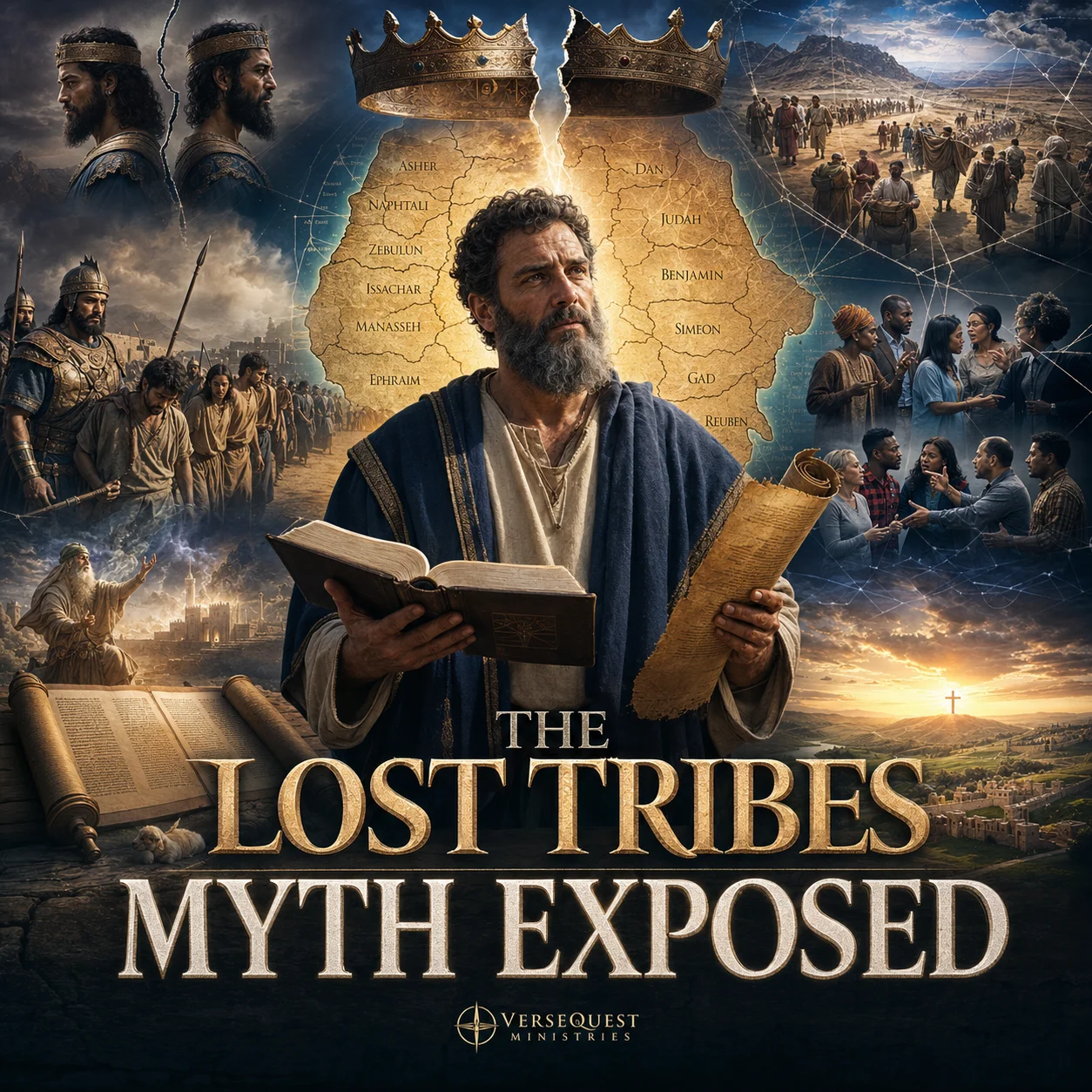
- The Lost Tribes Myth Exposed (213-Page Premium Study)
- A 213-page premium KJV study exposing the Lost Tribes myth, tribal identity errors, prophecy abuse, race theories, and false Israel claims through 35 detailed essays.
- $24.99
- Add to cart
-
-
Christology Studies
-
- The Deity of Christ Defended — 66 KJV Studies Proving Jesus Christ Is God Manifest in the Flesh
- he Deity of Christ Defended is a 444-page premium KJV Bible study defending the full deity of the Lord Jesus Christ. This 66-study book proves from Scripture that Jesus is…
- $29.99
- Add to cart
-
-
KJV Bible Study Resources
-
-60%
- Practical Christianity for Daily Battles – 329-Page KJV Study PDF
- A premium 329-page KJV study PDF with 40 full essays applying sound, rightly divided Bible doctrine to real daily Christian battles. Topics include temptation, anxiety, marriage, parenting, pornography, grief, church…
- Original price was: $24.99.$9.99Current price is: $9.99.
- Add to cart
-
-60%