
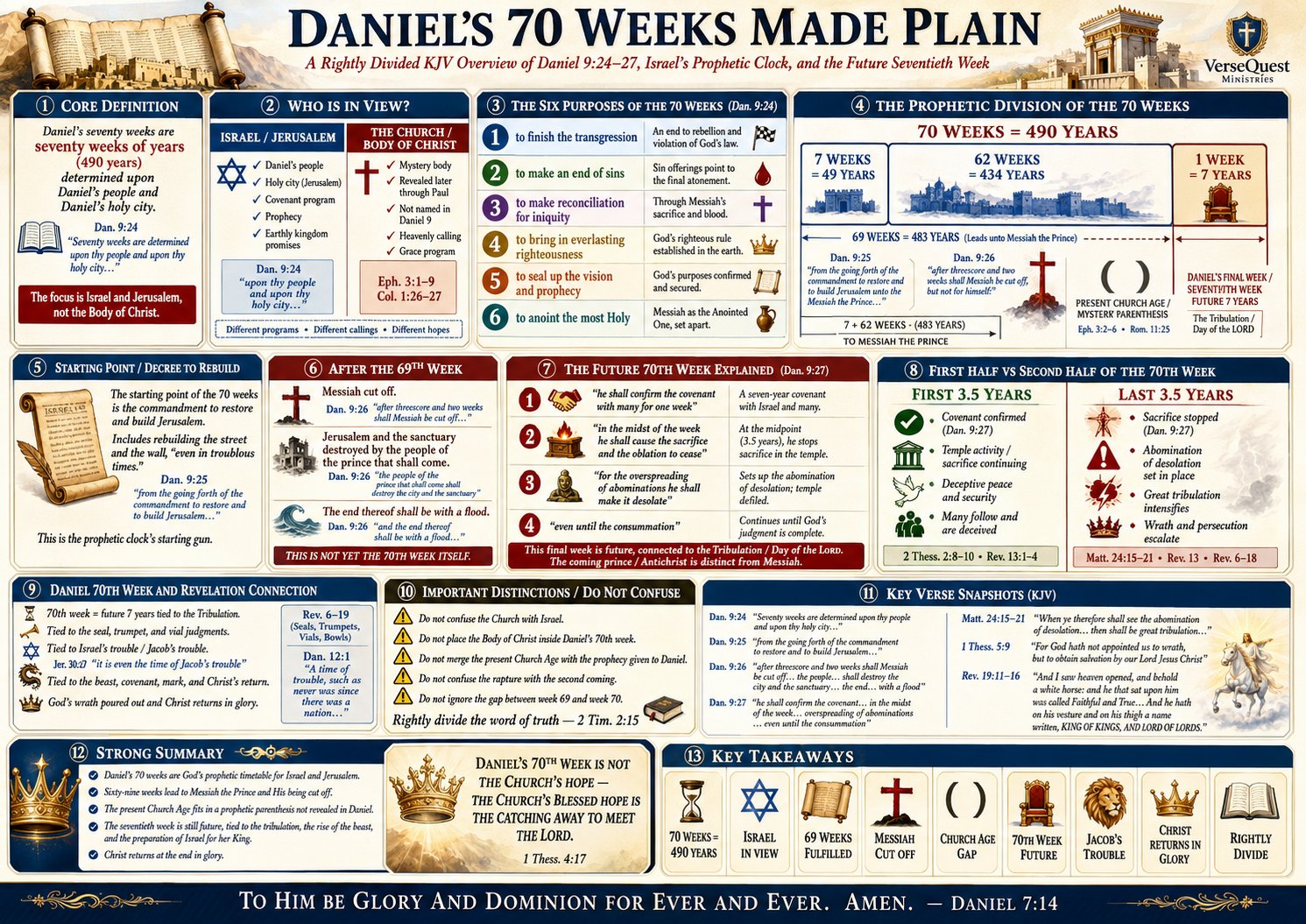
Daniel’s 70 Weeks Made Plain – Israel’s Prophetic Clock, Messiah’s First Coming, and the Future Seventieth Week (KJV Bible Study Chart)
Understand Daniel’s seventy weeks with this detailed KJV chart covering Israel and Jerusalem, the 490-year prophetic timetable, Messiah’s first coming and rejection, the Church-age interval, Antichrist’s covenant, the abomination of desolation, Great Tribulation, and Christ’s glorious return.
$3.99
Description
Daniel’s 70 Weeks Made Plain is a detailed, rightly divided KJV Bible study chart explaining the prophetic structure of Daniel 9:24–27, the identity of the people and city in view, the first sixty-nine weeks leading to Messiah the Prince, the cutting off of Christ, the destruction of Jerusalem, the present Church-age interval, and the future seventieth week connected with the Tribulation and the Day of the Lord.
Built around Daniel 9:24–27, this chart provides a clear visual overview of one of the most important prophetic passages in the entire Bible. Daniel’s seventy weeks establish the framework for understanding Israel’s prophetic calendar, the first coming and rejection of Jesus Christ, the interruption of the revealed timeline, the future covenant made by the coming prince, the abomination of desolation, the Great Tribulation, and Christ’s eventual return in glory.
Daniel 9:24 begins with a declaration that must govern the interpretation of everything that follows: “Seventy weeks are determined upon thy people and upon thy holy city.” Daniel’s people are Israel, and Daniel’s holy city is Jerusalem. The prophecy is not said to be determined upon the Church, the Body of Christ, the Gentile nations generally, or an invisible spiritualized Israel. The people and city are identified plainly before any of the prophetic details are given.
This distinction is the foundation of the chart. Israel belongs to God’s prophetic and earthly Kingdom program. The Church, the Body of Christ, belongs to the mystery later revealed especially through the apostle Paul. The Church was not named in Daniel 9, because the one Body of believing Jews and Gentiles was still a mystery hidden in God until its appointed revelation.
Ephesians 3 describes the mystery that believing Gentiles should be fellowheirs, members of the same Body, and partakers of God’s promise in Christ by the gospel. Colossians 1 speaks of the mystery hidden from ages and generations but now made manifest to the saints. Daniel’s prophecy therefore cannot be interpreted correctly by reading the later-revealed Body of Christ backward into Israel’s seventy-week calendar.
The seventy weeks are seventy units of seven years, producing a total of 490 prophetic years. The chart divides these seventy weeks according to the inspired structure of Daniel 9:25–27: seven weeks, sixty-two weeks, and one final week. The first seven weeks equal forty-nine years, the following sixty-two weeks equal 434 years, and the first two divisions together equal sixty-nine weeks or 483 years.
The prophecy begins with the commandment to restore and rebuild Jerusalem. Daniel 9:25 states that from the going forth of the commandment to restore and build Jerusalem unto Messiah the Prince would be seven weeks and sixty-two weeks. The rebuilding would occur during difficult conditions, with the street and wall restored “even in troublous times.”
The command to rebuild Jerusalem functions as the starting gun of the prophetic clock. Daniel’s seventy weeks do not begin vaguely with Israel’s existence, Daniel’s prayer, the Babylonian captivity, or a general desire to return home. The passage supplies a specific starting point connected with the decree to restore and rebuild the holy city.
The first seven weeks, or forty-nine years, are associated with the rebuilding period. The next sixty-two weeks continue the prophetic count toward Messiah the Prince. Together, the seven and sixty-two weeks produce sixty-nine weeks, or 483 years, leading to the appearance of Israel’s promised Messiah.
Daniel’s prophecy therefore places the coming of Messiah within a measurable prophetic framework. The Lord Jesus Christ did not appear accidentally, unexpectedly, or outside the declared plan of God. His first coming stood at the appointed point within Israel’s prophetic history.
Daniel 9:26 then declares that “after threescore and two weeks shall Messiah be cut off, but not for himself.” Messiah is not cut off during the sixty-nine weeks but after their completion. Jesus Christ came to Israel, presented Himself as the promised King, was rejected, and suffered death, yet not for His own sins.
The words “not for himself” point toward the substitutionary sacrifice of Jesus Christ. He was sinless, holy, harmless, undefiled, and separate from sinners. He did not die because He deserved judgment. He died for the sins of others, fulfilling the redemptive purpose of God through His shed blood.
Isaiah 53 declares that Messiah was wounded for our transgressions and bruised for our iniquities. Second Corinthians 5:21 states that God made Christ to be sin for us, though He knew no sin, that believers might be made the righteousness of God in Him. Daniel’s prophetic clock therefore leads directly to the rejected and crucified Messiah whose sacrifice became the foundation of salvation.
The cutting off of Messiah did not mean God had failed to fulfill His promises. Israel’s rejection of the King was already known within the divine plan. The cross became the place where Christ paid for sin, defeated the claims of the accuser, and accomplished the finished work through which sinners may be saved by grace through faith.
Daniel 9:26 next states that “the people of the prince that shall come shall destroy the city and the sanctuary.” Jerusalem and the Temple were later destroyed by the people associated historically with the coming prince. The city and sanctuary suffered judgment after Messiah had been cut off.
The passage distinguishes the coming prince from Messiah the Prince. Messiah is the true Prince who was cut off. The later prince is the ruler connected with the people who destroyed the city and sanctuary. This future prince becomes central in verse 27 and is associated with the final Antichrist ruler rather than Jesus Christ.
Daniel 9:26 also states that the end would be with a flood and that desolations were determined. The prophecy moves beyond the first coming of Christ and the destruction of Jerusalem toward continuing conflict and a future consummation. Israel’s prophetic troubles did not end with the Roman destruction of the city.
The chart emphasizes an essential truth: the events described after the sixty-ninth week do not immediately begin the seventieth week. Messiah is cut off after the sixty-nine weeks, and the city and sanctuary are subsequently destroyed, yet verse 27 still speaks of one future week.
This creates a prophetic interval between the sixty-ninth and seventieth weeks. The first sixty-nine weeks have been fulfilled, but the final week remains future. The prophetic clock connected with Israel pauses while God reveals and accomplishes His previously hidden purpose for the Church, the Body of Christ.
The present Church Age is therefore shown as a mystery parenthesis between the sixty-ninth and seventieth weeks. It was not revealed in Daniel’s prophecy because Daniel was receiving information concerning Israel, Jerusalem, and the future completion of the prophetic program.
During this present dispensation of grace, believing Jews and Gentiles are joined into one Body in Jesus Christ. The Church possesses a heavenly calling, spiritual blessings in heavenly places, and a blessed hope centred upon being caught up to meet the Lord in the air.
The Church has not replaced Israel, inherited Israel’s national identity, or spiritually fulfilled every promise made to Jerusalem. Romans 11 teaches that blindness in part has happened to Israel until the fulness of the Gentiles comes in, after which God will complete His covenant purposes concerning the nation.
The gap between the sixty-ninth and seventieth weeks does not mean the prophecy is inaccurate. It demonstrates that God may reveal prophetic events consecutively without disclosing the entire duration between them. The Old Testament prophets often saw the sufferings of Christ and the glory that should follow while the mystery Church Age remained hidden.
The chart warns against forcing the present Church inside Daniel’s seventieth week. Daniel’s weeks were determined upon Israel and Jerusalem, not upon the Body of Christ. The Tribulation concerns the completion of Israel’s prophetic calendar rather than the final purification of the Church.
The future seventieth week begins when the coming prince “shall confirm the covenant with many for one week.” This one week is seven years. The covenant involves Israel and many others and becomes the opening event of the final prophetic period.
The ruler does not begin by announcing himself to the world as a blasphemous monster. His rise includes diplomacy, political influence, promised security, covenant-making, and deceptive peace. What appears to offer protection ultimately becomes the instrument of betrayal.
The chart distinguishes the coming prince from Israel’s true Messiah. Jesus Christ fulfills God’s covenants and speaks truth. The Antichrist confirms a covenant for political purpose and later breaks it. Christ is the faithful King; the coming prince is the treacherous counterfeit.
Daniel 9:27 states that “in the midst of the week he shall cause the sacrifice and the oblation to cease.” The midpoint of the seven-year week divides it into two periods of three and a half years.
During the first half, the covenant remains in effect, Temple activity and sacrifice continue, and a deceptive sense of peace and security develops. Many accept the ruler’s promises and political order.
At the midpoint, the covenant is betrayed. The sacrifice and oblation cease, the sanctuary is defiled, and the abomination of desolation is established.
Jesus Christ refers directly to this event in Matthew 24:15, identifying “the abomination of desolation, spoken of by Daniel the prophet” standing in the holy place. He warns those in Judea to flee and describes the unprecedented Great Tribulation that follows.
The second half of the seventieth week becomes the most severe phase of the Tribulation. The Antichrist’s true character is openly revealed, persecution intensifies, beast worship spreads, the mark of the beast controls economic participation, and God’s judgments fall upon the rebellious world.
Revelation 6–19 supplies the expanded New Testament revelation of the period Daniel described in compressed prophetic language. The seals, trumpets, and vials reveal the escalating judgments of the Day of the Lord.
Revelation identifies the beast, false prophet, Dragon, Tribulation saints, sealed servants from Israel, two witnesses, preserved remnant, Babylonian system, gathered kings, and final return of Jesus Christ. Daniel’s seventieth week and Revelation’s Tribulation judgments belong to the same future prophetic framework.
Jeremiah 30:7 calls this period “the time of Jacob’s trouble.” Jacob is Israel. The Tribulation is tied directly to Israel’s trouble, refinement, repentance, preservation, and preparation for the return of her King.
The seventieth week also includes God’s judgment upon the nations. The world will follow the beast, worship the Dragon, persecute God’s servants, reject the truth, and gather in rebellion against Jesus Christ. Divine wrath will answer that rebellion.
The final week continues “even until the consummation.” Antichrist’s authority is temporary and limited. He may deceive nations, break the covenant, stop sacrifices, desecrate the sanctuary, persecute saints, and magnify himself, but God has already determined his end.
The Tribulation culminates in the visible return of Jesus Christ. Revelation 19 presents heaven opened and the true King descending upon a white horse with the armies of heaven following Him.
Jesus Christ destroys the beast’s armies, casts the beast and false prophet into the lake of fire, delivers Israel’s remnant, judges the nations, and establishes His righteous rule upon the earth.
The counterfeit prince confirms and breaks a covenant. The true Prince returns and establishes an everlasting Kingdom. Antichrist sits temporarily in self-exaltation; Jesus Christ receives the throne that belongs to Him by divine right.
The chart also explains the six purposes listed in Daniel 9:24. The first purpose is “to finish the transgression.” Israel’s long national rebellion against God will be brought to its appointed conclusion.
The second purpose is “to make an end of sins.” Sin’s dominion, national rebellion, and the conditions sustaining Israel’s estrangement will be answered through Messiah’s work and future Kingdom.
The third purpose is “to make reconciliation for iniquity.” The sacrificial death of Jesus Christ provides the only sufficient atonement for sin. Israel’s future restoration rests upon the same rejected Messiah whose blood accomplished redemption.
The fourth purpose is “to bring in everlasting righteousness.” Human government cannot establish permanent righteousness. Jesus Christ must return personally and rule as the righteous King.
The fifth purpose is “to seal up the vision and prophecy.” God will confirm and complete everything He has revealed. No prophetic promise will remain unfinished when the appointed program reaches its consummation.
The sixth purpose is “to anoint the most Holy.” This purpose is connected with the final sanctification of God’s appointed place and the establishment of Messiah’s holy rule.
These six purposes extend beyond the first coming of Jesus Christ. The cross provides the redemptive foundation, but the full national and Kingdom fulfillment awaits His return and the completion of the seventieth week.
This prevents the interpreter from declaring the entire prophecy completed merely because Christ accomplished redemption at Calvary. His sacrifice is finished, but Israel’s prophetic restoration, the judgment of the nations, the destruction of Antichrist, and the establishment of the earthly Kingdom remain future.
The chart presents the two halves of the seventieth week clearly. The first three and a half years involve covenant confirmation, continued sacrifices, apparent peace, and growing acceptance of the coming ruler.
The final three and a half years involve the broken covenant, stopped sacrifices, abomination of desolation, intensified persecution, Great Tribulation, and the concentrated wrath revealed in Revelation.
This division explains why the Tribulation cannot be treated as one undifferentiated block without a midpoint crisis. Daniel 9:27, Matthew 24, Second Thessalonians 2, and Revelation all emphasize a dramatic unveiling and escalation in the middle of the period.
Second Thessalonians 2 describes the man of sin being revealed, opposing and exalting himself above all that is called God, and sitting in the Temple of God while claiming divine honour. This agrees with Daniel’s description of the covenant-breaking prince and Christ’s warning concerning the abomination.
The chart’s right-division warnings are essential. The Church must not be confused with Israel. The Body of Christ must not be inserted into Daniel’s seventy weeks. The present Church Age must not be declared the seventieth week. The Rapture must not be merged with the Second Coming. The gap between weeks sixty-nine and seventy must not be ignored.
The Rapture is the Church’s blessed hope. First Thessalonians 4:16–17 teaches that the Lord will descend from heaven, the dead in Christ will rise first, and living believers will be caught up together with them to meet the Lord in the air.
First Thessalonians 5:9 declares that God has not appointed the Church to wrath. The Body of Christ is caught away before Daniel’s seventieth week resumes and the Tribulation judgments begin.
The Church’s hope is therefore not the seventieth week. Christians are not instructed to wait for the Antichrist to confirm his covenant, rebuild their hope around Temple sacrifices, or prepare to receive the abomination of desolation.
The Church waits for Jesus Christ. Israel’s prophetic clock resumes after the mystery Body has completed its present course and is gathered to the Lord.
The Rapture and Second Coming remain distinct. At the Rapture, Christ comes for His Church, and believers meet Him in the air. At the Second Coming, Christ returns with His saints to the earth to defeat His enemies and establish His Kingdom.
The chart’s strong summary is clear: Daniel’s seventy weeks are God’s prophetic timetable for Israel and Jerusalem. The first sixty-nine weeks led to Messiah the Prince and His being cut off. The present Church Age fills the unrevealed interval between the sixty-ninth and seventieth weeks.
The final week remains future and begins with the coming prince confirming a covenant for seven years. At the midpoint he breaks that covenant, stops sacrifice, establishes the abomination of desolation, and ushers in the most severe stage of the Great Tribulation.
The seventieth week ends with the consummation of judgment and the glorious return of Jesus Christ. The false prince is destroyed, Israel is delivered, prophecy is fulfilled, and the true King establishes His righteous reign.
Daniel’s seventieth week is not the Church’s hope. The Church’s blessed hope is to be caught up to meet the Lord before the final prophetic week begins.
The doctrine gives confidence in the precision of Scripture. God determined the times, revealed the divisions, foretold Messiah’s rejection, preserved Israel through centuries of dispersion, and will complete every remaining promise exactly as written.
This resource is ideal for personal Bible study, Daniel prophecy classes, seventy-weeks instruction, pre-Tribulation Rapture teaching, Church-and-Israel distinctions, Antichrist studies, Tribulation timelines, Matthew 24 lessons, Revelation studies, prophecy conferences, Sunday school, homeschool Bible curriculum, Christian schools, Bible institutes, pastoral training, and sermon preparation.
Daniel’s seventy weeks, Daniel 9:24–27, seventy weeks of years, 490 prophetic years, Israel’s prophetic clock, Daniel’s people and holy city, Jerusalem in prophecy, Messiah the Prince, Messiah cut off, seventy-nine weeks fulfilled, sixty-nine weeks fulfilled, Church-age mystery gap, future seventieth week, Daniel’s final week, Antichrist covenant, covenant broken, sacrifice stopped, abomination of desolation, Great Tribulation, Jacob’s trouble, Second Coming of Jesus Christ
Daniel’s seventy weeks are seventy units of seven years, producing a total prophetic period of 490 years. The prophecy is explicitly determined upon Daniel’s people and Daniel’s holy city, identifying Israel and Jerusalem as its subjects. The Church, the Body of Christ, was a mystery not yet revealed in Daniel’s time and should not be inserted into Israel’s seventy-week prophetic program.
The prophecy begins with the commandment to restore and rebuild Jerusalem. The first seven weeks equal forty-nine years and are connected with the rebuilding period, while the next sixty-two weeks equal 434 years. Together these divisions produce sixty-nine weeks, or 483 years, leading to Messiah the Prince.
Daniel 9:26 declares that Messiah would be cut off after the sixty-nine weeks and not for Himself. Jesus Christ was rejected and crucified, though He possessed no sin of His own. His death provided the substitutionary sacrifice through which sinners may receive redemption, forgiveness, and justification by faith.
After Messiah was cut off, the city and sanctuary were destroyed by the people associated with the coming prince. These events occurred after the sixty-ninth week, but the final seventieth week did not begin immediately. The prophecy therefore allows an interval between the sixty-ninth and seventieth weeks.
The present Church Age occupies this prophetic interval. God is now forming the Body of Christ from saved Jews and Gentiles united through the Holy Spirit. This mystery dispensation was hidden in earlier ages and revealed especially through Paul, so it does not become another week within Daniel’s timetable.
The future seventieth week begins when the coming prince confirms a covenant with many for one week, or seven years. This prince is not Jesus Christ but the coming Antichrist ruler connected with the final beast kingdom. His rise includes political influence, covenant-making, promised security, and deceptive peace.
In the middle of the seventieth week, the ruler breaks the covenant, causes sacrifice and oblation to cease, and establishes the abomination of desolation. Jesus Christ directly connects this event with Daniel’s prophecy in Matthew 24 and warns of the unparalleled Great Tribulation that follows.
The first half of the week is marked by covenant confirmation, Temple activity, continuing sacrifice, and deceptive stability. The last half is marked by betrayal, desecration, beast worship, persecution, the mark of the beast, escalating divine wrath, and the intensified judgments described in Revelation.
Daniel’s seventieth week is connected with the Tribulation, the Day of the Lord, and Jacob’s trouble. Israel, Jerusalem, the sanctuary, the remnant, Antichrist, and the nations under judgment remain central to the prophetic setting. The period is not God’s method of purifying the present Church or completing Christ’s unfinished work.
The Church is not appointed to wrath and awaits the catching away described in 1 Thessalonians 4 and 1 Corinthians 15. The Rapture gathers the Body of Christ to meet the Lord in the air before Israel’s final prophetic week resumes. The Rapture should not be merged with the visible Second Coming at the end of the Tribulation.
The six purposes of the seventy weeks are to finish transgression, make an end of sins, make reconciliation for iniquity, bring in everlasting righteousness, seal up vision and prophecy, and anoint the most Holy. Christ’s sacrifice supplies the redemptive foundation, while the full national and Kingdom fulfillment awaits His return.
The seventieth week ends with the consummation of God’s judgments and the glorious appearing of Jesus Christ. The beast and false prophet are destroyed, Israel’s surviving remnant recognizes her Messiah, the nations are judged, and Christ establishes His righteous Kingdom.
Right division keeps the Church distinct from Israel, the mystery distinct from prophecy, the Rapture distinct from the Second Coming, and the present dispensation distinct from Daniel’s future final week. Daniel’s timetable demonstrates that God has not forgotten Israel and will complete every promise exactly as written.
Daniel 9 Bible studies, seventy-weeks prophecy teaching, Israel-and-Church distinctions, explaining the Church-age gap, Messiah’s first-coming prophecy, Antichrist covenant studies, Daniel’s seventieth-week instruction, interpreting Matthew 24, abomination-of-desolation lessons, Great Tribulation teaching, pre-Tribulation Rapture studies, Revelation prophecy timelines, Second Coming instruction, pastoral training, prophecy conferences, Sunday school lessons, homeschool Bible curriculum, Christian school teaching, Bible institute classes, sermon preparation
King James Bible, Strong’s Concordance, Thompson Chain-Reference Bible, Treasury of Scripture Knowledge, Nave’s Topical Bible, Daniel 9 study notes, Daniel prophecy timelines, seventy-weeks charts, Nehemiah rebuilding studies, Israel-and-Church comparison resources, Church-age mystery outlines, Matthew 24 study materials, Second Thessalonians 2 commentary notes, Antichrist prophecy charts, Revelation 6–19 timelines, pre-Tribulation Rapture resources, Second Coming studies, VerseQuest prophecy and right-division charts
Related products
-
Doctrine Series
-

- The Lost Tribes Myth Exposed (213-Page Premium Study)
- A 213-page premium KJV study exposing the Lost Tribes myth, tribal identity errors, prophecy abuse, race theories, and false Israel claims through 35 detailed essays.
- $24.99
- Add to cart
-
-
Chart Collections
-
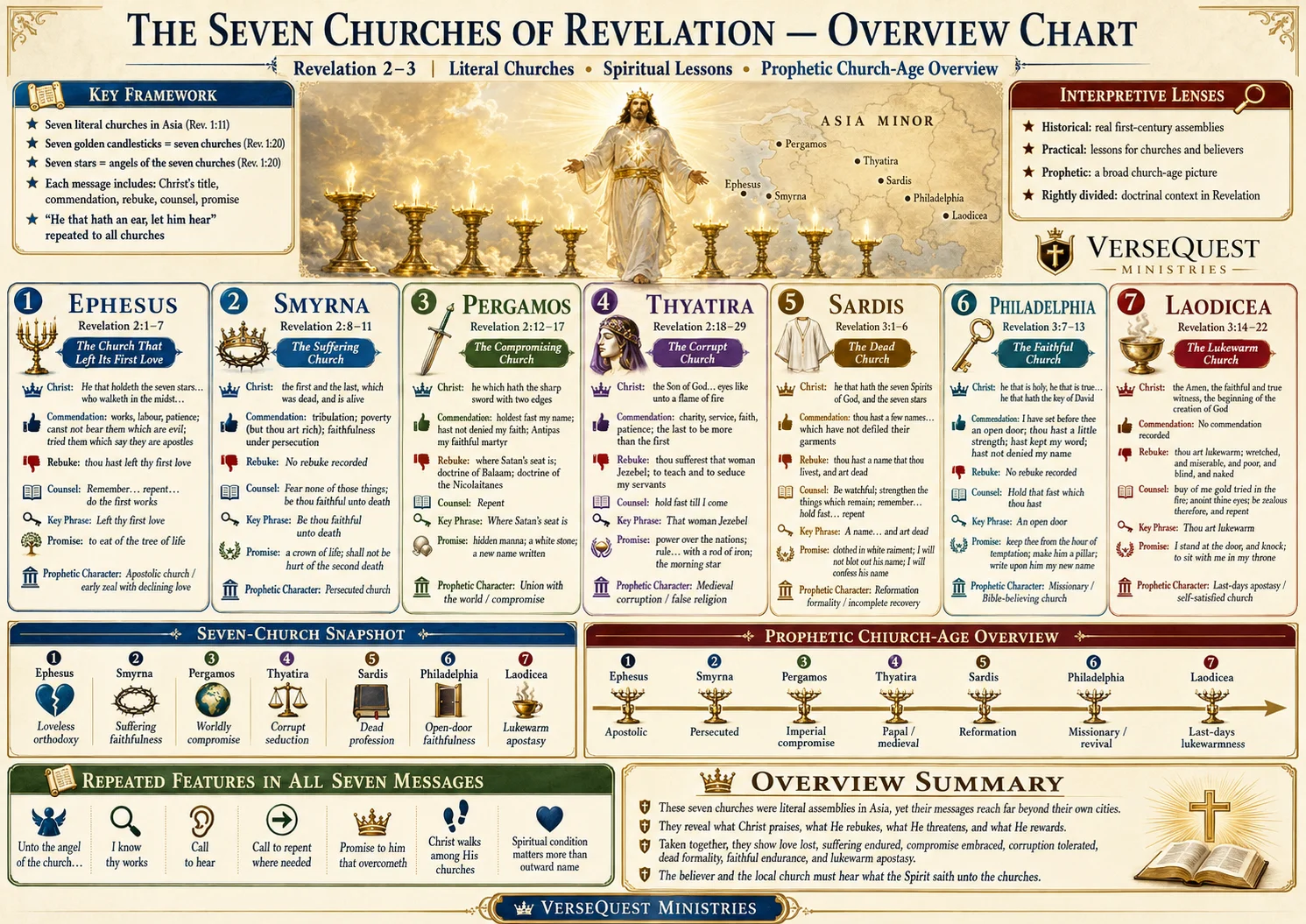
- The Seven Churches of Revelation Chart Collection – Christ Walking Among the Candlesticks
- A premium VerseQuest Ministries™ PDF chart collection covering the Seven Churches of Revelation in Revelation 2–3. Includes one overview chart plus individual KJV Bible study charts for Ephesus, Smyrna, Pergamos,…
- $12.99
- Add to cart
-
-
Messianic Prophecy Studies
-
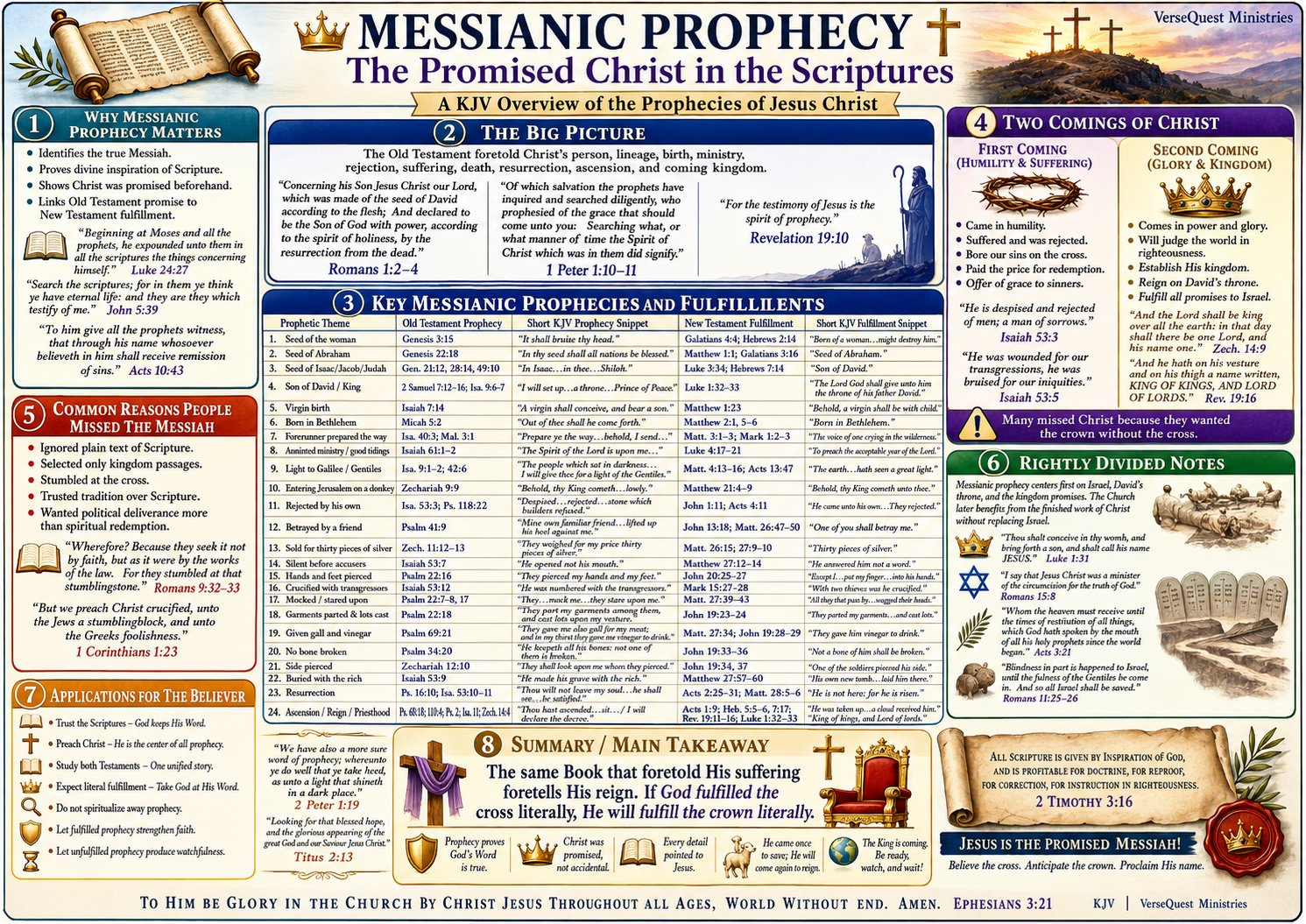
- Messianic Prophecy KJV Bible Study Chart – Printable Download
- This printable Messianic Prophecy KJV Bible Study Chart gives a clear overview of Old Testament prophecies fulfilled in Jesus Christ, including His lineage, birth, suffering, crucifixion, resurrection, and future reign.…
- $4.99
- Add to cart
-
-
Life of Christ
-
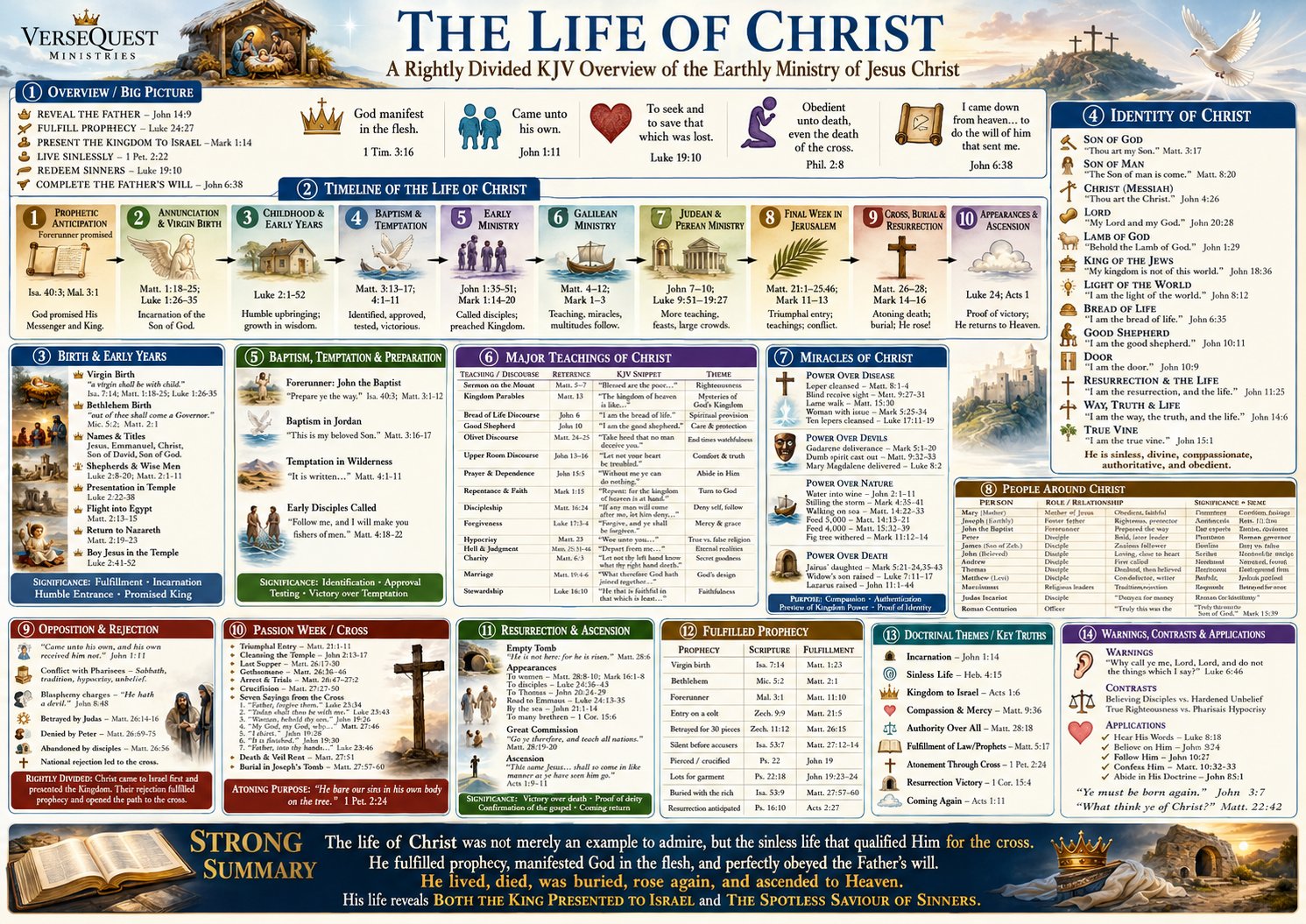
- The Life of Christ KJV Bible Study Chart – Printable Download
- A premium printable KJV Bible study chart giving a detailed overview of the life of Jesus Christ, including His birth, ministry, teachings, miracles, crucifixion, resurrection, and ascension. Designed for personal…
- $4.99
- Add to cart
-
-
Jesus Christ / Christology
-
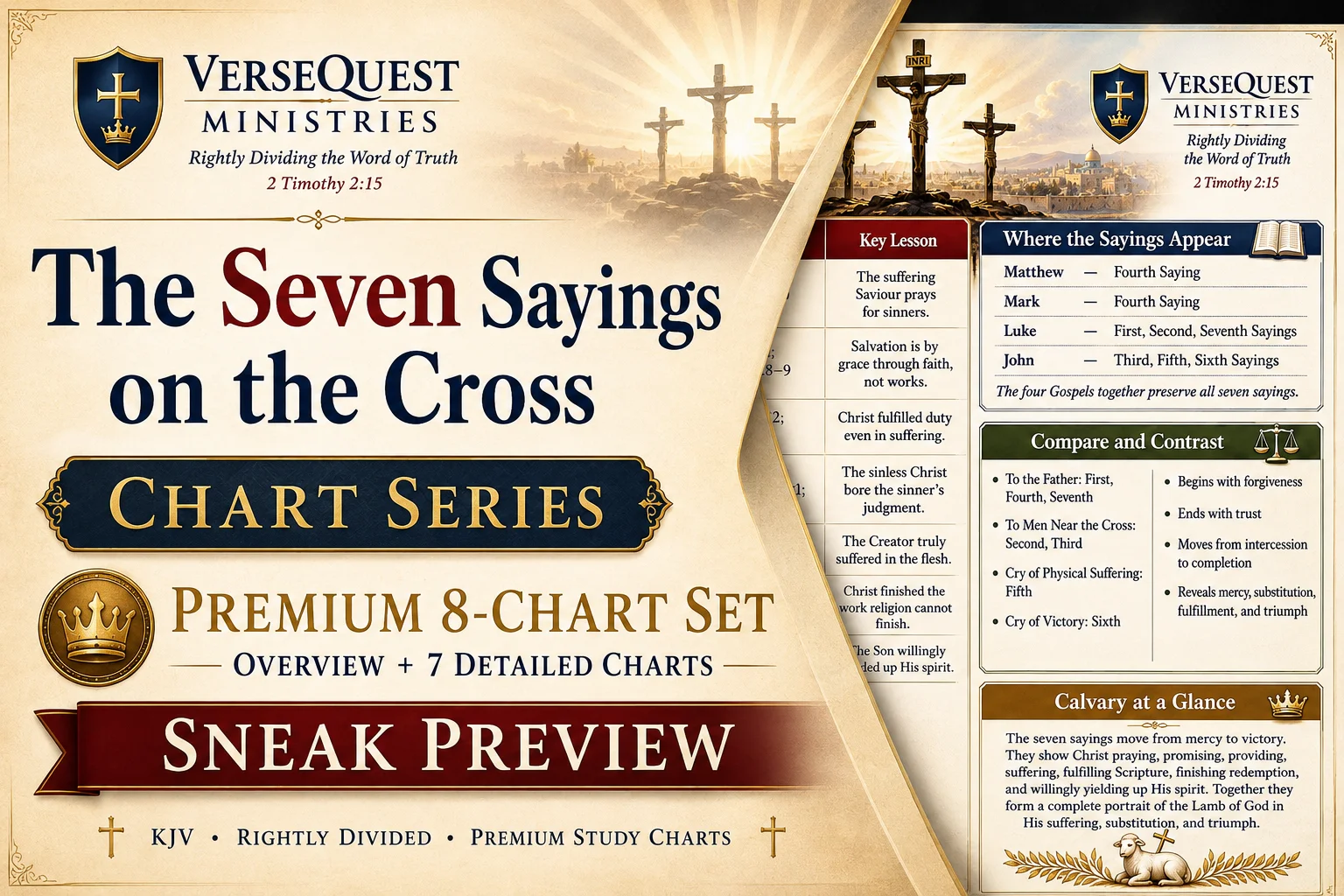
- The Seven Sayings on the Cross – Premium 8-Chart KJV Study Set
- A premium VerseQuest Ministries digital PDF study set on The Seven Sayings on the Cross, featuring an overview chart plus seven detailed KJV Bible study charts. This resource examines Calvary,…
- $12.99
- Add to cart
-