
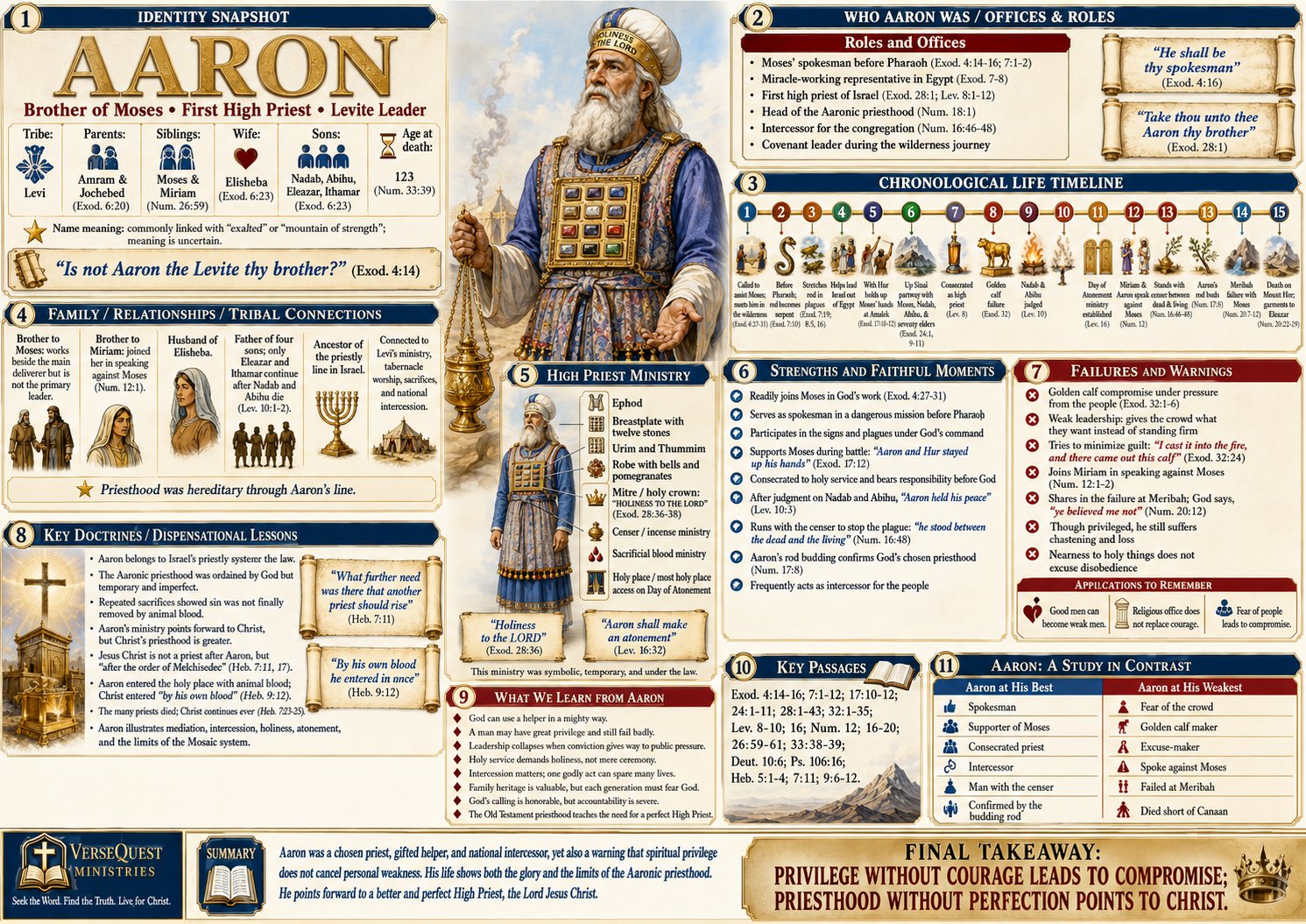
Aaron – Brother of Moses, Israel’s First High Priest, Intercessor, and Warning Against Compromise (KJV Bible Study Chart)
Study Aaron’s life with this detailed KJV chart covering his family, role beside Moses, high-priestly ministry, garments, intercession, golden-calf failure, budding rod, Meribah, and how his priesthood points to Jesus Christ.
$3.99
Description
Aaron: Brother of Moses, First High Priest, and Levite Leader is a detailed KJV Bible study chart examining the life, family, calling, priesthood, faithful service, serious failures, and doctrinal significance of one of the most prominent men in Israel’s wilderness history.
Aaron was born into the tribe of Levi to Amram and Jochebed. He was the older brother of Moses and Miriam, the husband of Elisheba, and the father of Nadab, Abihu, Eleazar, and Ithamar. He lived 123 years and died upon Mount Hor before Israel entered the promised land.
The chart begins with a complete identity snapshot that places Aaron within his family, tribe, generation, and historical setting. His life was closely connected with Moses, the exodus from Egypt, the giving of the law, Israel’s wilderness journey, the establishment of the priesthood, the tabernacle, the sacrificial system, and the nation’s repeated failures.
Aaron first appears prominently when God appoints him to serve as Moses’ spokesman. Moses feared that his lack of eloquence would prevent him from confronting Pharaoh, but the LORD declared that Aaron could speak well and would serve as Moses’ mouth before the people and the king.
Aaron therefore stood beside Moses during one of the most dangerous missions recorded in Scripture. He confronted Pharaoh, delivered the LORD’s commands, stretched out his rod during several plagues, and witnessed God overthrow Egypt’s power.
Although Aaron spoke publicly, he was not the primary leader of Israel. Moses held the central governmental and prophetic responsibility, while Aaron served as his spokesman, helper, priestly representative, and later the head of Israel’s priesthood.
The chart follows Aaron through a detailed chronological timeline. He is called to meet Moses, stands before Pharaoh, stretches out the rod, participates in the plagues, helps lead Israel out of Egypt, supports Moses during the battle with Amalek, accompanies selected leaders toward Mount Sinai, and is eventually consecrated as high priest.
Exodus 17 records Aaron and Hur holding up Moses’ hands during Israel’s battle with Amalek. As long as Moses’ hands remained raised, Israel prevailed. Aaron’s willingness to support Moses illustrates the importance of faithful assistance within God’s work.
Aaron’s greatest official responsibility began when God chose him and his sons for the priesthood. Exodus 28 declares, “Take thou unto thee Aaron thy brother”, establishing Aaron as Israel’s first high priest and the head of the hereditary Aaronic priesthood.
The high priest wore specially appointed garments that displayed holiness, glory, beauty, representation, and responsibility. These included the ephod, the breastplate containing twelve stones representing Israel’s tribes, the robe with bells and pomegranates, and the holy mitre bearing the words “HOLINESS TO THE LORD.”
Aaron carried the names of Israel before the LORD. His breastplate pictured representation, his sacrifices pictured substitution, and his entrance into the holy place pictured priestly access and intercession.
The Urim and Thummim were connected with priestly judgment and divine direction. Aaron’s office was therefore not ceremonial decoration. It involved serious responsibility before God for worship, sacrifice, holiness, judgment, intercession, and the nation’s covenant life.
Aaron ministered with sacrificial blood, incense, priestly garments, holy ordinances, and the appointed ceremonies of the tabernacle. On the Day of Atonement, he entered the holy place according to God’s strict command and made atonement for himself, his household, and the congregation.
The chart emphasizes that Aaron could not approach God casually. He did not enter the holiest place according to personal preference or religious creativity. Everything was governed by God’s revealed pattern.
The death of Aaron’s sons Nadab and Abihu demonstrates the seriousness of holy service. They offered strange fire before the LORD, which He had not commanded, and divine judgment fell immediately.
After their death, Scripture records the solemn words, “Aaron held his peace.” Aaron accepted God’s judgment even though the loss involved his own sons. Nearness to holy things did not excuse disobedience or permit the priesthood to rewrite God’s commands.
Aaron later demonstrated courageous intercession during the rebellion of Korah. When judgment broke out among the congregation, Moses commanded Aaron to take a censer, place incense upon it, and run among the people.
Numbers 16 records that Aaron “stood between the dead and the living; and the plague was stayed.” This scene is one of the most powerful moments in Aaron’s ministry. The high priest entered the place of death carrying the God-appointed means of intercession.
Aaron’s rod that budded provided another public confirmation of God’s chosen priesthood. After Korah’s rebellion challenged divine authority, God caused Aaron’s rod to bud, blossom, and produce almonds.
The dead rod producing life identified Aaron’s priestly line and silenced those who attempted to seize an office God had not given them. Religious ambition could not manufacture divine calling.
Aaron also displayed meaningful strengths throughout his life. He readily joined Moses in God’s work, entered Pharaoh’s presence, supported Moses during battle, accepted priestly responsibility, interceded for Israel, and served through decades of wilderness difficulty.
Yet the chart refuses to present Aaron as flawless. His privileges were extraordinary, but spiritual privilege did not remove personal weakness. His office was holy, but the man wearing the garments remained capable of fear, compromise, pride, and unbelief.
Aaron’s most notorious failure occurred at the golden calf. While Moses remained upon Mount Sinai, the people pressured Aaron to make gods that would lead them. Aaron collected their gold, fashioned the calf, built an altar, and announced a religious feast.
This failure reveals the danger of leadership governed by public pressure. Aaron knew the truth but surrendered to the crowd. He possessed authority but lacked courage at a decisive moment.
When Moses confronted him, Aaron minimized his guilt and offered one of Scripture’s weakest excuses: “I cast it into the fire, and there came out this calf.” The image did not manufacture itself. Aaron attempted to reduce a deliberate act of rebellion into an almost accidental event.
The golden-calf failure warns that religious leaders may use spiritual language while accommodating idolatry. Aaron proclaimed a feast to the LORD while standing before an image forbidden by God. Attaching biblical language to disobedience does not sanctify it.
Aaron also joined Miriam in speaking against Moses. Their criticism involved Moses’ marriage but exposed a deeper challenge to his God-given authority. Miriam received visible judgment, while Aaron quickly confessed their foolishness and appealed to Moses for mercy.
The incident demonstrates that proximity to leadership does not authorize rebellion against it. Aaron’s priestly position did not permit him to challenge God’s chosen servant through jealousy, criticism, or family influence.
At Meribah, both Moses and Aaron failed to sanctify the LORD before Israel. God declared that they would not bring the congregation into the promised land because they did not believe Him in that critical moment.
Aaron’s long history of service did not erase accountability. Past usefulness did not make present disobedience harmless. He remained God’s appointed priest, but he still suffered the consequences of failure.
The chart compares Aaron at his best with Aaron at his weakest. At his best, he was a spokesman, supporter of Moses, consecrated priest, intercessor, bearer of the censer, and the man whose budding rod confirmed God’s calling.
At his weakest, he feared the crowd, made the golden calf, excused his actions, joined criticism against Moses, failed at Meribah, and died before entering Canaan.
This contrast makes Aaron deeply instructive. He was neither a useless failure nor a flawless hero. He was a chosen servant whose life displayed both the glory of divine appointment and the danger of human weakness.
The chart also examines Aaron’s family relationships. He worked beside Moses but did not possess Moses’ primary authority. He joined Miriam in criticism, married Elisheba, fathered the priestly line, and suffered the loss of Nadab and Abihu.
After Nadab and Abihu died, Eleazar and Ithamar continued priestly service. The Aaronic priesthood was hereditary, passing through Aaron’s descendants according to God’s covenant order.
Aaron’s connection to the tribe of Levi placed him within Israel’s tabernacle ministry, sacrifices, worship, teaching, intercession, and national service. Yet Aaron alone began the high-priestly line.
The chart presents several major doctrinal and dispensational lessons. Aaron belonged to Israel’s priestly system under the Mosaic law. His office should not be transferred carelessly to the Body of Christ or used to create a continuing earthly priesthood between Christians and God.
The Aaronic priesthood was ordained by God but remained temporary and imperfect. Its priests were mortal, sinful, limited, and required repeated sacrifices. Aaron had to offer sacrifice for his own sin before representing the congregation.
Repeated animal sacrifices could not permanently remove sin. They provided ceremonial cleansing, covenant atonement, and prophetic pictures, but they could not perfect the conscience or accomplish eternal redemption.
Aaron’s ministry points forward to Jesus Christ, but Jesus is far greater than Aaron. Christ did not descend from Aaron’s priestly line; He is a priest “after the order of Melchisedec.”
Jesus Christ did not need to offer a sacrifice for His own sins because He possessed no sin. Aaron entered the earthly holy place with the blood of animals, but Christ entered heaven itself through the value of His own blood.
Aaron’s priesthood required repetition because its sacrifices could never finish redemption. Christ offered one sacrifice for sins forever and sat down because the work was complete.
Aaron died and his office passed to another. Jesus Christ possesses an unchangeable priesthood because He lives forever. He is able to save completely those who come unto God through Him because He ever lives to make intercession.
Aaron therefore illustrates mediation, intercession, holiness, sacrifice, atonement, representation, and priestly access while also demonstrating the limitations of the Mosaic system.
The chart’s practical lessons are direct. A gifted helper can become weak under pressure. A leader may possess great privilege and still fail badly. Leadership collapses when conviction gives way to public approval.
Holy service requires holiness rather than empty ceremony. Intercession matters because one godly servant may stand in the gap for many. Family heritage is valuable, but every generation must fear God personally.
God’s calling brings honour, but it also brings accountability. Spiritual position never removes the need for courage, humility, obedience, confession, and dependence upon the LORD.
Aaron’s story also warns against excuse-making. Sin should be confessed plainly rather than disguised through blame, exaggeration, selective memory, or impossible explanations.
The final lesson is that religious privilege without courage leads to compromise, while priesthood without perfection points beyond Aaron to Jesus Christ.
Aaron could carry Israel’s names upon his breastplate, but only Christ could carry the sins of the world in His own body upon the tree. Aaron could stand between the dead and the living temporarily, but Jesus Christ conquered death and gives eternal life.
This resource is ideal for personal Bible study, Bible-character instruction, studies in Exodus, Leviticus, and Numbers, priesthood and tabernacle teaching, leadership development, intercession studies, Sunday school, homeschool Bible curriculum, Bible institutes, sermon preparation, pastoral training, and Christ-centred studies of the Aaronic priesthood.
Aaron the high priest, brother of Moses, Aaronic priesthood, first high priest of Israel, tribe of Levi, spokesman before Pharaoh, golden calf, fear of the crowd, religious compromise, priestly garments, breastplate of judgment, Urim and Thummim, Day of Atonement, Nadab and Abihu, strange fire, Aaron’s censer, intercession for Israel, Aaron’s rod budded, failure at Meribah, Jesus Christ our High Priest
Aaron was born into the tribe of Levi to Amram and Jochebed. He was the brother of Moses and Miriam and became the first high priest of Israel.
Aaron was older than Moses, yet Moses held the primary leadership and prophetic office. Seniority did not determine divine calling.
God appointed Aaron as Moses’ spokesman because Moses feared his own lack of eloquence. Aaron’s ability was intended to strengthen Moses’ calling, not replace it.
Aaron stood before Pharaoh and participated in several miraculous signs and plagues. His ministry began in a setting of danger, confrontation, and national deliverance.
During Israel’s battle with Amalek, Aaron and Hur supported Moses’ weary hands. Faithful assistance can contribute greatly to victory even when the helper does not occupy the central office.
Aaron was chosen and consecrated as Israel’s first high priest. His office belonged to the Mosaic covenant and Israel’s national worship.
The high-priestly garments carried doctrinal meaning. The breastplate represented Israel before God, the holy mitre declared consecration, and every detail reflected divine order.
Aaron’s priestly ministry involved sacrifice, incense, intercession, judgment, teaching, representation, and entrance into the holy place.
The Day of Atonement demonstrated both Aaron’s privilege and his limitation. He entered by blood, but he first needed sacrifice for his own sin.
Nadab and Abihu died after offering strange fire. Their judgment proves that sincerity and priestly office do not excuse worship God has not commanded.
Aaron held his peace following their deaths. His silence acknowledged the righteousness and holiness of God’s judgment.
Aaron’s intercession during Korah’s rebellion is one of his strongest moments. He ran with the censer and stood between the dead and the living until the plague was stayed.
Aaron’s budding rod publicly confirmed God’s chosen priesthood. A dead rod producing life demonstrated that divine authority rests upon God’s appointment rather than human ambition.
The golden calf was Aaron’s greatest public failure. Fear of the people overcame loyalty to God’s command.
Aaron mixed idolatry with religious language by proclaiming a feast to the LORD before the calf. Using God’s name does not transform disobedience into worship.
His excuse concerning the calf exposed unwillingness to accept responsibility. Genuine repentance speaks plainly rather than manufacturing impossible explanations.
Aaron’s criticism of Moses with Miriam demonstrates the danger of family alliances formed against God-appointed leadership.
Aaron confessed quickly when Miriam was judged and appealed for mercy. His response shows that even serious failure can be followed by humility.
At Meribah, Aaron shared in Moses’ failure to sanctify the LORD. Their long histories of service did not cancel accountability.
Aaron died upon Mount Hor at 123 years old. His priestly garments were transferred to Eleazar, demonstrating the mortality and succession of the Aaronic priesthood.
The Aaronic priesthood was hereditary. Priestly office passed through Aaron’s descendants according to God’s covenant arrangement.
Aaron was a real historical priest, but his office also foreshadowed greater truths fulfilled in Jesus Christ.
Jesus is not a priest after Aaron’s order but after the order of Melchisedec. His priesthood is superior, eternal, and unchangeable.
Aaron offered animal blood repeatedly. Christ offered His own blood once and obtained eternal redemption.
Aaron needed atonement for himself. Christ is holy, harmless, undefiled, separate from sinners, and without personal sin.
Aaron died and required a successor. Jesus Christ lives forever and therefore possesses an unchangeable priesthood.
The Church does not require an earthly Aaronic priesthood. Every believer has direct access to God through Jesus Christ, the one great High Priest.
Aaron’s strengths teach service, support, intercession, courage, and responsibility. His failures warn against fear of man, excuse-making, compromise, envy, and unbelief.
The central lesson is that high privilege never removes accountability. Nearness to holy things must produce reverence rather than presumption.
Aaron Bible-character studies, Old Testament priesthood teaching, tabernacle studies, high-priest garments, leadership under pressure, resisting fear of man, confronting religious compromise, confession without excuses, biblical intercession, teaching holiness in ministry, handling family conflict, pastoral accountability, Christ-centred typology, Sunday school lessons, homeschool Bible curriculum, Christian school teaching, Bible institute classes, sermon preparation
King James Bible, Strong’s Concordance, Thompson Chain-Reference Bible, Treasury of Scripture Knowledge, Nave’s Topical Bible, Bible atlas, Exodus commentary notes, Leviticus priesthood studies, Numbers wilderness outlines, tabernacle diagrams, high-priest garment charts, Day of Atonement studies, Hebrews 5–10 commentary materials, Aaron and Moses character comparisons, leadership-accountability resources, VerseQuest Bible-character and doctrine charts
Related products
-
Angels
-
-67%
- The Doctrine of Angels Made Plain – 620-Page KJV Bible Study PDF
- The Doctrine of Angels Made Plain is a 620-page KJV Bible study that traces angels from Genesis to Revelation. This premium VerseQuest PDF explains holy angels, Christ’s supremacy over angels,…
- Original price was: $29.99.$9.99Current price is: $9.99.
- Add to cart
-
-67%
-
Bible Overview Series
-
- The New Jerusalem Made Plain — 621-Page PDF Study
- The New Jerusalem Made Plain is a massive 621-page KJV/rightly divided PDF study on the literal holy city revealed in Revelation 21–22. This 100-essay book makes the New Jerusalem plain…
- $34.99
- Add to cart
-
-
Heaven
-
- The Doctrine of Heaven Made Plain — 599-Page KJV Bible Study PDF
- A massive 599-page KJV, rightly divided study on heaven, covering the present heaven, resurrection body, Rapture, Millennium, New Jerusalem, eternal state, hard questions, funeral lies, and cult errors.
- $34.99
- Add to cart
-
-
Bible Prophecy Charts
-
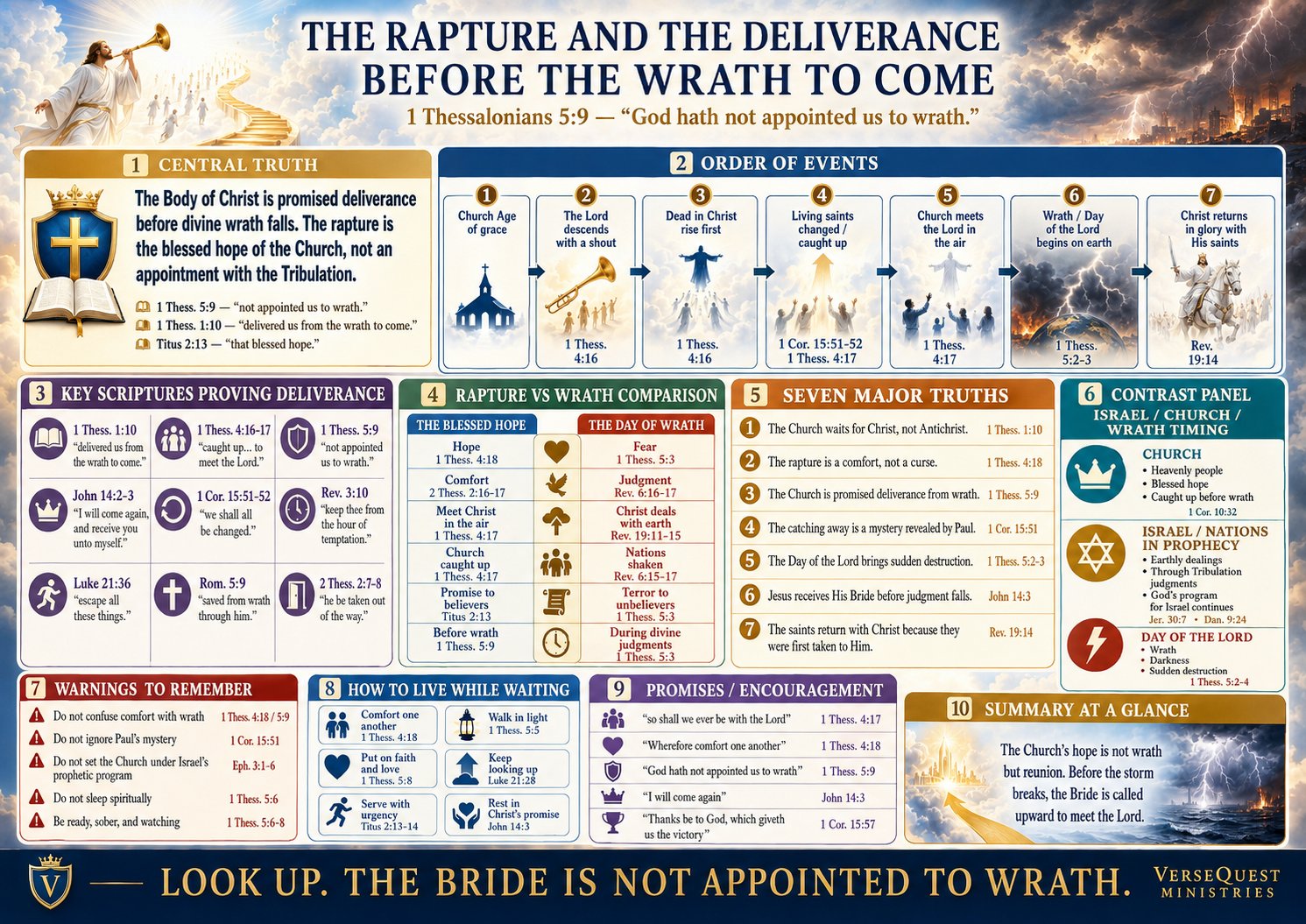
- The Rapture and the Deliverance Before the Wrath to Come – Printable Bible Study Chart
- Printable KJV Bible study chart on The Rapture and the Deliverance Before the Wrath to Come, showing from 1 Thessalonians 5:9 that the Church is not appointed to wrath. This…
- $4.99
- Add to cart
-
-
Revelation
-
-71%
- Moses and Elijah: The Two Witnesses Made Plain
- Moses and Elijah: The Two Witnesses Made Plain is a 636-page premium VerseQuest PDF study proving from Scripture that the Two Witnesses of Revelation 11 are Moses and Elijah. This…
- Original price was: $34.99.$9.99Current price is: $9.99.
- Add to cart
-
-71%