
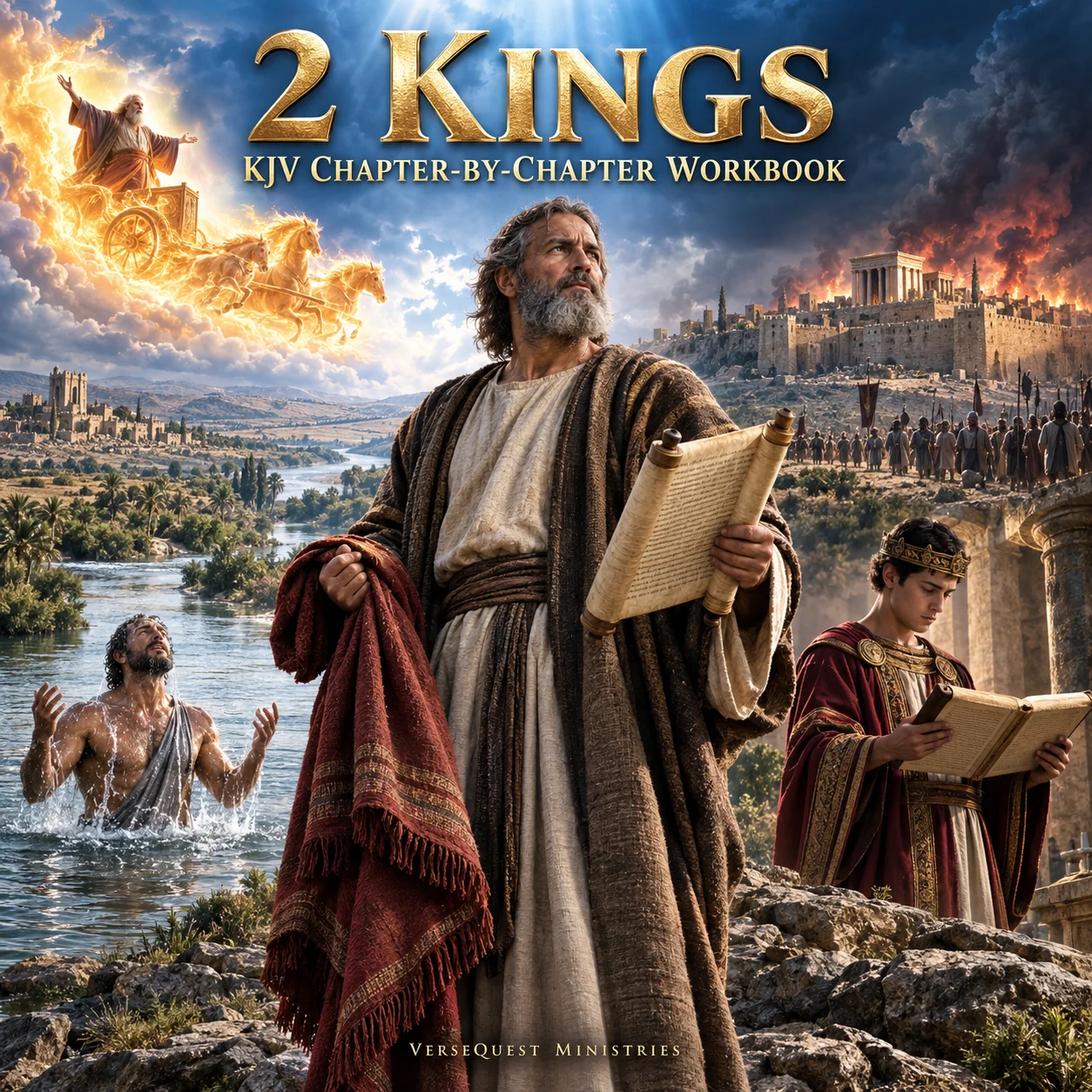
2 Kings KJV Chapter-by-Chapter Workbook
The 2 Kings KJV Chapter-by-Chapter Workbook is a complete 460-page downloadable Bible curriculum covering all 25 chapters of Second Kings from a Bible-believing, King James Bible-centered, rightly divided perspective.
Every chapter contains twelve coordinated pages covering close reading, exposition, structure, people and motives, KJV vocabulary, doctrine, right division, cross-references, difficult passages, error correction, special studies, written review, teach-back preparation, teacher guidance, suggested answers, and a model summary.
Students will examine Elijah’s translation, Elisha’s signs, Naaman’s cleansing, Jehu’s judgment upon Ahab’s house, the preservation of Joash, Israel’s Assyrian captivity, Hezekiah’s deliverance, Manasseh’s corruption, Josiah’s reforms, Jerusalem’s destruction, Judah’s Babylonian captivity, and the survival of David’s royal line.
The workbook also includes three learning tracks, multiple course schedules, five cumulative reviews, 25 advanced studies with worksheets, ten master charts with analysis, a four-part final assessment, answer guides, an eight-part KJV glossary, subject and Scripture indexes, supplemental research studies, a final teaching project, evaluation rubric, bookmarks, and a certificate of completion.
It may be printed for handwritten work or studied digitally with compatible PDF software. It is ideal for personal study, homeschool, Sunday school, Christian schools, church classes, discipleship groups, Bible institutes, pastors, preachers, teachers, and ministry training.
$24.99
Description
The 2 Kings KJV Chapter-by-Chapter Workbook is a complete 460-page downloadable Bible curriculum designed to lead students carefully through all 25 chapters of Second Kings. Continuing directly from First Kings, the workbook begins after Ahab’s death and follows the divided kingdoms of Israel and Judah through prophetic ministry, political upheaval, incomplete reforms, foreign invasion, Assyrian captivity, the destruction of Jerusalem, and the surviving hope connected with David’s royal line.
The opening chapters complete Elijah’s earthly ministry and establish Elisha as his prophetic successor. Students examine Ahaziah’s appeal to Baal-zebub, the fire that consumes the proud captains, Elijah’s translation by a whirlwind, the mantle received by Elisha, the divided Jordan, the healing of Jericho’s waters, and the severe judgment at Bethel. Careful attention is given to frequently misunderstood details, including the fiery chariot, Elisha’s request for a double portion, and the forty-two young persons torn by the bears.
Elisha’s ministry receives extensive chapter-by-chapter treatment. The workbook follows the prophet through the Moabite campaign, the multiplication of the widow’s oil, the birth and restoration of the Shunammite woman’s son, the cleansing of poisoned pottage, the feeding of one hundred men, Naaman’s cleansing, Gehazi’s covetousness, the floating axe head, the unseen armies at Dothan, the siege of Samaria, and the discovery of the abandoned Syrian camp by four lepers. These signs are studied as historical acts of God within Israel’s prophetic history rather than as formulas that believers may reproduce at will.
Students learn to distinguish divine provision from prosperity teaching, obedient response from meritorious works, prophetic signs from religious magic, and legitimate Christ-centered connections from uncontrolled typology. Naaman’s washing in Jordan is not turned into Christian water baptism, Elisha’s bones are not treated as relics possessing automatic power, and the prophet’s miracles are not presented as techniques available through imitation. Later Scripture is allowed to govern comparisons between Israel’s prophets and Jesus Christ.
The workbook then traces the rise of Hazael and the anointing of Jehu. Students follow the exact fulfillment of judgment upon Ahab’s house, the death of Jezebel, the destruction of Baal worship, and Jehu’s failure to depart from Jeroboam’s calves. His zeal is evaluated carefully: he performs the commission given against Ahab’s dynasty, but his incomplete obedience shows that energetic reform, political usefulness, and personal ambition must not be confused with an undivided heart toward the LORD.
The preservation of the Davidic royal line receives special attention in the accounts of Athaliah, Jehosheba, Jehoiada, and Joash. While Athaliah attempts to destroy the royal seed, the infant Joash is hidden in the house of the LORD until his public coronation. The workbook connects this preservation with the Davidic covenant without transferring Israel’s throne or national promises to the Body of Christ. Joash’s temple repairs, the handling of dedicated money, Jehoiada’s influence, and the king’s later decline are examined in connection with leadership, accountability, financial integrity, and borrowed conviction.
As the royal histories continue, students compare Amaziah, Azariah or Uzziah, Jotham, Ahaz, Hezekiah, Manasseh, Amon, Josiah, and Judah’s final kings with the rapidly changing dynasties of northern Israel. Special chronological guidance explains accession years, partial years, co-regencies, and alternate royal names without pretending that every reconstruction possesses the authority of the inspired text. The workbook teaches students to distinguish an explicit biblical fact from a strong inference, possible reconstruction, or speculative claim.
The fall of Samaria is studied as more than a military defeat. Second Kings 17 supplies the inspired explanation for Israel’s captivity: the people rejected the LORD, followed vanity, served idols, refused prophetic warnings, hardened their necks, and continued in the sins of Jeroboam. The workbook addresses Assyria’s deportations, the imported settlers, mixed worship, the continuing existence of identifiable Israelites, and errors surrounding the so-called lost tribes. Israel’s captivity does not erase Israel from God’s knowledge or transfer the nation’s identity and covenants to the Church.
Hezekiah’s reign provides a concentrated study of reform, trust, prayer, propaganda, deliverance, sickness, and pride. Students examine the removal of the high places, the destruction of Nehushtan, Rabshakeh’s carefully constructed speech, Hezekiah’s response before the LORD, Isaiah’s prophetic word, and the destruction of the Assyrian army. The workbook then studies Hezekiah’s sickness, the fifteen added years, the sign involving the shadow, the Babylonian ambassadors, and the king’s proud display of his treasures.
The contrast between Hezekiah, Manasseh, and Josiah reveals both the power and the limitations of royal reform. Manasseh’s idolatry, occult practices, child sacrifice, and shedding of innocent blood bring lasting national consequences. Josiah’s tender response to the rediscovered book of the law leads to covenant renewal, the removal of idolatry, the destruction of the Bethel altar foretold in First Kings 13, and the keeping of a remarkable Passover. Yet even genuine reform cannot make the accumulated consequences of generations of rebellion disappear.
The final chapters trace Babylon’s advance through tribute, rebellion, siege, deportation, temple plunder, and destruction. Students compare the stages of Judah’s captivity, examine the different ages associated with Jehoiachin through the evidence of Kings and Chronicles, and follow the fall of Jerusalem under Zedekiah. The temple, palace, houses, and walls are destroyed, while the surviving population is carried away or scattered after Gedaliah’s assassination.
Second Kings does not end with complete restoration. It closes with captive Jehoiachin released from prison, given an honorable place, and supplied with a daily allowance in Babylon. This restrained conclusion does not reverse Judah’s judgment, but it confirms that the Davidic line has not vanished. The book’s movement from Elijah’s translation to Judah’s captivity demonstrates that prophets may depart, kings may die, cities may burn, and nations may be removed from the land, but the word of the LORD continues to govern history and preserve the hope established by covenant.
Every biblical chapter receives twelve coordinated pages. The ten student pages cover chapter focus, principal movements, close reading, exposition, people and motives, KJV vocabulary, doctrine and right division, cross-reference study, difficult passages, error correction, special studies, written review, personal application, and teach-back preparation. Two additional pages provide a Teacher and Leader Guide, suggested answers, and a model chapter summary.
The course-preparation section includes Core, Standard, and Ministry Training tracks; interpretive principles; course outcomes; historical and teaching divisions; one-sentence chapter summaries; a continuation guide from First Kings; royal chronology instruction; geographical studies; a prophets-and-kings survey; recurring biblical formulas; a 25-week schedule; a 13-week intensive schedule; and a 50-lesson classroom plan.
The additional curriculum contains five cumulative reviews with answer guides, 25 advanced studies with coordinated research worksheets, and ten master charts with analysis pages. These charts cover the kings of Judah, the kings and dynasties of Israel, Elijah and Elisha, Elisha’s recorded signs, prophets and kings, Assyria’s advance, Hezekiah’s crisis, Josiah’s reforms, the stages of Babylonian captivity, and the recurring standards by which Scripture evaluates Israel’s rulers.
The workbook concludes with a four-part final assessment, answer guide, teacher-evaluation page, eight-part KJV glossary, selected subject index, selected Scripture index, eight supplemental study and research tools, a final teaching project, planning worksheet, 100-point evaluation rubric, final challenge, and certificate of completion.
This searchable, bookmarked PDF is formatted on letter-size pages. It may be printed for handwritten study or used on a computer or tablet with compatible PDF software for highlighting, comments, drawings, and added text. The 2 Kings KJV Chapter-by-Chapter Workbook is suitable for personal Bible study, homeschool families, Sunday school classes, Christian schools, church Bible studies, discipleship groups, Bible institutes, prison and recovery ministries, pastors, preachers, teachers, and ministry-training programs.
This is not merely a survey of ancient rulers and battles. It is a working Bible curriculum that teaches students to read the words, track the kingdoms, test the rulers, hear the prophets, compare Scripture with Scripture, handle difficult passages honestly, preserve dispensational distinctions, and recognize the governing authority of the word of the LORD.
The continuing authority of the word of the LORD — Prophets, kings, armies, cities, captivities, and foreign empires remain subject to God’s revealed word. Continuation from First Kings — Second Kings begins with the kingdom already divided and the judgment upon Ahab’s house already announced. Elijah’s final ministry — Ahaziah’s apostasy and the fire from heaven demonstrate that royal authority cannot command or silence God’s prophet. Elijah’s translation — The LORD removes Elijah by a whirlwind while continuing prophetic testimony through Elisha. Prophetic succession — Elisha’s double portion concerns inheritance and recognized office rather than a selfish demand for greater fame. The mantle and the divided Jordan — Elisha’s return across Jordan publicly confirms that the LORD has established him as Elijah’s successor. Mercy and judgment at the beginning of Elisha’s ministry — Healed waters at Jericho and severe judgment at Bethel display two aspects of prophetic authority. Provision during debt and scarcity — The widow’s oil, cleansed food, and multiplied bread demonstrate divine care joined with responsible human action. The Shunammite woman — Her hospitality, discernment, grief, determination, and restored son form one of the book’s most substantial household narratives. Naaman’s cleansing — A powerful Syrian captain must abandon offended pride and submit to the simple word delivered through Israel’s prophet. Gehazi’s covetousness — Privileged proximity to truth cannot protect a deceitful servant who attempts to commercialize grace. The unseen armies of God — Dothan reveals that visible military circumstances do not measure the full reality of divine protection. Good tidings during famine — Four lepers discover the abandoned Syrian camp and become unlikely messengers of deliverance. Prophecy concerning Hazael — Divine foreknowledge does not remove Hazael’s responsibility for the cruelty he later commits. Jehu’s commission — Jehu becomes the instrument through whom the announced judgment upon Ahab’s dynasty is executed. The exact fulfillment of judgment — Naboth’s field, Jezebel’s death, and the fall of Ahab’s house demonstrate the precision of the prophetic word. Jehu’s divided obedience — He destroys Baal worship but preserves the calves, revealing the difference between zeal and wholehearted faithfulness. The preserved royal seed — Joash’s survival through Athaliah’s massacre displays the certainty of the Davidic promise. Jehoiada’s influence — Wise spiritual leadership can direct a ruler, but borrowed conviction may collapse after the counselor is gone. Temple repair and stewardship — Joash’s reforms raise practical questions concerning neglected worship, financial procedures, trust, and accountability. The arrow of deliverance — Joash’s limited response before the dying Elisha illustrates missed opportunity within a promised deliverance. Royal pride after victory — Amaziah’s success in Edom becomes the occasion for a needless challenge that humiliates Judah. Royal synchronisms and alternate names — Accession years, partial years, co-regencies, and names such as Azariah and Uzziah require patient study. The advance of Assyria — Tribute and political dependence gradually lead to invasion, deportation, and the fall of Samaria. Ahaz’s altered altar — Political fear leads Judah’s king to copy pagan worship and displace the order revealed by God. The inspired causes of captivity — Israel falls because of persistent covenant rebellion, not merely because Assyria possesses a stronger army. The danger of mixed worship — The imported settlers fear the LORD while serving their own gods, producing religious confusion rather than acceptable worship. Israel’s identity after captivity — Deportation destroys the northern kingdom’s political independence without erasing the tribes from God’s knowledge. Hezekiah’s reform — The king removes high places, breaks images, destroys Nehushtan, and trusts the LORD in a manner unequalled among Judah’s surrounding rulers. Religious objects turned into idols — The destruction of the bronze serpent shows that a legitimate historical object must not become an object of worship. Rabshakeh’s propaganda — Assyria combines selective truth, ridicule, intimidation, false promises, and theological distortion to weaken Judah’s confidence. Hezekiah’s prayer — The king spreads the Assyrian letter before the LORD and seeks deliverance for the honor of God’s name. The Assyrian defeat — Jerusalem’s deliverance demonstrates that imperial power remains subject to the word spoken through Isaiah. The fifteen added years — Hezekiah’s healing reveals divine mercy while the remainder of his life warns against pride and careless display. Manasseh’s corruption — Idolatry, occult practice, child sacrifice, and innocent blood bring Judah toward irreversible national judgment. Personal repentance and national consequences distinguished — Chronicles records Manasseh’s personal humbling, while Kings emphasizes the continuing effects of his reign upon Judah. The rediscovered book of the law — Josiah’s response shows the authority of the written word to produce conviction, humility, inquiry, and reform. Huldah’s prophetic witness — The prophetess confirms both coming judgment and mercy toward Josiah because his heart is tender. Josiah’s covenant reform — The king removes idols, defiles false worship centers, fulfills the prophecy concerning Bethel, and restores the Passover. Reformation and accumulated consequence — Genuine reform matters, but it does not make generations of rebellion and innocent blood historically unreal. The stages of Babylonian captivity — Judah declines through tribute, rebellion, raids, deportation, temple plunder, siege, and final destruction. The fall of Jerusalem — The destruction of the city and temple fulfills repeated covenant and prophetic warnings. The captive Davidic king — Jehoiachin’s release leaves a restrained sign that David’s royal line has survived the catastrophe. Israel and the Body of Christ distinguished — Israel’s land, covenants, throne, temple, national judgments, and promised restoration retain their biblical identity.
- Central argument: Second Kings records how the word of the LORD continues through Elijah and Elisha, measures every king, warns both kingdoms, brings Israel to Assyrian captivity and Judah to Babylonian captivity, and preserves the Davidic line after Jerusalem falls.
- Book scope: Second Kings contains 25 chapters and 719 verses.
- Historical opening: The book opens after Ahab’s death, when Moab rebels and Ahaziah seeks counsel from Baal-zebub.
- Historical conclusion: The book ends in Babylon with Jehoiachin released from prison, honored above other captive kings, and given a daily allowance.
- Primary kingdoms: Judah in the south and the northern kingdom of Israel must remain distinct throughout the book.
- Major foreign powers: Syria dominates many earlier conflicts, Assyria destroys the northern kingdom, and Babylon destroys Jerusalem.
- Controlling movement: Elijah’s departure leads to Elisha’s accredited ministry; prophetic mercy gives way to royal judgment; Jehu’s zeal remains incomplete; Israel’s dynasties collapse; Assyria removes the northern kingdom; Hezekiah and Josiah bring limited reforms; Babylon destroys Jerusalem; and David’s captive heir remains alive.
- Elijah’s translation: The chariot of fire separates Elijah and Elisha, while the whirlwind takes Elijah up.
- Double portion: Elisha’s request is best understood through firstborn inheritance and succession rather than a demand for twice Elijah’s fame.
- Bethel judgment: The passage does not describe harmless toddlers, and it says the bears tore forty-two without expressly stating that every person died.
- Elisha’s signs: The miracles authenticate prophetic ministry and reveal divine power, mercy, judgment, provision, cleansing, protection, and life.
- Miracles and method: Historical signs should not be converted into rituals, financial formulas, magical objects, or guaranteed techniques.
- Naaman: His social rank and military success cannot remove his uncleanness; he must humble himself before the word delivered through the prophet.
- Jordan: The river possesses no independent cleansing power, and Naaman’s seven washings do not establish Christian water baptism.
- Gehazi: The servant’s deception demonstrates that religious access and correct vocabulary can conceal covetousness without hiding it from God.
- Dothan: Elisha’s servant initially judges the situation by visible numbers, while the opened eyes reveal the greater heavenly host.
- Samaria’s famine: Human unbelief does not prevent fulfillment, but the unbelieving lord sees the abundance without enjoying it.
- Four lepers: Those standing outside the city become the first human messengers of the deliverance God has already accomplished.
- Hazael: Elisha’s knowledge of future cruelty does not cause the cruelty or remove Hazael’s responsibility.
- Jehu: Authorized action in one area does not prove complete faithfulness in every area.
- Incomplete reform: Jehu removes Baal while retaining the calves because the counterfeit national religion remains politically useful.
- Athaliah: Her attempt to destroy the royal seed directly threatens the visible continuation of David’s house.
- Joash: The hidden child demonstrates that God can preserve His promise through one protected heir.
- Jehoiada: Joash’s later decline shows the danger of conviction that depends primarily upon another person’s presence.
- Temple finances: The repair account distinguishes collecting money, assigning responsibility, paying workers, and maintaining trustworthy administration.
- Elisha’s bones: The restored man confirms the continuing truth of the LORD’s word; the passage does not establish a shrine or doctrine of relic power.
- Amaziah: One victory does not make every later ambition wise.
- Royal chronology: Alternate names, co-regencies, accession systems, and partial years should be considered without changing the wording of Scripture.
- Ahaz: Political fear moves him from seeking imperial help to redesigning worship after a foreign pattern.
- Urijah: Obedience to a king does not excuse disobedience to God’s revealed order.
- Israel’s captivity: Assyria supplies the political instrument, but covenant rebellion supplies the inspired cause.
- The northern tribes: Captivity scatters and weakens the kingdom without making the tribes permanently unknown to God.
- Mixed worship: Fearing the LORD in speech while serving other gods in practice is not acceptable balance.
- Hezekiah: Trust is displayed not merely through speech but through the removal of entrenched idolatry and dependence upon the LORD during crisis.
- Nehushtan: A divinely appointed object from earlier history becomes an idol when people burn incense to it.
- Rabshakeh: Effective propaganda often mixes facts, mockery, threats, false alternatives, and distorted theology.
- Hezekiah’s prayer: The king does not merely ask for personal survival; he seeks deliverance so that the kingdoms may know that the LORD alone is God.
- Assyria’s fall: The empire that boasts against Jerusalem cannot move beyond the boundary established by the LORD.
- The added years: Divine mercy in healing does not eliminate the need for humility during the life that follows.
- Manasseh: Personal repentance can be genuine while consequences from earlier leadership continue to affect a nation.
- The found book: Josiah’s reform begins when the written word is heard, believed, and allowed to judge the existing religious order.
- Huldah: Her prophecy joins unavoidable national judgment with personal mercy toward a tender and humbled king.
- Josiah and Bethel: His actions fulfill the prophecy spoken by the man of God centuries earlier in First Kings 13.
- Josiah’s reform: The removal of idols and restoration of Passover are genuine acts of obedience even though national wrath remains.
- Babylonian captivity: Judah’s fall occurs in stages rather than through one isolated event.
- Jerusalem’s destruction: Temple possession and Davidic history do not protect a rebellious generation from announced judgment.
- Jehoiachin: His release is not the restoration of Judah, but it preserves restrained hope within captivity.
- Right division: Moral instruction may be applied today without relabeling Israel, Judah, Jerusalem, the temple, the throne, or the covenants as the Body of Christ.
- Question for further study: How do Elisha’s signs establish his prophetic office while also revealing that Christ is greater than every prophet?
- Question for further study: Which steps repeatedly turn political fear into spiritual compromise?
- Question for further study: How does Second Kings distinguish partial reform from wholehearted obedience?
- Question for further study: What does Rabshakeh’s speech teach about recognizing persuasive mixtures of truth and falsehood?
- Question for further study: How do Kings, Chronicles, Isaiah, and Jeremiah complement one another without serving identical purposes?
- Memorable teaching point: Elijah departed, but the word of the LORD did not depart with him.
- Memorable teaching point: Jehu destroyed the house of Ahab but would not destroy the idols that protected his own throne.
- Memorable teaching point: Israel’s army could not see the chariots around Dothan, but invisible protection was no less real.
- Memorable teaching point: The book found in the temple judged the worship already taking place around it.
- Memorable teaching point: Jerusalem burned and the king sat captive, but the Davidic line remained alive.
- Memorable teaching point: The throne may be empty and the city burned; the word of the LORD still stands.
For personal Bible study, the workbook provides a disciplined method for reading every chapter of Second Kings with an open King James Bible. Students can identify principal movements, mark repeated formulas, define older words, trace prophetic fulfillment, compare parallel passages, answer difficult questions, and prepare a one-sentence summary before consulting the suggested answers.
For homeschool families and Christian schools, the workbook can serve as a complete Old Testament Bible course. The Core, Standard, and Ministry Training tracks allow the workload to be adapted to the student’s age and ability. Families may use the 25-week schedule, 13-week intensive schedule, or 50-lesson classroom plan. Reviews, research worksheets, glossary work, assessment, teaching project, rubric, and certificate provide substantial curriculum components.
For Sunday school and church Bible classes, teachers may assign selected student pages before class and use the coordinated Teacher and Leader Guides to organize instruction. The material supports individual lessons or extended series on Elijah, Elisha, Naaman, Jehu, the preserved royal seed, Hezekiah, Josiah, Assyria, Babylon, and the captivities.
For small groups and discipleship, the chapters offer focused discussion concerning humility, obedience, grief, provision, covetousness, leadership, compromised worship, incomplete reform, propaganda, prayer, pride, repentance, stewardship, responsibility, and the consequences of refusing repeated warning.
For pastors, preachers, and Bible teachers, the chapter movements, KJV vocabulary, doctrinal conclusions, right-division distinctions, difficult-passage studies, advanced research sections, and master charts provide an organized foundation for sermons, Bible lessons, prophetic studies, character studies, leadership training, and Old Testament surveys.
For Bible institutes and ministry training, students may complete all 460 pages, every advanced study, all ten master charts, the cumulative reviews, the final assessment, and the 20–30-minute teaching project. The course trains students to distinguish historical fact, doctrinal conclusion, inference, typology, chronology, harmonization, and present application.
For prison, recovery, counseling, and care ministries, selected studies may support teaching concerning consequences, humility, restored usefulness, grief, desperation, greed, repeated compromise, the influence of counselors, responsible stewardship, trusting God under pressure, and responding to the word with a tender heart.
For sermon and lesson preparation, teachers can use the 25 chapter outlines, special studies, cross-reference workshops, model summaries, advanced studies, and charts to prepare either a complete series through Second Kings or focused messages on individual events and characters.
A King James Bible with clear reference formatting
An exhaustive concordance keyed to the King James Bible
A reliable KJV Bible dictionary for prophetic offices, royal titles, military terms, temple objects, ancient measurements, geographical names, and older English words
A cross-reference Bible or treasury of Scripture cross-references
A map of the divided kingdoms showing Jerusalem, Samaria, Bethel, Jericho, Jordan, Carmel, Shunem, Dothan, Damascus, Jezreel, Moab, Edom, Assyria, and Babylon
A timeline comparing the kings of Judah with the kings and dynasties of Israel
A chronological chart showing the stages of Assyrian advance and Babylonian deportation
A comparative study of Elijah and Elisha using First Kings 17–21 and Second Kings 1–13
A study of Elisha’s signs and miracles with careful comparison to the miracles of Jesus Christ
A study of the Davidic covenant using Second Samuel 7, Kings, Chronicles, the Psalms, the Prophets, Matthew 1, and Luke 1
A study of Israel’s covenant warnings using Leviticus 26 and Deuteronomy 28–30
A comparison of Second Kings with its parallel records in Second Chronicles
A comparative study of Hezekiah’s crisis using Second Kings 18–20, Second Chronicles 29–32, and Isaiah 36–39
A study of Judah’s final kings using Second Kings 23–25, Second Chronicles 35–36, and Jeremiah
A study of prophecy and fulfillment from First Kings 13 through Second Kings 23
A study of the northern kingdom using Kings, Hosea, Amos, Jonah, and selected passages in Isaiah
A study of Assyria using Second Kings, Isaiah, Micah, and Nahum
A study of the Babylonian captivity using Second Kings, Second Chronicles, Jeremiah, Ezekiel, and Daniel
1 Kings KJV Chapter-by-Chapter Workbook for the beginning of Solomon’s reign, the divided kingdom, Jeroboam’s religion, Elijah’s ministry, and the judgment pronounced upon Ahab
Through the Bible with VerseQuest for a broader survey of all sixty-six books of the King James Bible
Related products
-
Jesus Christ
-
-67%
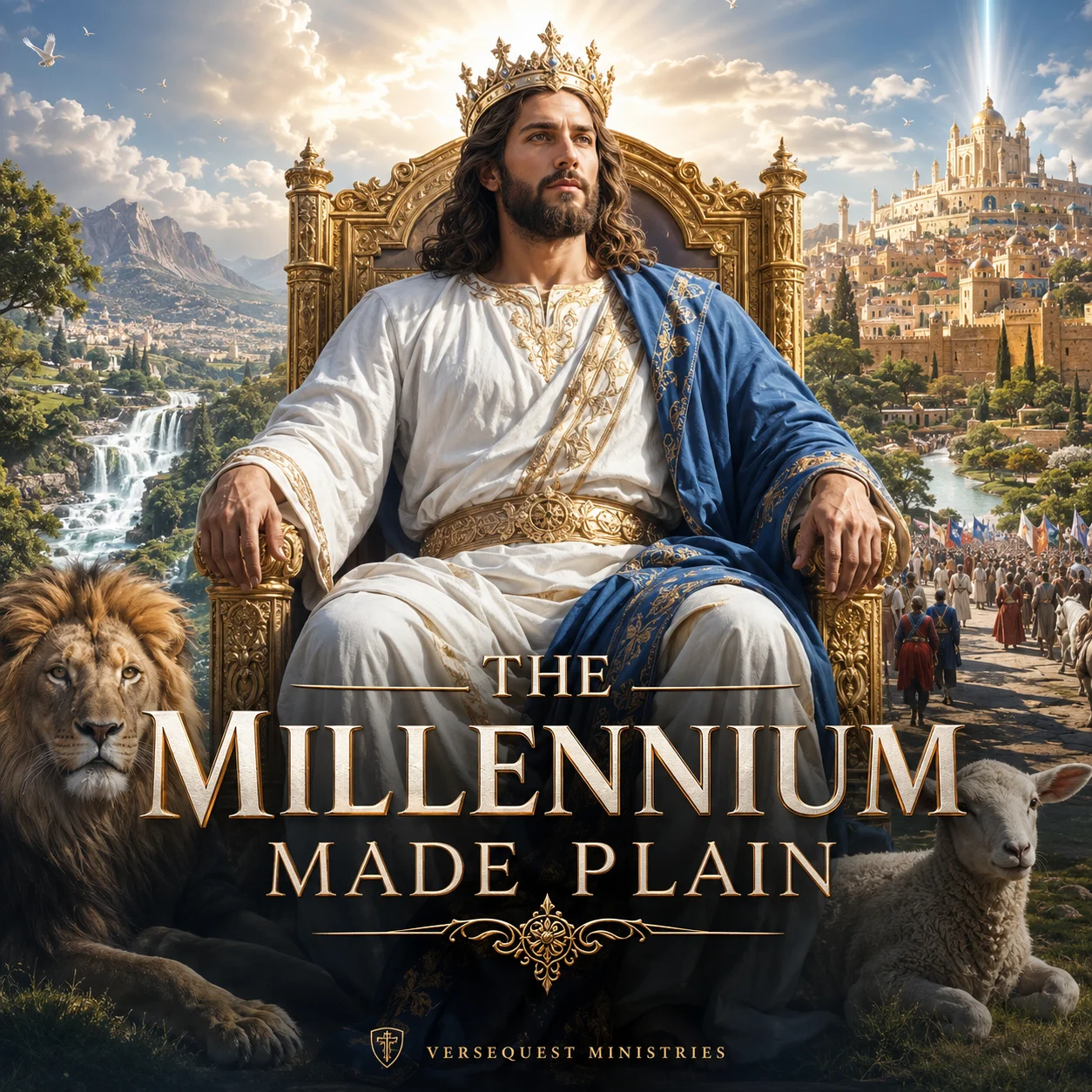
- The Millennium Made Plain – 416-Page KJV Study on Christ’s Future Reign
- A premium 416-page KJV, rightly divided Bible study on the literal future Millennial reign of Jesus Christ. The Millennium Made Plain explains Revelation 19–20, Israel’s restoration, Satan’s binding, the Kingdom…
- Original price was: $29.99.$9.99Current price is: $9.99.
- Add to cart
-
-67%
-
Angels
-
-67%
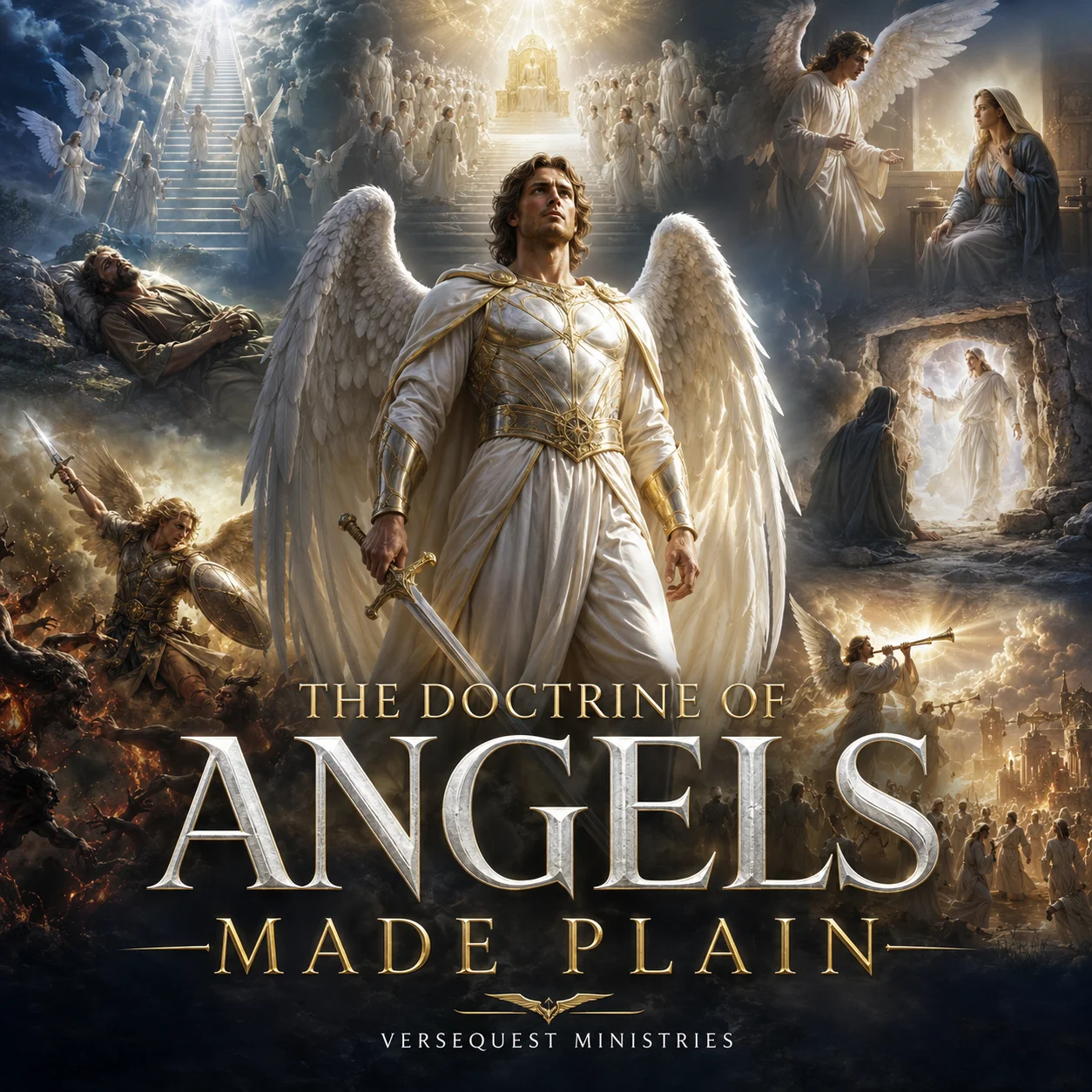
- The Doctrine of Angels Made Plain – 620-Page KJV Bible Study PDF
- The Doctrine of Angels Made Plain is a 620-page KJV Bible study that traces angels from Genesis to Revelation. This premium VerseQuest PDF explains holy angels, Christ’s supremacy over angels,…
- Original price was: $29.99.$9.99Current price is: $9.99.
- Add to cart
-
-67%
-
Jesus Christ / Christology
-
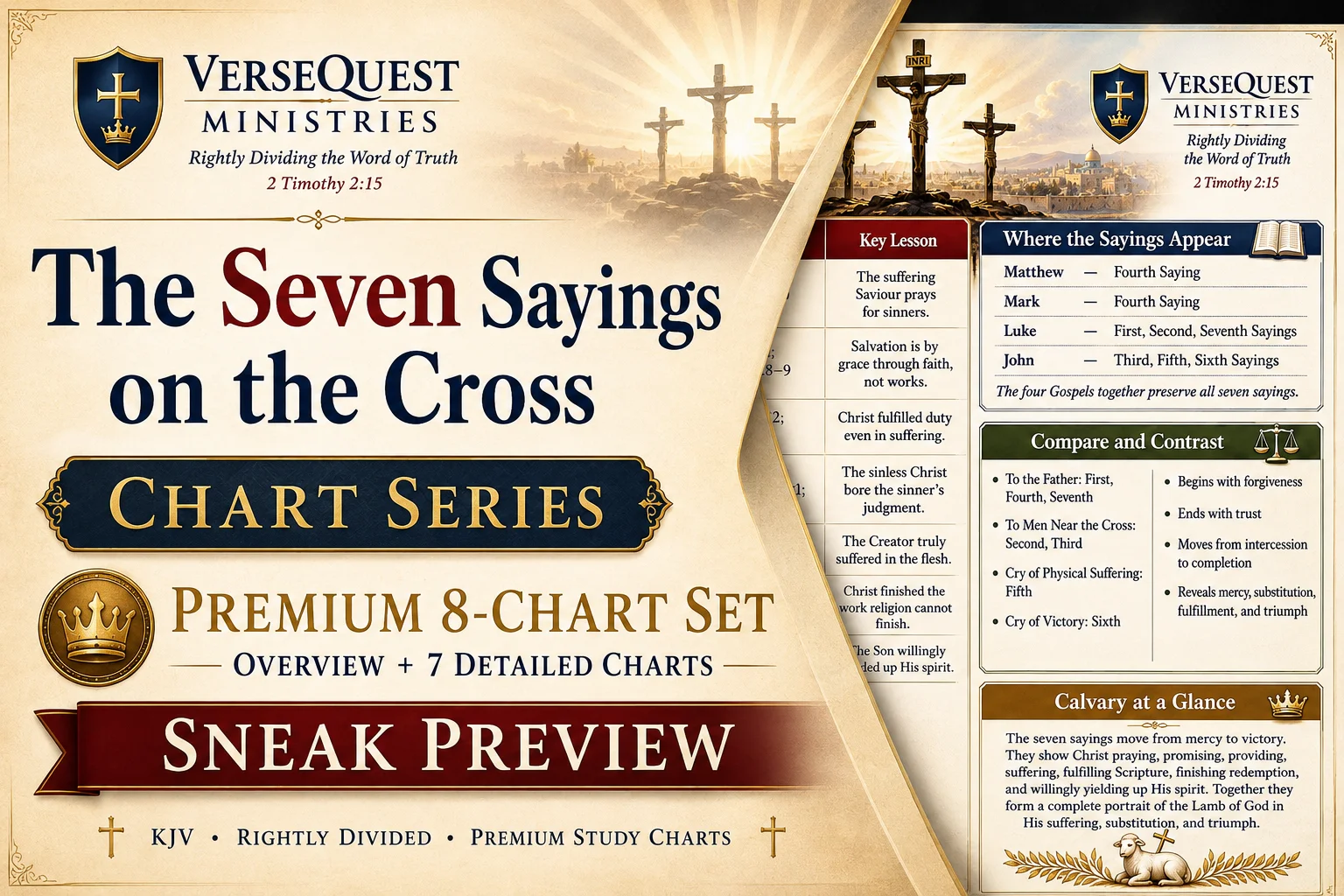
- The Seven Sayings on the Cross – Premium 8-Chart KJV Study Set
- A premium VerseQuest Ministries digital PDF study set on The Seven Sayings on the Cross, featuring an overview chart plus seven detailed KJV Bible study charts. This resource examines Calvary,…
- $12.99
- Add to cart
-
-
Bible Prophecy Charts
-
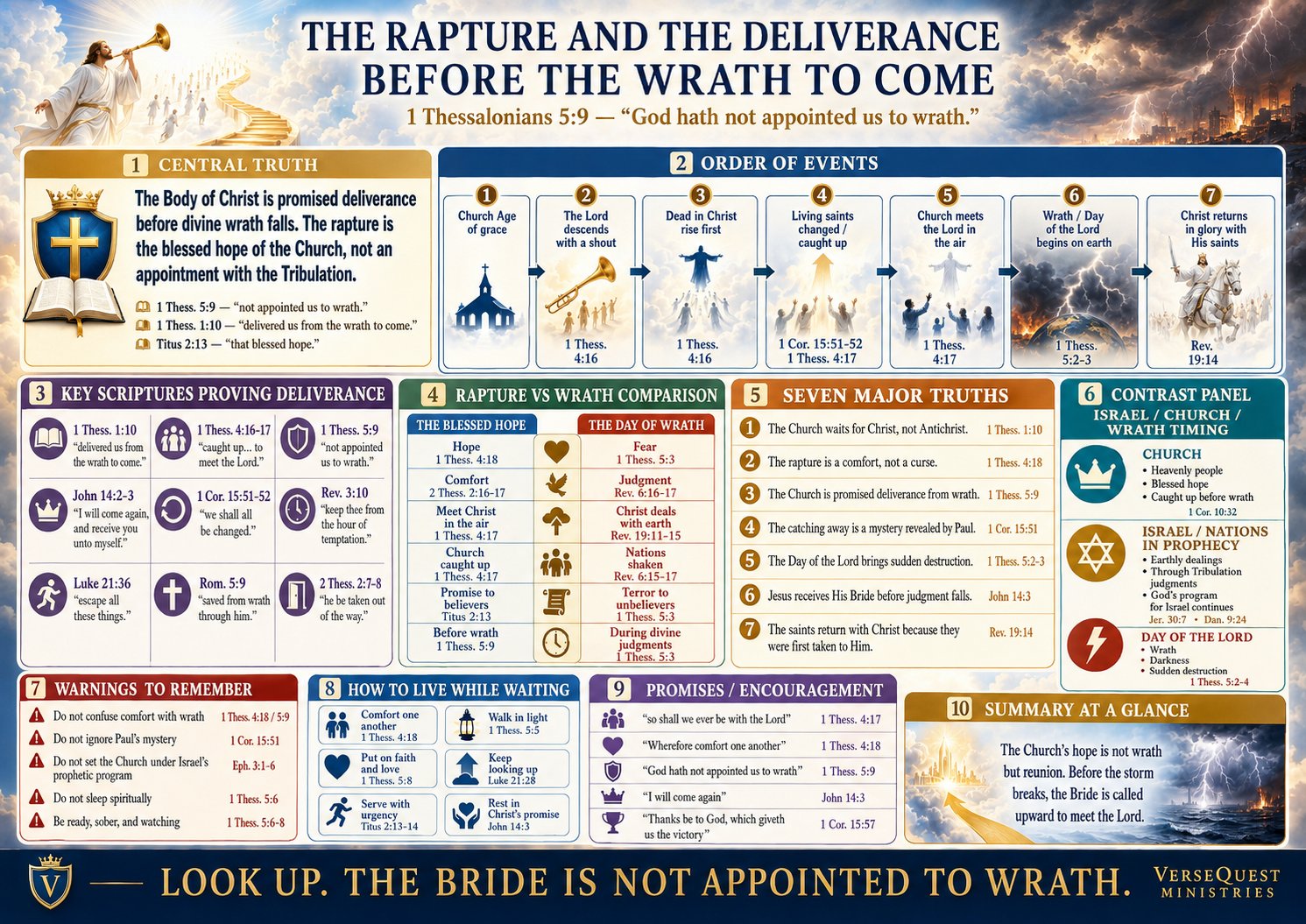
- The Rapture and the Deliverance Before the Wrath to Come – Printable Bible Study Chart
- Printable KJV Bible study chart on The Rapture and the Deliverance Before the Wrath to Come, showing from 1 Thessalonians 5:9 that the Church is not appointed to wrath. This…
- $4.99
- Add to cart
-
-
Bible Overview Series
-
- The New Jerusalem Made Plain — 621-Page PDF Study
- The New Jerusalem Made Plain is a massive 621-page KJV/rightly divided PDF study on the literal holy city revealed in Revelation 21–22. This 100-essay book makes the New Jerusalem plain…
- $34.99
- Add to cart
-